Yogurt topping calories come to 10 for a 2 Tbsp (5 g) spoonful and 200 per 100 g. The low serving number comes from air, not from a light recipe: a whipped topping weighs very little per spoonful, and 69% of its calories come from fat. Watch how many spoonfuls actually land on the plate.
10kcal
1 2 tbsp serving · 5 g, packaged, per label
0%protein
0 gProtein
1 gCarbs
1 gFat
How to burn off 10 kcal
—Walking, brisk
—Jogging
—Cycling, moderate
—Swimming
Skip the math. BodyPal counts these calories from your steps and workouts automatically.
Nutrition facts
Packaged, per label · per 5 g
Calories
10 kcal
Protein
0 g
Carbohydrate
1 g
Fat
1 g
Saturated fat
0.5 g
Cholesterol
5 mg
Sodium
0 mg
Potassium
0 mg
Source: USDA FoodData Central
🛡️
Verified nutrition data
Numbers on this page come from USDA FoodData Central, the U.S. Department of Agriculture’s food composition database, and from manufacturer labels where a branded product is named. Last verified September 2026. How we verify our data →
Yogurt topping: calories, protein and sodium by serving
Percent of daily value uses the FDA reference of 2,000 kcal a day.
Serving
kcal
Protein
Carbs
Fat
Sodium
% DV kcal
2 Tbsp (5 g)
10
0 g
1 g
1 g
0 mg
1%
100 g
200
0 g
20 g
20 g
0 mg
10%
3 × 2 Tbsp (5 g)
30
0 g
0 mg
5 × 2 Tbsp (5 g)
50
0 g
0 mg
A 2 Tbsp spoonful weighs only 5 g
The label serving is 2 Tbsp, yet it weighs just 5 g. That is why the count looks so small: 10 calories, 1 g of carbs and 1 g of fat. Most of the volume is whipped air, so a generous-looking dollop still adds very little.
The total climbs as the dollops multiply. Two servings (10 g) bring 20 calories, three servings (15 g) bring 30, and five servings (25 g) bring 50. Even at that heavier pour, the topping stays a small slice of a day's intake, but it is no longer close to zero.
The catch is measuring. Nobody scoops whipped topping with a tablespoon, and a squirt from a can or a spoon from a tub can be several servings at once. If you log it, count the dollops honestly rather than writing down one serving by default. BodyPal can also log it from a photo of the bowl.
Fat supplies more than two thirds of the calories
Per 100 g, yogurt topping carries 20 g of fat, 20 g of carbs and 0 g of protein. Because fat holds more energy per gram, it accounts for 69% of the calories, while carbs supply the other 31%. Protein contributes nothing.
That makes this a cream-style topping in yogurt branding. It tastes tangy and sounds like a dairy snack, but it does not do what a bowl of yogurt does. There is no protein to help a snack hold you over, and there is 0 g of fiber.
All of the carbs are sugar: 20 g of sugars per 100 g, matching the 20 g of total carbs. On a single 2 Tbsp serving that is 1 g, which barely registers. The point is the profile, not the spoonful: this is fat and sugar whipped light, so treat it like whipped cream rather than a yogurt serving.
Saturated fat and cholesterol are the rows to watch
Half the fat is saturated: 10 g per 100 g out of 20 g total. Against a daily value of 20 g, a full 100 g would cover half the day. Cholesterol reads 100 mg per 100 g against a daily value of 300 mg.
In practice, nobody eats 100 g of a topping that weighs 5 g per serving. At normal portions both numbers shrink to very little. They matter mostly as a signal of what the product is made of, and as a reason not to treat a heaping pile as harmless just because the spoonful looks small.
Sodium is the clean row. The label lists 0 mg per serving and 0 mg per 100 g, so it adds 0% of the daily value. Potassium is 0 as well, which again shows this is a topping rather than a dairy food with yogurt's usual minerals.
It works as a garnish, not as the yogurt
Yogurt topping makes the most sense as a finish on fruit, a slice of pie or a bowl of plain yogurt. At 10 calories a spoonful it adds creaminess without moving the total much, as long as it stays a garnish.
If you want the snack to keep you full, the protein has to come from somewhere else. Put a dollop on a bowl of berries with plain or Greek yogurt underneath, and the topping becomes the treat on top rather than the whole snack.
If you watch saturated fat, use it the way you would use whipped cream: one or two spoonfuls, measured, not a layer. Two servings at 20 calories is a fair trade for texture. Five servings at 50 calories is still modest, but at that point the bowl is mostly fat and sugar.
How does yogurt topping compare?
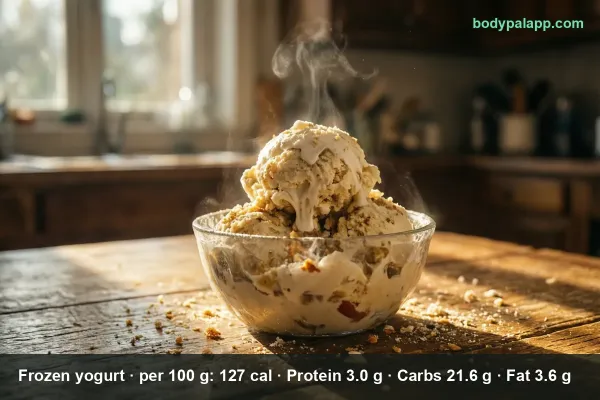
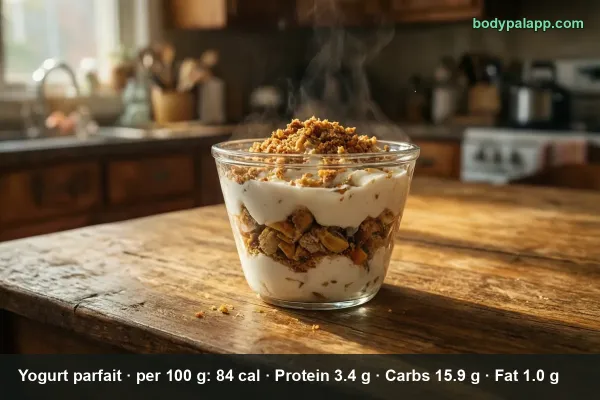
Here is how yogurt topping compares with yogurt ice cream, yogurt parfait and honey Greek yogurt, per 100 g and per usual serving.
Verdict: Gram for gram, yogurt topping is the richest item here at 200 calories per 100 g, while a yogurt parfait has 84 and yogurt ice cream has 127, and it is the only one with 0 g of protein. For a filling snack pick the parfait or honey Greek yogurt, and keep the topping to a 10-calorie spoonful on top.
Yogurt topping FAQs
How many calories are in yogurt topping?
Whipped yogurt topping has 10 calories per 2 tbsp serving (5 g), or 200 calories per 100 g.
Is yogurt topping good for weight loss?
A 2 tbsp serving is 10 calories and 1 g of fat. Per 100 g it is 200 calories, so larger amounts add up.
Yogurt topping vs frozen yogurt: which has fewer calories?
Per 100 g, whipped yogurt topping has 200 calories and frozen yogurt has 127.
How much sugar is in yogurt topping?
A 2 tbsp serving (5 g) has 1 g of sugars. Per 100 g it has 20 g of sugars and 0 g of protein.
How many calories are in 5 servings of yogurt topping?
Five 2 Tbsp servings (25 g) have 50 calories. That is still a modest amount, but it shows how quickly dollops add up when a light topping is piled on rather than measured.
Does yogurt topping have any protein?
No. Yogurt topping has 0 g of protein per serving and per 100 g. Its calories come from fat at 69% and carbs at 31%, so it will not add protein the way a bowl of yogurt does.
How much fat is in yogurt topping?
A 2 Tbsp (5 g) serving has 1 g of fat, and 100 g has 20 g. Half of that is saturated, 10 g per 100 g, against a daily value of 20 g.
Is there sodium in yogurt topping?
The label lists 0 mg of sodium per 2 Tbsp serving and 0 mg per 100 g, so it adds 0% of the 2300 mg daily value. Fat and sugar are the rows that matter here.
Why does a serving of yogurt topping weigh only 5 g?
It is whipped, so 2 Tbsp is mostly air and weighs 5 g. That keeps one serving at 10 calories, even though 100 g of the topping itself has 200.