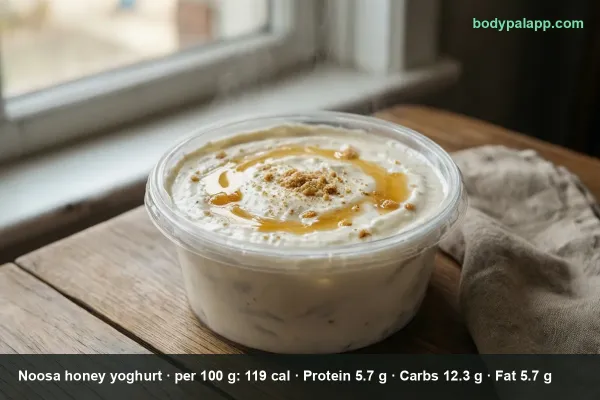
Honey Greek yogurt calories come to 211 for one 170 g container, or 124 per 100 g. The number to notice is what those calories are made of: only 11% comes from protein, while sugar and fat carry the rest. This is a creamy, sweetened yogurt, not the high-protein cup most people picture when they hear Greek.
211kcal
1 container · 170 g, packaged, per label
11%protein
6 gProtein
25 gCarbs
10 gFat
How to burn off 211 kcal
—Walking, brisk
—Jogging
—Cycling, moderate
—Swimming
Skip the math. BodyPal counts these calories from your steps and workouts automatically.
Nutrition facts
Packaged, per label · per 170 g
Calories
211 kcal
Protein
6 g
Carbohydrate
25 g
Fat
10 g
Saturated fat
7 g
Cholesterol
36 mg
Sodium
100 mg
Potassium
291 mg
Source: USDA FoodData Central
🛡️
Verified nutrition data
Numbers on this page come from USDA FoodData Central, the U.S. Department of Agriculture’s food composition database, and from manufacturer labels where a branded product is named. Last verified September 2026. How we verify our data →
Honey Greek yogurt: calories, protein and sodium by serving
Percent of daily value uses the FDA reference of 2,000 kcal a day.
Serving
kcal
Protein
Carbs
Fat
Sodium
% DV kcal
1 container (170 g)
211
6 g
25 g
10 g
100 mg
11%
1 cup (227 g)
291
8 g
34 g
14 g
129 mg
15%
100 g
124
3.5 g
14.7 g
5.9 g
59 mg
6%
3 × 1 container (170 g)
632
18 g
301 mg
5 × 1 container (170 g)
1,054
30 g
502 mg
A cup is 291 calories, not 211
The label serving is one 170 g container at 211 calories, about 11% of a 2,000-calorie daily value. Spoon it from a tub into a bowl and the usual pour is closer to a cup. That cup weighs 227 g and brings 291 calories, or 15% of the daily value. The jump is easy to miss because both look like a single snack.
Containers also add up quickly. Two of them come to 422 calories and 340 g of yogurt. Three reach 632 calories, and five climb to 1,054. If you keep a few in the fridge for the week, that is the scale of what a habit of eating two at a sitting adds.
Protein grows far more slowly than calories. One container gives 6 g, which is 12% of the daily value, and a cup gives 8 g. Even three containers deliver just 18 g. If you choose yogurt mainly to fill up on protein, the portion that gets you there costs a lot of calories with this style.
Fat and sugar carry this yogurt, not protein
The calorie split is 47% carbohydrate, 42% fat and 11% protein. That profile reads more like a dessert than a strained yogurt. Per 100 g you get 14.7 g of carbohydrate, 5.9 g of fat and only 3.5 g of protein.
Every gram of that carbohydrate is sugar: the card lists 14.7 g of sugars per 100 g and 0 g of fiber. Some of it comes from milk and some from the honey, but the label does not split the two. Either way, the carbs here are quick ones with nothing to slow them down.
The fat is the other half of the story. At 5.9 g per 100 g it makes the texture rich and smooth, and it explains why this yogurt sits so much higher than plain nonfat styles. Rich is the point of the product. Just do not count it as a lean protein source.
Sugar and saturated fat are the rows to watch
Sugar is the headline number. One container holds 25 g of sugars, and a cup holds 33 g. Because fiber is 0, nothing on the label offsets that load. If you track added or total sugar, this is the row that will move your day the most.
Saturated fat comes next. Of the 5.9 g of fat per 100 g, 4.1 g is saturated, measured against a daily value of 20 g. Most of the fat in this yogurt is the saturated kind, so a cup or a second container shows up clearly in that column.
Sodium, by contrast, is a non-issue. A container has 100 mg, just 4% of the 2,300 mg daily value, and a cup has 129 mg. Cholesterol is 21 mg per 100 g against a daily value of 300 mg, and potassium is 171 mg per 100 g. Those rows are modest; sugar and saturated fat are where the attention belongs.
Pair it with fiber and protein to round it out
Because the yogurt brings sweetness and fat but 0 g of fiber, the best add-ins supply what it lacks. Fresh berries, a spoon of oats or a few nuts add fiber and crunch. A scoop of plain nonfat Greek yogurt stirred in raises the protein and dilutes the sugar per bite without losing the honey flavor.
Think of one container as a treat-sized snack or a small dessert rather than a breakfast base. If you want it to anchor a meal, keep the yogurt to the 170 g serving and build volume around it. Several brands sell this style, including The Greek Gods, Ellenos, Best Choice, Hy-Vee and Old Home, so check your label against the numbers here.
If you are logging it, BodyPal can record the container from a photo, which helps when you eat it from a bowl and lose track of how much went in.
How does honey Greek yogurt compare?
Here is how honey Greek yogurt stacks up against vanilla Greek yogurt, Fage 2% Greek yogurt and noosa yogurt, per 100 g and per usual serving.
Verdict: For fewer calories and more protein, pick Fage 2% Greek yogurt at 73 calories and 10 g of protein per 100 g, against 124 calories and 3.5 g of protein here. If you want a rich, sweet cup anyway, noosa yogurt at 119 per 100 g is the closest match, while vanilla Greek yogurt at 78 per 100 g is the lighter flavored swap.
Most popular honey Greek yogurt brands in the United States
How many calories are in one container of honey Greek yogurt?
A 170 g container has 211 calories, and a 227 g cup has 291 calories.
Is honey Greek yogurt good for weight loss?
One 170 g container has 211 calories, 10.0 g of fat and 6.0 g of protein. Per 100 g it has 124 calories.
Honey Greek yogurt vs vanilla Greek yogurt: which has fewer calories?
Vanilla Greek yogurt has fewer, at 78 calories per 100 g versus 124 for honey Greek yogurt.
How much sugar is in honey Greek yogurt?
About 25.0 g of sugar per 170 g container, or 14.71 g per 100 g.
How many calories are in a cup of honey Greek yogurt?
A cup of honey Greek yogurt (227 g) has 291 calories, about 15% of a 2,000-calorie daily value. That is noticeably more than the 211 calories in a single 170 g container.
How much protein does honey Greek yogurt have?
One 170 g container has 6 g of protein, or 12% of the daily value, and 100 g has 3.5 g. Protein supplies only 11% of the calories, so it is not a high-protein yogurt.
How much fat is in honey Greek yogurt?
One container has 10 g of fat and a cup has 14 g. Per 100 g there are 5.9 g of fat, of which 4.1 g is saturated, and fat makes up 42% of the calories.
How many calories are in two containers of honey Greek yogurt?
Two 170 g containers come to 422 calories, 340 g of yogurt, 12 g of protein and 201 mg of sodium. Three containers reach 632 calories.
Is honey Greek yogurt high in sodium?
No. One container has 100 mg of sodium, only 4% of the 2,300 mg daily value, and a cup has 129 mg. Sugar and saturated fat are the rows worth watching instead.