
How many calories are in a yogurt parfait?
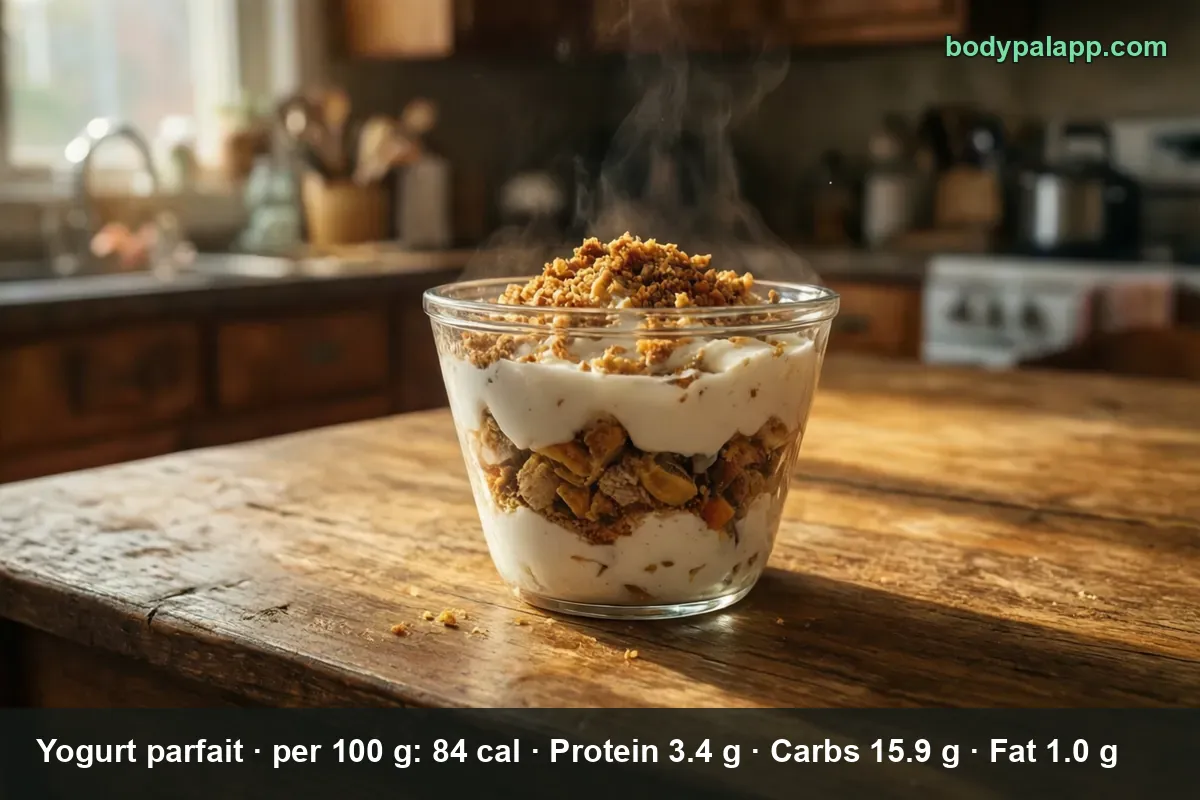
One parfait cup weighs 149 g and carries 125 calories. Per 100 g that is 84 calories, the lowest per-gram figure of any parfait record on this page. The number people get wrong is the cup itself: the refrigerated case at the grocery store sells the same word in 241 g and 283 g sizes.
On this page
- Yogurt parfait quick facts
- US servings, from one ounce to a deli cup
- With granola or without
- Store-bought cups are a different food
- Sugar is the row to watch, not fat
- How does a yogurt parfait compare
- Most popular yogurt parfait brands
- FAQ
Yogurt parfait quick facts
The numbers below come from USDA SR Legacy 170355, "Yogurt parfait, lowfat, with fruit and granola". It is the only generic record — no chain, no brand — that matches what most people picture: lowfat yogurt, fruit, and a granola layer, built in a clear cup. It also ships with a household measure of one parfait, 149 g, so the serving column is USDA's own portion rather than something we invented.
| Nutrient | Per 100 g | Per 1 parfait cup (149 g) | % Daily Value |
|---|---|---|---|
| Calories | 84 | 125 | — |
| Total fat | 1.01 g | 1.5 g | 2% |
| Saturated fat | 0.53 g | 0.8 g | 4% |
| Carbohydrate | 15.86 g | 23.6 g | 9% |
| Dietary fiber | 1.1 g | 1.6 g | 6% |
| Total sugars | 11.68 g | 17.4 g | — |
| Protein | 3.36 g | 5.0 g | 10% |
| Sodium | 49 mg | 73 mg | 3% |
| Cholesterol | 3 mg | 4 mg | 1% |
| Potassium | 189 mg | 282 mg | 6% |
% Daily Value is based on a 2,000-calorie diet.
Verified nutrition data
Numbers on this page come from USDA FoodData Central, the U.S. Department of Agriculture’s food composition database, and from manufacturer labels where a branded product is named. Last verified September 2026. How we verify our data →
There is no added sugars row here, and that is not an oversight on our end: the SR Legacy edition of this record has no added sugars field at all, so USDA does not publish a figure for it. Total sugars have no Daily Value either, which is why that cell stays empty — the FDA Daily Value list sets a limit for added sugars only.
Two rows worth a second look. Sodium is 73 mg per cup, 3% of the day, which is roughly a thirtieth of a teaspoon of table salt — a parfait is not a salt problem. Protein is 5.0 g, 10% of the Daily Value, which sounds respectable until you remember it comes attached to 23.6 g of carbohydrate.
US servings, from one ounce to a deli cup
| Serving | Weight | Calories |
|---|---|---|
| 1 oz | 28 g | 24 kcal |
| Half a parfait cup | 75 g | 63 kcal |
| One parfait cup, 5.2 oz | 149 g | 125 kcal |
| One large deli cup | 241 g | 202 kcal |
| Per 100 g | 100 g | 84 kcal |
Only two of those lines are USDA's: the 149 g parfait and the 100 g baseline. The ounce, the half cup and the 241 g deli size are our own arithmetic from the USDA 100 g figure, not USDA servings. That last one is a useful thought experiment rather than a shopping number — it tells you what a deli-size portion of this modest lowfat parfait would cost you, 202 calories, which is well under what the actual deli cups deliver. More on that gap below.
A cup measure is where people slip. The 149 g in this record is a parfait cup, the tall clear one, not a US measuring cup. Scoop yogurt, fruit and granola into an 8 oz measuring cup and you are closer to 225 g, or about 189 calories of the generic build — our own scaling of the USDA 100 g figure, not a USDA serving.
With granola or without
USDA happens to publish the same chain parfait twice, once with its granola cap and once without, and that pair is the cleanest answer anyone has to "how much does the granola cost me."
| Version | Per 100 g | Typical piece | Calories |
|---|---|---|---|
| Yogurt parfait with fruit, no granola layer | 104 kcal | 1 parfait (150 g) | 156 kcal |
| McDonald's Fruit 'n Yogurt Parfait | 105 kcal | 1 item, 5.2 oz (149 g) | 156 kcal |
| McDonald's parfait without granola | 90 kcal | 1 item (142 g) | 128 kcal |
| Greek yogurt parfait, deli cup | 116 kcal | 1 package (241 g) | 280 kcal |
| Strawberry yogurt parfait, deli cup | 124 kcal | 1 container (283 g) | 351 kcal |
| Blueberry Greek yogurt parfait | 102 kcal | 1 serving (283.5 g) | 289 kcal |
Held at the same weight, the granola is worth 15 calories per 100 g — 105 against 90 — which is about 22 calories on a 149 g cup. As the items are actually sold, the one with granola is 156 and the one without is 128, a 28-calorie gap, because the granola version is the heavier item too.
That is smaller than most people expect, and it is the argument for keeping the granola. It buys crunch, it buys the fiber that yogurt alone does not have, and it costs about the same as three almonds. What it does not do is turn a parfait into a filling breakfast.
The generic USDA build is lighter than both chain versions: 84 calories per 100 g against 105 and 90. The difference is sweetened yogurt, not the fruit.
Store-bought cups are a different food
Take the same two words to a supermarket cooler and the math changes shape. A Taylor Farms Greek yogurt parfait with apple is 241 g and 280 calories. The mango version, same package size, is 289. A Signature Farms strawberry parfait is 283 g and 351 calories. A Good & Delish blueberry Greek cup is 283.5 g and 289.
Set that against the 125-calorie USDA cup and you are looking at up to 2.8 times the calories for something you would describe with the identical sentence. Two things are happening at once. The packages hold 1.6 to 1.9 times more food, and the contents are denser — 102 to 137 calories per 100 g against 84.
This is the single most useful thing to know about parfaits. Nobody logs a parfait wrong because they misjudged the granola. They log it wrong because they picture the little cup and eat the big one.
Sugar is the row to watch, not fat
A 149 g parfait cup carries 1.5 g of total fat and 0.8 g of saturated fat — 2% and 4% of the Daily Value. As desserts-shaped-like-breakfast go, that is nothing.
The sugar column is the interesting one: 17.4 g of total sugars in a cup, from 11.68 g per 100 g. Total sugars include the lactose in the yogurt and the sugar in the fruit alongside anything sweetening the granola, and USDA gives no split for this record, so nobody can tell you from this data how much of it was added. The Dietary Guidelines for Americans cap added sugars at under 10% of daily calories, and a parfait built at home with plain yogurt and fresh fruit lands nowhere near that line — the store cups, at 241 g and up, are where it is worth reading the label.
For what it is worth in the other direction: MyPlate counts the yogurt toward the dairy group, and the cup carries 282 mg of potassium, 6% of the day, plus 1.6 g of fiber.
How does a yogurt parfait compare
| Parfait | Per 100 g | US serving | Calories |
|---|---|---|---|
| Yogurt parfait, lowfat, fruit and granola | 84 kcal | one parfait cup, 149 g | 125 kcal |
| Yogurt parfait with fruit | 104 kcal | one parfait, 150 g | 156 kcal |
| McDonald's Fruit 'n Yogurt Parfait | 105 kcal | one item, 149 g | 156 kcal |
| McDonald's parfait, no granola | 90 kcal | one item, 142 g | 128 kcal |
Our take: the lowfat generic build is the lightest of the four per gram, and it is the one to aim at if you assemble your own. The two 156-calorie cups are still a cheap breakfast by any standard, and pulling the granola off a chain parfait to save 28 calories is not a trade we would make — you lose the only crunchy thing in the cup. The decision that actually matters is which container you buy, not which layer you skip. For weight loss, keep the cup near 149 g; for staying full until lunch, a parfait at 5.0 g of protein needs an egg or a handful of nuts beside it.
Most popular yogurt parfait brands in the United States
Ranked by how widely each product appears among foods sold in the United States, from the BodyPal food database of over 3.3 million products. Calories are the figures printed on each Nutrition Facts label, checked against USDA FoodData Central.
| Product | Calories (per 100 g) |
|---|---|
| Good & Delish Blueberry Greek Yogurt Parfait | 102 cal |
| Taylor Farms Yogurt Parfait with Fruit, Blueberry | 137 cal |
| Taylor Farms Greek Yogurt Parfait with Apple | 116 cal |
| Taylor Farms Greek Yogurt Parfait with Mango | 120 cal |
| Signature Farms Strawberry Yogurt Parfait | 124 cal |
| Marketside Yogurt Parfait with Fresh Blueberries | 137 cal |
Brand popularity: BodyPal food database. Nutrition: manufacturer labels / USDA FoodData Central.
Yogurt parfait FAQs
How many calories are in a yogurt parfait?
A standard parfait cup of 149 g holds 125 calories, or 84 calories per 100 g. That is the USDA record for lowfat yogurt layered with fruit and granola. Half a cup comes to 63 calories. Store-bought deli cups are much bigger and run from 280 to 351 calories.
How many calories in a McDonald's fruit and yogurt parfait?
156 calories for the 149 g McDonald's Fruit 'n Yogurt Parfait, which USDA lists at 105 calories per 100 g. That is 31 more than the generic 149 g cup, because the chain version uses sweetened yogurt. Order it without the granola cap and the same item drops to 128 calories.
How much protein is in a yogurt parfait?
5.0 g of protein in a 149 g parfait cup, which is 10% of the Daily Value. Per 100 g the figure is 3.36 g. A fruit parfait made with whole-milk yogurt is higher, 5.25 g per 100 g, so roughly 7.9 g in a 150 g cup. Neither is a high-protein breakfast on its own.
How much sugar is in a yogurt parfait?
17.4 g of total sugars in a 149 g cup, scaled from 11.68 g per 100 g. Total sugars carry no Daily Value, so the label shows no percentage for them. USDA does not publish added sugars for this record, so there is no clean split between the fruit and milk sugars and the sweetener in the granola.
How many calories in a yogurt parfait without granola?
128 calories for the 142 g parfait sold without a granola layer, against 156 for the 149 g version with it. Weighed at the same 149 g, the granola cap is worth about 22 calories. The fiber barely moves either: 1.0 g per 100 g with granola, 0.9 g without.
How many calories in a Greek yogurt parfait?
280 calories in a 241 g Greek yogurt parfait from the deli case, at 116 calories per 100 g. A mango version of the same package size is 289. The gap against the 84 calories per 100 g of the plain USDA parfait comes from size as much as recipe: 241 g against 149 g.
How many calories in a store-bought yogurt parfait cup?
From 280 to 351 calories for a store cup, depending on the brand and the size. A 283 g strawberry parfait is 351, a 241 g blueberry one 330, and a 283.5 g blueberry Greek cup 289. All of them beat the 125-calorie USDA cup because they hold 1.6 to 1.9 times more food.
Is a yogurt parfait a healthy breakfast?
At 125 calories, 5.0 g of protein, 1.5 g of fat and 17.4 g of sugars, a 149 g parfait cup is a light breakfast rather than a filling one. MyPlate counts the yogurt toward the dairy group. If you are watching sugar, the deli cups at 280 to 351 calories are the ones to check.
Similar foods
- Egg — 72 cal per large egg
- Omelet — 305 cal for 3-egg omelet
- Crepe — 179 cal per crepe
- Pancake — 423 cal for 3 medium pancakes
- Toast with butter — 100 cal per slice with butter
- Injera — 118 cal per injera (12 in)
Count it without the math
Point the camera at the cup and BodyPal counts it for you, granola layer and all.


How long does it take to burn off 125 kcal of yogurt parfait?
One parfait cup (149 g) is 125 kcal. Enter your weight and the amount you ate to see how long it takes you to burn that off:
lb
| Activity | Time to burn 125 kcal |
|---|---|
| Walking, brisk | 25 min |
| Cycling, moderate | 16 min |
| Swimming, moderate | 18 min |
| Jogging | 15 min |
| Weight training, moderate | 28 min |
Times are for a 155 lb adult at a steady pace; change the weight to see yours. The amount is set to the portion in the text (149 g); change it to what you actually ate. BodyPal works this out from your steps automatically.
This table assumes you know your daily total. If you do not, the daily calorie calculator works it out from five numbers.