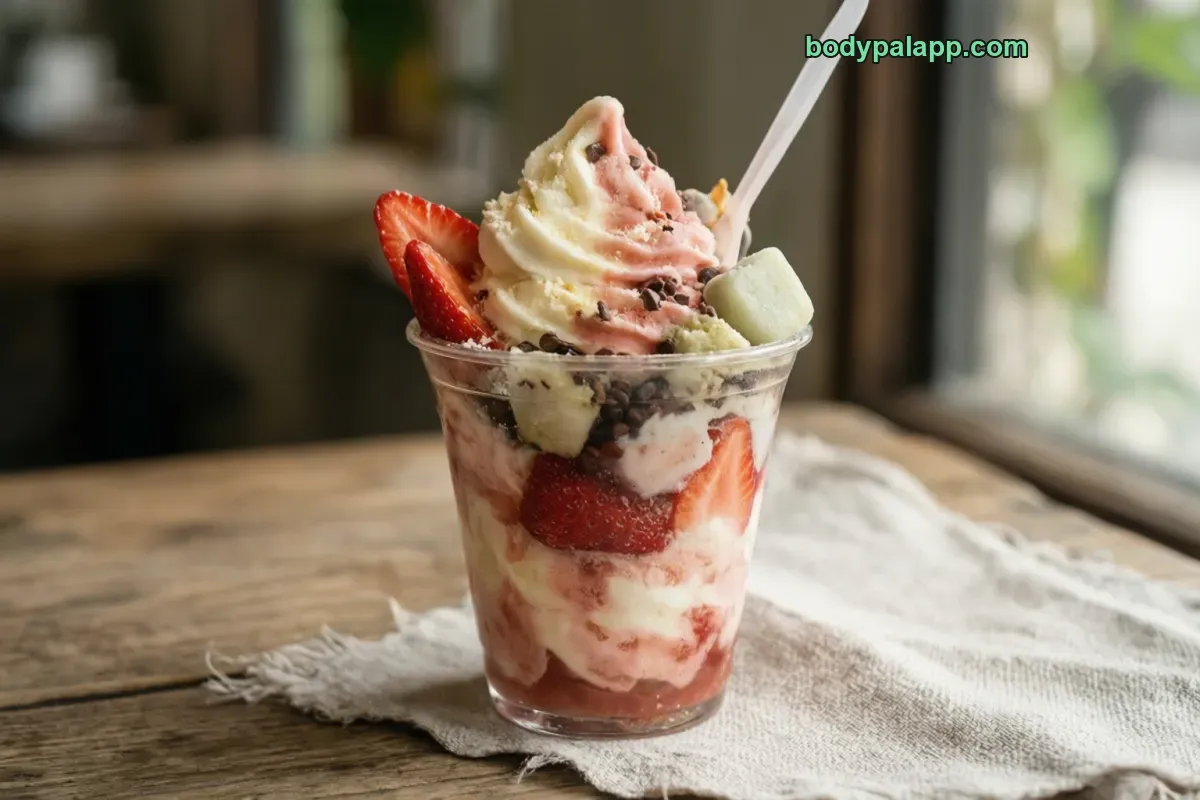
Self-serve frozen yogurt calories come to 278 for a 1 cup (175 g) serving and 159 per 100 g. The number that should catch your eye is sugar: 42 g in that cup, nearly all of its carbs. And because self-serve has no fixed portion, the cup you pull can easily double the total.
278kcal
1 cup · 175 g, soft serve, vanilla
10%protein
7 gProtein
42 gCarbs
9.8 gFat
How to burn off 278 kcal
—Walking, brisk
—Jogging
—Cycling, moderate
—Swimming
Skip the math. BodyPal counts these calories from your steps and workouts automatically.
Nutrition facts
Soft serve, vanilla · per 175 g
Calories
278 kcal
Protein
7 g
Carbohydrate
42 g
Fat
9.8 g
Saturated fat
6 g
Cholesterol
4 mg
Sodium
152 mg
Potassium
369 mg
Iron
0.5 mg
Source: USDA FoodData Central
🛡️
Verified nutrition data
Numbers on this page come from USDA FoodData Central, the U.S. Department of Agriculture’s food composition database, and from manufacturer labels where a branded product is named. Last verified September 2026. How we verify our data →
Self-serve frozen yogurt: calories, protein and sodium by serving
Percent of daily value uses the FDA reference of 2,000 kcal a day.
Serving
kcal
Protein
Carbs
Fat
Sodium
% DV kcal
1 cup (175 g)
278
7 g
42.4 g
9.8 g
152 mg
14%
Half cup (72 g)
114
2.9 g
17.4 g
4 g
63 mg
6%
100 g
159
4 g
24.2 g
5.6 g
87 mg
8%
3 × 1 cup (175 g)
835
21 g
457 mg
5 × 1 cup (175 g)
1,391
35 g
761 mg
A cup is 278 calories, a half cup is 114
The default serving here is 1 cup (175 g) of vanilla soft serve, which lands at 278 calories, 7 g of protein and 42 g of sugars. That covers 14% of the daily value for calories in a single dessert. A half cup (72 g) is the smaller measured scoop, and it comes to 114 calories, or 6% of the daily value.
Self-serve is where the math slips. Nobody portions the cup for you, so the weight is whatever comes out of the lever before you stop. Two cups' worth, 350 g, comes to 557 calories. Three cups' worth, 525 g, reaches 835 calories, which is close to a full meal on its own.
A big shared tub of 875 g, five cups, adds up to 1,391 calories and 761 mg of sodium. If you want a number you can trust, use the smallest cup and fill it once. Most shops weigh the cup at the register anyway, and every 100 g on that scale is 159 calories. That makes the receipt a decent calorie log.
Carbs supply 59% of the calories, and they are mostly sugar
Per 100 g, vanilla soft serve frozen yogurt carries 24.2 g of carbohydrate, 5.6 g of fat and 4 g of protein. Carbs make up 59% of the calories, fat 31% and protein 10%. That is a dessert profile, not a dairy-snack one, despite the yogurt name.
The detail that matters: 24 g of those 24.2 g of carbs are sugars, and fiber sits at 0. Almost every carb gram is sugar, with nothing to slow it down. A full cup delivers 42.4 g of carbs, of which 42 g are sugars.
Fat is the second lever. Saturated fat accounts for 3.4 g of the 5.6 g of fat per 100 g, measured against a daily value of 20 g. Protein is modest at 7 g per cup, 14% of the 50 g daily value. It helps a little with fullness, but it is not the reason anyone orders froyo, and it will not carry a cup as a protein snack.
Sugar is the row to watch
A cup holds 42 g of sugars and a half cup holds 17.3 g. The card lists no daily value for sugar, so there is no percentage to quote, but the plain weight says enough. Sugar is nearly the entire carb count, and it arrives before you add a single topping.
Sodium and cholesterol look calm by comparison. A cup carries 152 mg of sodium, 7% of the 2300 mg daily value, and cholesterol is just 2 mg per 100 g. Potassium is 211 mg per 100 g, a small contribution against a daily value of 4700 mg.
Toppings move this row more than the yogurt itself. Candy pieces, syrups, cookie crumbs and sauces pile sugar onto a cup that already carries 42 g. If you watch sugar, fresh fruit is the gentler topping choice, and a lighter hand on the bar keeps the cup closer to its 278-calorie base.
A half cup works as dessert, a full cup needs a plan
At 114 calories and 6% of daily calories, a half cup fits after a meal without much planning. A full cup at 278 calories is closer to a small meal in calorie terms, and it deserves a spot in your day like one. Anything past that is a deliberate splurge.
Because protein supplies only 10% of the calories, frozen yogurt will not hold you long on its own. Pair it with something that does: have it after a meal built around lean protein rather than as a stand-alone snack. If you have the calories to spare, a few nuts on top add some crunch and staying power.
Logging it beats guessing. Read the grams off the register scale and use 159 calories per 100 g, or snap a photo and let BodyPal log the cup for you. Either way, the cup size you grab at the start decides most of the total.
How does self-serve frozen yogurt compare?
Here is self-serve frozen yogurt next to Menchie's, Pinkberry and yogurt pretzels, compared per 100 g and per usual serving.
Verdict: Menchie's and Pinkberry match self-serve vanilla exactly at 278 calories a cup and 159 per 100 g, so pick the shop by taste, not by numbers. Yogurt pretzels are the real trap: 438 calories per 100 g, about 2.8 times as dense, and 123 calories in just 1 oz.
Self-serve frozen yogurt FAQs
How many calories are in a cup of self-serve frozen yogurt?
A 1 cup serving (175 g) has 278 calories. A half cup (72 g) has 114 calories.
Is frozen yogurt good for weight loss?
A full cup carries 278 calories and 42 g of sugar, while a half cup keeps it to 114 calories and 17.3 g of sugar.
Self-serve frozen yogurt vs Menchie's frozen yogurt: which has more calories?
Both sit at 159 calories per 100 g, so a 175 g cup lands at 278 calories either way.
How much protein and sugar are in frozen yogurt?
One cup (175 g) has 7 g of protein, 42.4 g of carbs, 9.8 g of fat and 42 g of sugar.
How many carbs are in frozen yogurt?
A cup of self-serve frozen yogurt has 42.4 g of carbs, or 24.2 g per 100 g. Nearly all of it is sugar: 42 g per cup, with 0 g of fiber to balance it.
How many calories are in a half cup of froyo?
A half cup (72 g) of vanilla soft serve frozen yogurt has 114 calories, 6% of the daily value. It also carries 2.9 g of protein, 17.4 g of carbs and 4 g of fat.
What are the nutrition facts for frozen yogurt per 100 g?
Per 100 g, frozen yogurt has 159 calories, 4 g of protein, 24.2 g of carbs, 5.6 g of fat, 24 g of sugars and 87 mg of sodium. Saturated fat is 3.4 g.
How much fat is in a cup of frozen yogurt?
A cup (175 g) of frozen yogurt has 9.8 g of fat, which supplies 31% of its calories. Per 100 g the fat is 5.6 g, of which 3.4 g is saturated.
Is frozen yogurt high in sodium?
No. A cup has 152 mg of sodium, 7% of the daily value, and a half cup has 63 mg. Even 3 cups stay at 457 mg.