
Calories in Dates: 30 per Fresh Date, 47 per Dried
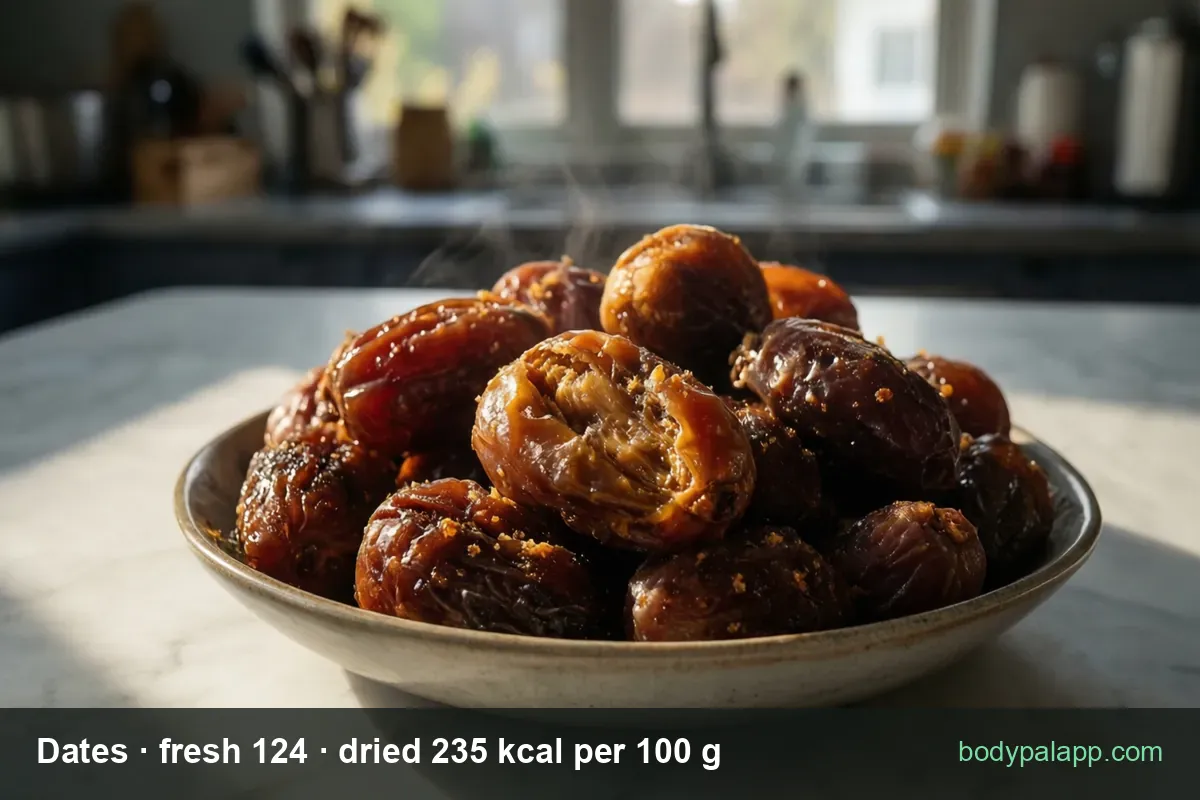
One fresh date has about 30 calories and one dried date about 47, which per 100 g works out at 124 kcal fresh against 235 dried. So the first question about calories in dates is really: which dates? The pitted, sticky ones in most UK cupboards are the dried kind — nearly twice as dense as fresh.
On this page
Quick facts
The table shows fresh dates (flesh and skin), with reference-intake percentages for a single fruit. Dried figures follow in their own section.
| Nutrient | Per 100 g (fresh) | Per fresh date (~24 g) | % RI (one fresh date) |
|---|---|---|---|
| Energy | 124 kcal / 519 kJ | 30 kcal / 126 kJ | 2% |
| Protein | 1.5 g | 0.4 g | 1% |
| Carbohydrates | 31.3 g | 7.5 g | 3% |
| Fat | 0.1 g | 0.0 g | <1% |
| Fibre | –* | –* | — |
Verified nutrition data
Numbers on this page come from CoFID, the UK government’s Composition of Foods Integrated Dataset, and from manufacturer labels where a branded product is named. Last verified August 2026. How we verify our data →
*CoFID does not publish a fibre value for fresh dates; the dried figure below is measured.
| Sugars | 31.3 g | 7.5 g | 8% |
| Salt | 0.018 g | 0.004 g | <1% |
|---|
RI = reference intake for an average adult: 2,000 kcal, 70 g fat, 260 g carbohydrate, 90 g sugars, 50 g protein, 6 g salt. Fibre has no RI on UK labels.
Even fresh, dates are an outlier among fruit: 124 kcal per 100 g is triple an orange and half as much again as a banana. Every gram of their carbohydrate is sugar — 31.3 g per 100 g — which is precisely why one date can rescue a dull porridge bowl.
Per single fruit, though, the damage is small. One fresh date is 30 kcal and 8% of your sugars reference. Dates get expensive by the handful, not by the piece.
Portion sizes
| Portion | Weight | Calories |
|---|---|---|
| One fresh date | ~24 g | 30 kcal |
| One dried date | ~20 g | 47 kcal |
| Snack handful, dried | 30 g | 70 kcal |
Note the inversion in the first two rows: the dried date is smaller yet carries more than half again the calories. Water has left; everything else stayed and concentrated.
The 30 g handful is the honest snack unit — roughly a modest palmful of chopped dates, or one and a half whole ones, for 70 kcal. Weigh it once so your eye learns what 30 g looks like; bags of pitted dates are engineered for absent-minded eating.
Stuffed dates deserve a separate line in your diary. The date is 47 kcal; the teaspoon of peanut butter or the almond inside it is extra, and often the bigger number of the two once you've had three.
Fresh vs dried dates
| Per 100 g | Fresh (flesh and skin) | Dried (flesh and skin) |
|---|---|---|
| Energy | 124 kcal / 519 kJ | 235 kcal / 983 kJ |
| Protein | 1.5 g | 2.4 g |
| Carbohydrates | 31.3 g | 58.7 g |
| Fat | 0.1 g | 0.6 g |
| Fibre | –* | 7.5 g |
| Sugars | 31.3 g | 58.0 g |
| Salt | 0.018 g | 0.028 g |
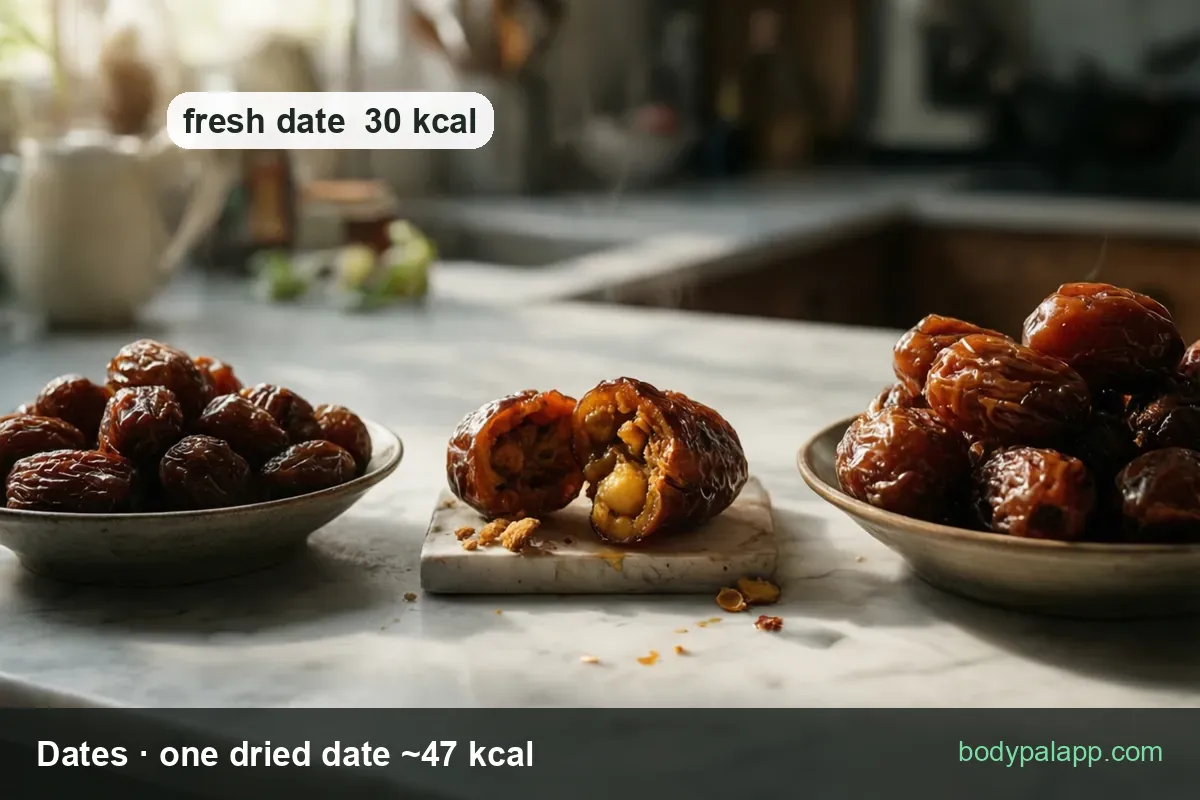
Drying is simple arithmetic: take the water out and every remaining gram gets denser. Dried dates end up 58% sugar by weight — 58 g per 100 g — a figure that sits closer to confectionery than to anything else in the fruit aisle. That is the whole secret of why they make such convincing "healthy caramel" in energy balls and sticky toffee pudding.
The redeeming feature is fibre: 7.5 g per 100 g in dried dates, which is a serious number and part of why a date is still a better sweet than a toffee. Sweetness with fibre attached beats sweetness without it — the NHS's free-sugars guidance draws exactly that line, and sugars still inside whole dried fruit stay on the right side of it.
One 5-a-day note: dried fruit counts, but the NHS portion for dried fruit is 30 g — that snack-handful row above, 70 kcal — not the 80 g used for fresh produce. Log dried dates by the gram, not by the fistful.
How does it compare?
The verdict cuts both ways. Against fruit, dates lose badly — gram for gram, dried dates carry nearly three times the calories of a banana, so they're a poor choice for high-volume snacking. Against the desserts they impersonate, they win convincingly: at 235 kcal per 100 g, dried dates are under half a brownie's 506, with fibre the brownie can't offer.
Use them as a sweetener and a treat-swap, and the maths flatters you. Graze on them like grapes, and it won't.
Most popular date brands in the United Kingdom
Ranked by how widely each product appears among foods sold in the United Kingdom, from the BodyPal food database of over 3.3 million products. Calories are the figures printed on each label. Label values for Medjool dates vary between growers; both figures are as printed.
| Product | Calories (per 100 g) |
|---|---|
| Al Nafees Medjool Dates | 277 kcal |
| Mehadrin Medjool Dates | 322 kcal |
Brand popularity: BodyPal food database. Nutrition: manufacturer labels.
FAQ
How many calories are in dates?
One fresh date has around 30 calories and one dried date about 47. Per 100 g, fresh dates are 124 kcal while dried reach 235, because drying removes water and concentrates the sugars. Most dates sold in UK supermarkets are the dried kind, so count 47 per date.
How many calories are in dates per 100 g?
Fresh dates are 124 kcal per 100 g; dried dates are 235 kcal per 100 g. The sugar tells the same story — 31.3 g against 58 g. If the packet says pitted, medjool or baking dates, you are almost certainly holding the dried, more concentrated kind.
How many calories are in dried dates?
A single dried date is about 47 calories, and a 30 g snack handful comes to 70. At 235 kcal per 100 g with 58 g of sugar, dried dates sit closer to confectionery than to fresh fruit in density, so weigh them out rather than grazing from the bag.
How many calories are in 2 dates?
Two dried dates come to about 94 calories, with roughly 23 g of sugar between them; two fresh dates are about 60 calories. That gap is what removing water does. Stuff them with nut butter or marzipan and the total climbs quickly, so log the filling separately.
How many calories are in 3 dates?
Three dried dates are about 141 calories; three fresh, about 90. For scale, the dried trio outweighs a whole 100 g of banana at 81 kcal. As deliberate pre-run fuel that's useful, fast energy; as absent-minded desk snacking it adds up faster than it feels.
Are dates good for weight loss?
At 47 calories per dried date, dates can fit a deficit if they're counted — a 30 g handful is 70 kcal — but at 235 kcal per 100 g they're easy to overshoot. They work best replacing sweets rather than adding to them. Portion first, then enjoy.
Are dates good for diabetes?
Dried dates are 58 g sugar per 100 g — 58% sugar by weight — so portion control matters if you're managing blood glucose. One date at a time, ideally alongside a meal or some protein, is a sensible pattern; your diabetes team can set limits that fit you personally.
Are dates good for pregnancy?
A dried date at 47 calories is a convenient, naturally sweet snack during pregnancy, and there's nothing in dates themselves you need to avoid. Popular claims that they change labour outcomes go beyond what these numbers can support. Keep the 58 g of sugar per 100 g in mind and portion normally.
Similar foods
- Banana — 81 kcal per medium fruit
- Grapes — 52 kcal per 80 g handful
- Cherries — 5 kcal per cherry
- Mango — 48 kcal per 80 g portion
- Apple — 66 kcal a medium apple
- Pomegranate — 77 kcal per 150 g bowl of seeds
Count it without the maths
Snap the snack plate — dates, nuts and all — and BodyPal logs the calories and macros from one photo.


How long does it take to burn off dates?
One fresh date (~24 g) is 30 kcal. Enter your weight and the amount you ate to see how long it takes you to burn that off:
lb
| Activity | Time to burn 30 kcal |
|---|---|
| Walking, brisk | 6 min |
| Cycling, moderate | 4 min |
| Swimming, moderate | 4 min |
| Jogging | 4 min |
| Weight training, moderate | 7 min |
Times are for a 154 lb (11 st) adult at a steady pace; change the weight to see yours. The amount is set to the portion in the text (24 g); change it to what you actually ate. BodyPal works this out from your steps automatically.
Burning it off is one side of it. The other is knowing your number: work out how many calories you need a day, with macros and a goal date.