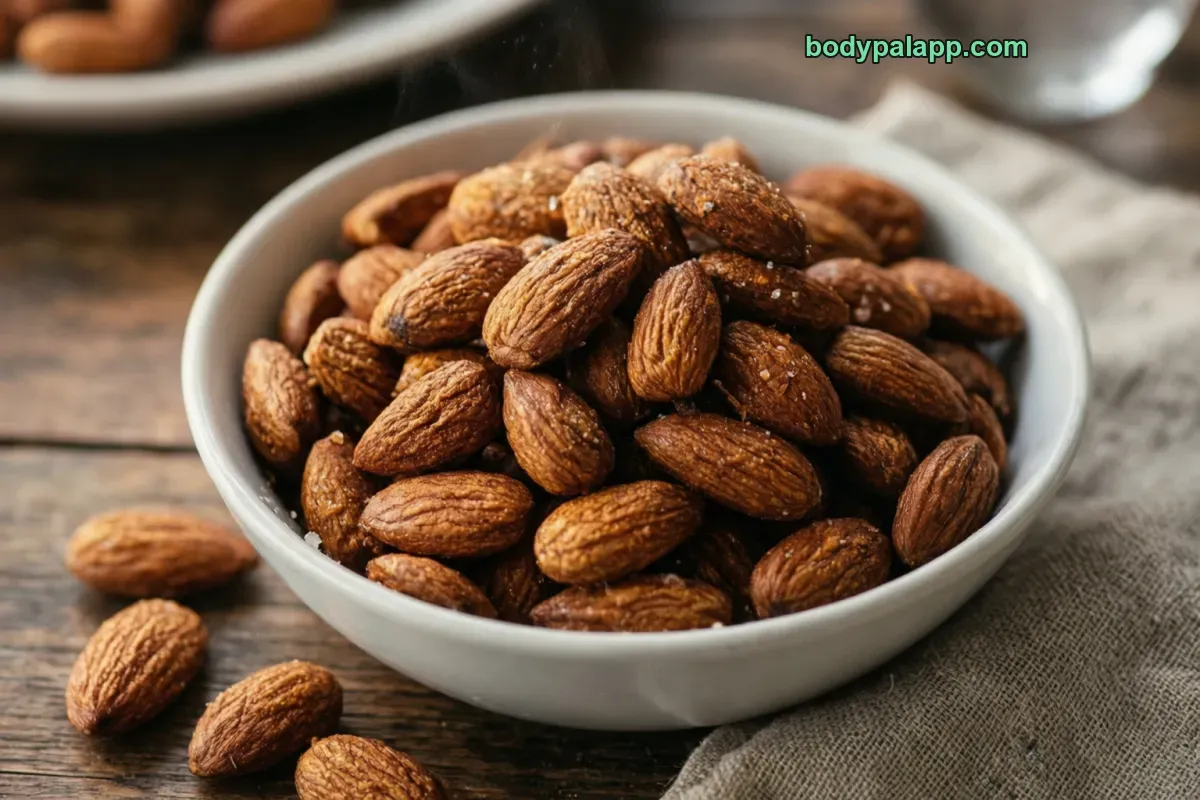
Roasted almonds calories come to 167 for a 1 oz (28 g) serving and 598 per 100 g. Fat supplies 74% of those calories, so the total climbs fast once you stop counting. A cup of whole kernels reaches 825 calories, which is 41% of the daily value in a single bowl.
167kcal
1 ounce · 28 g, dry roasted, salted
13%protein
5.9 gProtein
6 gCarbs
14.7 gFat
How to burn off 167 kcal
—Walking, brisk
—Jogging
—Cycling, moderate
—Swimming
Skip the math. BodyPal counts these calories from your steps and workouts automatically.
Nutrition facts
Dry roasted, salted · per 28 g
Calories
167 kcal
Protein
5.9 g
Carbohydrate
5.9 g
Fat
14.7 g
Saturated fat
1.1 g
Cholesterol
0 mg
Sodium
66 mg
Potassium
200 mg
Iron
1 mg
Source: USDA FoodData Central
🛡️
Verified nutrition data
Numbers on this page come from USDA FoodData Central, the U.S. Department of Agriculture’s food composition database, and from manufacturer labels where a branded product is named. Last verified September 2026. How we verify our data →
Roasted almonds: calories, protein and sodium by serving
Percent of daily value uses the FDA reference of 2,000 kcal a day.
Serving
kcal
Protein
Carbs
Fat
Sodium
% DV kcal
1 oz (28 g)
167
5.9 g
5.9 g
14.7 g
66 mg
8%
1 cup whole kernels (138 g)
825
28.9 g
29 g
72.5 g
323 mg
41%
100 g
598
21 g
21 g
52.5 g
234 mg
30%
Oil roasted (28 g)
170
5.9 g
5 g
15.4 g
95 mg
8%
3 × 1 oz (28 g)
502
17.6 g
197 mg
5 × 1 oz (28 g)
837
29.3 g
328 mg
One ounce is 167 calories, a cup is 825
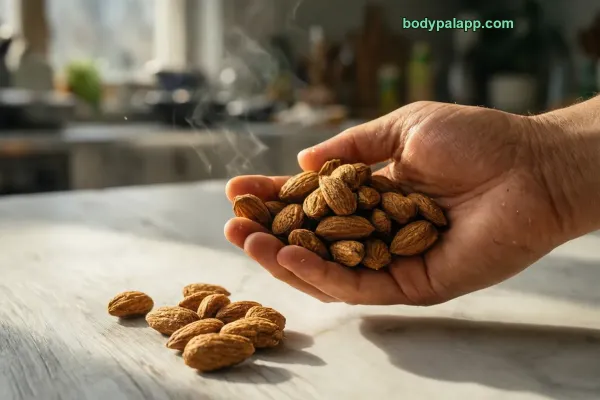
The standard 1 oz (28 g) serving of dry roasted, salted almonds holds 167 calories, about 8% of the daily value. That is a small handful, and it is easy to eat without noticing. The trouble starts when the bag stays open.
Two ounces (56 g) bring you to 335 calories. Three ounces (84 g) land at 502, already the size of a light meal. Five ounces (140 g) total 837 calories, almost exactly what a full cup of whole kernels (138 g) delivers at 825. Most people do not measure nuts by the cup, but a desk-side jar emptied over an afternoon gets there quickly.
Protein grows along with the calories: 5.9 g per ounce, 11.7 g for two, 17.6 g for three and 29.3 g for five. That is a respectable return, yet it never catches up with the energy. If you want almonds as a snack rather than a meal, pour one ounce into a small dish and close the bag before you sit down.
Fat is nearly three quarters of every calorie
The calorie split is lopsided: 74% from fat, 13% from protein and 13% from carbs. Per 100 g, roasted almonds carry 52.5 g of fat, 21 g of protein and 21 g of carbohydrate. This is why they are so dense. Fat packs more energy per gram than the other two, and almonds are mostly fat.
The fat is largely not the saturated kind. Only 4.1 g of the 52.5 g per 100 g is saturated, and cholesterol is 0. In a 1 oz serving that means 14.7 g of total fat with a small saturated share.
The carb side is better than the number suggests. Of the 21 g of carbs per 100 g, 10.9 g is fiber and just 4.9 g is sugar. One ounce gives 3.1 g of fiber and 1.4 g of sugar, so almonds are a low-sugar snack that still adds real fiber. Protein covers 12% of the daily value per ounce, a useful bonus rather than the main act.
Salt changes the label more than roasting does
Roasting itself barely moves calories. Raw almonds list 170 per ounce, dry roasted 167 and oil roasted 170. What changes is sodium. These dry roasted, salted almonds carry 234 mg per 100 g, against just 3 mg for raw almonds.
Per ounce that is 66 mg of sodium, only 3% of the daily value. A single serving is not a salt problem. A cup is a different story at 323 mg, or 14% of the daily value, and that comes alongside 825 calories. Oil roasted almonds run slightly higher in sodium at 95 mg per 28 g, 4% of the daily value, with 15.4 g of fat instead of 14.7 g.
If you watch sodium, labels such as Archer Farms Lightly Salted Roasted Almonds or Good Sense Dry Roasted Almonds, Lightly Salted are worth a look, and unsalted raw almonds sit near zero. Honey roasted versions like Ava's Snacks add a sweet coating, so check that label for sugar before assuming it matches these numbers.
Almonds work best as a measured add-on
Because one ounce is only 167 calories but delivers fat, fiber and protein together, almonds fit well as a topping or a side. Scatter a portion over yogurt, oatmeal or a salad and the dish gets crunch and staying power without the nuts becoming the meal.
Pair them with foods that add volume for few calories, such as fruit or raw vegetables. An apple with an ounce of almonds feels like more food than three ounces of almonds alone, which already cost 502 calories. The fiber and fat in the nuts help slow the snack down.
Potassium is a quiet plus at 713 mg per 100 g. If you track snacks closely, log the portion when you pour it, not when the bag is empty. BodyPal can log roasted almonds from a photo, which makes that habit easier to keep.
How does roasted almonds compare?
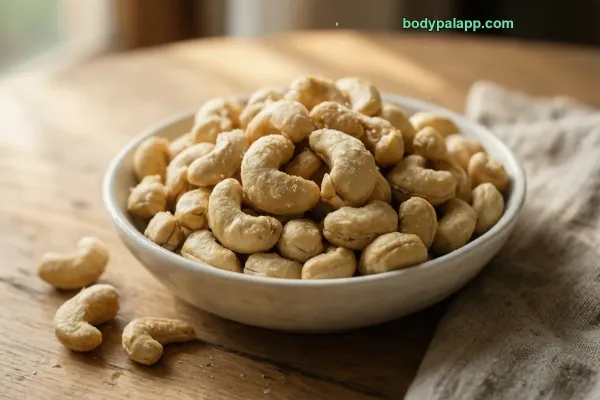
Here is how roasted almonds compare with raw almonds, a plain almond handful and cashews, per 100 g and per usual serving.
Verdict: If calories decide it, cashews come in lowest at 161 per ounce and 574 per 100 g, while raw almonds at 170 per ounce win on sodium with just 3 mg per 100 g. For the most protein per bite, choose almonds, roasted at 21 g or raw at 20.3 g per 100 g, over cashews at 15.3 g.
Most popular roasted almonds brands in the United States
Ranked by popularity in the BodyPal database
# Productkcal / 100 g
1Ava's Snacks Honey Roasted Almonds1 oz · 28 g536 kcal
Honey roasted and sweetened packs carry added sugar in place of some fat, so they read lower per 100 g than plain dry roasted almonds. Source: manufacturer labels / USDA FoodData Central.
Roasted almonds FAQs
How many calories are in roasted almonds?
One ounce (28 g) of dry roasted almonds is 167 calories. A full cup of whole kernels (138 g) is 825 calories.
Are roasted almonds good for weight loss?
A measured 28 g ounce is 167 calories with 5.9 g protein and 3.1 g fiber, while the same amount eaten straight from a 138 g cup would be 825 calories.
Roasted almonds vs cashews: which has fewer calories?
Cashews have 574 calories per 100 g against 598 for dry roasted almonds, a gap of 24 calories per 100 g.
How much protein is in roasted almonds?
Dry roasted almonds have 21 g protein per 100 g, which works out to 5.9 g in a 28 g ounce.
How many calories are in a cup of roasted almonds?
A cup of whole roasted almond kernels (138 g) has 825 calories, about 41% of the daily value. It also carries 72.5 g of fat, 28.9 g of protein and 15 g of fiber.
Do oil roasted almonds have more calories than dry roasted?
Only slightly. Oil roasted almonds have 170 calories per 28 g versus 167 for dry roasted. Fat rises from 14.7 g to 15.4 g, and sodium from 66 mg to 95 mg.
How much sodium is in salted roasted almonds?
One ounce of dry roasted, salted almonds has 66 mg of sodium, 3% of the daily value. Per 100 g it is 234 mg, and a full cup reaches 323 mg, or 14%.
How much fiber is in roasted almonds?
One ounce of roasted almonds gives 3.1 g of fiber. Per 100 g the figure is 10.9 g, and a cup of whole kernels supplies 15 g, which is a large share of the 28 g daily value.
How many calories are in 2 ounces of roasted almonds?
Two ounces (56 g) of roasted almonds come to 335 calories. That portion also gives 11.7 g of protein and 131 mg of sodium.