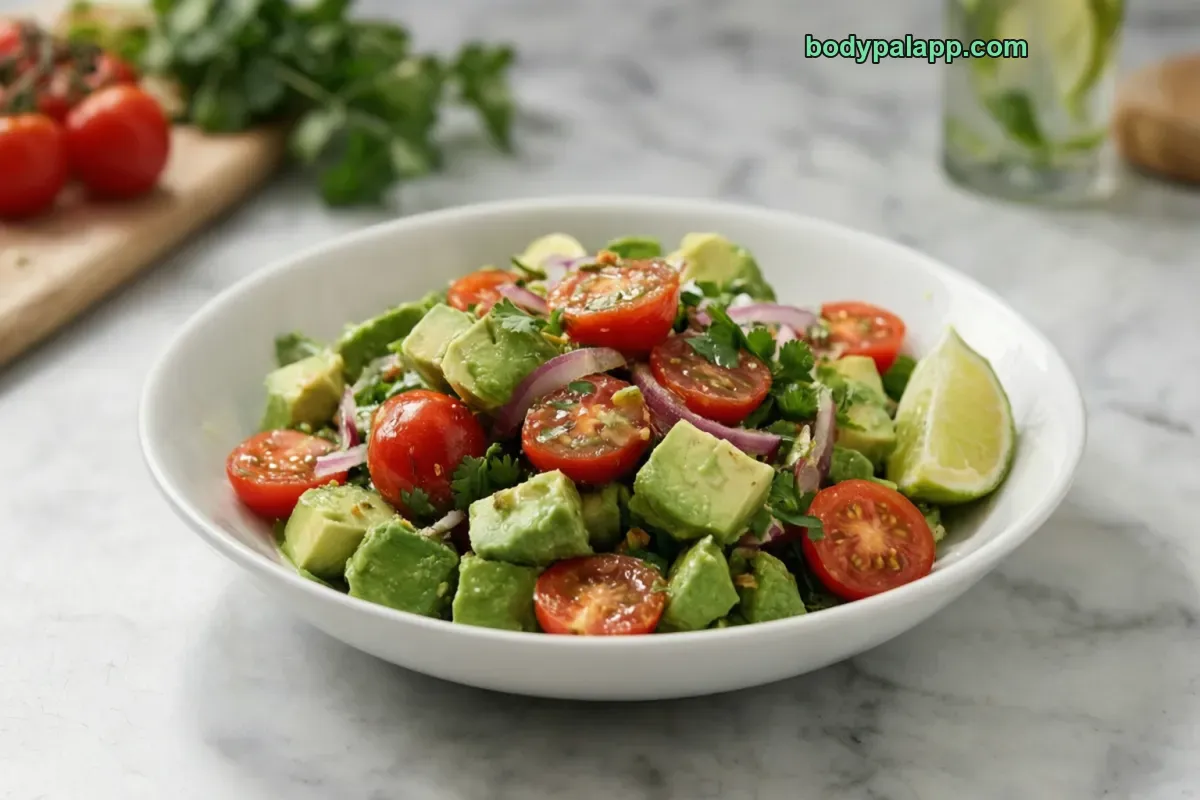
Avocado salad calories come to 47 for 1 cup (87 g) and 54 per 100 g, for a plain bowl of lettuce with avocado, tomato or carrots and no dressing. The split is what stands out: fat supplies 53% of those calories, nearly all of it from the avocado, while protein covers just 9%.
47kcal
1 cup · 87 g, salad with avocado, no dressing
9%protein
1.1 gProtein
5 gCarbs
2.9 gFat
How to burn off 47 kcal
—Walking, brisk
—Jogging
—Cycling, moderate
—Swimming
Skip the math. BodyPal counts these calories from your steps and workouts automatically.
Nutrition facts
Salad with avocado, no dressing · per 87 g
Calories
47 kcal
Protein
1.1 g
Carbohydrate
4.8 g
Fat
2.9 g
Saturated fat
0.4 g
Cholesterol
0 mg
Sodium
29 mg
Potassium
280 mg
Iron
0.3 mg
Source: USDA FoodData Central
🛡️
Verified nutrition data
Numbers on this page come from USDA FoodData Central, the U.S. Department of Agriculture’s food composition database, and from manufacturer labels where a branded product is named. Last verified September 2026. How we verify our data →
Avocado salad: calories, protein and sodium by serving
Percent of daily value uses the FDA reference of 2,000 kcal a day.
Serving
kcal
Protein
Carbs
Fat
Sodium
% DV kcal
1 cup (87 g)
47
1.1 g
4.8 g
2.9 g
29 mg
2%
3 oz portion (85 g)
46
1.1 g
4.7 g
2.9 g
28 mg
2%
100 g
54
1.3 g
5.5 g
3.4 g
33 mg
3%
3 × 1 cup (87 g)
141
3.4 g
86 mg
5 × 1 cup (87 g)
235
5.6 g
144 mg
Five cups of plain avocado salad add up to only 235 calories
A single 1 cup serving (87 g) holds 47 calories, about 2% of a standard daily calorie budget. A 3 oz portion (85 g) is practically the same at 46. This is one of the few foods where the serving size barely matters for the total, because the base is mostly water-rich lettuce and vegetables.
Scale it up and the numbers stay small. Two cups (174 g) come to 94 calories, three cups (261 g) reach 141, and a very large bowl of five cups (435 g) still lands at 235. Few lunch bases let you eat that much volume for so little energy.
The flip side is that volume alone does not make a meal. Those same five cups deliver only 5.6 g of protein, and the calorie count you see here assumes no dressing at all. The salad itself is rarely the reason a bowl ends up heavy. What goes on top usually is.
Fat supplies more than half of every calorie
Per 100 g, avocado salad carries 3.4 g of fat, 5.5 g of carbohydrate and 1.3 g of protein. Because fat packs more energy per gram, that small amount accounts for 53% of the calories. Carbohydrates contribute 38% and protein the remaining 9%.
The fat is the avocado talking, and most of it is not saturated: only 0.5 g per 100 g falls into that category. Of the 5.5 g of carbohydrate, 2.7 g is fiber and just 1.6 g is sugar, so this is a low-sugar, fiber-forward base rather than a starchy one.
What this profile lacks is protein. At 1.1 g per cup, a bowl of avocado salad covers about 2% of the daily value for protein. Think of it as a side or a base layer, not a complete plate. If staying full until dinner is your goal, the salad needs a partner.
Fiber and potassium are the useful rows, sodium is almost absent
Sodium is the row that usually ruins prepared salads, and here it barely registers. A cup holds 29 mg, about 1% of the daily value, and 100 g holds 33 mg. Even the five-cup bowl totals 144 mg. Cholesterol sits at 0.
The numbers worth noticing go the other way. Each cup brings 2.3 g of fiber, and 100 g carries 2.7 g against a daily value of 28 g. Potassium reaches 322 mg per 100 g, a solid figure for something this low in calories.
That clean sodium line only holds for the plain version. Store-bought bowls such as Good & Gather Cilantro Avocado Salad, Ready Pac Turkey Avocado Salad or Giant Eagle Everything Avocado Salad Bowl add dressings, cheese, meat or toppings, so check their labels rather than assuming they match these values. If you watch sodium, the dressing packet is where to look first.
Add protein and measure the dressing to make it a meal
Plain avocado salad is a light, fiber-rich base that leaves plenty of room in your day. The smart move is to spend some of that room on protein: grilled chicken, eggs, beans, tuna or tofu turn a side into something that holds you for hours. That is the gap the card numbers point to most clearly.
Dressing deserves a measuring spoon. The figures on this page assume none, and the avocado already provides fat and creaminess, so a lighter splash of vinegar or citrus often does the job. If you prefer a creamy dressing, pour it on the side and dip rather than toss.
Tracking a salad by eye is tricky because the bowl hides how much avocado and dressing went in. BodyPal can log it from a photo, which makes it easier to see whether your lunch stayed near 47 calories per cup or drifted well above that once toppings arrived.
How does avocado salad compare?
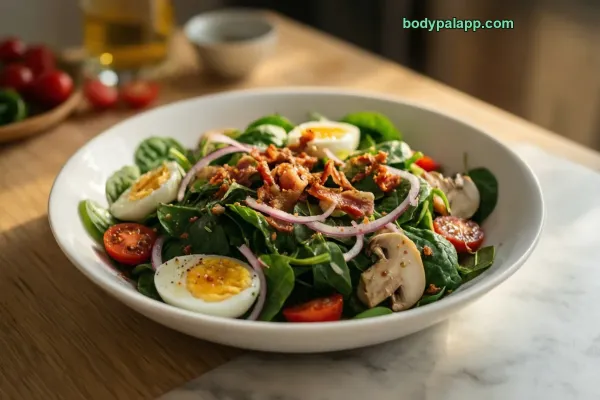
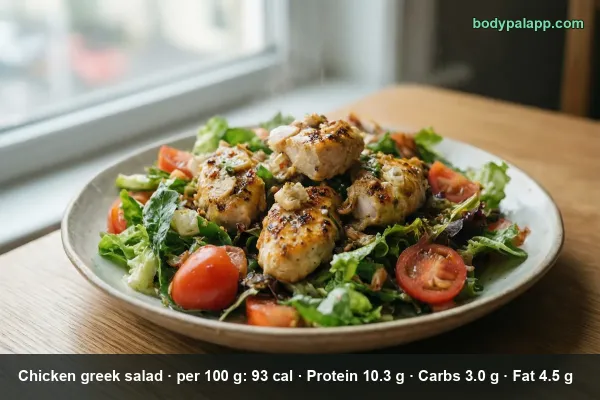
Here is how plain avocado salad stacks up against spinach salad, chef salad and chicken greek salad, compared per 100 g and per usual serving.
Verdict: For the fewest calories pick avocado salad at 54 per 100 g with just 33 mg of sodium, while spinach salad runs about 1.6 times higher at 84 and carries 220 mg. For staying full pick chicken greek salad: it costs 93 calories per 100 g but brings 10.3 g of protein against 1.3 g in avocado salad.
Most popular avocado salad brands in the United States
Branded avocado salad bowls add turkey, chicken or cheese and dressing on top of the plain lettuce, avocado and tomato mix above, so their calories run higher. Source: manufacturer labels / USDA FoodData Central.
Avocado salad FAQs
How many calories are in avocado salad?
A 1 cup (87 g) serving of avocado salad is about 47 calories, with lettuce, avocado and tomato and no dressing. Per 100 g it is 54 calories.
Is avocado salad good for weight loss?
A cup of avocado salad is 47 calories with 2.3 g fiber and 2.9 g fat, so it is a relatively low-calorie dish before any dressing is added.
Avocado salad vs spinach salad: which has fewer calories?
Avocado salad is 54 calories per 100 g and spinach salad is 84, so avocado salad is about 30 calories lower per 100 g.
How much fat is in avocado salad?
A 1 cup (87 g) serving has about 2.9 g of fat, from 3.39 g per 100 g. It also has 4.8 g of carbs and 1.1 g of protein.
How many calories are in 2 cups of avocado salad?
Two cups (174 g) of plain avocado salad have 94 calories and 2.2 g of protein. Three cups (261 g) come to 141 calories, still without any dressing counted.
How much protein does avocado salad have?
A cup of avocado salad has 1.1 g of protein, and 100 g has 1.3 g. Protein supplies only 9% of its calories, so add chicken, eggs or beans if you want a filling meal.
Is avocado salad high in sodium?
No. A cup of plain avocado salad holds 29 mg of sodium, about 1% of the daily value, and 100 g holds 33 mg. Dressings and toppings are what push the sodium up.
How much fiber is in a cup of avocado salad?
One cup of avocado salad provides 2.3 g of fiber and just 1.4 g of sugar. Per 100 g, that rises to 2.7 g of fiber and 1.6 g of sugar.