
How many calories are in a chicken Greek salad?
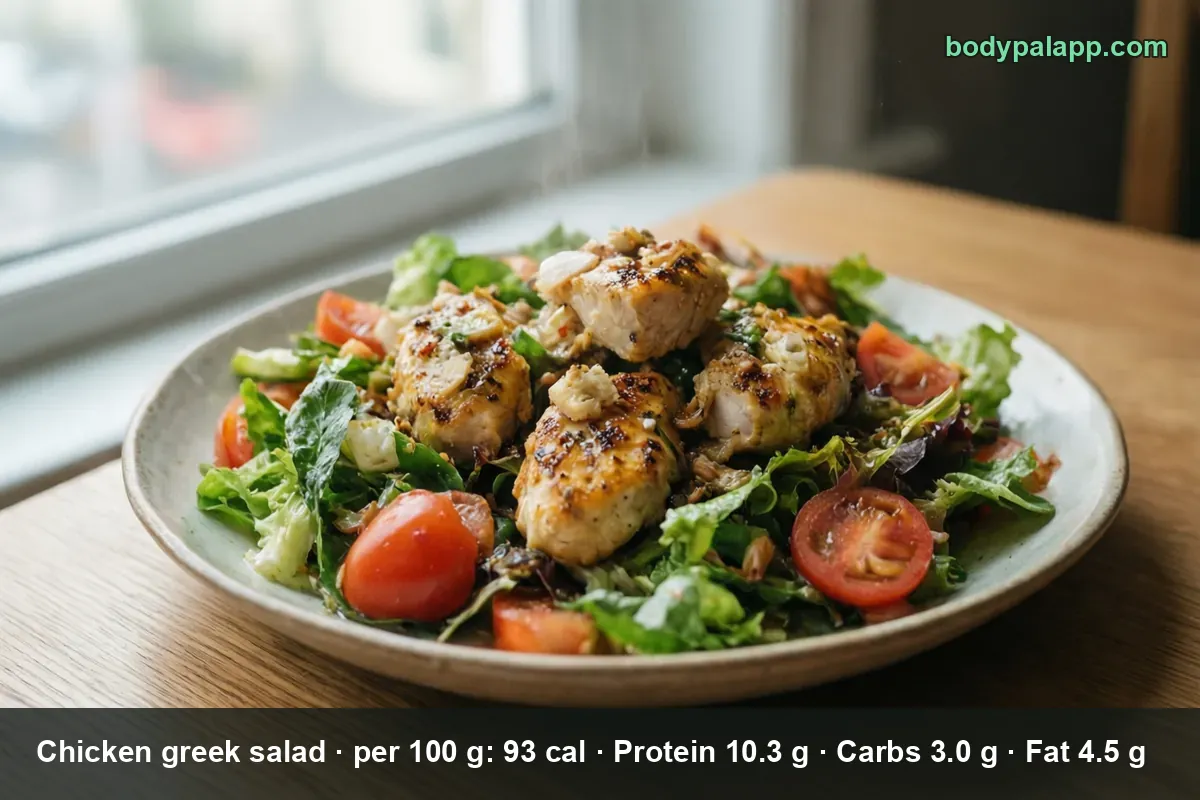
A full 370 g plate of chicken Greek salad, dressing on the side and untouched, is 344 calories. Per 100 g it is 93 calories. That is 38 g of protein and 11.2 g of carbohydrate on one plate, and the cheese is the part that moves the calorie number most.
On this page
- Chicken Greek salad quick facts
- US servings, from one cup to the whole plate
- What the cheese, the bacon and the breading cost
- Protein and sodium are the rows to watch
- How does chicken Greek salad compare?
- FAQ
Chicken Greek salad quick facts
USDA does not publish a record called "Greek salad with chicken." What it publishes is the same plate described by its parts, and the closest match is FNDDS 2706814, "Chicken or turkey garden salad with cheese, lettuce and/or greens, tomato and/or carrots, other vegetables, no dressing". Greens, tomato, other vegetables, cooked chicken, cheese, nothing poured over the top. Swap the generic cheese for feta and that is a Greek salad with chicken, structurally and calorically.
Two things about this record matter before you read the table. The cheese is included, which is why it sits at 93 calories per 100 g instead of the low sixties. And the dressing is not included, so every figure below is the dry bowl. Olives and cucumber are not called out separately in the USDA description either; they land inside "other vegetables" and barely move a 93-calorie-per-100 g food.
| Nutrient | Per 100 g | Per 1 salad (370 g) | % Daily Value |
|---|---|---|---|
| Calories | 93 | 344 | — |
| Total fat | 4.52 g | 16.7 g | 21% |
| Saturated fat | 2.21 g | 8.2 g | 41% |
| Carbohydrate | 3.02 g | 11.2 g | 4% |
| Dietary fiber | 0.9 g | 3.3 g | 12% |
| Total sugars | 1.12 g | 4.1 g | — |
| Protein | 10.26 g | 38.0 g | 76% |
| Sodium | 176 mg | 651 mg | 28% |
| Cholesterol | 32 mg | 118 mg | 39% |
| Potassium | 260 mg | 962 mg | 20% |
% Daily Value is based on a 2,000-calorie diet.
Verified nutrition data
Numbers on this page come from USDA FoodData Central, the U.S. Department of Agriculture’s food composition database, and from manufacturer labels where a branded product is named. Last verified September 2026. How we verify our data →
There is no added sugars row and no trans fat row here, and that is not an omission on our side: the FNDDS edition behind this record does not publish either value for mixed dishes. The 4.1 g of total sugars in the plate is what tomato, carrot and the rest of the vegetables bring on their own, so comparing it to the 50 g added-sugars limit would be comparing two different things.
US servings, from one cup to the whole plate
| Serving | Weight | Calories |
|---|---|---|
| 1 oz | 28 g | 26 kcal |
| 1 cup | 90 g | 84 kcal |
| 2 cups | 180 g | 167 kcal |
| One full salad plate | 370 g | 344 kcal |
| Per 100 g | 100 g | 93 kcal |
The 90 g cup and the 370 g plate are USDA household measures for this record. The ounce and the two-cup line are our own arithmetic from the USDA 100 g figure, not USDA servings, which is why 2 cups reads 167 rather than a clean doubling of 84.
This is where most people log the wrong number. A cup of chopped salad is small — 90 g, about 84 calories — and it looks like a reasonable unit because that is how cups work everywhere else in the kitchen. But the plate a deli counter or a diner hands you is 370 g, which is 4.1 cups. Log "1 cup" for a lunch you actually finished and you are 260 calories and 29 g of protein short. Undercounting protein is the part that hurts, since it makes the meal look far less filling on paper than it was.
Going the other way is just as easy. If you build the salad at home in a mixing bowl and eat two cups of it, that is 167 calories and roughly 18.5 g of protein, scaled from the 100 g figure. That is a snack, not a lunch, and it will not hold anyone until dinner.
What the cheese, the bacon and the breading cost
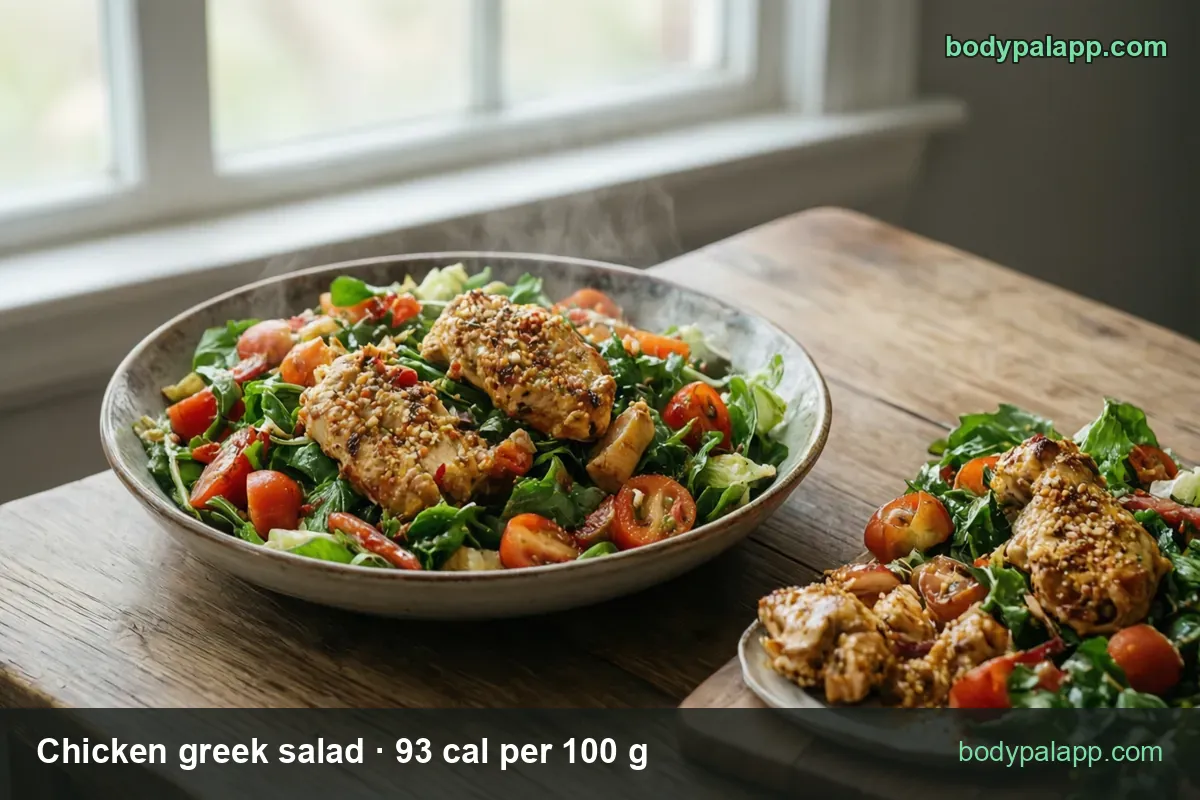
USDA carries six versions of this salad, and the gap between the lightest and the heaviest is almost double. The plate column below is our own arithmetic, scaling each 100 g figure to the same 370 g plate so the versions can be read against each other.
| Version | Per 100 g | 1 cup (90 g) | Same 370 g plate |
|---|---|---|---|
| With cheese, no dressing (the main record) | 93 kcal | 84 kcal | 344 kcal |
| Without cheese | 64 kcal | 58 kcal | 237 kcal |
| Greens and vegetables, no tomato, no cheese | 66 kcal | 59 kcal | 244 kcal |
| With bacon and cheese | 106 kcal | 95 kcal | 392 kcal |
| Breaded fried chicken with cheese | 123 kcal | 111 kcal | 455 kcal |
| Breaded fried chicken with bacon and cheese | 122 kcal | 110 kcal | 451 kcal |
Only two of those six rows come in lighter than the main record, and both of them are the ones that drop the cheese. That is the whole story of a Greek salad's calorie count: 93 against 64 per 100 g, which on a 370 g plate is 344 against 237. Roughly 107 calories, and most of the saturated fat, sit in the crumble of feta.
The breading is the more expensive swap, and it is the one people talk themselves into. Crispy chicken pushes the salad to 123 calories per 100 g while protein falls from 10.26 g to 6.5 g per 100 g. More calories, less of the nutrient you ordered a chicken salad for. Bacon behaves more predictably: it adds fat on top of the cheese, 106 per 100 g, and it also pushes sodium from 176 mg to 228 mg per 100 g.
One oddity worth noting. The breaded version with bacon (122 per 100 g) reads marginally lower than the breaded version without it (123). At that scale the two are the same food to within recipe noise, not evidence that bacon saves calories.
Protein and sodium are the rows to watch
Protein is the reason this salad earns its place at lunch. The 370 g plate delivers 38 g, which is 76% of the Daily Value the FDA sets for the Nutrition Facts label, out of 344 calories. Very few 344-calorie lunches do that. It also covers a serving of vegetables and a serving of protein foods in one bowl, which is exactly the pairing MyPlate asks for.
Saturated fat is the surprise in the other direction. Grilled chicken and salad greens carry almost none of it, so the 8.2 g in the plate — 41% of the Daily Value — is coming from the cheese. The Dietary Guidelines for Americans put the ceiling at under 10% of daily calories. Nothing here is out of bounds for one meal, but if you are watching that row, asking for half the feta is a cheaper fix than trimming anywhere else on the plate.
Sodium lands at 651 mg, 28% of the Daily Value, roughly the equivalent of just over a quarter teaspoon of table salt. That is before dressing, before olives, before anything else the counter adds. Order the no-cheese build and it drops to 136 mg per 100 g. Cholesterol is 118 mg, 39% of the Daily Value, and potassium is a genuinely useful 962 mg, 20%, from the vegetables.
How does chicken Greek salad compare?
All four rows below are shown at the same 1 cup (90 g) scoop so the differences are the recipe, not the portion size.
| Salad | Per 100 g | US serving | Calories |
|---|---|---|---|
| Chicken Greek salad, with cheese | 93 kcal | 1 cup, 90 g | 84 kcal |
| Chicken garden salad, no cheese | 64 kcal | 1 cup, 90 g | 58 kcal |
| Chicken salad with bacon and cheese | 106 kcal | 1 cup, 90 g | 95 kcal |
| Breaded fried chicken salad with cheese | 123 kcal | 1 cup, 90 g | 111 kcal |
Our take: for weight loss, order it grilled and ask for the feta light — that is 344 down toward 237 on a full plate without touching the protein. For staying full through an afternoon, keep the cheese and eat the whole 370 g, because 38 g of protein for 344 calories is the best trade on this list. The one version not worth ordering is the breaded fried build: it costs 111 calories a cup instead of 84 and hands back less protein than the grilled version does. And on every one of these numbers, the dressing is still sitting outside the count.
Chicken Greek salad FAQs
How many calories are in a chicken Greek salad?
A 370 g plate of chicken garden salad with cheese and no dressing carries 344 calories, at 93 calories per 100 g. That covers the greens, tomato, roast chicken and the cheese. Dressing is not in the number, so a two-tablespoon pour of vinaigrette lands on top of it.
How much protein is in a Greek salad with chicken?
38 grams of protein in the 370 g plate, which is 76% of the Daily Value on a 2,000-calorie diet. Per 100 g the salad runs 10.26 g. That is the roast chicken doing most of the work, with the cheese adding a few grams behind it.
How many calories in a Greek salad with grilled chicken and no dressing?
344 calories, because the USDA record itself is a no-dressing salad. Every number on this page already assumes a dry bowl. Grilled chicken is what the 93 calories per 100 g figure is built on; add dressing and you are adding to 344, not replacing part of it.
How many calories in 1 cup of chicken Greek salad?
One cup weighs 90 g and comes to 84 calories, with about 9.2 g of protein. The catch is that a restaurant plate is roughly 4.1 cups, so logging a single cup when you ate the whole thing misses about 260 calories.
Does the feta change the calories much?
Yes: with cheese the salad is 93 calories per 100 g; the same salad without it is 64. Scaled to a 370 g plate that is 344 against 237, so the crumble of feta is worth roughly 107 calories and most of the saturated fat.
How many carbs are in a chicken Greek salad?
11.2 g of carbohydrate in the 370 g plate, only 4% of the Daily Value, with 3.3 g of that as fiber and 4.1 g as natural sugars from the vegetables. Per 100 g it is 3.02 g. That is low enough that the dressing, not the salad, usually decides the carb count.
How much sodium is in a chicken Greek salad?
651 mg in the 370 g plate, 28% of the Daily Value, and that is before any dressing or olives. It works out to just over a quarter teaspoon of table salt. The cheese and the seasoning on the chicken carry it; the no-cheese version drops to 136 mg per 100 g.
Is grilled or crispy chicken lower in calories on a Greek salad?
Grilled, by 30 calories per 100 g: 93 against 123 for the breaded fried version with cheese. The protein moves the other way, from 10.26 g down to 6.5 g per 100 g. Crispy chicken costs more calories and gives back less protein, which is the worst trade on the menu.
Similar foods
- Avocado Roll — 167 cal per roll
- Avocado Sushi — 167 cal per roll
- Shrimp Curry — 223 cal per cup
- Vegetable Sushi Roll — 123 cal per roll
- Taco Bowl — 289 cal per bowl
- California Rolls — 169 cal per roll
Count it without the math
Point the camera at the bowl and BodyPal counts the chicken, the greens and the feta for you.


How long does it take to burn off 344 kcal of chicken Greek salad?
One salad (370 g) is 344 kcal. Enter your weight and the amount you ate to see how long it takes you to burn that off:
lb
| Activity | Time to burn 344 kcal |
|---|---|
| Walking, brisk | 1 hr 9 min |
| Cycling, moderate | 43 min |
| Swimming, moderate | 49 min |
| Jogging | 40 min |
| Weight training, moderate | 1 hr 16 min |
Times are for a 155 lb adult at a steady pace; change the weight to see yours. The amount is set to the portion in the text (370 g); change it to what you actually ate. BodyPal works this out from your steps automatically.
Burning it off is one side of it. The other is knowing your number: work out how many calories you need a day, with macros and a goal date.