
How many calories are in shrimp curry?
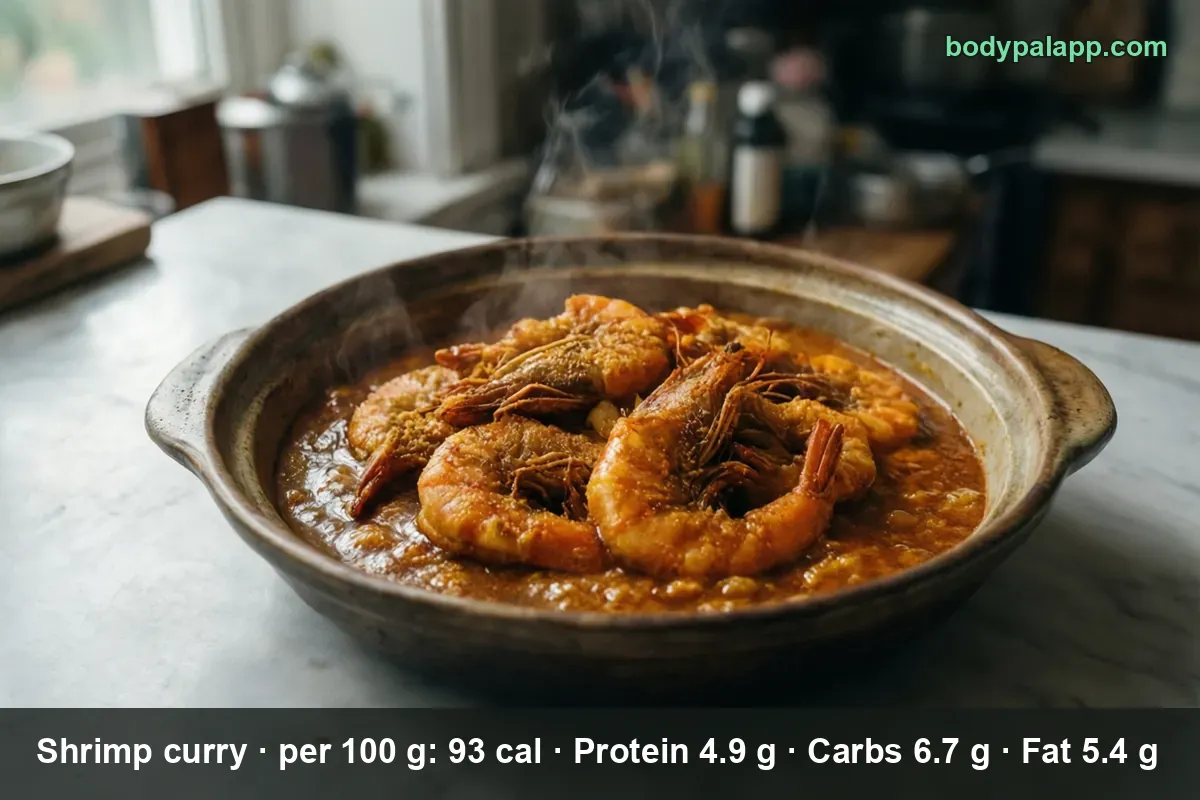
A 1-cup (240 g) serving of shrimp curry runs 223 calories, and the dish itself sits at 93 calories per 100 g — light for something this rich on the tongue. The sauce is what you are really counting. Shrimp bring the protein; the oil, coconut and spice paste bring the fat. Half a cup is 112.
On this page
- Shrimp curry quick facts
- US servings, from one ounce to a takeout bowl
- With rice, sauce only, and other curries
- Sodium is the row to watch, not calories
- How does shrimp curry compare?
- Most popular shrimp curry brands
- FAQ
Shrimp curry quick facts
There is no USDA record called "shrimp curry." The closest match, and the one this page uses, is FNDDS 2706460, "Fish curry", the survey record for seafood simmered in a curry sauce with no rice or bread underneath it. That substitution matters less than it sounds: in a curry, the sauce carries the calories and the seafood rides along. Swapping cod for shrimp nudges the fat up a fraction and the protein down a fraction, but it does not move the calorie line by much.
The numbers below are for the curry as it comes out of the pot — shrimp, sauce, aromatics, and nothing else in the bowl. If rice is in the same cup, skip to the variants table, because that is a different USDA record with a different weight per cup.
| Nutrient | Per 100 g | Per 1 cup (240 g) | % Daily Value |
|---|---|---|---|
| Calories | 93 | 223 | — |
| Total fat | 5.42 g | 13.0 g | 17% |
| Saturated fat | 1.292 g | 3.1 g | 16% |
| Carbohydrate | 6.65 g | 16.0 g | 6% |
| Dietary fiber | 1.4 g | 3.4 g | 12% |
| Total sugars | 2.56 g | 6.1 g | — |
| Protein | 4.94 g | 11.9 g | 24% |
| Sodium | 351 mg | 842 mg | 37% |
% Daily Value is based on a 2,000-calorie diet.
Verified nutrition data
Numbers on this page come from USDA FoodData Central, the U.S. Department of Agriculture’s food composition database, and from manufacturer labels where a branded product is named. Last verified September 2026. How we verify our data →
Two rows you will not find here: added sugars and trans fat. USDA does not publish either figure for FNDDS mixed dishes, so rather than guess at them, they are gone. Cholesterol and potassium are in the record and worth naming — a cup gives 55 mg of cholesterol (18% DV) and 660 mg of potassium (14% DV), the potassium coming mostly from the tomato and onion base rather than the shellfish.
US servings, from one ounce to a takeout bowl
| Serving | Weight | Calories |
|---|---|---|
| 1 oz | 28.4 g | 26 kcal |
| Per 100 g | 100 g | 93 kcal |
| 1/2 cup | 120 g | 112 kcal |
| 1 cup | 240 g | 223 kcal |
| 1 1/2 cups, takeout bowl | 360 g | 335 kcal |
The 1-cup, 240 g line is the USDA household measure, and it doubles as the default portion when a survey respondent did not say how much they ate. Everything else in that table is our own arithmetic from the USDA 100 g figure, not a USDA serving — the half cup, the ounce, and the 1 1/2-cup bowl are all straight scaling.
That last row is the one that catches people. A curry-house or takeout container rarely stops at a level cup. Ladle it out and you are usually somewhere between 1 1/4 and 1 3/4 cups of sauce and shrimp before a grain of rice arrives, which is roughly 280 to 390 calories. The number stays modest; the sodium does not, and that is covered below.
One more measuring note. Shrimp curry is a wet dish, so a cup of it weighs 240 g — heavier than a cup of most rice-based mixes. If you are logging by volume, weight is doing quiet work in the background, and it is the reason a cup of the rice version comes out lighter than a cup of the curry alone.
With rice, sauce only, and other curries
| Version | Per 100 g | Typical serving | Calories |
|---|---|---|---|
| Shrimp curry, no rice | 93 kcal | 1 cup (240 g) | 223 kcal |
| With rice | 107 kcal | 1 cup (200 g) | 214 kcal |
| Curry sauce only | 95 kcal | 1 tbsp (16 g) | 15 kcal |
| Chicken curry | 107 kcal | 1 cup (240 g) | 257 kcal |
| Vegetable curry | 86 kcal | 1 cup (240 g) | 206 kcal |
| Lentil curry (dal) | 111 kcal | 1 cup (240 g) | 266 kcal |
| Plain steamed shrimp | 90 kcal | 1 cup (135 g) | 122 kcal |
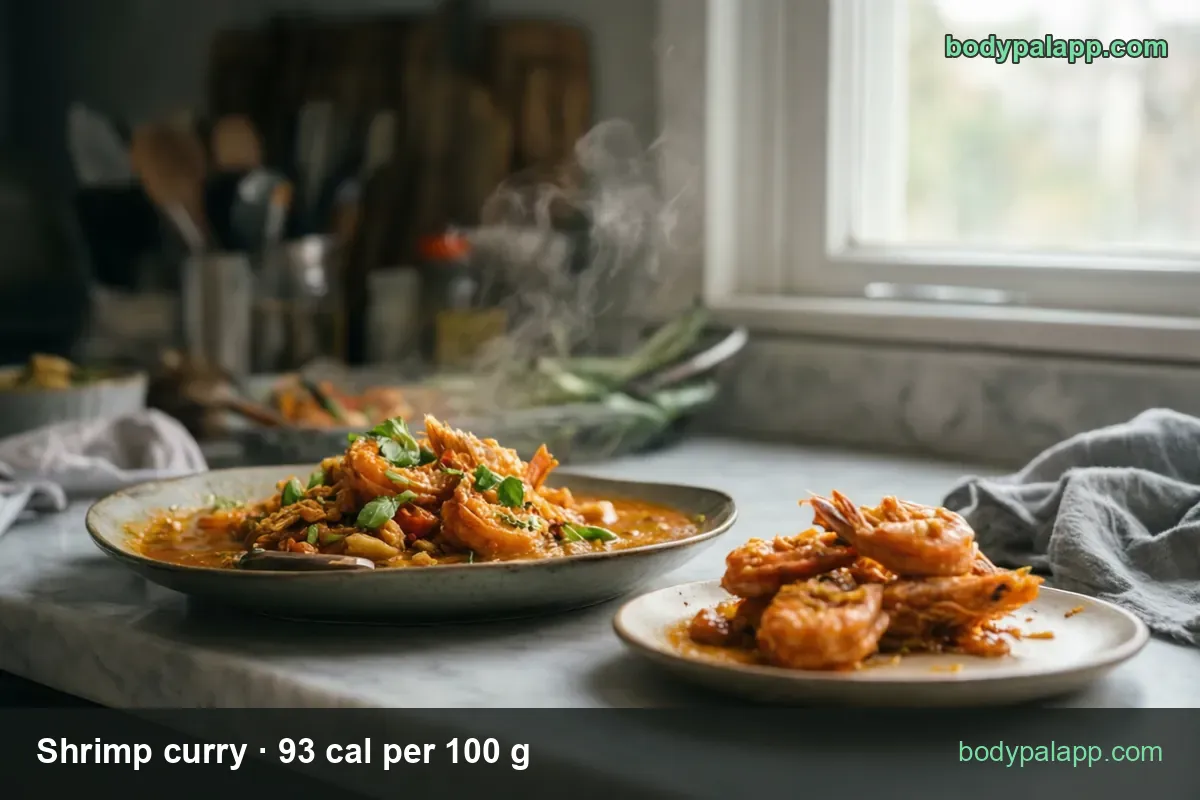
With rice is the trap. A cup of shrimp curry with rice is 214 calories, nine fewer than a cup of the curry alone, and that reads like rice is free. It is not. The rice version is denser per 100 g — 107 against 93 — but a cup of it weighs 200 g instead of 240 g, so the cup shrinks faster than the density grows. Weigh both at 240 g and the rice version comes to 257 calories, 34 more.
Sauce alone tells you where the fat lives. Curry sauce on its own is 8.22 g of fat per 100 g, well above the 5.42 g in the finished dish, because the shrimp dilute it. A tablespoon spooned over rice at the table is 15 calories, so four tablespoons of extra sauce is 60 — small on its own, invisible in a food diary, and the single easiest thing to under-log about this meal.
Plain steamed shrimp is the honest comparison for anyone chasing protein rather than dinner. A cup of steamed shrimp is 122 calories and almost pure protein at 17.19 g per 100 g.
Frozen shrimp curry bowls sit in the same band. USDA's branded records put Monsoon Kitchens' Kerala-style coconut shrimp curry with basmati at 120 calories per 100 g, or 340 for the 283 g bowl, and the same brand's shrimp tikka masala bowl at 117 per 100 g and 331 per bowl; Choice Canning's shrimp cashew korma is lighter, 88 calories per 100 g. Bowls with rice built in land between 330 and 350 — call it a sixth of a 2,000-calorie day for a single tray.
Sodium is the row to watch, not calories
Here is the number that should change how you order. One cup of shrimp curry is 842 mg of sodium — 37% of the 2,300 mg Daily Value the FDA uses on the Nutrition Facts label — from just 223 calories, or 11% of a 2,000-calorie day. That is over a third of the day's sodium for about a ninth of the day's energy. In salt terms, it is roughly a third of a teaspoon of table salt sitting in one cup of sauce.
Shrimp are part of the reason. They are naturally salty and usually brined before freezing; even plain steamed shrimp carry 248 mg of sodium per 100 g before anything is added. Then comes the salt in the sauce, the fish sauce or shrimp paste in Thai-style versions, and the soy in others. If you are watching sodium, this is a dish to eat as one cup with unsalted rice rather than two cups on its own, and cooking it at home is where you actually control it.
The protein row deserves a second look too. A cup delivers 11.9 g of protein, 24% of the Daily Value, which sounds fine until you notice the shrimp are being outvoted. Plain shrimp run 17.19 g of protein per 100 g; the finished curry runs 4.94 g. Gram for gram, the protein density drops about three and a half times once the sauce joins in. If shrimp curry is your protein source for the meal, the fix is more shrimp in the pan, not a bigger ladle of sauce — and MyPlate's protein foods guidance plus the Dietary Guidelines' 8-ounces-of-seafood-a-week target both point the same way.
Saturated fat is the mild row: 3.1 g per cup, 16% of the Daily Value. That is with the FNDDS sauce. Cook yours with a full can of coconut milk and it will read higher, because the record above reflects a typical American preparation rather than a heavy coconut one.
How does shrimp curry compare?
| Dish | Per 100 g | US serving | Calories |
|---|---|---|---|
| Shrimp curry | 93 kcal | 1 cup (240 g) | 223 kcal |
| Fish curry with rice | 107 kcal | 1 cup (200 g) | 214 kcal |
| Chicken curry | 107 kcal | 1 cup (240 g) | 257 kcal |
| Shrimp creole, no rice | 124 kcal | 1 cup (246 g) | 305 kcal |
Our take: shrimp curry is the lightest of these four per 100 g, and it is not close on the creole comparison — 93 against 124, which works out to 82 more calories once the cup is filled, because creole is a thicker, tomato-and-oil dish with far more shrimp packed into the same volume. Against chicken curry it saves 34 calories a cup. If you are ordering for the lowest calorie count, shrimp curry is the right pick on this table; if you are ordering for protein per calorie, shrimp creole is the better deal at 14.33 g per 100 g against 4.94 g, and it is worth paying the 82 calories for. Judge these by what goes under them, though — a cup of any of them plus a cup of rice is a different conversation.
Most popular shrimp curry brands in the United States
Ranked by how widely each product appears among foods sold in the United States, from the BodyPal food database of over 3.3 million products. Calories are the figures printed on each Nutrition Facts label, checked against USDA FoodData Central.
| Product | Calories (per 100 g) |
|---|---|
| Monsoon Kitchens Coconut Shrimp Kerala-Style Curry | 120 cal |
| Monsoon Kitchens Shrimp Tikka Masala Bowl | 117 cal |
| Choice Canning Shrimp Cashew Korma | 88 cal |
Brand popularity: BodyPal food database. Nutrition: manufacturer labels / USDA FoodData Central.
Shrimp curry FAQs
How many calories are in shrimp curry?
A 1-cup (240 g) serving is 223 calories, and the dish runs 93 calories per 100 g. That is USDA's figure for curry with no rice or bread underneath. Half a cup comes to 112 calories, and a 1 1/2-cup takeout bowl of sauce and shrimp lands near 335.
How much protein is in shrimp curry?
A cup gives 11.9 g of protein, 24% of the Daily Value — less than the shrimp themselves suggest. Plain steamed shrimp carry 17.19 g per 100 g, while the finished curry carries only 4.94 g, because sauce makes up most of the weight in the bowl.
Is shrimp curry high in sodium?
Yes, one cup holds 842 mg of sodium, 37% of the 2,300 mg Daily Value, from only 223 calories. That is roughly a third of a teaspoon of table salt. Shrimp start at 248 mg per 100 g before cooking, and the sauce adds the rest.
How many calories in shrimp curry with rice?
One cup of curry with rice is 214 calories, nine fewer than a cup of curry alone. The catch is weight: the rice version measures 200 g per cup against 240 g. Per 100 g it is denser, 107 calories against 93, so matched by weight rice costs more.
How many carbs are in shrimp curry?
A cup has 16.0 g of carbohydrate, 6% of the Daily Value, including 3.4 g of fiber and 6.1 g of total sugars from onion, tomato and coconut. Add rice to the same dish and carbohydrate jumps to 15.19 g per 100 g instead of 6.65 g.
Does coconut milk make shrimp curry higher in calories?
USDA does not publish a separate coconut-milk version, but the sauce is where fat sits: curry sauce alone is 8.22 g of fat per 100 g against 5.42 g in the finished dish. A coconut-heavy sauce pushes the dish above the 93 calories per 100 g baseline here.
Shrimp curry vs chicken curry: which has fewer calories?
Shrimp curry, by 34 calories a cup: 223 against 257, and 93 calories per 100 g against 107. Chicken curry also carries more fat, 6.48 g per 100 g versus 5.42 g. Chicken pays some of it back with more protein, 6.48 g per 100 g against 4.94 g.
Is shrimp curry good for weight loss?
At 93 calories per 100 g it is one of the lighter options: among the curries here, only vegetable curry at 86 is lower. A 223-calorie cup fits an ordinary lunch comfortably. The rice, the naan and the second ladle of sauce are what move the total, not the shrimp.
Similar foods
- Avocado Roll — 167 cal per roll
- Avocado Sushi — 167 cal per roll
- Chicken Greek Salad — 344 cal per salad
- Vegetable Sushi Roll — 123 cal per roll
- Taco Bowl — 289 cal per bowl
- California Rolls — 169 cal per roll
Count it without the math
Point the camera at the bowl and BodyPal counts the curry for you, sauce and all.


How long does it take to burn off shrimp curry?
A 1-cup (240 g) serving is 223 kcal. Enter your weight and the amount you ate to see how long it takes you to burn that off:
lb
| Activity | Time to burn 223 kcal |
|---|---|
| Walking, brisk | 45 min |
| Cycling, moderate | 28 min |
| Swimming, moderate | 32 min |
| Jogging | 26 min |
| Weight training, moderate | 50 min |
Times are for a 155 lb adult at a steady pace; change the weight to see yours. The amount is set to the portion in the text (240 g); change it to what you actually ate. BodyPal works this out from your steps automatically.
Want the bigger picture? Calculate your daily calorie needs — your maintenance figure, a target for losing or gaining, and the date you get there.