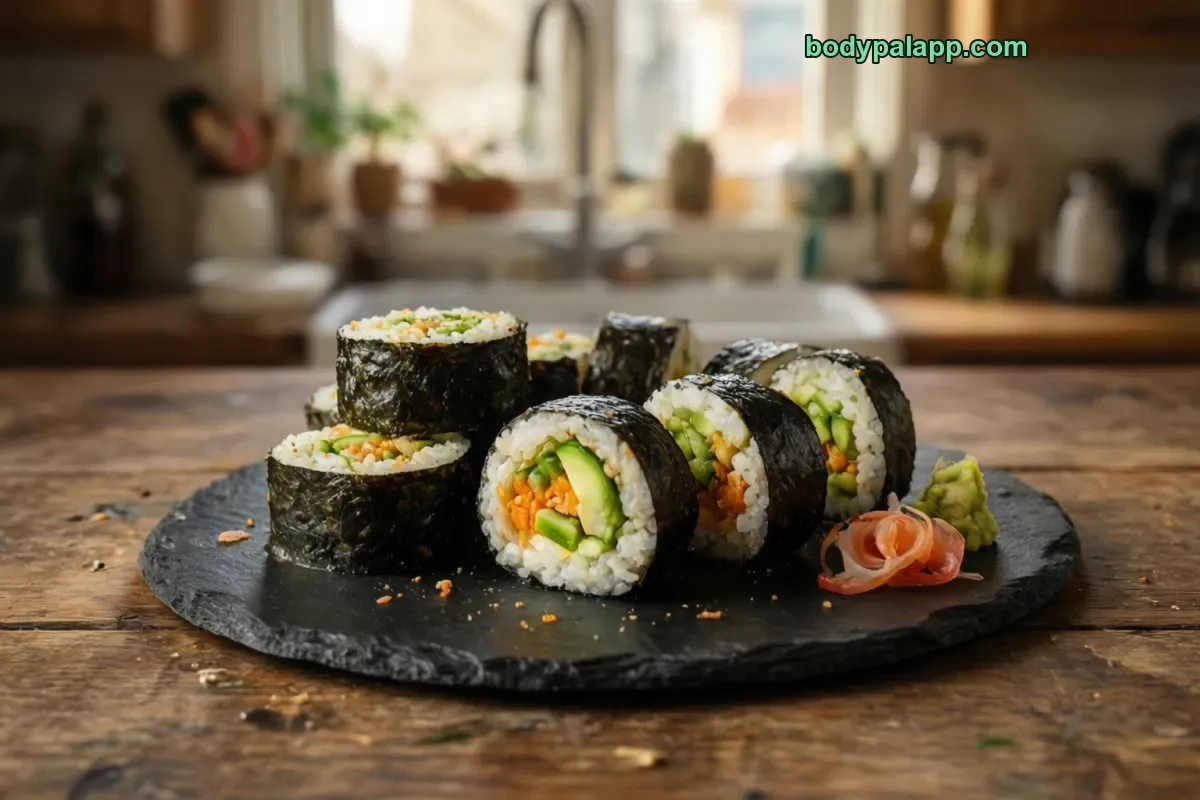
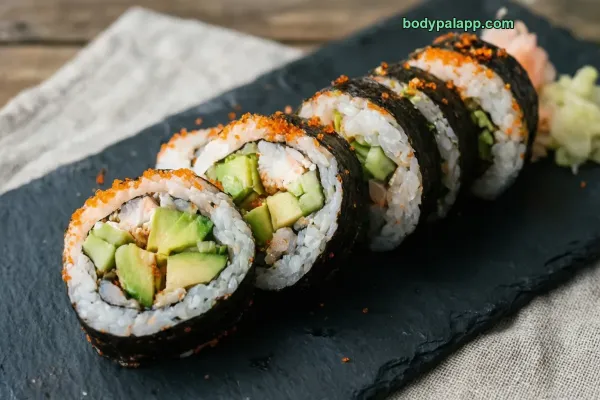
Veggie sushi roll calories come to 123 for one roll of 6 pieces (132 g) and 93 per 100 g. That makes it one of the lighter orders at a sushi counter. The number to notice is sodium: one roll carries 477 mg, 21% of the daily value, while giving only 6% of daily calories.
123kcal
1 6-piece roll · 132 g, vegetable roll, restaurant style
8%protein
2.4 gProtein
23 gCarbs
1.9 gFat
How to burn off 123 kcal
—Walking, brisk
—Jogging
—Cycling, moderate
—Swimming
Skip the math. BodyPal counts these calories from your steps and workouts automatically.
Nutrition facts
Vegetable roll, restaurant style · per 132 g
Calories
123 kcal
Protein
2.4 g
Carbohydrate
23 g
Fat
1.9 g
Saturated fat
0.3 g
Cholesterol
0 mg
Sodium
477 mg
Potassium
94 mg
Iron
0.2 mg
Source: USDA FoodData Central
🛡️
Verified nutrition data
Numbers on this page come from USDA FoodData Central, the U.S. Department of Agriculture’s food composition database, and from manufacturer labels where a branded product is named. Last verified September 2026. How we verify our data →
Veggie sushi roll: calories, protein and sodium by serving
Percent of daily value uses the FDA reference of 2,000 kcal a day.
Serving
kcal
Protein
Carbs
Fat
Sodium
% DV kcal
1 roll, 6 pieces (132 g)
123
2.4 g
23.3 g
1.9 g
477 mg
6%
1 piece (22 g)
20
0.4 g
3.9 g
0.3 g
79 mg
1%
100 g
93
1.8 g
17.7 g
1.5 g
361 mg
5%
3 × 1 roll, 6 pieces (132 g)
368
7.1 g
1,430 mg
5 × 1 roll, 6 pieces (132 g)
614
11.9 g
2,383 mg
One roll is 123 calories, three are 368
A standard restaurant-style veggie roll is 6 pieces weighing 132 g, and it lands at 123 calories. Each piece is about 22 g and 20 calories, so counting pieces works well on a mixed platter. Piece for piece, few things on a sushi menu come in lighter.
The catch is that one roll rarely makes a meal. Two rolls (264 g) bring 246 calories, three rolls (396 g) reach 368, and five rolls, a full platter, hit 614 calories across 660 g. Protein barely keeps up: 4.8 g for two rolls, 7.1 g for three and 11.9 g for five.
So the total is driven by how many rolls you eat, not by any single filling. If you are tracking, log the roll count first and the loose pieces second. Soy sauce, spicy mayo and tempura crunch are extras that sit outside these numbers, so add them separately if you use them.
Nearly four fifths of the calories are carbs
The calorie split is 78% carbs, 15% fat and 8% protein. Per 100 g that works out to 17.7 g of carbs, 1.5 g of fat and 1.8 g of protein. The rice does almost all the work here; the vegetables and nori add crunch and volume rather than energy.
A full roll gives 23.3 g of carbs and only 2.4 g of protein, about 5% of the daily value. Fat stays low at 1.9 g per roll, and saturated fat is just 0.2 g per 100 g. Cholesterol is 0, since there is no fish, egg or cream cheese in the standard version.
Fiber is modest at 1.8 g per roll, or 1.4 g per 100 g. Sugars are 1.6 g per roll. Put together, this is a light, carb-led food. It is easy on calories, but on its own it offers little of the protein that tends to make a meal feel complete.
Sodium is the row to watch
One roll carries 477 mg of sodium, 21% of the daily value, while supplying only 6% of daily calories. That gap is the most notable thing on this label. Per 100 g, sodium is 361 mg, or 16% of the daily value.
It stacks quickly. Two rolls reach 953 mg, three reach 1,430 mg, and five reach 2,383 mg, which on its own passes the full daily value. Even a single piece adds 79 mg, about 3% of the day.
Soy sauce comes on top of all that, and it is the easiest part to control. If you watch sodium, dip lightly or skip the dip, and count rolls rather than pieces. Potassium is low at 71 mg per 100 g, so this is not a food that brings much of it to the plate.
Add protein to turn it into a meal
With 2.4 g of protein per roll, a veggie roll works better as one part of an order than as the whole order. Pair it with a fish roll, a few slices of sashimi or a side of edamame to lift protein without a big jump in calories. A side salad adds volume for very little.
Miso soup is a common add-on, but it brings more salt to an already salty meal, so weigh it against the sodium you have planned for the day. Pickled ginger and wasabi are light extras; sauces drizzled on top are where calories quietly climb.
Mixed platters are hard to count by eye. BodyPal can log the food from a photo, which helps when veggie, avocado and fish pieces share one plate. For a lighter lunch, one veggie roll plus a protein side keeps the meal simple and easy to track.
How does veggie sushi roll compare?
Here is the veggie roll next to avocado, California and tuna sushi rolls, compared per 100 g and per usual serving.
Verdict: On calories they are nearly tied at 93 to 97 per 100 g, so choose by protein: the tuna sushi roll gives 7.4 g per 100 g against 1.8 g here, making it the better pick for staying full. If sodium is your concern, skip the California roll at 428 mg per 100 g and stick with the veggie or tuna roll.
Veggie sushi roll FAQs
How many calories are in a veggie sushi roll?
A 6-piece vegetable roll (132 g) has about 123 calories, and one piece (22 g) has about 20.
Is a veggie sushi roll good for weight loss?
It is 93 calories per 100 g with 1.5 g fat and 1.4 g fiber, so a full 6-piece roll comes to about 123 calories.
Veggie roll vs avocado roll: which has fewer calories?
They are the same in the data: both are 93 calories per 100 g, with 1.8 g protein and 17.7 g carbs.
How many carbs are in a veggie sushi roll?
A 6-piece roll (132 g) has about 23.3 g carbs, 1.6 g sugar and 2.4 g protein, mostly from the rice.
How many calories are in one piece of veggie sushi?
One piece of veggie sushi roll has about 20 calories for a 22 g piece. A standard 6-piece roll comes to 123 calories, so counting pieces is a practical way to track a mixed sushi platter.
How much sodium is in a veggie sushi roll?
A veggie sushi roll has 477 mg of sodium, 21% of the daily value, before any soy sauce. Per 100 g it is 361 mg, and three rolls reach 1,430 mg.
How much protein is in a veggie sushi roll?
A veggie sushi roll has only 2.4 g of protein, about 5% of the daily value. Protein supplies just 8% of its calories, so pairing it with fish or edamame makes the meal more filling.
How many calories are in two veggie sushi rolls?
Two veggie sushi rolls (264 g) have 246 calories, 4.8 g of protein and 953 mg of sodium. Three rolls rise to 368 calories, so portion size moves the total fast.
Does a veggie sushi roll have cholesterol?
A veggie sushi roll has 0 mg of cholesterol, since the standard version has no fish or egg. Saturated fat is also low at 0.2 g per 100 g.