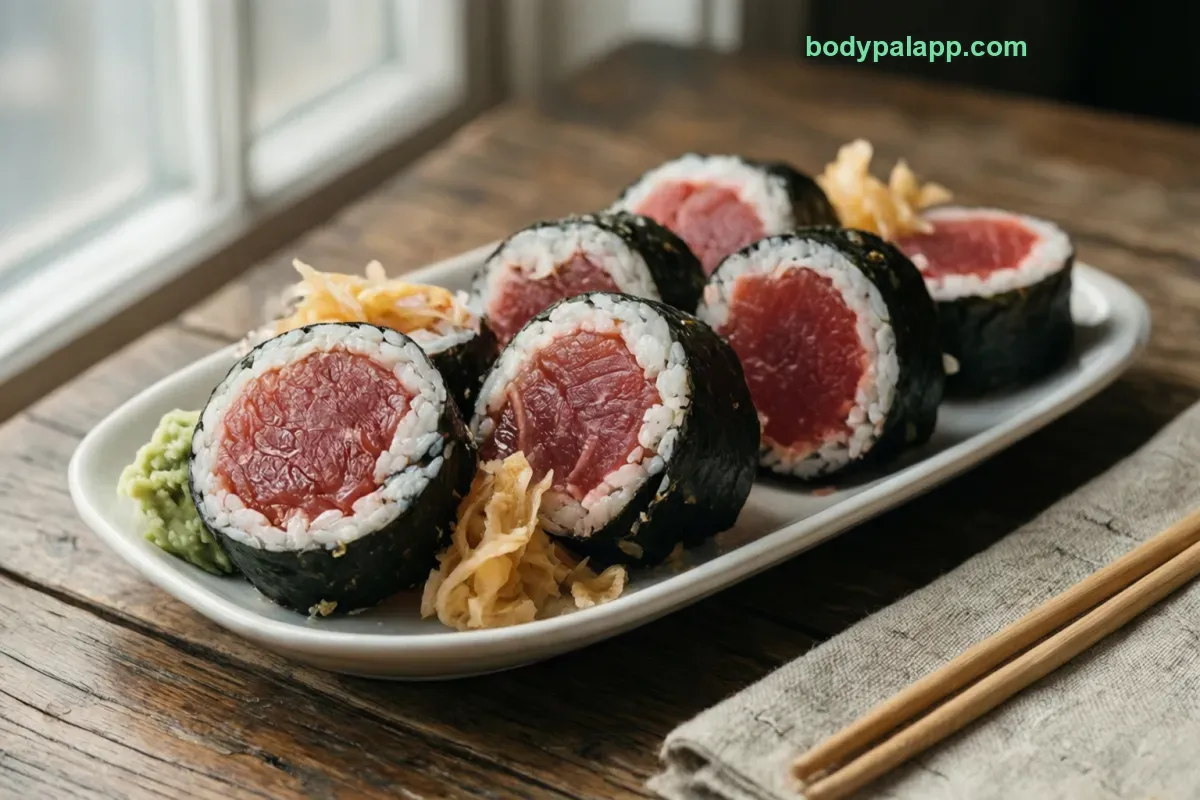
Tuna sushi roll calories come to 175 for one 180 g roll of 6 pieces, or 97 per 100 g. That is 9% of a 2000-calorie day with 13.3 g of protein attached. The catch is sodium: one roll carries 616 mg, 27% of the daily value, and that is before you add any dip.
175kcal
1 roll of 6 pieces · 180 g, tuna maki, 6 pieces
32%protein
13.3 gProtein
28 gCarbs
0.5 gFat
How to burn off 175 kcal
—Walking, brisk
—Jogging
—Cycling, moderate
—Swimming
Skip the math. BodyPal counts these calories from your steps and workouts automatically.
Nutrition facts
Tuna maki, 6 pieces · per 180 g
Calories
175 kcal
Protein
13.3 g
Carbohydrate
28 g
Fat
0.5 g
Saturated fat
0.1 g
Cholesterol
18 mg
Sodium
616 mg
Potassium
214 mg
Iron
0.6 mg
Source: USDA FoodData Central
🛡️
Verified nutrition data
Numbers on this page come from USDA FoodData Central, the U.S. Department of Agriculture’s food composition database, and from manufacturer labels where a branded product is named. Last verified September 2026. How we verify our data →
Tuna sushi roll: calories, protein and sodium by serving
Percent of daily value uses the FDA reference of 2,000 kcal a day.
Serving
kcal
Protein
Carbs
Fat
Sodium
% DV kcal
1 roll (180 g)
175
13.3 g
27.5 g
0.5 g
616 mg
9%
1 piece (30 g)
29
2.2 g
4.6 g
0.1 g
103 mg
1%
100 g
97
7.4 g
15.3 g
0.3 g
342 mg
5%
3 × 1 roll (180 g)
524
40 g
1,847 mg
5 × 1 roll (180 g)
873
66.6 g
3,078 mg
One roll is 175 calories, three are 524
A standard tuna maki is cut into 6 pieces and weighs about 180 g, which comes to 175 calories. That is 9% of a 2000-calorie day, a modest number for something that eats like a light meal. A single piece is about 30 g and 29 calories, so counting pieces is the simplest way to log a shared platter.
Rolls are where the total moves. Two rolls (360 g) come to 349 calories, three rolls (540 g) reach 524, and five rolls (900 g) land at 873. Sushi is easy to order in multiples because each roll looks small on the plate. If your usual order is two or three rolls, the honest figure sits between 349 and 524, not at 175.
Protein climbs in step with calories. Two rolls give 26.6 g, three give 40 g, and five give 66.6 g. Few takeout meals scale that cleanly, which makes tuna rolls easy to plan around once you know your count.
Rice supplies two thirds of the calories
Tuna sounds like a protein food, but the roll is mostly rice. Carbs supply 66% of the calories, protein 32% and fat just 3%. Per 100 g that works out to 15.3 g of carbs, 7.4 g of protein and 0.3 g of fat.
Per roll, you get 27.5 g of carbs, 13.3 g of protein and only 0.5 g of fat. The protein covers 27% of the daily value, a solid share for 175 calories. Lean tuna keeps the fat line near zero: saturated fat is 0.1 g per 100 g and cholesterol is 10 mg.
Sugar is low at 1.7 g per roll, and fiber is modest at 1.3 g. The rice is the energy source here, so the roll behaves more like a light rice dish with a protein topping than a fish plate. If carbs are what you track, count the roll as a starch serving first and the protein as a bonus.
Sodium is the row to watch
One roll carries 616 mg of sodium, 27% of the daily value, for only 9% of the day's calories. That gap is the real story of this food. Per 100 g it is 342 mg, and a single piece holds 103 mg, or 4% of the daily value.
Multiples push the number up quickly. Two rolls bring 1,231 mg, three bring 1,847 mg, and five reach 3,078 mg, well past the 2300 mg daily value. These figures count the roll alone, before any dipping sauce goes on.
If you watch sodium, the roll count matters more than the fish inside. Keeping the order to one or two rolls and going easy on the dip leaves room in the rest of the day. Potassium is modest at 119 mg per 100 g, so the roll is not a meaningful source of it either.
Pair a roll with vegetables, not a second roll
At 175 calories and 13.3 g of protein, one tuna roll is a light lunch on its own and a thin dinner. The usual move is to add another roll, which doubles both the calories and the sodium. A vegetable side adds volume without adding more rice.
Since rice already supplies most of the calories, the gaps are fiber and fat. A side salad or steamed greens help the fiber line, which sits at only 1.3 g per roll. If you want the meal to feel bigger, a second protein dish does more than a second roll of rice.
BodyPal can log the roll from a photo, which helps when a platter mixes several rolls and you lose count of pieces. Counting pieces at 29 calories each keeps the total honest even when the plate is shared.
How does tuna sushi roll compare?
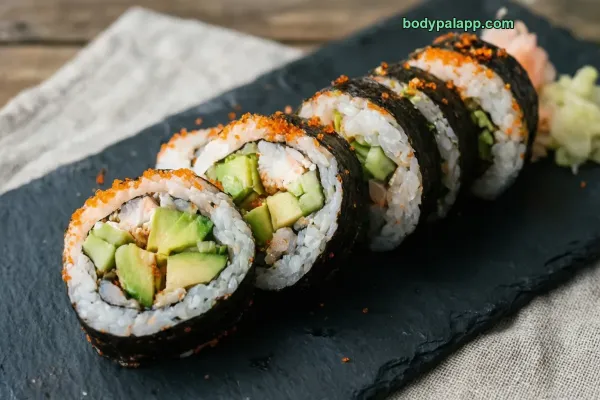
Here is how a tuna roll stacks up against salmon, veggie and California rolls, per 100 g and per usual serving.
Verdict: For protein per bite the tuna roll wins, beating salmon's 6.9 g, California's 2.9 g and veggie's 1.8 g of protein per 100 g. The veggie roll is the lightest plate at 123 calories, but salmon at 185 costs more calories for less protein, so tuna is the better everyday order.
Tuna sushi roll FAQs
How many calories are in one tuna sushi roll?
About 175 calories in a 6-piece tuna roll (180 g), or 29 calories per piece (30 g).
Is a tuna sushi roll good for weight loss?
A 6-piece tuna roll has 175 calories, 13.3 g of protein and 0.5 g of fat. It also carries 616 mg of sodium.
Tuna roll vs salmon roll: which has fewer calories?
The tuna roll has 97 calories per 100 g and the salmon roll 103, so a 180 g roll is about 175 calories for tuna versus 185 for salmon.
How much protein and carbs are in a tuna sushi roll?
A 6-piece roll (180 g) has 13.3 g of protein and 27.5 g of carbs, mostly from the rice. Per 100 g that is 7.4 g protein and 15.3 g carbs.
How many calories are in one piece of tuna sushi?
One piece of a tuna roll is about 30 g and 29 calories, with 2.2 g of protein and 103 mg of sodium. Six pieces make a full 180 g roll at 175 calories.
Are tuna roll calories counted for all 6 pieces?
Yes. The standard tuna roll here is 6 pieces weighing 180 g, which comes to 175 calories. If your roll is cut differently or runs larger, weigh it and use the 97 calories per 100 g figure.
How many calories does tuna sushi have per 100 grams?
Tuna sushi roll has 97 calories per 100 g, with 15.3 g of carbs, 7.4 g of protein and 0.3 g of fat. That figure lets you log a roll of any size by weight.
How much protein do two or three tuna rolls give?
Two tuna rolls give 26.6 g of protein for 349 calories, and three give 40 g for 524 calories. One roll alone provides 13.3 g, which is 27% of the daily value.
How many calories are in five tuna rolls?
Five tuna rolls (900 g) come to 873 calories and 3,078 mg of sodium. That sodium is above the 2300 mg daily value, so the number of rolls matters more than the calories alone suggest.