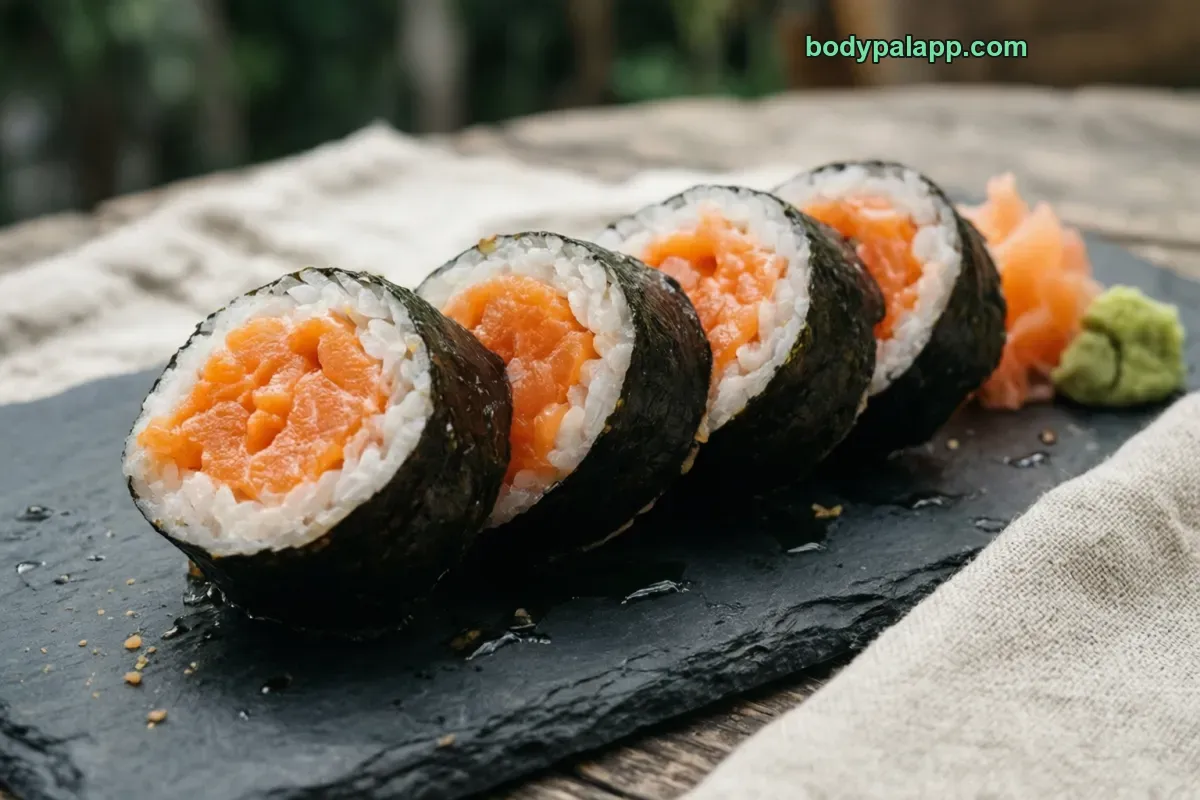
Salmon sushi roll calories come to 185 for one roll of 6 pieces (180 g), or 103 per 100 g. Each piece is about 31 calories. The number to notice is sodium: one roll carries 630 mg, 27% of the daily value, before any soy sauce touches it.
185kcal
1 6-piece roll · 180 g, ready-to-eat
27%protein
12.4 gProtein
28 gCarbs
2.3 gFat
How to burn off 185 kcal
—Walking, brisk
—Jogging
—Cycling, moderate
—Swimming
Skip the math. BodyPal counts these calories from your steps and workouts automatically.
Nutrition facts
Ready-to-eat · per 180 g
Calories
185 kcal
Protein
12.4 g
Carbohydrate
28 g
Fat
2.3 g
Saturated fat
0.4 g
Cholesterol
22 mg
Sodium
630 mg
Potassium
182 mg
Iron
0.4 mg
Source: USDA FoodData Central
🛡️
Verified nutrition data
Numbers on this page come from USDA FoodData Central, the U.S. Department of Agriculture’s food composition database, and from manufacturer labels where a branded product is named. Last verified September 2026. How we verify our data →
Salmon sushi roll: calories, protein and sodium by serving
Percent of daily value uses the FDA reference of 2,000 kcal a day.
Serving
kcal
Protein
Carbs
Fat
Sodium
% DV kcal
1 roll, 6 pieces (180 g)
185
12.4 g
27.5 g
2.3 g
630 mg
9%
1 piece (30 g)
31
2.1 g
4.6 g
0.4 g
105 mg
2%
100 g
103
6.9 g
15.3 g
1.3 g
350 mg
5%
3 × 1 roll, 6 pieces (180 g)
556
37.2 g
1,890 mg
5 × 1 roll, 6 pieces (180 g)
927
61.9 g
3,150 mg
One roll is 185 calories, three is 556
The standard serving is one roll cut into 6 pieces, 180 g in total, at 185 calories. That is 9% of a 2000-calorie daily value, light enough to count as a modest lunch on its own. Each 30 g piece adds about 31 calories, so counting pieces works just as well as counting rolls.
Totals climb fast once rolls start stacking up on the plate. Two rolls come to 371 calories and three reach 556. A party platter of 5 rolls, 900 g of sushi, lands at 927 calories, which is the size of a large restaurant dinner rather than a light bite.
Protein scales along with it. One roll gives 12.4 g, 25% of the daily value; two rolls give 24.8 g and three give 37.2 g. If you want sushi to work as a filling meal rather than a snack, two rolls is where the protein starts to look like a real serving, and the bill is still only 371 calories.
Rice supplies most of the calories
The name says salmon, but the calorie split says rice. Carbs make up 61% of the calories, protein 27% and fat just 11%. Per 100 g that works out to 15.3 g of carbs, 6.9 g of protein and 1.3 g of fat.
Over a full roll, that adds up to 27.5 g of carbs, 12.4 g of protein and 2.3 g of fat. Sugars stay low at 1.7 g per roll, and saturated fat barely registers at 0.2 g per 100 g. Cholesterol sits at 12 mg per 100 g. This is a lean, starch-led food, not a fatty fish dish.
Fiber is the weak spot. One roll gives 1.3 g, and per 100 g it is only 0.7 g, because the rice is white and the filling is fish. Potassium is modest too, at 101 mg per 100 g. The roll fills you mostly through volume and protein, not through fiber.
Sodium is the row to watch
At 350 mg per 100 g, sodium is the number that stands out on this label. One roll carries 630 mg, 27% of the daily value, while supplying only 9% of daily calories. Even a single piece has 105 mg, or 5% of the daily value.
That gap widens as the order grows. Two rolls reach 1,260 mg and three hit 1,890 mg. A platter of 5 rolls carries 3,150 mg, more than a full day's daily value in one sitting, and that is with no dipping at all.
These figures cover the roll itself, taken from the USDA entry for a salmon sushi roll. Soy sauce, pickled ginger and other dips are not counted, and soy sauce in particular is salty. If you watch sodium, dip lightly or skip the sauce, and treat one roll as the portion rather than the starting point.
Pair it with vegetables, not more rice
One roll at 185 calories leaves plenty of room in a meal. The gap is fiber and vegetables, since the roll brings only 1.3 g of fiber. A cucumber salad, a green salad or steamed edamame adds volume and plant fiber without piling on more starch.
Miso soup is the classic partner, but it adds sodium on top of the 630 mg already in the roll. If sodium matters to you, pick one salty side, not several. Plain green tea or water keeps the drink side of the meal simple.
For a bigger appetite, a second salmon roll is a predictable move, because you know exactly what it adds: two rolls total 371 calories and 24.8 g of protein. BodyPal can log the roll from a photo, which helps when a platter is shared and the pieces are hard to keep track of.
How does salmon sushi roll compare?
Here is how the salmon sushi roll stacks up against tuna, salmon maki and California rolls, per 100 g and per usual serving.
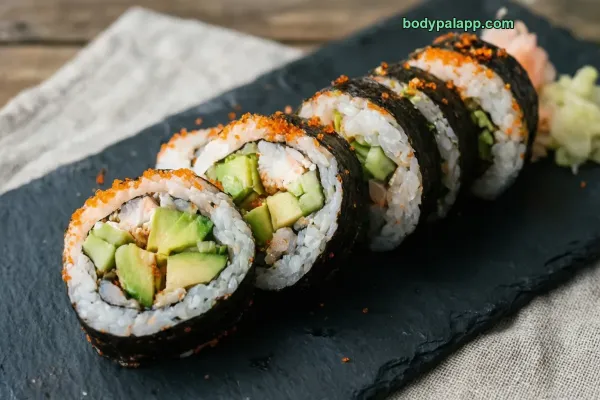
Verdict: For the fewest calories pick the California roll at 169 per serving, but for protein the tuna sushi roll wins with 7.4 g per 100 g against just 2.9 g in the California roll. Salmon at 185 costs only a little more than tuna at 175 and brings the fat tuna lacks, 1.3 g versus 0.3 g per 100 g, so choose it when flavor and fullness matter more than the last few calories.
Salmon sushi roll FAQs
How many calories are in a salmon sushi roll?
About 185 calories for a 6-piece roll (180 g), or 31 calories per piece (30 g).
Is a salmon sushi roll good for weight loss?
It has 103 calories per 100 g with 1.3 g of fat and 6.9 g of protein, so a 6-piece roll comes to 185 calories.
Salmon roll vs tuna roll: which has fewer calories?
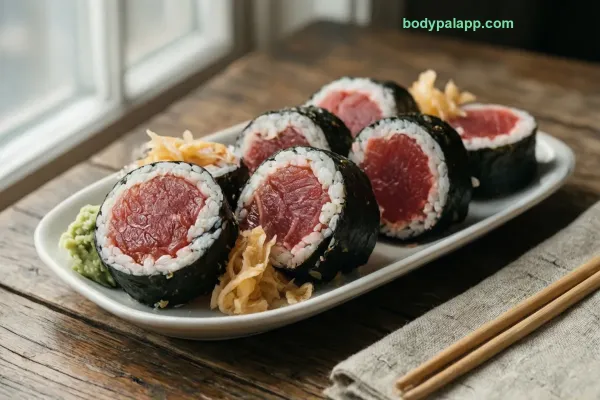
A tuna roll has 97 calories per 100 g versus 103 for salmon, so a 180 g roll is 175 vs 185 calories. Tuna also has less fat, 0.26 g vs 1.28 g per 100 g.
How much protein is in a salmon sushi roll?
A 6-piece roll (180 g) has 12.4 g of protein and 27.5 g of carbs, mostly from the rice.
How many calories are in one piece of salmon sushi?
One piece of salmon sushi roll (30 g) has about 31 calories. It also carries 2.1 g of protein, 4.6 g of carbs and 105 mg of sodium, so a 6-piece roll lands at 185 calories.
How many calories are in salmon maki?
Salmon maki has 185 calories per roll of 6 pieces (180 g), or 103 per 100 g. That matches the salmon sushi roll exactly, since maki is simply the Japanese name for this rolled style.
How many of the calories in salmon sushi come from the rice?
Carbs supply 61% of the calories in a salmon sushi roll, and the rice is where they come from. One roll holds 27.5 g of carbs against 12.4 g of protein and 2.3 g of fat.
What are the nutrition facts for a salmon sushi roll?
One salmon sushi roll (180 g) has 185 calories, 12.4 g of protein, 27.5 g of carbs and 2.3 g of fat. It also has 630 mg of sodium, 1.3 g of fiber and 1.7 g of sugars.