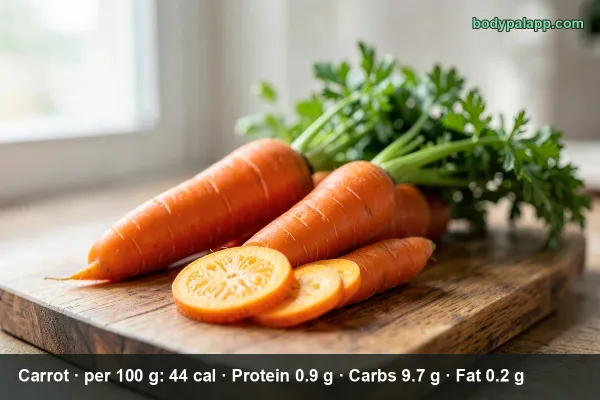
Baby carrots calories come to 30 for a 3 oz serving (85 g) and 35 per 100 g, or about 4 for a single medium carrot. Carbs supply 90% of those calories, yet the totals stay tiny because so much of each carrot is water and fiber. Even a big handful barely registers in a day's count.
4kcal
1 medium baby carrot · 10 g, raw
7%protein
0.1 gProtein
1 gCarbs
0 gFat
How to burn off 4 kcal
—Walking, brisk
—Jogging
—Cycling, moderate
—Swimming
Skip the math. BodyPal counts these calories from your steps and workouts automatically.
Nutrition facts
Raw · per 10 g
Calories
4 kcal
Protein
0.1 g
Carbohydrate
0.8 g
Fat
0 g
Saturated fat
0 g
Cholesterol
0 mg
Sodium
8 mg
Potassium
24 mg
Iron
0.1 mg
Source: USDA FoodData Central
🛡️
Verified nutrition data
Numbers on this page come from USDA FoodData Central, the U.S. Department of Agriculture’s food composition database, and from manufacturer labels where a branded product is named. Last verified October 2026. How we verify our data →
Baby carrots: calories, protein and sodium by serving
Percent of daily value uses the FDA reference of 2,000 kcal a day.
Serving
kcal
Protein
Carbs
Fat
Sodium
% DV kcal
1 medium (10 g)
4
0.1 g
0.8 g
0 g
8 mg
0%
1 large (15 g)
5
0.1 g
1.2 g
0 g
12 mg
0%
3 oz serving (85 g)
30
0.5 g
7 g
0.1 g
66 mg
1%
100 g
35
0.6 g
8.2 g
0.1 g
78 mg
2%
3 × 1 medium (10 g)
11
0.2 g
23 mg
5 × 1 medium (10 g)
18
0.3 g
39 mg
Five baby carrots are an 18-calorie snack
One medium baby carrot weighs about 10 g and carries 4 calories. A large one at 15 g reaches 5. Two medium carrots come to 7 calories, three come to 11, and five, a typical small handful, come to 18. The numbers climb so slowly that counting individual carrots is mostly a formality.
The standard 3 oz serving (85 g) is roughly what fits in a snack bag, and it lands at 30 calories. That is 1% of the daily value for calories. A full 100 g, which is about ten medium carrots, is 35 calories and 2% of the daily value. Few foods let you eat this much volume for so little.
The practical takeaway: weigh portions of almost anything else on your plate before you worry about baby carrots. If you snack straight from the bag, the difference between a light and a heavy handful is a few calories, not a few hundred.
Carbs are 90% of the calories, and that is fine
Per 100 g, baby carrots hold 8.2 g of carbs, 0.6 g of protein and 0.1 g of fat. Run that through the calorie split and carbs account for 90% of the energy, protein for 7% and fat for 3%. This is a carbohydrate food in the plainest sense.
But the carb number needs context. Of those 8.2 g, 2.9 g is fiber and 4.8 g is sugar, the natural sweetness you taste in a crisp carrot. A 3 oz serving carries 7 g of carbs, 4 g of sugars and 2.5 g of fiber. The sugar is real, yet in absolute terms it is small.
Protein is close to absent: 0.5 g per 3 oz serving, about 1% of the daily value. Fat is effectively zero, and saturated fat and cholesterol both read 0. Baby carrots add crunch and volume to a meal; they will not carry its protein or keep you full for hours on their own.
Fiber does the heavy lifting, sodium stays low
Fiber is the row that makes baby carrots worth eating in quantity. A 3 oz serving delivers 2.5 g, measured against a daily value of 28 g, while costing only 30 calories. Few snacks give you that much fiber per calorie.
Sodium is modest. Baby carrots carry 78 mg per 100 g and 66 mg per 3 oz serving, which is 3% of the 2300 mg daily value. That sodium is naturally present; nothing is added in the cut-and-peel process reflected here. If you watch sodium, the carrots are not your problem. The dip or dressing next to them usually is.
Potassium sits at 237 mg per 100 g, a useful contribution against a daily value of 4700 mg. Put together, the micronutrient rows show a food that adds a little of several things and very little of anything you would want to limit.
What you dip them in decides the total
On their own, baby carrots rarely move a calorie budget. The swing comes from what goes with them. Ranch, hummus, peanut butter or a cheese dip can easily outweigh the carrots themselves, so if you track closely, log the dip as its own item and measure it.
Because they bring almost no protein or fat, baby carrots pair well with foods that do. A protein-rich dip, a few slices of cheese or a hard-boiled egg turns a bag of carrots into a snack that lasts longer. As a side at lunch, a 3 oz portion adds crunch and fiber for 30 calories.
Brands like Bunny-Luv, Grimmway Farms, Cal-Organic Farms and Bolthouse Farms all sell cut and peeled baby carrots, and the plain product varies little from bag to bag. If you would rather not weigh them, BodyPal can log baby carrots from a photo of your plate.
How does baby carrots compare?
Here is how baby carrots stack up against whole, stick-cut and cooked carrots, per 100 g and per usual serving.
Verdict: For the fewest calories per bite, baby carrots and cooked carrots tie at 35 per 100 g, while whole carrots run 44 and carrot sticks 41. The differences are small enough that convenience should decide: grab baby carrots for snacking, and pick a half cup of cooked carrots at 27 calories when you want them warm on the plate.
Most popular baby carrots brands in the United States
A medium baby carrot (10 g) has about 4 calories, and a large one (15 g) has about 5.
Are baby carrots good for weight loss?
Baby carrots have 35 calories and 2.9 g of fiber per 100 g, so a 3 oz serving (85 g) comes to 30 calories.
Baby carrots vs regular carrots: which has fewer calories?
Per 100 g, raw baby carrots have 35 calories and raw regular carrots 44. One baby carrot (10 g) is about 4 calories, one regular carrot (60 g) about 26.
How much sugar is in baby carrots?
A 3 oz serving (85 g) has 4.0 g of sugar and 7.0 g of carbs, including 2.5 g of fiber. Per 100 g that is 4.8 g of sugar.
How many calories are in a handful of baby carrots?
A handful of baby carrots has about 18 to 30 calories. Five medium carrots (50 g) come to 18 calories, while a heaping handful closer to a 3 oz serving (85 g) reaches 30.
How many calories are in 10 baby carrots?
Ten medium raw baby carrots have about 35 calories. At roughly 10 g each, they add up to about 100 g, which carries 35 calories, 8.2 g of carbs and 2.9 g of fiber.
How many calories are in five baby carrots?
Five medium baby carrots have 18 calories. They weigh about 50 g together and carry 39 mg of sodium and 0.3 g of protein, so the snack is mostly water, fiber and natural sugar.
How many calories are in 11 baby carrots?
Eleven medium baby carrots come to a little more than 35 calories. Each medium carrot weighs about 10 g and carries 4 calories, and 100 g of baby carrots has 35 calories.
How much fiber is in a serving of baby carrots?
A 3 oz serving (85 g) of baby carrots has 2.5 g of fiber for 30 calories. Per 100 g, the fiber rises to 2.9 g, measured against a daily value of 28 g.