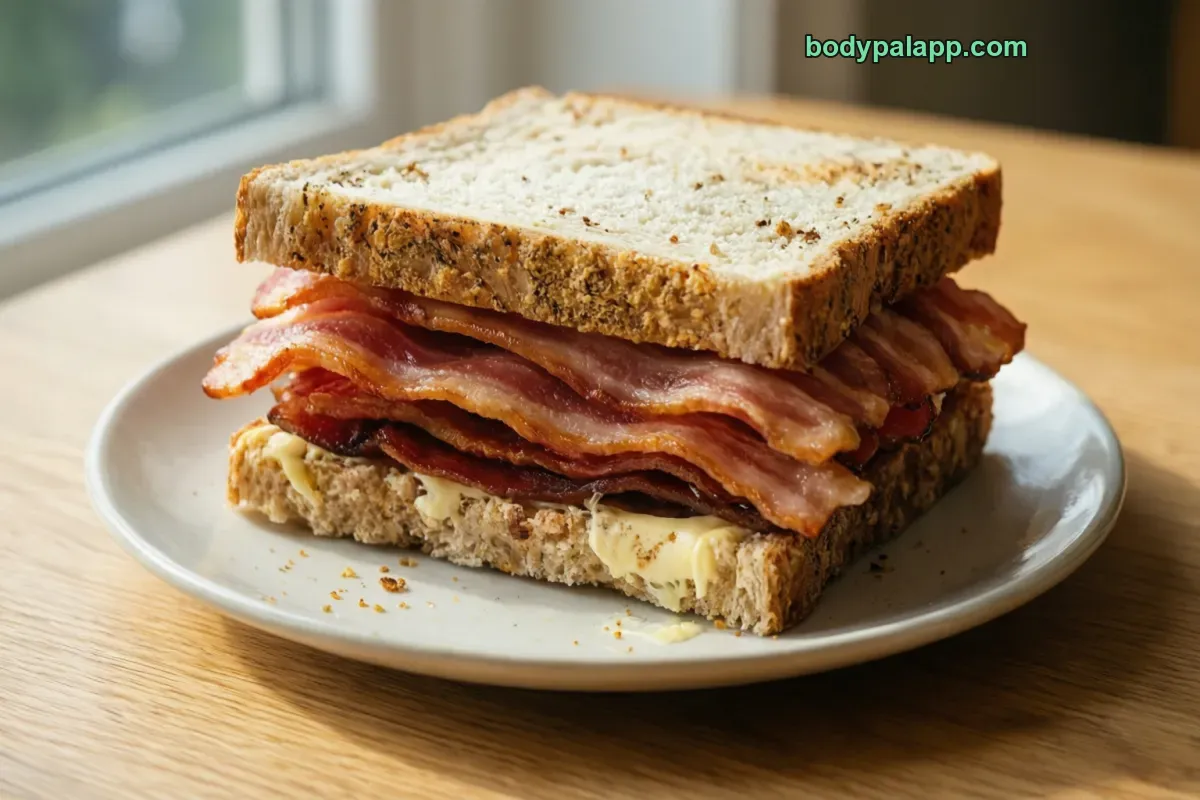
Bacon sandwich calories come to 401 for a regular biscuit sandwich (105 g) and 382 per 100 g. Fat supplies 55% of those calories, and the same sandwich carries 1,145 mg of sodium, which is 50% of the daily value before anything else lands on your plate.
401kcal
1 sandwich · 105 g, bacon on a biscuit
14%protein
14.4 gProtein
31 gCarbs
24 gFat
How to burn off 401 kcal
—Walking, brisk
—Jogging
—Cycling, moderate
—Swimming
Skip the math. BodyPal counts these calories from your steps and workouts automatically.
Nutrition facts
Bacon on a biscuit · per 105 g
Calories
401 kcal
Protein
14.4 g
Carbohydrate
31 g
Fat
24 g
Saturated fat
13.4 g
Cholesterol
35 mg
Sodium
1145 mg
Potassium
200 mg
Iron
2.1 mg
Source: USDA FoodData Central
🛡️
Verified nutrition data
Numbers on this page come from USDA FoodData Central, the U.S. Department of Agriculture’s food composition database, and from manufacturer labels where a branded product is named. Last verified September 2026. How we verify our data →
Bacon sandwich: calories, protein and sodium by serving
Percent of daily value uses the FDA reference of 2,000 kcal a day.
Serving
kcal
Protein
Carbs
Fat
Sodium
% DV kcal
Regular biscuit (105 g)
401
14.4 g
30.7 g
24.4 g
1,145 mg
20%
Large biscuit (160 g)
611
21.9 g
46.8 g
37.1 g
1,744 mg
31%
100 g
382
13.7 g
29.3 g
23.2 g
1,090 mg
19%
3 × Regular biscuit (105 g)
1,203
43.2 g
3,434 mg
5 × Regular biscuit (105 g)
2,006
72 g
5,723 mg
A large biscuit pushes it to 611 calories
The numbers here describe bacon on a biscuit, the USDA row for a bacon biscuit sandwich. A regular biscuit version weighs 105 g and comes to 401 calories, or 20% of the daily value for energy. That is a reasonable breakfast on paper. The trouble is that biscuit sizes vary a lot, and the bigger ones are common.
Step up to a large biscuit (160 g) and the total climbs to 611 calories, 31% of the daily value. Protein rises to 21.9 g, which sounds good, but fat rises to 37.1 g and sodium to 1,744 mg, or 76% of the daily value. The extra 55 grams of bread and bacon cost you about half again as many calories as the regular size.
Doubling up is where it gets heavy. Two regular sandwiches add up to 802 calories and 2,289 mg of sodium, which is close to a full day's sodium allowance in one sitting. Three come to 1,203 calories and 3,434 mg of sodium. If you are tracking, weigh the biscuit or at least note which size you ordered, because the label on the wrapper rarely tells you.
Fat is more than half of every bite
Look at the calorie split and the story is clear: 55% of the energy comes from fat, 31% from carbs and only 14% from protein. Per 100 g that is 23.2 g of fat, 29.3 g of carbs and 13.7 g of protein. The biscuit dough is rich in fat on its own, and the bacon adds more on top, so this is not a lean sandwich in any version.
Saturated fat is the part of that fat to notice. At 12.7 g per 100 g, a single 100 g portion uses more than half of the 20 g daily value. Nearly all the rest of the fat story follows the same direction, which is why the sandwich feels filling but leaves little room for butter, cheese or a fried egg on the same day.
The carbs are mostly refined flour. Fiber is just 1.6 g per 100 g and sugars only 3.1 g, so the biscuit is not sweet, but it does little to slow digestion. The protein is real, at 14.4 g in a regular sandwich, or 29% of the daily value. It simply arrives wrapped in a lot of fat.
Sodium is the row to watch
Cured bacon and salted biscuit dough stack up fast. Per 100 g this sandwich has 1,090 mg of sodium, already 47% of the daily value. A regular biscuit sandwich carries 1,145 mg, exactly half of the 2300 mg reference, and the large one reaches 1,744 mg.
That matters because breakfast is rarely the only salty meal of the day. If lunch is a deli sandwich or soup, a single bacon biscuit can push you over the daily value before dinner. Two regular sandwiches at 2,289 mg nearly cover the full reference by themselves, and five would reach 5,723 mg.
Other rows look calmer. Cholesterol is modest at 33 mg per 100 g against a 300 mg daily value, and potassium sits at 190 mg per 100 g. If you watch sodium, the practical move is to keep the rest of the meal unsalted: fresh fruit, plain yogurt or water instead of a salty side like hash browns. Skipping extra cheese or a salted spread on the biscuit also helps, since each layer brings its own sodium.
It works best as a planned treat, not a habit
At 401 calories a regular bacon biscuit fits most days if you plan for it. The catch is what it lacks. With 1.7 g of fiber per sandwich against a 28 g daily value, it does almost nothing for your fiber intake, and it brings little in the way of vegetables or fruit.
Pairing fixes much of that. Add a piece of fruit, a handful of berries or a side of sliced tomato, and you get volume and fiber for very few calories. Black coffee or tea keeps the drink from adding to the total. If you want more protein without more fat, a glass of milk or a cup of plain yogurt does the job better than a second sandwich.
The bigger risk is portion creep. The regular size and the large size look similar on a tray, yet the gap is 210 calories. Order the regular, and treat the large one as a full meal rather than a snack. If you log meals, BodyPal can log a bacon sandwich from a photo, which makes it easier to catch which size you actually ate.
How does bacon sandwich compare?
Here is how the bacon biscuit sandwich stacks up against a sub, a Reuben and a falafel sandwich, per 100 g and per usual serving.
Verdict: For weight loss pick the sub sandwich: 178 calories and 3.7 g of fat per 100 g, against 382 calories and 23.2 g of fat for the bacon biscuit. If sodium is your concern, the falafel sandwich at 359 mg per 100 g beats this sandwich's 1,090 mg, though its 570-calorie serving is bigger than the regular bacon biscuit's 401.
Bacon sandwich FAQs
How many calories are in a bacon sandwich?
About 401 calories for a regular bacon sandwich on a biscuit (105 g). A large 160 g version has about 611 calories.
Is a bacon sandwich good for weight loss?
A regular bacon sandwich is 401 calories, with about 24.4 g of fat and 14.4 g of protein, so it is fairly energy-dense for a breakfast sandwich.
Bacon sandwich vs reuben sandwich: which has more calories?
A bacon sandwich is 382 calories per 100 g, more than a reuben sandwich at 282 calories per 100 g, a difference of about 100 calories per 100 g.
How much fat is in a bacon sandwich?
A regular 105 g bacon sandwich has about 24.4 g of fat, of which 12.7 g is saturated. Per 100 g that is 23.2 g of fat.
How many carbs are in a bacon sandwich?
A regular bacon biscuit sandwich (105 g) has 30.7 g of carbs, and a large one (160 g) has 46.8 g. Per 100 g it is 29.3 g, with only 3.2 g of sugars in the regular size.
How much protein is in a bacon sandwich?
A regular bacon sandwich on a biscuit gives 14.4 g of protein, 29% of the daily value. The large biscuit version brings 21.9 g, but protein supplies only 14% of the calories.
How many calories does a large bacon sandwich have?
A large bacon biscuit sandwich (160 g) has 611 calories, 31% of the daily value. It also carries 37.1 g of fat and 1,744 mg of sodium, so it eats more like a full meal.
How much sodium is in a bacon sandwich?
A regular bacon biscuit sandwich contains 1,145 mg of sodium, 50% of the daily value. The large size reaches 1,744 mg, or 76%, mostly from cured bacon and salted biscuit dough.
How many calories are in two bacon sandwiches?
Two regular bacon biscuit sandwiches total 802 calories and 2,289 mg of sodium. They also give 28.8 g of protein, but most of the energy still comes from fat.