
How many calories are in a banana?
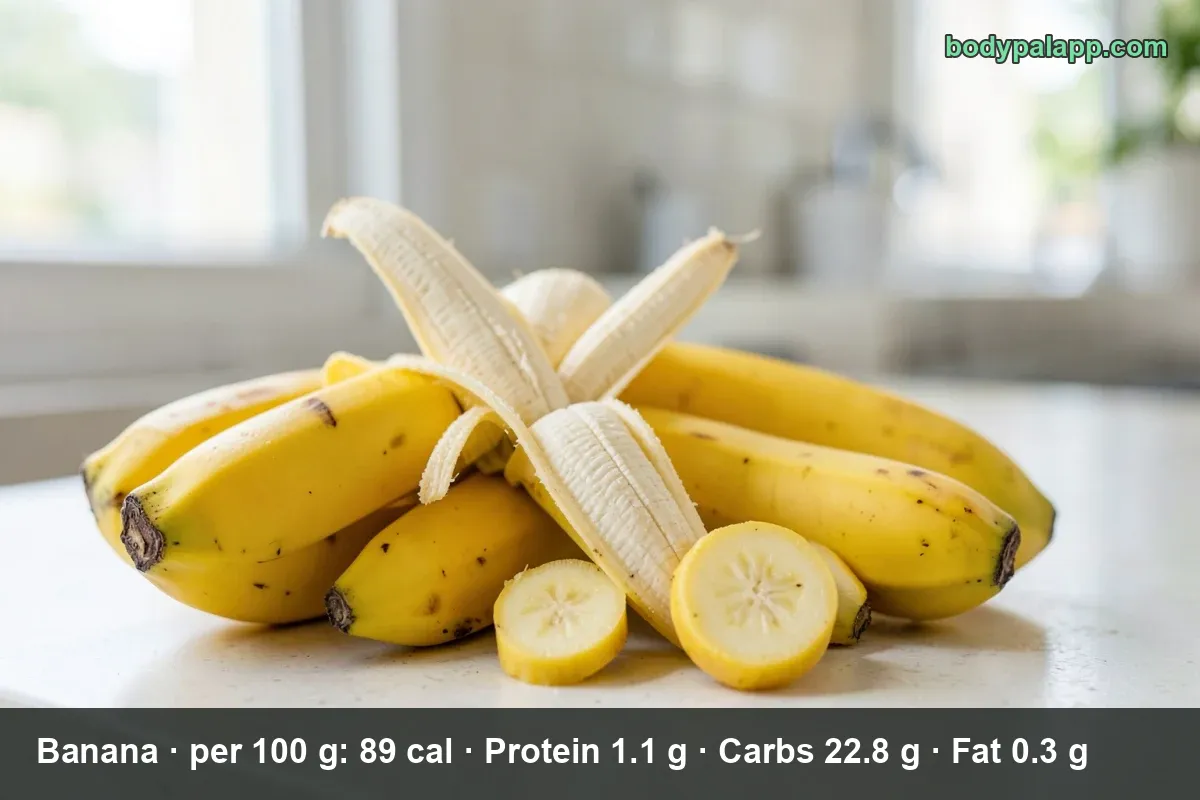
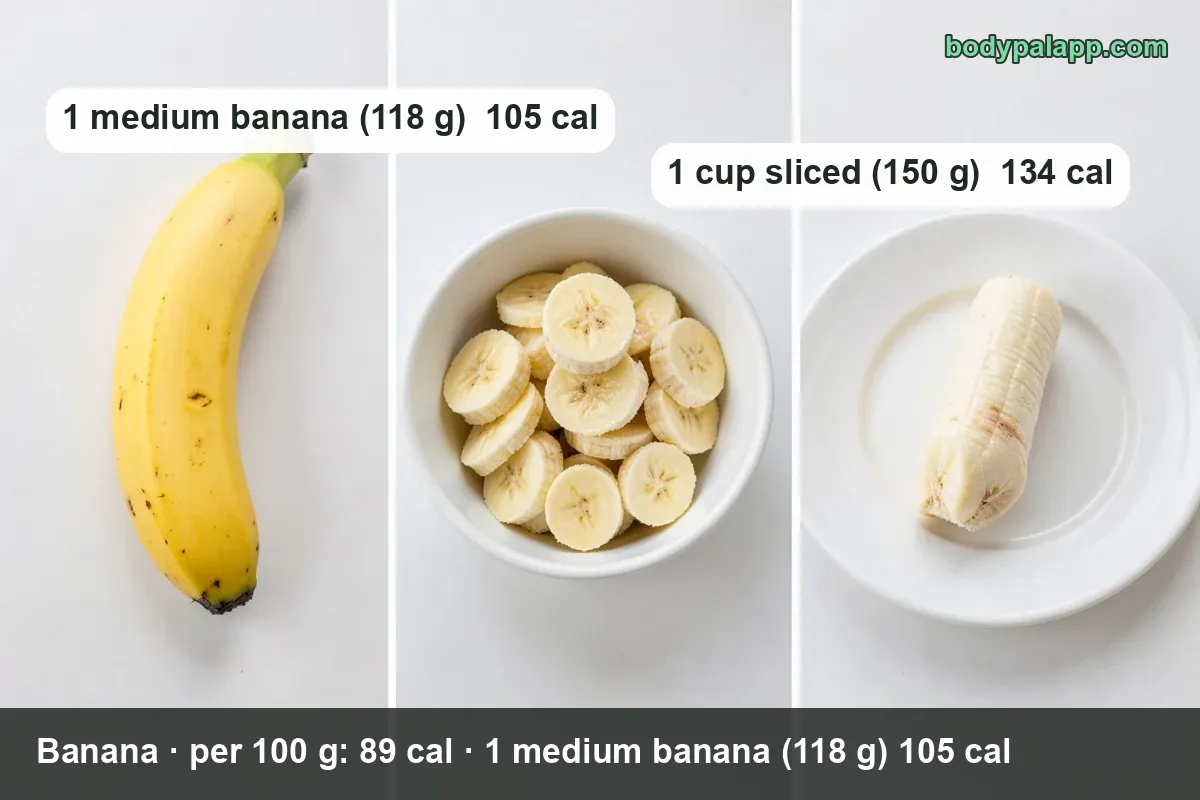
A medium banana weighs 118 g and carries 105 calories. Raw banana runs 89 calories per 100 g, so the peel-and-eat portion most people log sits just above a hundred. A small banana is 90, a large one 121, and a cup of slices lands at 134.
On this page
- Banana quick facts
- US servings from one ounce to a cup of slices
- Ripeness moves the number more than size does
- Baked dried and fried bananas
- Potassium is the row people get wrong
- How does a banana compare?
- FAQ
Banana quick facts
The row on this page is SR Legacy 173944, "Bananas, raw". It is the plain fruit you peel at the counter, and it is the only banana record that carries the full set at once: sugars, fiber, saturated fat, sodium and potassium, plus household measures by fruit size. USDA's newer Foundation samples come in at 97 and 85 calories per 100 g, but they leave sugars and saturated fat blank, so they work as ripeness variants further down rather than as the headline.
Everything in the serving column below is that 89-calorie profile scaled to 118 g, the weight USDA assigns to a medium banana measuring 7 to 7-7/8 inches. The peel is not part of the weight.
| Nutrient | Per 100 g | Per 1 medium banana (118 g) | % Daily Value |
|---|---|---|---|
| Calories | 89 | 105 | — |
| Total fat | 0.33 g | 0.4 g | 0% |
| Saturated fat | 0.11 g | 0.1 g | 1% |
| Carbohydrate | 22.84 g | 27.0 g | 10% |
| Dietary fiber | 2.6 g | 3.1 g | 11% |
| Total sugars | 12.23 g | 14.4 g | — |
| Protein | 1.09 g | 1.3 g | 3% |
| Sodium | 1 mg | 1 mg | 0% |
% Daily Value is based on a 2,000-calorie diet.
Verified nutrition data
Numbers on this page come from USDA FoodData Central, the U.S. Department of Agriculture’s food composition database, and from manufacturer labels where a branded product is named. Last verified September 2026. How we verify our data →
There is no added sugars line in the table because a raw banana has no added sugar and the SR Legacy edition does not publish the field at all. Cholesterol is 0 mg. Potassium is 358 mg per 100 g, which works out to 422 mg in a medium banana, and that number gets its own section below because it is the one most people guess wrong.
US servings from one ounce to a cup of slices
| Serving | Weight | Calories |
|---|---|---|
| 1 oz | 28 g | 25 kcal |
| 1 small banana, 6 to 6-7/8 inches | 101 g | 90 kcal |
| 1 medium banana, 7 to 7-7/8 inches | 118 g | 105 kcal |
| 1 large banana, 8 to 8-7/8 inches | 136 g | 121 kcal |
| 1 cup sliced | 150 g | 134 kcal |
| Per 100 g | 100 g | 89 kcal |
The three fruit sizes and the sliced cup are USDA household measures for record 173944, so those weights are not our guesses. The 1 oz line is our own arithmetic from the USDA 100 g figure, not a USDA serving, and it is there because scale-users log in ounces.
The cup is where banana tracking goes sideways. A cup of slices is 150 g and 134 calories. A cup of mashed banana is a different animal: about 225 g of fruit pressed into the same measuring cup, which comes to roughly 200 calories by our own scaling of the 100 g number. Same word, same cup, 66 calories apart. If a smoothie recipe says "one cup banana" without saying sliced or mashed, log it as one and a half bananas and you will be close.
The gap between the smallest and largest fruit is 31 calories, or about a third of a small banana. That matters more than it sounds for anyone eating one a day.
Ripeness moves the number more than size does
USDA sampled bananas at two stages of ripeness and got two different answers. Neither is wrong. A banana loses moisture and firmness as it browns, and the starch turns into sugar without any energy appearing or disappearing.
| Version | Per 100 g | Typical banana | Calories |
|---|---|---|---|
| Overripe, brown-spotted | 85 kcal | 1 banana peeled, 110 g | 94 kcal |
| Ripe and slightly ripe | 97 kcal | 1 banana peeled, 115 g | 112 kcal |
| Raw, SR Legacy main row | 89 kcal | 1 medium, 118 g | 105 kcal |
Read the spread rather than the individual rows. One banana somewhere between 110 and 118 g is anywhere from 94 to 112 calories depending on which sample it resembles, an 18-calorie band on a single piece of fruit. That is wider than the gap between a small and a medium banana. USDA's survey edition, FNDDS record 2709224, uses the ripe Foundation sample and lists banana at 97 calories per 100 g with 15.8 g of sugars, which is why some apps show 97 while others show 89.
Our position: log 105 for a medium banana and stop there. The 18-calorie band is about the same size as the gap between a medium and a large fruit, 16 calories, and no one weighs fruit twice a day for eighteen calories.
Baked dried and fried bananas
Take the water out or add fat and the banana stops being a 100-calorie snack. These are the versions that catch people who assume the fruit's number travels with the name.
| Version | Per 100 g | Typical piece | Calories |
|---|---|---|---|
| Baked banana | 161 kcal | 1 oz, 28 g | 46 kcal |
| Banana chips | 519 kcal | 1 oz, 28 g | 147 kcal |
| Dried banana or banana powder | 346 kcal | 1 cup, 100 g | 346 kcal |
| Banana nectar | 74 kcal | 1 oz, 28 g | 21 kcal |
Banana chips are the headline. A single ounce is 147 calories, more than a whole medium banana, because the slices are fried in coconut oil: 33.6 g of fat per 100 g, of which 28.97 g is saturated. An ounce of chips carries 8.2 g of saturated fat, which is 41% of the 20 g Daily Value, from a food most people file under "dried fruit." The FDA's Daily Value reference is the yardstick there.
Dried banana without the frying is 346 calories per 100 g, all concentration and no added fat. Baked banana at 161 is the mildest of the three, and its 3.21 g of fat per 100 g tells you the pan was greased. Banana nectar is thinned with water and sugar and lands at 74 per 100 g, below the fresh fruit, which is the only entry on this table that goes down instead of up. The ounce figures are our own scaling from the USDA 100 g values.
Potassium is the row people get wrong
A medium banana delivers 422 mg of potassium. The Daily Value is 4,700 mg, so that is 9%: real, but under the 20% threshold the FDA uses before a food can be labeled "high" in a nutrient. Eleven bananas would cover a day. The fruit's reputation as a potassium bomb comes from it being the potassium food people can name, not from it topping any list.
The quieter number is fiber. A medium banana is 3.1 g, or 11% of the 28 g Daily Value, which beats its own potassium percentage. Sodium is 1 mg, effectively nothing, a rounding error next to a 2,300 mg limit.
On the sugar question: 14.4 g in a medium banana is all naturally occurring, so it does not count against the 50 g Daily Value for added sugars. MyPlate counts one medium banana as one cup from the fruit group, which for most adults is between half and two thirds of the daily fruit target. If you are watching added sugars specifically, the banana is not the thing to cut.
How does a banana compare?
Canned fruit in syrup is the useful comparison here, because gram for gram it lands in the same place and almost nobody expects that.
| Food | Per 100 g | US serving | Calories |
|---|---|---|---|
| Banana, raw | 89 kcal | 1 oz, 28 g | 25 kcal |
| Plums, canned in heavy syrup, drained | 89 kcal | 1 oz, 28 g | 25 kcal |
| Blueberries, canned in light syrup, drained | 88 kcal | 1 oz, 28 g | 25 kcal |
| Figs, canned in heavy syrup | 88 kcal | 1 oz, 28 g | 25 kcal |
The ounce column is our own arithmetic across all four rows, so the comparison is like for like.
Our take: on calories alone the fresh banana has no edge at all. It sits level with drained plums in heavy syrup and one calorie above canned figs and blueberries. What separates them is where the sugar came from and how you eat them. The banana's 12.23 g of sugars per 100 g are the fruit's own, it brings 2.6 g of fiber, and it arrives in a fixed 105-calorie unit with a peel that tells you when to stop. A can does not portion itself. For anyone counting, that packaging is worth more than the one-calorie difference on paper.
Banana FAQs
How many calories are in one banana?
A medium banana of 118 g is 105 calories. Raw banana is 89 calories per 100 g, so the size of the fruit does the work: 90 calories for a small one, 105 for a medium, 121 for a large. The peel is not counted in any of those numbers.
How many calories in a large banana?
A large banana runs 8 to 8-7/8 inches and weighs 136 g peeled, which is 121 calories. That is 16 more than a medium and 31 more than a small. All three come off the same 89 calories per 100 g, so weight is the only thing separating them.
How many carbs are in a banana?
A medium banana holds 27.0 g of carbohydrate, 10% of the Daily Value, and 3.1 g of that is fiber. Per 100 g the figure is 22.84 g. Sugars account for 14.4 g of the medium banana, and the rest is starch and fiber that shifts as the fruit ripens.
How much sugar is in a banana?
A medium banana carries 14.4 g of total sugars, or 12.23 g per 100 g. None of it is added sugar, so it does not count toward the 50 g Daily Value for added sugars. USDA does not publish an added sugars figure for this record because raw fruit has none.
How much potassium is in a banana?
A medium banana gives 422 mg of potassium, which is 9% of the 4,700 mg Daily Value. Per 100 g the figure is 358 mg. It is a useful contribution rather than the megadose the fruit's reputation suggests, and eleven bananas would be needed to cover a full day.
Are bananas good for weight loss?
A medium banana is 105 calories with 3.1 g of fiber, 11% of the Daily Value, and 1 mg of sodium. It fits most calorie targets as a snack, and MyPlate counts it as one cup of fruit. If you are tracking closely, weigh it: the 90 to 121 spread across sizes is real.
Do ripe bananas have more calories than green ones?
Barely: USDA lists ripe banana at 97 calories per 100 g and overripe at 85, with no separate row for green fruit. Ripening converts starch into sugar without adding energy. In practice one banana of 110 to 118 g lands anywhere between 94 and 112 calories.
How many calories in a cup of sliced banana?
One cup of sliced banana weighs 150 g and is 134 calories. Mashed is the trap: a cup of mashed banana packs about 225 g into the same measure and comes to roughly 200 calories by our own arithmetic from the 100 g figure. The density itself never changes.
Similar foods
- Large Banana — 121 cal per large banana
- Pineapple Chunks — 211 cal per cup chunks
- Papaya salad — 190 cal per plate
- Jackfruit — 157 cal per cup, sliced
- Pomegranate — 72 cal for 1/2 cup arils
- Ataulfo Mango — 129 cal per cup diced
Count it without the math
Point the camera at the fruit bowl and BodyPal counts the banana for you, size and all.


How long does it take to burn off a banana?
One medium banana (118 g) is 105 kcal. Enter your weight and the amount you ate to see how long it takes you to burn that off:
lb
| Activity | Time to burn 105 kcal |
|---|---|
| Walking, brisk | 21 min |
| Cycling, moderate | 13 min |
| Swimming, moderate | 15 min |
| Jogging | 12 min |
| Weight training, moderate | 23 min |
Times are for a 155 lb adult at a steady pace; change the weight to see yours. The amount is set to the portion in the text (118 g); change it to what you actually ate. BodyPal works this out from your steps automatically.
This table assumes you know your daily total. If you do not, the daily calorie calculator works it out from five numbers.