
How many calories are in jackfruit?
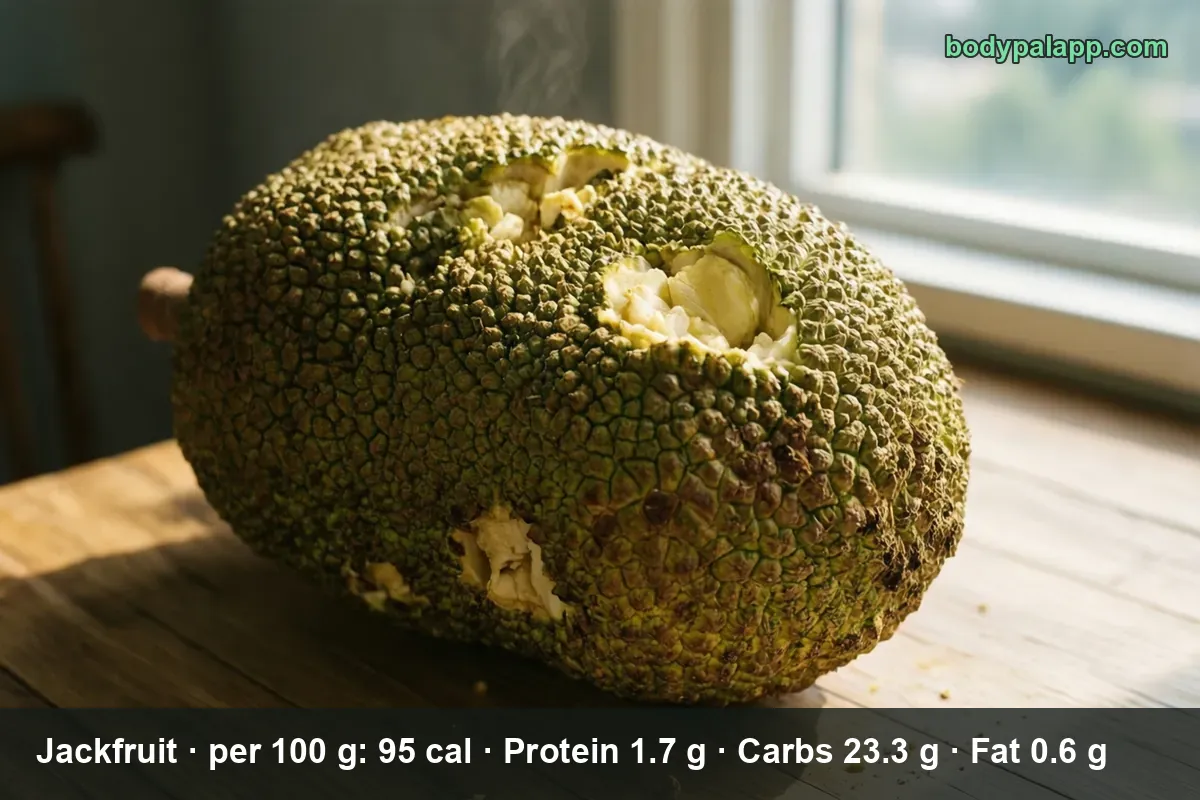
One cup of sliced jackfruit weighs 165 g and carries 157 calories. The fresh yellow bulbs run 95 calories per 100 g, so the fruit is light by the gram and heavy by the cup. Almost all of it is carbohydrate: 38.4 g in that cup, and 31.5 g of it sugar.
On this page
- Jackfruit quick facts
- US servings, from one ounce to a full cup
- Canned, dried, brined and barbecued
- Sugar and potassium are the rows to read
- How does jackfruit compare?
- Most popular jackfruit brands
- FAQ
Jackfruit quick facts
The row below is SR Legacy 174687, "Jackfruit, raw". That is the food most people are actually holding: ripe yellow bulbs pulled out of the rind, or the tub of them sold ready-cleaned in the produce case. It is also the only raw jackfruit record with a full nutrient profile and USDA household measures, so every cup and half-cup figure on this page traces back to it.
Anything sold in a can, a pouch or a bag is a different food with its own record, and those live further down the page. Mixing them into one average would hide exactly the differences that matter.
| Nutrient | Per 100 g | Per 1 cup, sliced (165 g) | % Daily Value |
|---|---|---|---|
| Calories | 95 | 157 | — |
| Total fat | 0.64 g | 1.1 g | 1% |
| Saturated fat | 0.2 g | 0.3 g | 2% |
| Carbohydrate | 23.25 g | 38.4 g | 14% |
| Dietary fiber | 1.5 g | 2.5 g | 9% |
| Total sugars | 19.08 g | 31.5 g | — |
| Protein | 1.72 g | 2.8 g | 6% |
| Sodium | 2 mg | 3 mg | 0% |
% Daily Value is based on a 2,000-calorie diet.
Verified nutrition data
Numbers on this page come from USDA FoodData Central, the U.S. Department of Agriculture’s food composition database, and from manufacturer labels where a branded product is named. Last verified September 2026. How we verify our data →
There is no added sugars row here because the SR Legacy edition never measured that value, and raw fruit flesh has no added sugar to measure. Cholesterol is 0 mg, as it is in every plant food. Potassium is the standout: 448 mg per 100 g, or 739 mg in the cup, which is 16% of the Daily Value.
US servings, from one ounce to a full cup
| Serving | Weight | Calories |
|---|---|---|
| 1 oz | 28.4 g | 27 kcal |
| 1/2 cup, sliced | 82.5 g | 78 kcal |
| 1 cup, 1" pieces | 151 g | 143 kcal |
| 1 cup, sliced | 165 g | 157 kcal |
| Per 100 g | 100 g | 95 kcal |
Two of these are USDA household measures: 1 cup sliced at 165 g and 1 cup of 1-inch pieces at 151 g. The 14 g gap between them is just packing — slices lie flatter in the cup than chunks do — and it is worth 14 calories. The 1 oz and half-cup lines are our own arithmetic from the USDA 100 g figure, not USDA servings.
The practical lesson is that jackfruit rewards weighing. A generous heap logged as "a cup" can drift 20 or 30 calories either side of 157 depending on how you cut it, while 165 g on a scale is 165 g.
Canned, dried, brined and barbecued
| Version | Per 100 g | Typical serving | Calories |
|---|---|---|---|
| Raw, 1" pieces | 95 kcal | 1 cup (151 g) | 143 kcal |
| Canned in syrup, drained | 92 kcal | 1 cup (178 g) | 164 kcal |
| Dried slices | 250 kcal | 1.55 oz bag (44 g) | 110 kcal |
| Young green in brine | 36 kcal | 2 oz (56 g) | 20 kcal |
| Seasoned BBQ pouch | 60 kcal | 2.65 oz (75 g) | 45 kcal |
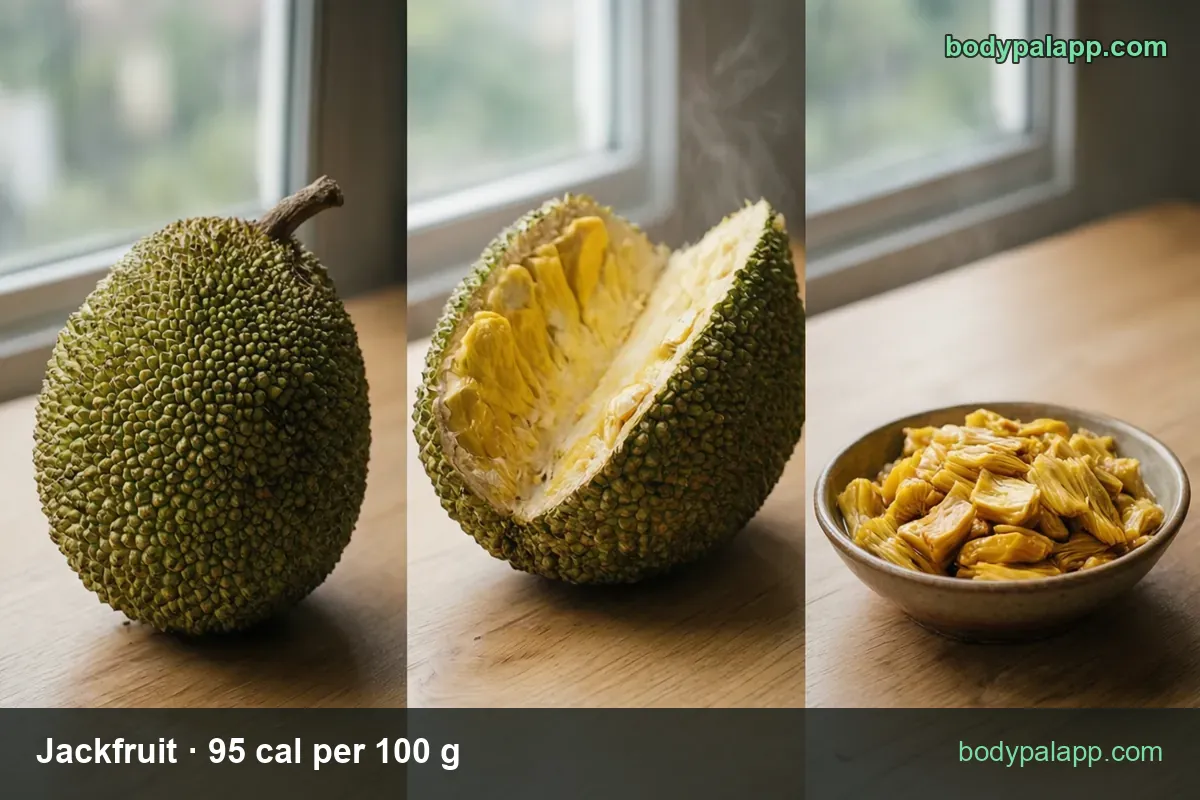
The spread from 36 to 250 per 100 g is the widest thing about this fruit — the dried slices are nearly seven times the brined ones by weight.
Canned in syrup. At 92 calories per 100 g it looks like a wash against the raw 95, and per cup it is 164 against 157. What changes is everything else: protein falls from 1.72 g to 0.36 g per 100 g, fiber from 1.5 g to 0.9 g, sodium climbs from 2 mg to 11 mg, and potassium drops from 448 mg to 96 mg. Syrup has taken the place of some of the fruit.
Dried slices. A 1.55 oz (44 g) bag of dried jackfruit slices is 110 calories at 250 per 100 g. That is the same energy as roughly 116 g of fresh bulbs — our own arithmetic from the 95-calorie figure — so a bag you can finish in two minutes replaces most of a cup you would eat with a fork.
Young green jackfruit. The canned green fruit sold in brine as a meat substitute is a different product from the ripe yellow bulbs: 36 calories per 100 g, 20 in a 2 oz (56 g) portion. It is picked before the sugars develop, which is why it shreds like pork and tastes of almost nothing until it is sauced.
Seasoned pouches. Upton's Naturals sells shelf-stable jackfruit in flavors that land between 33 and 67 calories per 100 g; the BBQ version is 60 per 100 g, or 45 in a 2.65 oz (75 g) pouch, and the plain original is 33. The sauce, not the fruit, is what separates them.
Sugar and potassium are the rows to read
Sugar is the number that surprises people. A cup of ripe jackfruit carries 31.5 g of total sugars, all of it naturally occurring in the fruit — the FDA's Daily Value table sets a limit for added sugars only, and there is no %DV for total sugars, which is why that cell reads "—" above. It still counts toward your day's carbohydrate, and at 38.4 g the cup is 14% of the DV.
Potassium runs the other way. That same cup delivers 739 mg, 16% of the Daily Value, against 3 mg of sodium. If you are watching sodium, fresh jackfruit is about as quiet as food gets; the brined and canned versions are not, and the syrup pack alone takes potassium down to 96 mg per 100 g.
Then there is the protein question, which comes up because jackfruit gets sold as a meat replacement. The cup has 2.8 g, 6% of the DV. Shredded green jackfruit can stand in for pulled pork on texture, but it does not stand in for it nutritionally, so a jackfruit taco needs beans, tofu or something similar alongside it. As a fruit it counts toward the fruit group in MyPlate, which is where it belongs.
How does jackfruit compare?
| Fruit | Per 100 g | US serving | Calories |
|---|---|---|---|
| Jackfruit, raw | 95 kcal | 1 oz, 28.4 g | 27 kcal |
| Sugar-apple (sweetsop), raw | 94 kcal | 1 oz, 28.4 g | 27 kcal |
| Passion fruit, purple, raw | 97 kcal | 1 oz, 28.4 g | 28 kcal |
| Peaches, frozen, sliced, sweetened | 94 kcal | 1 oz, 28.4 g | 27 kcal |
Our take: on calories alone these four are the same food. Three calories separate the lightest from the heaviest per 100 g, and at an ounce apiece they are 27, 27, 28 and 27 — a distinction no one needs to log. What separates them is protein and sugar. Passion fruit and sugar-apple both carry more protein than jackfruit (2.2 g and 2.06 g against 1.72 g per 100 g), and the sweetened frozen peaches are the only one of the four with sugar added at the factory. If you want jackfruit, eat jackfruit; just measure the cup rather than eyeballing it, because that is where the calories actually move.
Most popular jackfruit brands in the United States
Ranked by how widely each product appears among foods sold in the United States, from the BodyPal food database of over 3.3 million products. Calories are the figures printed on each Nutrition Facts label, checked against USDA FoodData Central.
| Product | Calories (per 100 g) |
|---|---|
| Healthy Truth Jackfruit Slices (dried) | 250 cal |
| Upton's Naturals Bar-B-Que Jackfruit | 60 cal |
| Upton's Naturals Original Jackfruit | 33 cal |
| Upton's Naturals Sriracha Jackfruit | 67 cal |
| Upton's Naturals Thai Curry Jackfruit | 53 cal |
| Chef's Choice Young Green Jackfruit in Brine | 36 cal |
Brand popularity: BodyPal food database. Nutrition: manufacturer labels / USDA FoodData Central.
Jackfruit FAQs
How many calories are in 1 cup of jackfruit?
157 calories in 1 cup of sliced raw jackfruit, which USDA weighs at 165 g. A cup of 1-inch pieces packs looser at 151 g and comes to 143 calories. Both trace back to the same raw fruit at 95 calories per 100 g, so the cup you use decides the number.
How much sugar is in jackfruit?
19.08 g of total sugars per 100 g, which works out to 31.5 g in a 165 g cup. All of it occurs naturally in the ripe fruit, so none of it counts as added sugar. That sugar sits inside 38.4 g of total carbohydrate per cup, alongside 2.5 g of fiber.
Is jackfruit high in carbs?
23.25 g of carbohydrate per 100 g, or 38.4 g in a 1-cup serving, which is 14% of the Daily Value. That is high for a fruit and high enough to matter on a low-carb plan. Fiber contributes only 2.5 g of the cup, so most of the total is sugar.
How many calories are in canned jackfruit in syrup?
92 calories per 100 g, or 164 in a drained 178 g cup. Nearly identical to fresh on calories, but not on anything else: protein falls to 0.36 g per 100 g, fiber to 0.9 g, potassium to 96 mg, and sodium rises to 11 mg. The syrup has displaced fruit.
How many calories are in dried jackfruit?
250 calories per 100 g for dried jackfruit slices, and 110 in a 1.55 oz (44 g) bag. Drying removes the water and concentrates everything else, so that small bag matches about 116 g of fresh bulbs by our own arithmetic from the USDA 100 g figure.
Is jackfruit good for weight loss?
At 95 calories per 100 g it is moderate for a fruit, and a 165 g cup costs 157 calories with 2.5 g of fiber. Portion is what decides it: a half cup is 78 calories, a full cup double that. If you are counting closely, weigh it instead of scooping it.
How much potassium is in jackfruit?
448 mg per 100 g, and 739 mg in a 165 g cup, which is 16% of the 4,700 mg Daily Value. That comes with just 3 mg of sodium per cup. Canned syrup-pack jackfruit is far weaker on this point at 96 mg of potassium per 100 g.
Is young green jackfruit lower in calories than ripe jackfruit?
Yes, by a wide margin: canned young green jackfruit in brine is 36 calories per 100 g against 95 for the ripe raw fruit, and a 2 oz (56 g) portion is only 20 calories. It is picked before the sugars develop, which is why it shreds and why it tastes savory.
Similar foods
- Passion Fruit — 17 cal per fruit
- Banana — 105 cal per medium banana
- Large Banana — 121 cal per large banana
- Green Banana — 105 cal per medium banana
- Pineapple Chunks — 211 cal per cup chunks
- Papaya salad — 190 cal per plate
Count it without the math
Point the camera at the bowl and BodyPal counts the bulbs for you, cup or ounce.


How long does it take to burn off jackfruit?
A 1-cup (165 g) serving is 157 kcal. Enter your weight and the amount you ate to see how long it takes you to burn that off:
lb
| Activity | Time to burn 157 kcal |
|---|---|
| Walking, brisk | 31 min |
| Cycling, moderate | 20 min |
| Swimming, moderate | 22 min |
| Jogging | 18 min |
| Weight training, moderate | 35 min |
Times are for a 155 lb adult at a steady pace; change the weight to see yours. The amount is set to the portion in the text (165 g); change it to what you actually ate. BodyPal works this out from your steps automatically.
This table assumes you know your daily total. If you do not, the daily calorie calculator works it out from five numbers.