
How Many Calories Are in Papaya Salad?
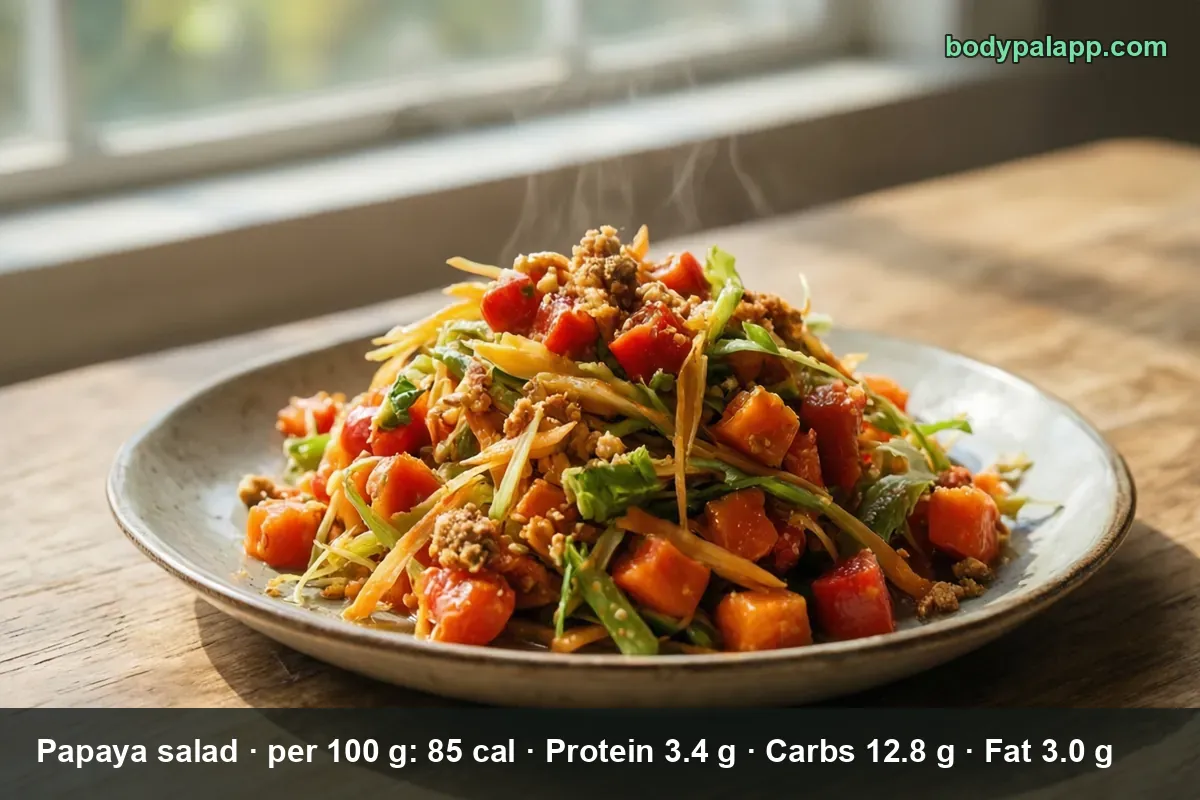
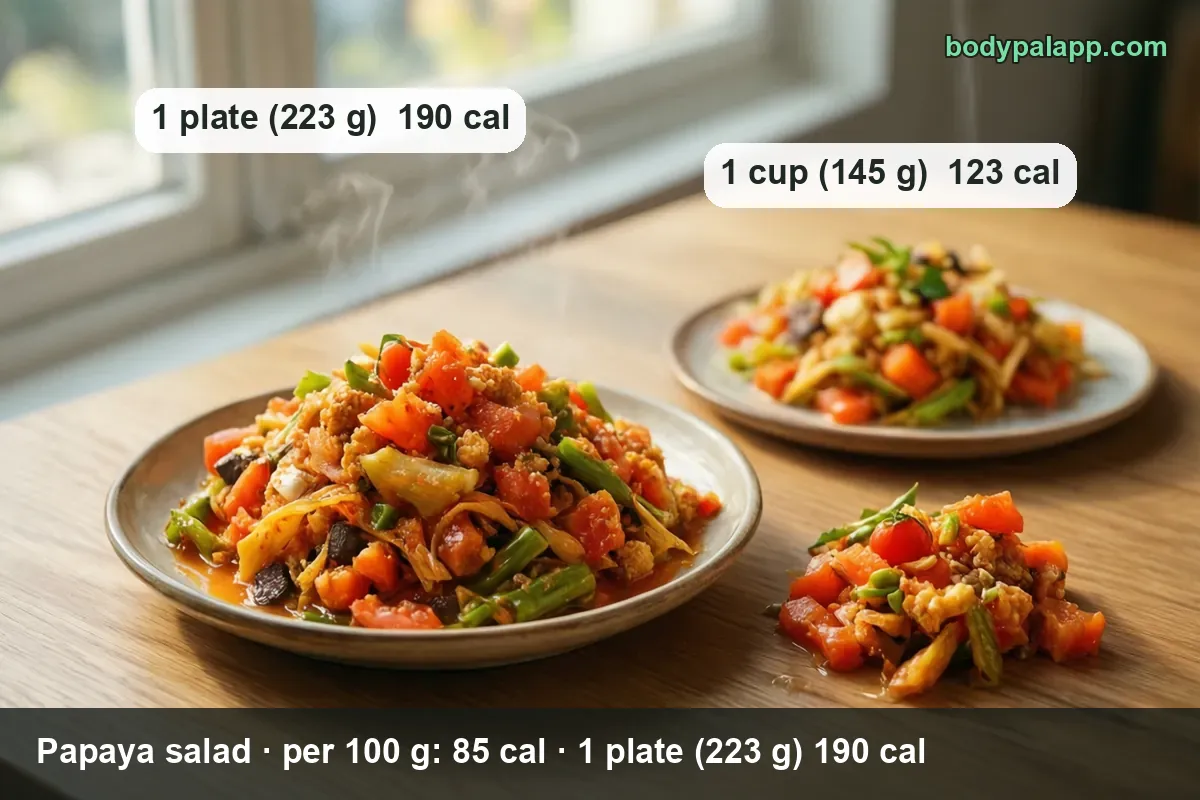
A restaurant plate of green papaya salad — som tam, the shredded Thai kind with tomatoes, green beans and crushed peanuts — is 190 calories for 223 g, or 85 calories per 100 g. A measured cup, 145 g, comes to 123. The calories in papaya salad are genuinely low. The sodium is not: one plate carries 1,066 mg, and that is the number worth knowing before you order.
On this page
- Papaya salad quick facts
- What 190 calories is actually made of
- Cup, plate and takeout container
- The sodium is the whole story
- Peanuts are 37% of the calories
- Sugar in the dressing
- The other papaya salad
- How papaya salad compares
- FAQ
Papaya salad quick facts
The reference below is a full plate as a Thai restaurant serves it: shredded green papaya, tomato, green beans, peanuts, dried shrimp, and a lime, fish sauce and palm sugar dressing poured over the whole thing.
| Nutrient | Per 100 g | Per 1 plate (223 g) | % Daily Value |
|---|---|---|---|
| Calories | 85 | 190 | — |
| Total fat | 3.0 g | 6.7 g | 9% |
| Saturated fat | 0.5 g | 1.1 g | 6% |
| Carbohydrate | 12.8 g | 28.5 g | 10% |
| Dietary fiber | 1.8 g | 4.0 g | 14% |
| Total sugars | 9.1 g | 20.3 g | — |
| Added sugars | 3.6 g | 8.0 g | 16% |
| Protein | 3.4 g | 7.6 g | 15% |
| Sodium | 478 mg | 1066 mg | 46% |
% Daily Value is based on a 2,000-calorie diet.
Verified nutrition data
Numbers on this page come from USDA FoodData Central, the U.S. Department of Agriculture’s food composition database, and from manufacturer labels where a branded product is named. Last verified September 2026. How we verify our data →
Total sugars carry no Daily Value on a US label, which is why that row is blank. There is no trans fat row at all: the survey entries for fish sauce and dried shrimp simply do not report the value, and printing a "0" built from half the ingredients would be worse than leaving it out.
Read the table sideways and the shape of the dish appears. Fat, calories and carbohydrate are all under 11% of a day. Sodium is 46%. Nothing else on the plate comes close to that imbalance.
What 190 calories is actually made of
USDA FoodData Central has no entry for som tam. It has papaya, tomatoes, green beans, peanuts, fish sauce and everything else, so the number above is built the way the salad is built — ingredient by ingredient, each one weighed against its own USDA row.
| Ingredient | USDA entry | In one plate | Calories |
|---|---|---|---|
| Green papaya, shredded | Papayas, raw (169926) | 120 g | 51.6 |
| Tomatoes | Tomatoes, red, ripe, raw (170457) | 30 g | 5.4 |
| Green beans | Beans, snap, green, raw (169961) | 20 g | 6.2 |
| Peanuts, dry-roasted | Peanuts, all types, dry-roasted (173806) | 12 g | 70.4 |
| Dried shrimp | Shrimp, dried (2706366) | 5 g | 12.5 |
| Fish sauce | Fish sauce (2706457) | 12 g | 4.2 |
| Lime juice | Lime juice, raw (168156) | 10 g | 2.5 |
| Palm sugar | Sugars, granulated (169655) | 8 g | 31.0 |
| Garlic | Garlic, raw (169230) | 3 g | 4.5 |
| Chili | Peppers, hot chili, red, raw (170106) | 3 g | 1.2 |
| Whole plate | 223 g | 190 |
Two honest caveats come with that build. First, the gram weights are a standard som tam recipe, not a USDA measurement — every nutrient is from the entries listed, but the portioning is the recipe's. Second, USDA has no row for unripe green papaya, so ripe papaya stands in for it. Green fruit holds less sugar at close to the same calorie count, which means 9.1 g of total sugars per 100 g is, if anything, slightly generous, while 85 calories lands about right.
What the breakdown shows is where the money goes. Papaya, tomato, green beans, lime, garlic and chili together are 186 g of the plate and 71 calories. The four small things poured or scattered on top — peanuts, sugar, dried shrimp, fish sauce — are 37 g and 118 calories.
Cup, plate and takeout container
| Portion | Weight | Calories |
|---|---|---|
| 1 oz, a couple of forkfuls | 28 g | 24 |
| 1 cup, shredded | 145 g | 123 |
| Per 100 g | 100 g | 85 |
| 1 plate, restaurant serving | 223 g | 190 |
The gap between the middle two rows is where most logging errors live. A cup is the American default, and papaya shreds pack at 145 g to the cup. A restaurant plate is a cup and a half. Log "1 cup papaya salad" after eating the plate in front of you and you are 67 calories light, plus about 370 mg of sodium you never counted.
Nothing here is cooked, which removes the raw-versus-cooked trap that follows meat and rice around. Som tam is pounded, not heated, so the weight you see on the plate is the weight that went into it.
The sodium is the whole story
A plate of shredded vegetables that delivers 1,066 mg of sodium is not what most people expect from a salad. That is 46% of the Daily Value of 2,300 mg, and the CDC points at exactly this kind of source when it notes how much of American sodium arrives in restaurant food rather than from the shaker.
The split inside the dish is stark:
- Fish sauce, 12 g: 942 mg
- Dried shrimp, 5 g: 109 mg
- Everything else, 206 g of vegetables, lime, garlic and sugar: under 15 mg
Roughly a tablespoon of fish sauce is doing 88% of it. The papaya is innocent. In practical terms 1,066 mg is close to half a teaspoon of table salt sitting in the dressing at the bottom of the plate, which is also why the last few forkfuls taste sharper than the first.
There are two ways out and only one of them works. Asking for less fish sauce cuts the number directly. Skipping the peanuts, and the dried shrimp that goes with them, is the move people reach for when they want the dish lighter; it saves calories and leaves the sodium almost untouched at 956 mg.
Peanuts are 37% of the calories
Twelve grams of dry-roasted peanuts, a single scattered handful, carry 70 of the 190 calories and 6.0 of the 6.7 g of fat. That is the largest single decision in the dish, and it is made by somebody else in the kitchen.
Order som tam without peanuts and dried shrimp — the vegetarian som tam jay — and the plate falls to 206 g and 107 calories, or 52 per 100 g. Fat drops to 0.5 g. Protein falls with it, from 7.6 g to about 2 g, because the peanuts and shrimp were carrying most of it.
So the choice is real but it is not free. The full version is 190 calories with 7.6 g of protein and 4.0 g of fiber, which is a side dish that behaves like a small meal. The stripped version is 107 calories of mostly vegetables and water. Neither is a big number; the peanut version is simply better company for the rest of the table.
Anyone avoiding fish or shellfish should know the classic build contains both, in the fish sauce and the dried shrimp, and neither is visible on the plate.
Sugar in the dressing
The dressing takes 8 g of palm sugar, and on a US label that is 8.0 g of added sugars, 16% of the Daily Value in one side salad. Total sugars on the plate are 20.3 g, so the fruit and tomatoes contribute the remaining 12 g or so on their own.
That is the quiet cost of the sweet-sour balance. Papaya salad reads as a vegetable dish, and MyPlate would count most of it as one, but a sixth of a day's added sugar is riding in the sauce. It is also why som tam pairs so easily with grilled meat: the sugar and the lime are doing the same job a barbecue glaze does.
Fiber balances part of the ledger. Four grams a plate is 14% of the Daily Value, better than most restaurant sides manage at any calorie count.
The other papaya salad
Type "papaya salad" into a nutrition database and you may land on something entirely different: tropical fruit salad canned in heavy syrup, pineapple and papaya and banana and guava, USDA entry 167764. The trap is that the calories match almost exactly.
| Version | Per 100 g | Portion | Calories | Sodium |
|---|---|---|---|---|
| Som tam, classic with peanuts | 85 | 1 plate (223 g) | 190 | 1,066 mg |
| Som tam jay, no peanuts or shrimp | 52 | 1 plate (206 g) | 107 | 956 mg |
| Canned tropical fruit salad in syrup | 86 | 1 cup (257 g) | 221 | 2 mg |
| Fresh ripe papaya with lime | 43 | 1 cup, 1" pieces (145 g) | 62 | 8 mg |
Eighty-five against 86 per 100 g is a coin flip. Everything behind those two numbers is different. The canned fruit salad holds 22.4 g of carbohydrate per 100 g against 12.8 for som tam, essentially none of the protein, and 2 mg of sodium instead of 478. One is a dessert in syrup; the other is a savory salad that happens to contain fruit. If a calorie tracker offers you both, the sodium column tells you instantly which one you are holding.
Plain ripe papaya is the lightest thing in the group. A cup of 1-inch pieces is 62 calories, under a third of the som tam plate, with 8 mg of sodium.
How papaya salad compares
| Item | Per 100 g | US portion | Calories | P / C / F per portion |
|---|---|---|---|---|
| Green papaya salad (som tam) | 85 | 1 plate (223 g) | 190 | 7.6 / 28.5 / 6.7 |
| Papaya, raw | 43 | 1 cup, 1" pieces (145 g) | 62 | 0.7 / 15.7 / 0.4 |
| Coleslaw | 117 | 1 cup (220 g) | 257 | 2.1 / 23.0 / 17.6 |
| Cucumber salad with vinegar | 34 | 1 cup (159 g) | 54 | 0.8 / 10.8 / 0.2 |
| Pad Thai with chicken | 154 | 1 cup (200 g) | 308 | 16.3 / 28.7 / 15.0 |
Our take: as a side, som tam beats coleslaw and it is not close — 190 calories against 257 for a smaller plate, with 6.7 g of fat against 17.6, because the dressing is lime juice rather than mayonnaise. If you want the lightest side on the table, cucumber salad wins at 54 calories a cup and 34 per 100 g, and it does it without the fish sauce.
Against pad Thai the comparison changes shape. A cup of pad Thai is 308 calories and 16.3 g of protein; a plate of som tam is 190 and 7.6. Papaya salad is not the main course, and ordering it as one usually means ordering a second dish twenty minutes later.
Papaya salad FAQs
How many calories are in papaya salad?
190 calories for a 223 g restaurant plate of Thai green papaya salad, at 85 calories per 100 g. A measured cup, 145 g, is 123 calories. The version made without peanuts and dried shrimp drops to 107 calories a plate.
How many calories are in a cup of papaya salad?
123 calories. Shredded papaya salad packs at 145 g to the cup, and at 85 calories per 100 g that comes to 123. A restaurant plate is about a cup and a half, so logging "1 cup" after eating a full plate leaves 67 calories uncounted.
Is papaya salad healthy?
A plate gives 4.0 g of fiber (14% of the Daily Value) and 7.6 g of protein for 190 calories, which is a good return for a side dish. The number to watch is sodium: 1,066 mg, or 46% of the 2,300 mg Daily Value, nearly all of it from about a tablespoon of fish sauce.
How much sodium is in papaya salad?
1,066 mg in a 223 g plate, which is 46% of the FDA Daily Value. Fish sauce contributes 942 mg of that and dried shrimp another 109 mg; the papaya, tomatoes, green beans, lime and garlic together add under 15 mg. Asking for less fish sauce is the only change that moves it much.
How many calories in papaya salad without peanuts?
107 calories for a 206 g plate, at 52 calories per 100 g, if the dried shrimp goes with them. The 12 g of peanuts alone are 70 calories and 6.0 g of fat, so they account for 37% of the full dish. Sodium barely moves, from 1,066 mg to 956 mg.
How many carbs and how much sugar are in papaya salad?
28.5 g of carbohydrate and 20.3 g of total sugars in a 223 g plate, of which 8.0 g are added sugars from the palm sugar in the dressing. That is 16% of the Daily Value for added sugars. Fiber comes to 4.0 g, so net carbohydrate is around 24.5 g.
Green papaya or ripe papaya, which has fewer calories?
Ripe papaya on its own is lighter: 43 calories per 100 g, or 62 for a cup of 1-inch pieces. The green papaya in som tam sits at a similar calorie level as fruit, but the finished salad is 85 per 100 g because of the peanuts, palm sugar and dried shrimp mixed through it.
Is som tam the same as canned papaya fruit salad?
No, though the calories nearly match at 85 against 86 per 100 g. The canned tropical fruit salad in heavy syrup holds 22.4 g of carbohydrate per 100 g and 2 mg of sodium; som tam holds 12.8 g of carbohydrate and 478 mg. One is a dessert, the other a savory salad.
Similar foods
- Pineapple Chunks — 211 cal per cup chunks
- Pomegranate — 72 cal for 1/2 cup arils
- Banana — 105 cal per medium banana
- Large Banana — 121 cal per large banana
- Ataulfo Mango — 129 cal per cup diced
- Jackfruit — 157 cal per cup, sliced
Count it without the math
Point the camera at the plate and BodyPal logs the calories and the sodium in one go.


How long does it take to burn off papaya salad?
A restaurant plate (223 g) is 190 kcal. Enter your weight and the amount you ate to see how long it takes you to burn that off:
lb
| Activity | Time to burn 190 kcal |
|---|---|
| Walking, brisk | 38 min |
| Cycling, moderate | 24 min |
| Swimming, moderate | 27 min |
| Jogging | 22 min |
| Weight training, moderate | 42 min |
Times are for a 155 lb adult at a steady pace; change the weight to see yours. The amount is set to the portion in the text (223 g); change it to what you actually ate. BodyPal works this out from your steps automatically.
This table assumes you know your daily total. If you do not, the daily calorie calculator works it out from five numbers.