
How many calories are in a pomegranate?
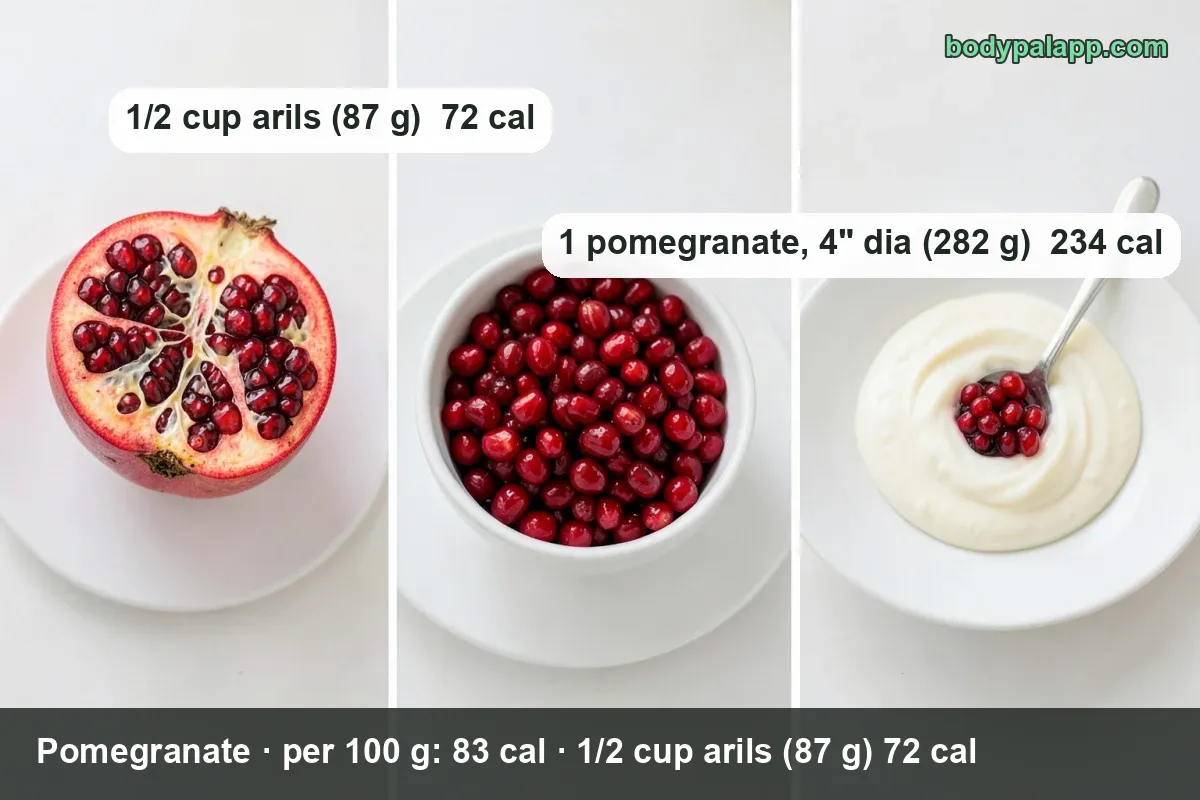
A half cup of pomegranate arils weighs 87 g and carries 72 calories. Straight seeds run 83 calories per 100 g, and a whole 4-inch fruit at 282 g works out to 234. Most people eat somewhere between those two numbers, which is why the half-cup line is the one worth memorizing.
On this page
- Pomegranate quick facts
- US servings, from one ounce to a whole fruit
- Arils, a whole fruit and a cup of juice
- Juice drinks, cocktails and molasses
- Fiber is the row that separates fruit from bottle
- How does pomegranate compare?
- Most popular pomegranate brands
- FAQ
Pomegranate quick facts
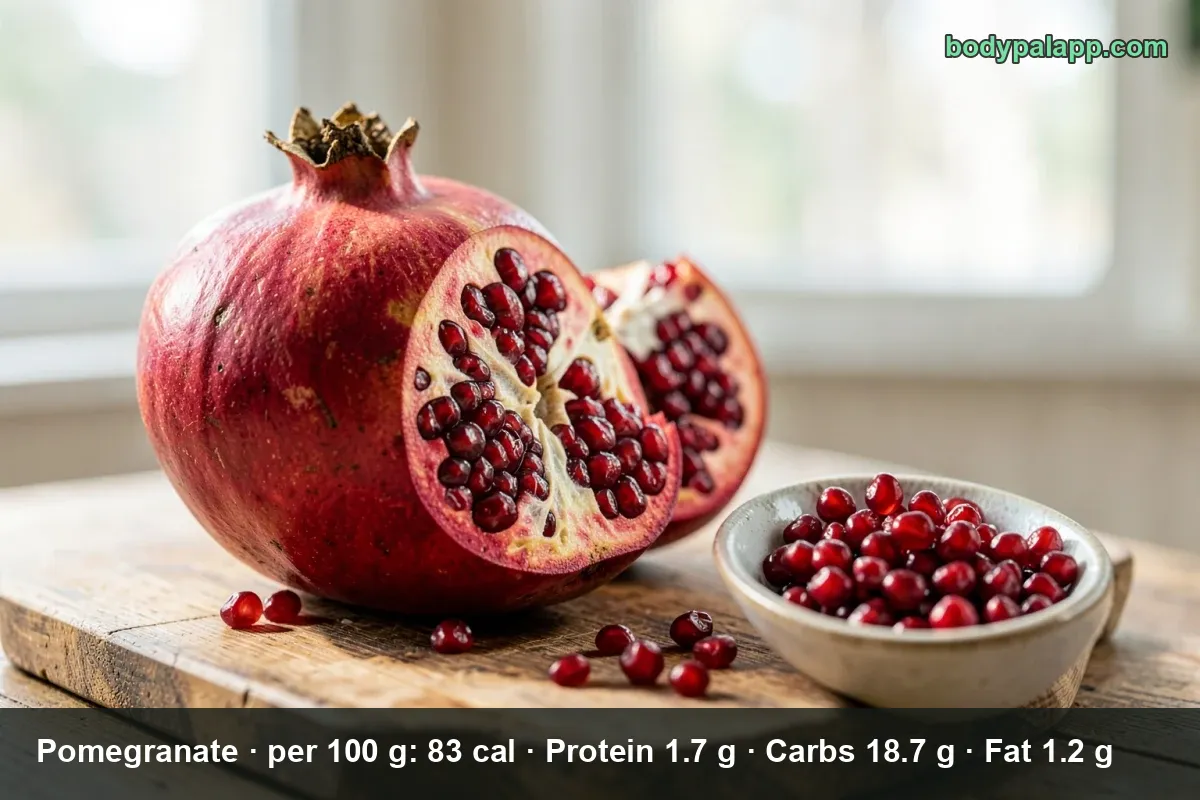
The numbers below come from SR Legacy 169134, "Pomegranates, raw". That is the record for the part you actually put in your mouth: the arils, the little juice sacs with a seed inside. USDA attaches two household measures to it, a half cup of arils at 87 g and one 4-inch fruit at 282 g, so both of the servings people search for come straight out of the record instead of being estimated.
Seven USDA records carry the word pomegranate, and only two of them are the fruit. The rest are juice, juice drinks and a fruit-on-the-bottom yogurt. FNDDS 2709267 is the same raw fruit in a different USDA release with identical macros; SR Legacy wins here because it is the fuller record, potassium and all.
| Nutrient | Per 100 g | Per 1/2 cup arils (87 g) | % Daily Value |
|---|---|---|---|
| Calories | 83 | 72 | — |
| Total fat | 1.17 g | 1.0 g | 1% |
| Saturated fat | 0.12 g | 0.1 g | 1% |
| Carbohydrate | 18.7 g | 16.3 g | 6% |
| Dietary fiber | 4 g | 3.5 g | 12% |
| Total sugars | 13.67 g | 11.9 g | — |
| Protein | 1.67 g | 1.5 g | 3% |
| Sodium | 3 mg | 3 mg | 0% |
% Daily Value is based on a 2,000-calorie diet.
Verified nutrition data
Numbers on this page come from USDA FoodData Central, the U.S. Department of Agriculture’s food composition database, and from manufacturer labels where a branded product is named. Last verified September 2026. How we verify our data →
There is no added sugars row on this page because the SR Legacy edition does not publish added sugars, and a raw fruit has none to publish. Cholesterol is 0 mg, as it is in every plant food. Potassium is the one worth noting: 236 mg per 100 g, or 205 mg in the half cup, which is 4% of the FDA Daily Value of 4,700 mg.
US servings, from one ounce to a whole fruit
| Serving | Weight | Calories |
|---|---|---|
| 1 oz | 28.4 g | 24 kcal |
| 1/2 cup arils | 87 g | 72 kcal |
| 1 cup arils | 174 g | 144 kcal |
| One pomegranate, 4" diameter | 282 g | 234 kcal |
| Per 100 g | 100 g | 83 kcal |
The half cup and the whole fruit are USDA household measures. The one-ounce line and the one-cup line are our own arithmetic from the USDA 100 g figure, not USDA servings, which is why a cup here reads 174 g rather than the 175 g USDA uses in its newer release. One calorie between those two versions is not a number to lose sleep over.
Where people get tripped up is the container. A clamshell of ready-to-eat arils from the produce aisle usually holds far more than a half cup, and a whole fruit deseeded into a bowl looks like a snack while costing 234 calories. Weigh the bowl once and you will never have to guess again.
Arils, a whole fruit and a cup of juice
| Version | Per 100 g | Typical serving | Calories |
|---|---|---|---|
| Arils, raw (USDA cup) | 83 kcal | 1 cup, 175 g | 145 kcal |
| Whole fruit, 4" diameter | 83 kcal | 1 fruit, 282 g | 234 kcal |
| Bottled 100% juice | 54 kcal | 1 cup, 249 g | 134 kcal |
| 100% juice, small pour | 54 kcal | 1 fl oz, 31 g | 17 kcal |
Juice looks like the light option on a per-100 g basis, and it is: 54 calories against 83. Then the glass size undoes it. A cup of bottled 100% pomegranate juice is 134 calories, nearly double the 72 in a half cup of arils, and it takes about a minute to drink. The seeds take ten minutes to chew through.
Squeezing also strips the fiber out. The arils hold 4 g per 100 g; the bottled juice holds 0.1 g. Everything that made the fruit filling stays behind in the press cake. If you like the flavor but not the calories, a 1 fl oz pour over sparkling water is 17 calories and does the job.
Juice drinks, cocktails and molasses
| Drink | Per 100 g | Serving | Calories |
|---|---|---|---|
| Pomegranate juice beverage, 40-50% juice, light | 27 kcal | 8 fl oz, 240 g | 65 kcal |
| Cranberry-pomegranate juice cocktail | 47 kcal | 8 fl oz, 248 g | 117 kcal |
These two are not pomegranate. They are diluted blends built around it, and the light beverage gets to 27 calories per 100 g by being mostly water. That is a fair trade if you want something to sip, but do not log it as fruit.
Branded bottles sit in the same range. USDA's branded records put POM Wonderful 100% Pomegranate Juice at 65 calories per 100 g, so the 12 fl oz bottle on its label comes to roughly 231 calories at 1 mL to 1 g, our own conversion rather than a USDA serving. Ocean Spray's 100% Juice Cranberry Pomegranate is 50 per 100 g, about 120 for an 8 fl oz glass. And pomegranate molasses is a different animal entirely at 333 calories per 100 g, though a tablespoon is only 18 g and 60 calories, which is all a salad dressing ever needs.
Fiber is the row that separates fruit from bottle
Twelve percent of a day's fiber for 72 calories is a strong ratio. The FDA Daily Value is 28 g, and a half cup of arils delivers 3.5 g of it. Take the whole 282 g fruit and you are at about 11.3 g by our own arithmetic from the USDA figure, roughly 40% of the day, for 234 calories. Very few snacks in the produce aisle move the fiber line that far.
Sodium is the other easy win: 3 mg per 100 g, rounding to 0% of the Daily Value. That is less than a hundredth of a teaspoon of table salt in a whole fruit's worth of seeds. If you are watching sodium, whole fruit is the pick that never costs you anything, and MyPlate counts a half cup of arils as a half-cup serving toward the fruit group.
The sugar question comes up constantly. Pomegranate is 13.67 g of total sugars per 100 g, which is not low. All of it is naturally occurring, the USDA record lists none of it as added, and total sugars carry no Daily Value on the label, so there is no percentage to fail. The Dietary Guidelines for Americans set their added-sugars limit around foods with sugar added during processing, which a raw pomegranate is not.
How does pomegranate compare?
| Food | Per 100 g | Carbohydrate | Protein | US serving |
|---|---|---|---|---|
| Pomegranate arils | 83 kcal | 18.7 g | 1.67 g | 1/2 cup, 87 g, 72 kcal |
| Sapodilla, raw | 83 kcal | 19.96 g | 0.44 g | 1 cup pulp, weight not published in our extract |
| Apricots, canned in heavy syrup, drained | 83 kcal | 21.31 g | 0.64 g | 1 cup halves, weight not published in our extract |
| Pineapple, canned in extra heavy syrup | 83 kcal | 21.5 g | 0.34 g | 1 cup, weight not published in our extract |
USDA lists a cup measure for all three neighbors, but the gram weight for those cups was not in the extract behind this page, so the per-serving calories stay blank rather than guessed.
Our take: four foods land on exactly 83 calories per 100 g and only one of them earns it honestly. Pomegranate is the lowest-carbohydrate row of the four at 18.7 g and the highest-protein at 1.67 g, and its calories arrive with fiber attached. The two canned rows get to the same number with syrup. For weight control, arils are the pick; for a fruit you can eat with a spoon and not think about, canned in juice beats canned in heavy syrup every time.
Most popular pomegranate brands in the United States
Ranked by how widely each product appears among foods sold in the United States, from the BodyPal food database of over 3.3 million products. Calories are the figures printed on each Nutrition Facts label, checked against USDA FoodData Central.
| Product | Calories (per 100 g) |
|---|---|
| POM Wonderful 100% Pomegranate Juice | 65 cal |
| POM Wonderful Pomegranate Blueberry 100% Juice | 64 cal |
| Wonderful 100% Pomegranate Blueberry Juice from Concentrate | 64 cal |
| Ocean Spray 100% Juice Cranberry Pomegranate | 50 cal |
| KRAL Pomegranate Juice | 48 cal |
| Al Wadi Al Akhdar Pomegranate Molasses | 333 cal |
Brand popularity: BodyPal food database. Nutrition: manufacturer labels / USDA FoodData Central.
Pomegranate FAQs
How many calories are in one pomegranate?
A whole 4-inch pomegranate weighs 282 g in USDA's household measure and comes to 234 calories. That is the fruit as USDA weighs it, seeds and all. Very few people finish a whole one in a sitting, which is why the serving most often logged is a half cup of arils at 72 calories.
How many calories in 1/2 cup of pomegranate seeds?
A half cup of pomegranate seeds, or arils, weighs 87 g and carries 72 calories. Along with them come 16.3 g of carbohydrate, 3.5 g of fiber and 11.9 g of naturally occurring sugars. Fat is negligible at 1.0 g, and sodium is 3 mg, effectively zero for the day.
How many calories in 1 cup of pomegranate arils?
A cup of arils is 174 g by our own arithmetic from the USDA 100 g figure, putting it at 144 calories. USDA's newer release uses a slightly heavier 175 g cup and lists 145 calories. Either way, budget 145 calories and roughly 7 g of fiber for a full cup of seeds.
Is pomegranate high in sugar?
Pomegranate carries 13.67 g of total sugars per 100 g, which is 11.9 g in a half-cup serving. All of it occurs naturally in the fruit; the USDA record lists no added sugars at all. Total sugars carry no Daily Value on the Nutrition Facts label, so there is no percentage to compare against.
How much fiber is in a pomegranate?
A half cup of arils gives 3.5 g of fiber, 12% of the 28 g Daily Value. Per 100 g the seeds hold 4 g. A whole 282 g fruit works out to about 11.3 g by our own arithmetic from the USDA figure, roughly 40% of a day's fiber for 234 calories.
Pomegranate juice vs whole pomegranate calories?
Bottled 100% pomegranate juice is 54 calories per 100 g, so a 249 g cup is 134 calories. That is nearly double the 72 calories in a half cup of arils. The bigger gap is fiber: 4 g per 100 g in the seeds against 0.1 g per 100 g in the bottled juice.
How many carbs are in pomegranate?
A half-cup serving holds 16.3 g of carbohydrate, 6% of the 275 g Daily Value, and 3.5 g of that total is fiber. Per 100 g the figure is 18.7 g. A whole 4-inch fruit at 282 g comes to about 52.7 g of carbohydrate by our own arithmetic from the USDA figure.
Does pomegranate have potassium?
Yes, 236 mg per 100 g, which is 205 mg in a half-cup serving, or 4% of the 4,700 mg Daily Value. Sodium runs the other way at 3 mg per 100 g, 0% of the Daily Value, so pomegranate is one of the easiest fruits to fit into a low-sodium day.
Similar foods
- Papaya salad — 190 cal per plate
- Pineapple Chunks — 211 cal per cup chunks
- Ataulfo Mango — 129 cal per cup diced
- Banana — 105 cal per medium banana
- Large Banana — 121 cal per large banana
- Fig — 47 cal per large fig
Count it without the math
Point the camera at the bowl and BodyPal counts the arils for you, half cup or whole fruit.


How long does it take to burn off pomegranate?
A 1/2-cup serving of arils (87 g) is 72 kcal. Enter your weight and the amount you ate to see how long it takes you to burn that off:
lb
| Activity | Time to burn 72 kcal |
|---|---|
| Walking, brisk | 14 min |
| Cycling, moderate | 9 min |
| Swimming, moderate | 10 min |
| Jogging | 8 min |
| Weight training, moderate | 16 min |
Times are for a 155 lb adult at a steady pace; change the weight to see yours. The amount is set to the portion in the text (87 g); change it to what you actually ate. BodyPal works this out from your steps automatically.
Burning it off is one side of it. The other is knowing your number: work out how many calories you need a day, with macros and a goal date.