
How many calories are in a fig?
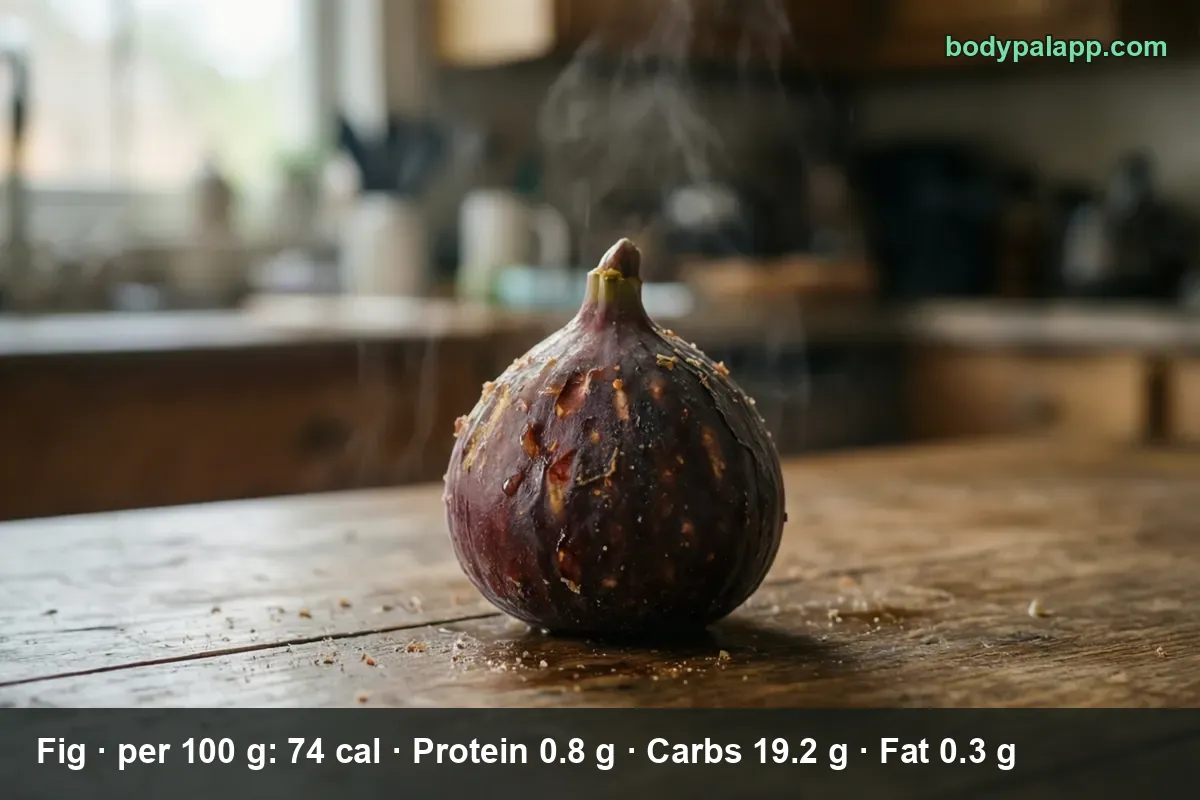
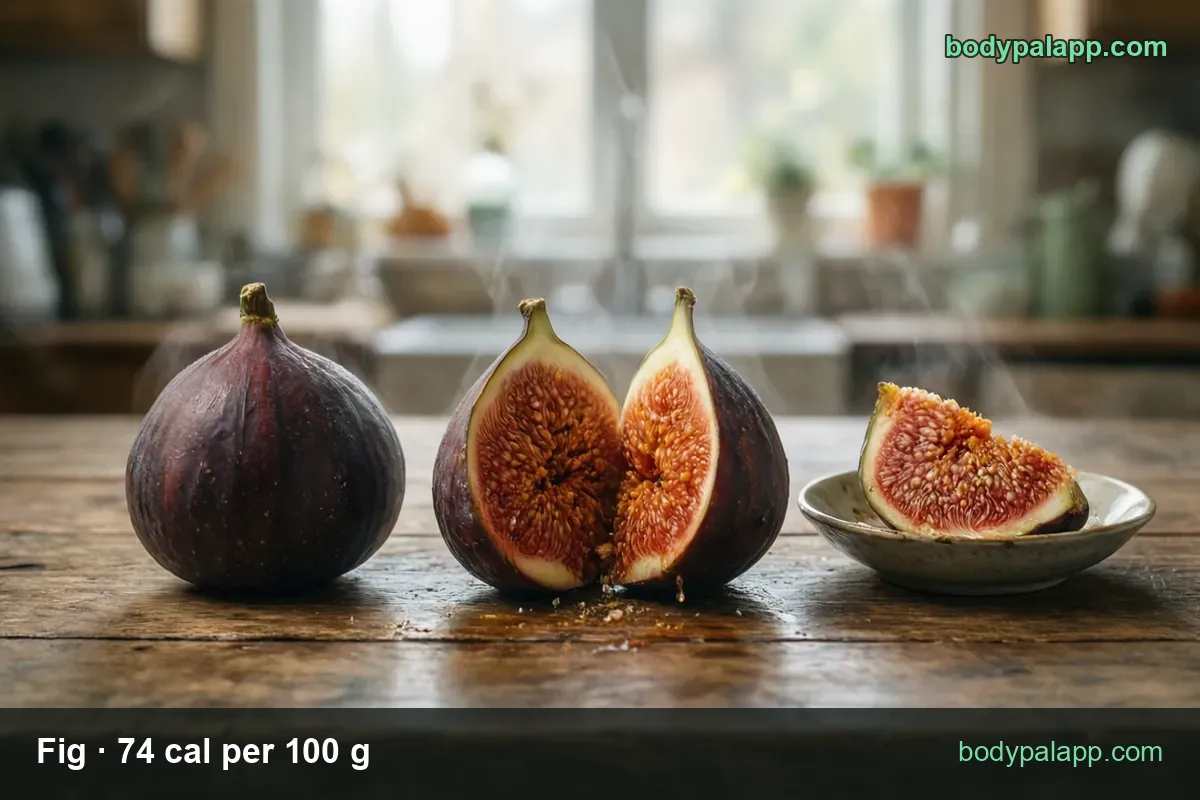
One large fresh fig weighs 64 g and carries 47 calories. Raw figs run 74 calories per 100 g, which puts them among the lighter fruits by weight. A medium fig is 37 calories and a small one 30, so three figs on a plate land somewhere between 90 and 141 depending only on size.
On this page
- Fig quick facts
- US servings, from one fig to a cup
- Dried, stewed and canned figs
- Fiber and sugar, the two rows that matter
- How does a fig compare?
- Most popular fig brands
- FAQ
Fig quick facts
The record behind every number on this page is SR Legacy 173021, "Figs, raw". It is the only complete entry for the fresh fruit that also carries household measures by fruit size, which is how people actually eat figs: one at a time, off a plate, not weighed out in grams.
Added sugars are missing from the table below on purpose. The SR Legacy edition does not track that nutrient at all, and a raw fig has none anyway, so the row would be an invented zero.
| Nutrient | Per 100 g | Per one large fig (64 g) | % Daily Value |
|---|---|---|---|
| Calories | 74 | 47 | — |
| Total fat | 0.3 g | 0.2 g | 0% |
| Saturated fat | 0.06 g | 0.0 g | 0% |
| Carbohydrate | 19.18 g | 12.3 g | 4% |
| Dietary fiber | 2.9 g | 1.9 g | 7% |
| Total sugars | 16.26 g | 10.4 g | — |
| Protein | 0.75 g | 0.5 g | 1% |
| Sodium | 1 mg | 1 mg | 0% |
| Cholesterol | 0 mg | 0 mg | 0% |
| Potassium | 232 mg | 148 mg | 3% |
% Daily Value is based on a 2,000-calorie diet.
Verified nutrition data
Numbers on this page come from USDA FoodData Central, the U.S. Department of Agriculture’s food composition database, and from manufacturer labels where a branded product is named. Last verified September 2026. How we verify our data →
Nothing in that column is dramatic, which is the point. A fig is about four fifths water, so the fruit contributes almost no fat, no cholesterol and one single milligram of sodium. The two rows worth reading are fiber and total sugars, and both change hard once the water leaves.
US servings, from one fig to a cup
USDA lists fresh figs by diameter, not by cup, and the three sizes are far enough apart to matter. A large fig measures about 2-1/2 inches across, a medium 2-1/4 inches and a small 1-1/2 inches. That last one is barely bigger than a walnut.
| Serving | Weight | Calories |
|---|---|---|
| 1 oz | 28 g | 21 kcal |
| One small fig, 1-1/2 inch | 40 g | 30 kcal |
| One medium fig, 2-1/4 inch | 50 g | 37 kcal |
| One large fig, 2-1/2 inch | 64 g | 47 kcal |
| Two large figs | 128 g | 95 kcal |
| Per 100 g | 100 g | 74 kcal |
The three single-fig rows are USDA household measures. The 1 oz line and the two-fig line are our own arithmetic from the USDA 100 g figure, not USDA servings — useful because figs get eaten in pairs and because grocery scales speak in ounces.
Two large figs at 95 calories is a reasonable snack anchor, and figs count toward the fruit group on MyPlate. The practical trap is not the fresh fruit at all. It is what happens when the same fig arrives dried.
Dried, stewed and canned figs
Dried figs, uncooked run 249 calories per 100 g against 74 for the fresh fruit. Drying removes water; it does not add sugar. Everything that was in the fig is still there, packed into roughly a third of the weight.
| Version | Per 100 g | Typical serving | Calories |
|---|---|---|---|
| Fresh, raw | 74 kcal | one large fig, 64 g | 47 kcal |
| One dried fig | 249 kcal | 1 fig, 8.4 g | 21 kcal |
| Dried figs | 249 kcal | 1 cup, 149 g | 371 kcal |
| Dried figs, stewed | 107 kcal | 1 cup, 259 g | 277 kcal |
| Canned in water | 53 kcal | 1 cup, 248 g | 131 kcal |
| Canned in light syrup | 69 kcal | 1 cup, 252 g | 174 kcal |
| Canned in heavy syrup | 88 kcal | 1 cup, 259 g | 228 kcal |
Read the first two rows against each other. One dried fig weighs 8.4 g and costs 21 calories. One large fresh fig weighs 64 g — more than seven times as much — and costs 47. You are chewing a fraction of the food for close to half the calories, which is exactly why a bowl of dried figs disappears without registering.
The cup measure makes it worse. A cup of dried figs is 371 calories. To reach that with fresh fruit you would need about eight large figs, 512 g and 379 calories by our own arithmetic from the 100 g figure. Same fruit, one fits in a fist, the other fills a produce bag.
Stewing sends the water back in. Dried figs stewed drop to 107 calories per 100 g, and a full 259 g cup is 277 calories — heavier than a cup of canned figs but far below the dry version, because most of that cup is liquid again.
The canned rows separate the fruit from the pack. Water pack figs are 53 calories per 100 g, lighter than fresh, since the canning liquid dilutes the fruit. Light syrup lifts it to 69 and heavy syrup to 88. Across a full cup that spread runs from 131 to 228 calories. The syrup is doing all the work.
One record worth flagging: USDA also carries a FNDDS entry for dried figs listing the identical macros — 3.3 g protein, 63.9 g carbohydrate, 9.8 g fiber — but 277 calories per 100 g instead of 249. The difference is the energy factor applied, not different fruit. We use the SR Legacy figure throughout.
Fig bars are not figs. USDA puts generic fig bar cookies at 348 calories per 100 g with 350 mg of sodium, and Nature's Bakery, the brand that dominates the US shelf, labels its fig bars at 393 calories per 100 g, or 110 per 28 g bar. That is a cookie with fig paste in it, and it belongs in a different column of your log.
Fiber and sugar, the two rows that matter
One large fig gives 1.9 g of fiber, 7% of the 28 g Daily Value set by the FDA. Respectable for a 47-calorie snack, but not the headline. The headline is dried: at 9.8 g per 100 g, a 149 g cup delivers 14.6 g of fiber, 52% of a full day. Seven percent against fifty-two, from the same fruit.
Sugar moves in the same direction. A large fresh fig carries 10.4 g of total sugars, all of it intrinsic to the fruit. USDA does not publish an added sugars figure for this record because whole raw fruit has none, and the Dietary Guidelines advice on limiting added sugars applies to sugars added during processing, not to what is already in a fig. Total sugars have no Daily Value on the label either, which is why that cell stays empty in the table above.
Potassium is the quiet one. A large fig has 148 mg, 3% of the 4,700 mg Daily Value. Not a reason to eat figs on its own, but figs are one of the few fruits that bring fiber and potassium together at under 50 calories a piece.
How does a fig compare?
| Fruit | Per 100 g | US serving | Calories |
|---|---|---|---|
| Fig, raw | 74 kcal | one large fig, 64 g | 47 kcal |
| Elderberries, raw | 73 kcal | 1 oz, 28 g | 21 kcal |
| Pears, canned in heavy syrup, drained | 74 kcal | 1 oz, 28 g | 21 kcal |
| Peaches, canned in heavy syrup | 74 kcal | 1 oz, 28 g | 21 kcal |
Our take: at 74 calories per 100 g the fresh fig sits level with canned pears and canned peaches in heavy syrup, and only elderberries come in lighter, by a single calorie. That is the whole argument for fresh figs — you get a fruit with 2.9 g of fiber per 100 g at the same energy cost as fruit sitting in sugar water. For weight loss, eat them fresh and count them by the piece: two large figs, 95 calories, is a snack you can repeat. For a hiking pocket or an energy-dense breakfast bowl, dried figs at 249 calories per 100 g do a job fresh fruit cannot. Just do not treat the two as interchangeable by the handful.
Most popular fig brands in the United States
Ranked by how widely each product appears among foods sold in the United States, from the BodyPal food database of over 3.3 million products. Calories are the figures printed on each Nutrition Facts label, checked against USDA FoodData Central.
| Product | Calories (per 100 g) |
|---|---|
| Nature's Bakery Fig Bar, Fig | 393 cal |
| Nature's Bakery Fig Bar (whole wheat), Fig | 357 cal |
| Nature's Bakery Fig Bar, Raspberry | 393 cal |
| Nature's Bakery Fig Bar, Blueberry | 393 cal |
| Nature's Bakery Fig Bar, Lemon | 393 cal |
| Nature's Bakery Fig Bar, Strawberry | 393 cal |
Brand popularity: BodyPal food database. Nutrition: manufacturer labels / USDA FoodData Central.
Fig FAQs
How many calories are in one fig?
One large fig of 64 g is 47 calories, and raw figs run 74 calories per 100 g. A medium fig (50 g) is 37 calories and a small one (40 g) is 30. Size swings the answer by more than a third, so log the fig you actually picked up rather than a generic one.
How many calories in a dried fig?
One dried fig weighs about 8.4 g and carries 21 calories, because dried figs run 249 calories per 100 g. Drying removes water, not sugar, so the calories concentrate into a much smaller piece. Two dried figs, 42 calories, sit just under one large fresh fig at 47.
Are figs high in sugar?
One large fresh fig has 10.4 g of total sugars, and raw figs hold 16.26 g per 100 g. All of it is naturally occurring: USDA does not publish added sugars for this record, and whole fruit carries none. Total sugars have no Daily Value on the Nutrition Facts label.
How much fiber is in a fig?
One large fig gives 1.9 g of fiber, 7% of the 28 g Daily Value, from 2.9 g per 100 g of raw fruit. Dried figs are the real source at 9.8 g per 100 g, so a 149 g cup delivers 14.6 g, which is 52% of a full day.
Are fresh or dried figs better for weight loss?
Fresh wins on volume: one large fig is 47 calories for 64 g of food, while a cup of dried figs is 371. Dried figs are not worse food, only denser at 249 calories per 100 g against 74. If you eat by the handful, fresh keeps the daily total down.
How many figs is one serving?
USDA lists figs by piece rather than by serving: one large fig is 64 g and 47 calories. Two large figs, 128 g and 95 calories, is our own arithmetic from the USDA 100 g figure and a fair plate. For dried figs the USDA cup measure is 149 g and 371 calories.
Do canned figs have more calories than fresh?
Not always: figs canned in water are 53 calories per 100 g, below raw figs at 74. Light syrup lifts that to 69 and heavy syrup to 88. Across a cup the gap is wide: 131 calories for the water pack against 228 for heavy syrup. The syrup drives it.
How many carbs are in a fig?
One large fig has 12.3 g of carbohydrate, 4% of the 275 g Daily Value, with 1.9 g of that as fiber. Raw figs hold 19.18 g per 100 g. Dried figs jump to 63.87 g per 100 g, so even a single 8.4 g dried fig adds about 5.4 g.
Similar foods
- Fruit Cocktail — 181 cal per cup
- Ataulfo Mango — 129 cal per cup diced
- Persimmon — 118 cal per medium persimmon
- Grapes — 104 cal per cup
- Grapes Black — 104 cal per cup
- Green Grapes — 104 cal per cup
Count it without the math
Point the camera at the plate and BodyPal counts the figs for you, fresh or dried.


How long does it take to burn off fig?
One large fig (64 g) is 47 kcal. Enter your weight and the amount you ate to see how long it takes you to burn that off:
lb
| Activity | Time to burn 47 kcal |
|---|---|
| Walking, brisk | 9 min |
| Cycling, moderate | 6 min |
| Swimming, moderate | 7 min |
| Jogging | 6 min |
| Weight training, moderate | 10 min |
Times are for a 155 lb adult at a steady pace; change the weight to see yours. The amount is set to the portion in the text (64 g); change it to what you actually ate. BodyPal works this out from your steps automatically.
This table assumes you know your daily total. If you do not, the daily calorie calculator works it out from five numbers.