
How many calories are in a persimmon?
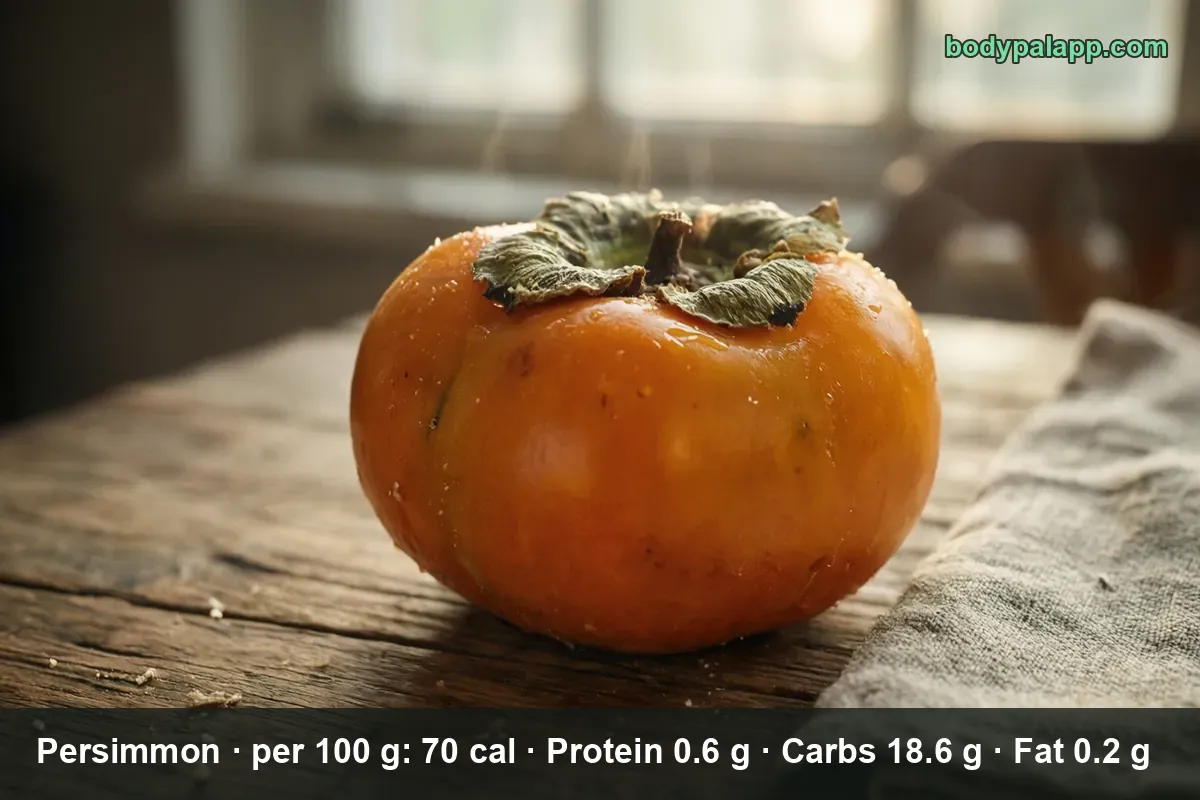
One medium persimmon weighs 168 g and carries 118 calories. Per 100 g the raw fruit runs 70 calories, lighter per gram than the mamey sapote, plantain or Florida avocado sitting near it in the produce aisle. Half a fruit is 59. Dry that same fruit and the math changes completely.
On this page
- Persimmon quick facts
- US servings, from one ounce to two on a plate
- Fuyu, Hachiya and the wild American persimmon
- Dried persimmon is a different food
- Fiber is the row that beats the calories
- How does a persimmon compare?
- Most popular persimmon brands
- Persimmon FAQs
Persimmon quick facts
The fruit in your hand is almost certainly the Japanese persimmon, sold in US stores as Fuyu (squat, eaten firm) or Hachiya (acorn-shaped, eaten soft). That is the record used here: SR Legacy 169941, "Persimmons, japanese, raw". It is the fullest entry USDA publishes for the fresh fruit, with fiber and sugars broken out. The FNDDS version of the same fruit repeats these values exactly and only differs in the household measures it offers.
The column on the right is a medium fruit about 2-1/2 inches across, which USDA weighs at 168 g.
| Nutrient | Per 100 g | Per 1 medium fruit (168 g) | % Daily Value |
|---|---|---|---|
| Calories | 70 | 118 | — |
| Total fat | 0.19 g | 0.3 g | 0% |
| Saturated fat | 0.02 g | 0.0 g | 0% |
| Carbohydrate | 18.59 g | 31.2 g | 11% |
| Dietary fiber | 3.6 g | 6.0 g | 22% |
| Total sugars | 12.53 g | 21.1 g | — |
| Protein | 0.58 g | 1.0 g | 2% |
| Sodium | 1 mg | 2 mg | 0% |
% Daily Value is based on a 2,000-calorie diet.
Verified nutrition data
Numbers on this page come from USDA FoodData Central, the U.S. Department of Agriculture’s food composition database, and from manufacturer labels where a branded product is named. Last verified September 2026. How we verify our data →
Two label rows are missing on purpose. USDA does not publish added sugars or trans fat for this record, and neither belongs on a raw fruit anyway: nothing was sweetened and nothing was hydrogenated. Cholesterol is 0 mg. Potassium is the one extra worth naming, at 161 mg per 100 g and 270 mg in a medium fruit, or 6% of the 4,700 mg Daily Value.
Sodium is the row people expect to be a problem in packaged fruit and simply is not here: 2 mg in a whole persimmon, a rounding error against the 2,300 mg FDA Daily Value.
US servings, from one ounce to two on a plate
| Serving | Weight | Calories |
|---|---|---|
| 1 oz | 28 g | 20 kcal |
| Half a medium persimmon | 84 g | 59 kcal |
| One medium persimmon, 2-1/2" across | 168 g | 118 kcal |
| Two medium persimmons | 336 g | 235 kcal |
| Per 100 g | 100 g | 70 kcal |
Only one of those is a USDA household measure: the medium fruit at 168 g. The ounce, the half fruit and the pair on a plate are our own arithmetic from the USDA 100 g figure, not USDA servings, which matters mostly because real persimmons vary. A firm Fuyu from a grocery clamshell often runs lighter than 168 g; a big Hachiya can run heavier. If you log persimmons often, put one on a kitchen scale once and you will know which end of the range your store sells.
Skin is the other variable. The USDA record is for the fruit as eaten with the skin on, which is normal for Fuyu and where a good share of the fiber sits. Peeling a Hachiya and spooning out the pulp lowers the weight on your plate, not the calories per gram.
Fuyu, Hachiya and the wild American persimmon
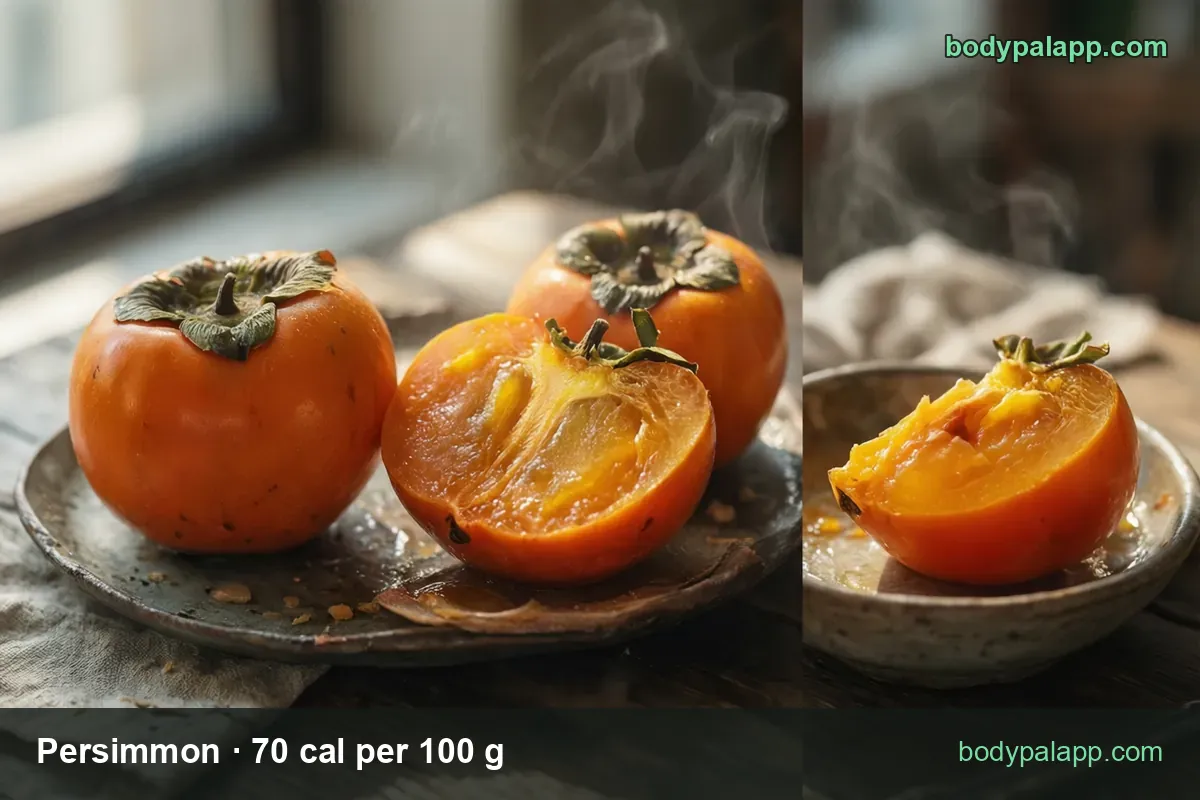
One word, two very different fruits. The Japanese persimmon that fills US produce shelves is 70 calories per 100 g. The native American persimmon, the small wild fruit that drops off trees across the South and Midwest in fall, is 127 calories per 100 g. Same name, 81% more energy per gram, because the wild fruit is denser and far less watery.
The saving grace is size. A native persimmon is tiny, about 25 g once the seeds and calyx are out, so a whole one is 32 calories. You would need roughly four of them to match a single store Fuyu.
| Version | Per 100 g | Typical piece | Calories |
|---|---|---|---|
| Japanese persimmon (Fuyu or Hachiya), raw | 70 kcal | 1 fruit, 170 g | 119 kcal |
| Persimmon, raw, one slice | 70 kcal | 1 slice, 20 g | 14 kcal |
| Native American persimmon, raw | 127 kcal | 1 fruit, seeds out, 25 g | 32 kcal |
| Dried Japanese persimmon (hoshigaki style) | 274 kcal | 1 dried fruit, 34 g | 93 kcal |
| Dried persimmon slices | 374 kcal | 1 cup, 160 g | 598 kcal |
| Dried persimmon, single piece | 374 kcal | 1 slice or chunk, 8 g | 30 kcal |
Slices are the practical unit for a firm Fuyu. At 20 g a slice, 14 calories each, a whole fruit fanned across a salad is eight or nine slices and still just 118 calories. Packaged fruit snacks made with persimmon sit in a different tier: RIND's skin-on superfruit blend of persimmon, apple and peach is 326 calories per 100 g, and its 43 g (1.5 oz) bag is 140 calories, more than the whole fresh fruit it came from.
Dried persimmon is a different food
This is where persimmon logging goes wrong. Drying removes the water and leaves the sugar, so per 100 g the number jumps from 70 to somewhere between 274 and 374, depending on how far the drying went. The FNDDS dried record at 374 calories per 100 g reflects a harder dry than the SR Legacy dried fruit at 274.
A cup of dried slices weighs 160 g and comes to 598 calories — about five fresh persimmons, in a portion you can finish standing at the counter. One dried whole fruit at 34 g is 93 calories, close to a fresh one; one chunk at 8 g is 30. Carbohydrate follows the same curve, from 18.59 g per 100 g fresh to 73.43 g in the SR Legacy dried record and 96.07 g in the FNDDS one, where total sugars run 80.06 g per 100 g. Fiber concentrates too, to 14.5 g per 100 g, which is the one thing drying improves.
Practical rule: treat fresh persimmon as fruit and dried persimmon as candy with fiber in it. Both count as fruit under MyPlate, but a half-cup of dried counts the same as a full cup of fresh, at 374 calories per 100 g against 70.
Fiber is the row that beats the calories
Most fruit gives you fiber in proportion to its calories. Persimmon does better than that. One medium fruit is 6.0 g of fiber, 22% of the 28 g Daily Value, for 118 calories. Put another way, a fifth of a day's fiber for under 6% of a 2,000-calorie day. Very little fresh produce clears that ratio.
That matters because fiber is one of the nutrients Americans consistently under-eat; the Dietary Guidelines for Americans flag it as a nutrient of public health concern. If your gap is fiber rather than calories, persimmon is one of the cheapest ways to close it.
The counterweight is sugar: 21.1 g of total sugars per fruit. All of it comes packaged with the fruit's fiber and water, and total sugars have no Daily Value, so there is no percentage to compare it against — the 50 g added sugars limit does not apply to a raw persimmon. Protein is negligible at 1.0 g, so this is not a fruit that carries a snack on its own. Pair it with a handful of nuts or some cottage cheese if you need the snack to hold.
How does a persimmon compare?
Weighed the same way, against the other dense-fleshed fruits it shares a display with:
| Fruit | Per 100 g | US serving | Calories |
|---|---|---|---|
| Persimmon, japanese, raw | 70 kcal | 1 oz, 28 g | 20 kcal |
| Mamey sapote, raw | 124 kcal | 1 oz, 28 g | 35 kcal |
| Plantain, yellow, raw | 122 kcal | 1 oz, 28 g | 35 kcal |
| Avocado, Florida, raw | 120 kcal | 1 oz, 28 g | 34 kcal |
Our take: persimmon is the lightest of the four per gram, by a wide margin — the other three are all within 4 calories of each other per 100 g and all at least 50 higher than persimmon. If you are choosing a filling fruit for a calorie target, persimmon wins on volume; you can eat a whole one for what three and a half ounces of Florida avocado costs you. The avocado wins on staying power, since most of its 120 calories are fat rather than sugar. For a lunchbox or an afternoon slump, take the persimmon whole and skip the dried bag.
Most popular persimmon brands in the United States
Ranked by how widely each product appears among foods sold in the United States, from the BodyPal food database of over 3.3 million products. Calories are the figures printed on each Nutrition Facts label, checked against USDA FoodData Central.
| Product | Calories (per 100 g) |
|---|---|
| RIND Sweet Persimmon, Tart Apple & Tangy Peach Superfruit Snack | 326 cal |
Brand popularity: BodyPal food database. Nutrition: manufacturer labels / USDA FoodData Central.
Persimmon FAQs
How many calories are in one persimmon?
118 calories for a medium Japanese persimmon weighing 168 g, the round orange kind sold as Fuyu or Hachiya. Per 100 g the raw fruit is 70 calories. Half of one is 59 calories, and two fruits on a plate come to 235.
How many calories in half a persimmon?
59 calories for half a medium fruit, 84 g. That is our own arithmetic from the USDA 100 g figure rather than a listed USDA serving, since the database stops at the whole fruit. Half a persimmon still brings 3 g of fiber, and it slices cleanly if the fruit is firm.
Is a Fuyu persimmon the same as a Hachiya?
For calories, yes. USDA files both under Persimmons, japanese, raw at 70 calories per 100 g, so a 168 g fruit is 118 either way. The difference is texture and timing: squat Fuyu is eaten firm like an apple, acorn-shaped Hachiya only when it turns jelly-soft.
How many carbs are in a persimmon?
31.2 g of carbohydrate in one medium 168 g fruit, which is 11% of the 275 g Daily Value. Of that, 21.1 g is total sugars and 6.0 g is fiber. Per 100 g the raw fruit holds 18.59 g of carbohydrate. Dried persimmon is a different animal at 73.43 g per 100 g.
How much fiber is in a persimmon?
6.0 g in one medium 168 g fruit, or 22% of the 28 g Daily Value, from 3.6 g per 100 g. That is the standout row on the label: the fruit delivers a fifth of a day's fiber for 118 calories, and dried persimmon concentrates it to 14.5 g per 100 g.
How many calories are in dried persimmon?
93 calories for one dried Japanese persimmon of 34 g, and 598 for a full cup of dried slices at 160 g. Per 100 g dried runs 274 to 374 calories depending on how far the drying went, against 70 fresh. A cup is roughly five fresh fruits.
Are persimmons good for weight loss?
At 70 calories per 100 g with 3.6 g of fiber, a whole fresh persimmon is an easy fruit to fit: 118 calories for a filling medium fruit. Dried is the trap, since 160 g of slices is 598. MyPlate counts either toward your daily fruit cups.
Do persimmons have a lot of sugar?
21.1 g of total sugars in a medium 168 g fruit, all of it naturally occurring; USDA does not publish an added sugars figure for this record. Total sugars carry no Daily Value, so there is nothing to compare it against. Dried slices climb to 80.06 g per 100 g.
Similar foods
- Grapes — 104 cal per cup
- Grapes Black — 104 cal per cup
- Green Grapes — 104 cal per cup
- Purple Grapes — 104 cal per cup
- Grapes, Seedless — 104 cal per cup
- White Grapes — 104 cal per cup
Count it without the math
Point the camera at the plate and BodyPal counts the persimmon for you, whole, sliced or dried.


How long does it take to burn off persimmon?
One medium fruit (168 g) is 118 kcal. Enter your weight and the amount you ate to see how long it takes you to burn that off:
lb
| Activity | Time to burn 118 kcal |
|---|---|
| Walking, brisk | 24 min |
| Cycling, moderate | 15 min |
| Swimming, moderate | 17 min |
| Jogging | 14 min |
| Weight training, moderate | 26 min |
Times are for a 155 lb adult at a steady pace; change the weight to see yours. The amount is set to the portion in the text (168 g); change it to what you actually ate. BodyPal works this out from your steps automatically.
Want the bigger picture? Calculate your daily calorie needs — your maintenance figure, a target for losing or gaining, and the date you get there.