Brazil nuts calories come to 185 for a 1 oz (28 g) serving and 659 per 100 g, with a single 5 g nut at 33. The thing to notice is the fat: it supplies 85% of the calories, so a loose handful adds up much faster than the small nut count suggests.
185kcal
1 ounce · 28 g, dried, unblanched
8%protein
4 gProtein
3 gCarbs
18.8 gFat
How to burn off 185 kcal
—Walking, brisk
—Jogging
—Cycling, moderate
—Swimming
Skip the math. BodyPal counts these calories from your steps and workouts automatically.
Nutrition facts
Dried, unblanched · per 28 g
Calories
185 kcal
Protein
4 g
Carbohydrate
3.3 g
Fat
18.8 g
Saturated fat
4.5 g
Cholesterol
0 mg
Sodium
1 mg
Potassium
185 mg
Iron
0.7 mg
Source: USDA FoodData Central
🛡️
Verified nutrition data
Numbers on this page come from USDA FoodData Central, the U.S. Department of Agriculture’s food composition database, and from manufacturer labels where a branded product is named. Last verified September 2026. How we verify our data →
Brazil nuts: calories, protein and sodium by serving
Percent of daily value uses the FDA reference of 2,000 kcal a day.
Serving
kcal
Protein
Carbs
Fat
Sodium
% DV kcal
1 oz (28 g)
185
4 g
3.3 g
18.8 g
1 mg
9%
1 nut (5 g)
33
0.7 g
0.6 g
3.4 g
0 mg
2%
1 cup whole (133 g)
876
19 g
15.6 g
89.2 g
4 mg
44%
100 g
659
14.3 g
11.7 g
67.1 g
3 mg
33%
3 × 1 oz (28 g)
554
12 g
3 mg
5 × 1 oz (28 g)
923
20 g
4 mg
One nut is 33 calories, an ounce is 185
The smallest unit here is the nut itself. One Brazil nut weighs about 5 g and carries 33 calories, 0.7 g of protein and 3.4 g of fat. That makes this one of the few snacks you can count by the piece, and counting is the most reliable way to keep the total honest.
The standard label serving is 1 oz (28 g), which comes to 185 calories, 4 g of protein and 18.8 g of fat. That is 9% of the daily calorie value from a portion that fits in a cupped palm. Doubling it to 2 oz (56 g) takes you to 369 calories, and 3 oz (84 g) lands at 554.
The jump gets steep when you pour from the bag. A full cup of whole nuts (133 g) holds 876 calories, or 44% of the daily value, and 5 oz (140 g) reaches 923. If you snack straight from a container, count out the nuts first and close the bag. The gap between one ounce and one cup is the whole story of this food.
Fat supplies 85% of every calorie
Brazil nuts are a fat food with some protein attached. Per 100 g they hold 67.1 g of fat, 14.3 g of protein and 11.7 g of carbs, and the calorie split is 85% fat, 8% protein and 7% carbs. Protein is present, but it is not the reason to eat them. One ounce gives 4 g of protein, which is 8% of the daily value.
Saturated fat is the number worth a second look. There are 16.1 g per 100 g, set against a 20 g daily value for saturated fat. Most of the fat is not saturated, and a single ounce carries a modest slice of that figure. Still, it is the row that climbs fastest as portions grow toward a cup.
Carbs stay low. One ounce has 3.3 g of carbs, 2.1 g of fiber and just 0.7 g of sugars, so the nuts barely register on the carb side of a food log. If you track sugar or carbs, Brazil nuts are an easy fit. If you track fat or total calories, they need a plan.
Plain Brazil nuts carry almost no sodium
Plain dried, unblanched Brazil nuts have 3 mg of sodium per 100 g and 1 mg per ounce, which works out to 0% of the daily value. Even a full cup carries only 4 mg. Cholesterol is 0. On the salt front, the plain nut is about as clean as snack food gets.
That can change with seasoning. Salted, roasted or mixed bags are a different product, and the brand table on this page is the place to check them. The cashew nut entry in our compare table lists 640 mg of sodium per 100 g, a clear sign that you should read labels before assuming any nut is low in salt.
Potassium and fiber are the quieter positives. Per 100 g there are 659 mg of potassium against a 4700 mg daily value, and 7.5 g of fiber against a 28 g daily value. A one-ounce serving brings 2.1 g of that fiber, a small but real contribution to the day.
Use Brazil nuts as a topping, not a bowl
At 33 calories each, Brazil nuts work best as an add-on. Two or three chopped over yogurt, oatmeal or a salad add crunch and richness for well under a full ounce. That keeps the calories visible instead of buried in a handful you forgot to count.
Because 85% of the calories come from fat, pairing them with a food that brings protein or fiber rounds out a snack. An apple, a bowl of plain yogurt or a boiled egg next to a few nuts makes a more balanced plate than a bigger pile of nuts alone. You get the flavor without the full fat load.
If you are counting calories, log the nuts by count or by weight rather than by eye. BodyPal can log Brazil nuts from a photo, and the 5 g per nut figure settles any doubt on a kitchen scale. Brands such as Woodstock Brazil Nuts and Nature's Eats Brazil Nuts appear in the table above; check the label if a bag is roasted or salted.
How does Brazil nuts compare?
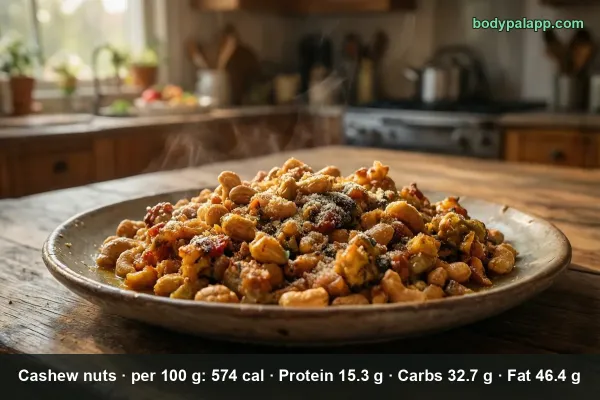
Here is how Brazil nuts stack up against cashews, almonds and pumpkin seeds, per 100 g and per usual serving.
Verdict: Brazil nuts are the most calorie-dense of the four at 659 per 100 g, so for weight loss pumpkin seeds at 161 per 1 oz (28 g) or almonds at 167 are the leaner pick. For protein, pumpkin seeds win clearly with 29.8 g per 100 g against 14.3 g here.
Most popular Brazil nuts brands in the United States
Ranked by popularity in the BodyPal database
# Productkcal / 100 g
1Woodstock Brazil Nuts30 g667 kcal
2Woodstock Organic Brazil Nuts8 pieces · 30 g733 kcal
3Nature's Eats Brazil Nuts1 oz · 28 g679 kcal
4Nature's Place Brazil Nuts1/4 cup · 30 g667 kcal
5Nature's Garden Brazil Nuts10 pieces · 30 g667 kcal
6Nature's Harvest Brazil Nuts1 oz · 28 g643 kcal
These are the same raw, dried kernels as the number above, but label values are rounded per serving, so they read anywhere from 643 to 733 calories per 100 g. Source: manufacturer labels / USDA FoodData Central.
Brazil nuts FAQs
How many calories are in Brazil nuts?
One ounce (28 g), about six kernels, is 185 calories, and a single nut is 33 calories. Per 100 g, Brazil nuts have 659 calories.
Are Brazil nuts good for weight loss?
An ounce is 185 calories and 18.8 g of fat, one of the higher counts among nuts, so the portion size matters. Two nuts come to 66 calories.
Brazil nuts vs cashews: which has more calories?
Brazil nuts have 659 calories per 100 g and cashews 574, a difference of 85 calories per 100 g.
How much protein and fat is in Brazil nuts?
Per 100 g there are 14.3 g of protein and 67.1 g of fat, of which 16.1 g is saturated. An ounce (28 g) gives 4 g of protein and 18.8 g of fat.
How many calories are in one Brazil nut?
One Brazil nut has 33 calories. It weighs about 5 g and carries 0.7 g of protein and 3.4 g of fat, which is why counting nuts is the simplest way to track them.
How many calories are in 2, 3 or 4 Brazil nuts?
Each Brazil nut adds 33 calories, so multiply 33 by your count. Even 4 nuts stay well below the 185 calories in a 1 oz (28 g) serving, which makes a few nuts an easy add-on to a meal.
How many calories are in 10 Brazil nuts?
At 33 calories per nut, 10 Brazil nuts come in just under the 369 calories listed for 2 oz (56 g). Ten nuts weigh a little less than that portion, so treat 369 as the ceiling.
How many calories are in one raw Brazil nut?
One nut has 33 calories, based on the USDA row for dried, unblanched Brazil nuts, the closest match to raw. Roasted or salted nuts can differ, so check the label on those bags.