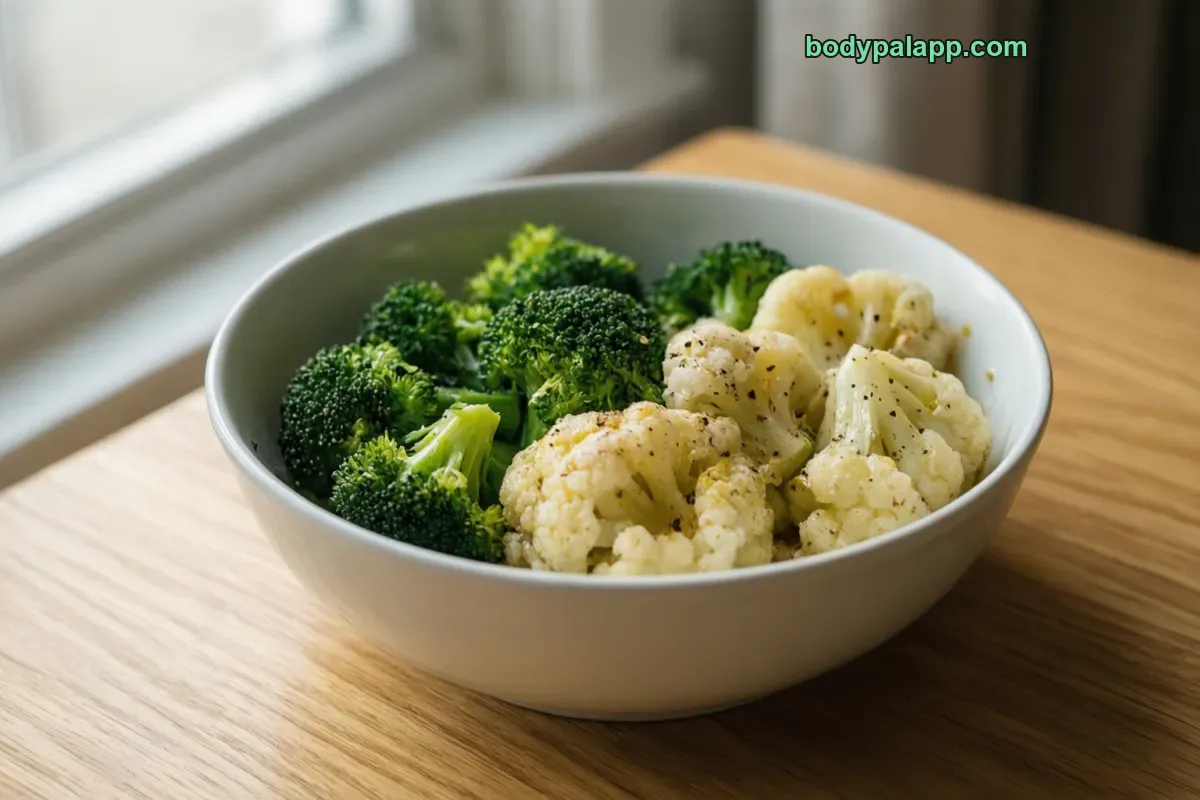
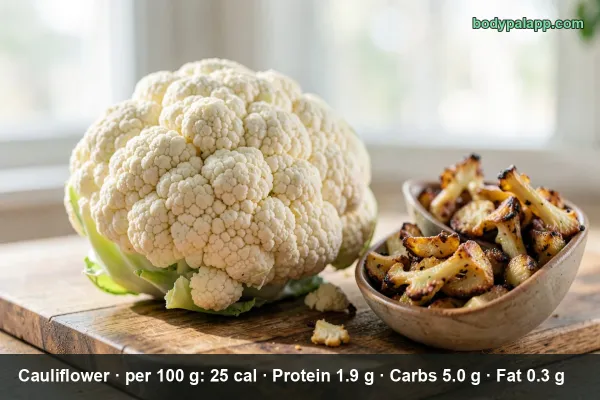
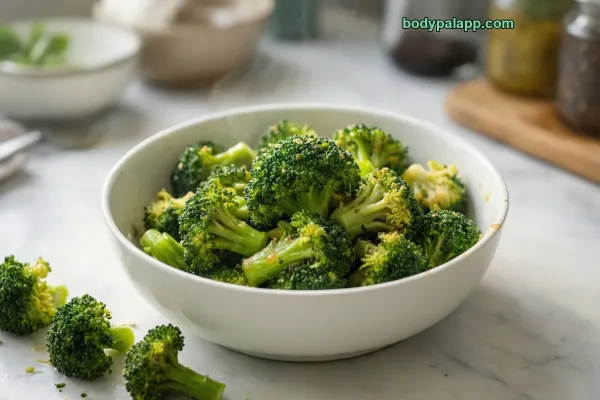
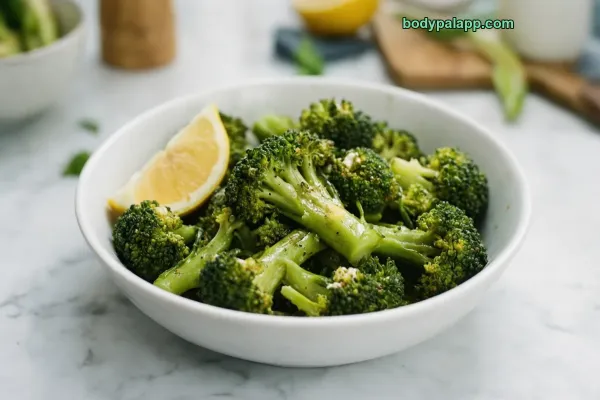
Broccoli and cauliflower calories come to 36 for 1 cup (155 g) and 23 per 100 g, cooked with no added fat. The thing to notice is what cooking fat does: the same cup made with fat reaches 74 calories, about double. Sodium is the other row worth a glance, at 202 mg per cup.
36kcal
1 cup · 155 g, cooked, no added fat
32%protein
3.6 gProtein
7 gCarbs
0.3 gFat
How to burn off 36 kcal
—Walking, brisk
—Jogging
—Cycling, moderate
—Swimming
Skip the math. BodyPal counts these calories from your steps and workouts automatically.
Nutrition facts
Cooked, no added fat · per 155 g
Calories
36 kcal
Protein
3.6 g
Carbohydrate
7 g
Fat
0.3 g
Saturated fat
0 g
Cholesterol
0 mg
Sodium
202 mg
Potassium
217 mg
Iron
0.8 mg
Source: USDA FoodData Central
🛡️
Verified nutrition data
Numbers on this page come from USDA FoodData Central, the U.S. Department of Agriculture’s food composition database, and from manufacturer labels where a branded product is named. Last verified September 2026. How we verify our data →
Broccoli and cauliflower: calories, protein and sodium by serving
Percent of daily value uses the FDA reference of 2,000 kcal a day.
Serving
kcal
Protein
Carbs
Fat
Sodium
% DV kcal
1 cup (155 g)
36
3.6 g
7 g
0.3 g
202 mg
2%
Cooked with fat, 1 cup (160 g)
74
3.7 g
7.1 g
4.3 g
216 mg
4%
100 g
23
2.4 g
4.5 g
0.2 g
130 mg
1%
3 × 1 cup (155 g)
107
10.9 g
605 mg
5 × 1 cup (155 g)
178
18.2 g
1,008 mg
Five cups of the blend still come in at 178 calories
A plain cup of cooked broccoli and cauliflower is 36 calories, which is 2% of a 2000-calorie daily value. That is a small number for a full cup of food. You can pile this vegetable mix high without the total moving much.
Doubling up to 2 cups (310 g) gives 71 calories. Three cups (465 g) lands at 107. Even a very large bowl of 5 cups (775 g) adds up to only 178 calories, less than many single snack bars. The volume grows fast while the calories barely climb.
Protein grows along with the portion: 3.6 g in one cup, 7.3 g in two, 10.9 g in three and 18.2 g in five. Fiber follows the same path, with 4.3 g in a single cup. If you build meals around big servings of vegetables, this blend is one of the cheapest ways in calories to fill the plate.
Carbs supply most of the calories, but protein takes a third
Of the calories in broccoli and cauliflower, 62% come from carbohydrate, 32% from protein and only 5% from fat. Per 100 g that works out to 4.5 g carbs, 2.4 g protein and 0.2 g fat. Saturated fat and cholesterol are both 0.
The carbs here are not the sugary kind. Of the 4.5 g per 100 g, 2.8 g is fiber and just 1.3 g is sugars. A cup brings 4.3 g of fiber and 2 g of sugars, so most of the carbohydrate is the structural part of the plant.
The protein share looks impressive as a percentage, yet the gram count stays modest. One cup gives 3.6 g, which is 7% of the 50 g daily value. Treat the blend as a high-volume side that adds a little protein, not as the protein anchor of a meal.
Cooking it with fat roughly doubles the calories
The USDA lists two versions of this mix. Cooked with no added fat, 1 cup (155 g) is 36 calories with 0.3 g of fat. Cooked with fat, 1 cup (160 g) jumps to 74 calories with 4.3 g of fat. The vegetables did not change; the oil or butter did.
Everything else stays nearly flat between the two. Protein goes from 3.6 g to 3.7 g, carbs from 7 g to 7.1 g, fiber from 4.3 g to 4.5 g. So the extra calories are almost entirely fat, which is the one lever you control in the kitchen.
If you want the lowest number, steam or boil the blend and season it after. If you prefer it roasted or sauteed, the 74-calorie cup is still a light side dish. Just log the version you actually ate, because the gap between the two is about double.
Sodium is the row to watch in big bowls
Plain cooked broccoli and cauliflower carries 130 mg of sodium per 100 g, and 202 mg per cup. That is 9% of the 2300 mg daily value. The USDA figure reflects the cooked dish, so the salt in the cooking water is part of the count.
The number scales with the bowl. Two cups bring 403 mg, three cups 605 mg, and 5 cups reach 1,008 mg. For comparison, plain cauliflower on its own lists 30 mg per 100 g, and steamed broccoli florets 41 mg. If you watch sodium, cooking the vegetables unsalted is the easiest fix.
As a side, the blend pairs well with a lean protein and a whole grain, filling out the plate with volume and fiber for few calories. Potassium sits at 140 mg per 100 g. BodyPal can log the mix from a photo, so a bigger serving does not need a measuring cup.
How does broccoli and cauliflower compare?
Here is how the broccoli and cauliflower blend compares with plain cauliflower, steamed broccoli florets and cooked broccoli, per 100 g and per usual serving.
Verdict: For the fewest calories, the blend wins at 23 per 100 g, just under cauliflower at 25 and well below broccoli at 35. If sodium matters more to you, plain cauliflower at 30 mg or broccoli at 41 mg per 100 g beat the blend's 130 mg.
Most popular broccoli and cauliflower brands in the United States
Ranked by popularity in the BodyPal database
# Productkcal / 100 g
1Weis Broccoli Cauliflower Blend1 cup · 79 g32 kcal
Frozen blends are labeled per uncooked weight, so they read higher than the cooked number above. Source: manufacturer labels / USDA FoodData Central.
Broccoli and cauliflower FAQs
How many calories are in a cup of broccoli and cauliflower?
About 36 calories in a cup (155 g) cooked without fat, or 74 in a cup (160 g) cooked with fat added.
Is broccoli and cauliflower good for weight loss?
It has 23 calories per 100 g, and a cup gives 4.3 g of fiber for 36 calories.
Broccoli and cauliflower vs cauliflower: which has fewer calories?
The cooked mix has 23 calories per 100 g and plain cauliflower has 25, so they are nearly the same.
How much protein is in broccoli and cauliflower?
A cup (155 g) has 3.6 g of protein and 7.0 g of carbs, with 0.3 g of fat.
How many calories are in broccoli and cauliflower cooked with oil or butter?
One cup (160 g) cooked with fat has 74 calories and 4.3 g of fat. The same cup with no added fat is 36 calories, so the cooking fat roughly doubles the total.
How many calories are in 100 grams of cooked broccoli and cauliflower?
100 g of cooked broccoli and cauliflower has 23 calories, with 2.4 g protein, 4.5 g carbs and 0.2 g fat. That is about 1% of a 2000-calorie daily value.
How much fiber is in a cup of broccoli and cauliflower?
A cup (155 g) of the cooked blend has 4.3 g of fiber. Per 100 g it is 2.8 g, which makes up a large part of the 4.5 g total carbohydrate.
How much sodium is in broccoli and cauliflower?
One cup has 202 mg of sodium, 9% of the 2300 mg daily value. Per 100 g it is 130 mg, more than plain cauliflower at 30 mg, likely from salted cooking.
Is broccoli and cauliflower low in sugar?
Yes. A cup contains 2 g of sugars and 100 g contains 1.3 g. Most of the carbohydrate is fiber rather than sugar, with 2.8 g of fiber per 100 g.