
How many calories are in butternut squash soup?
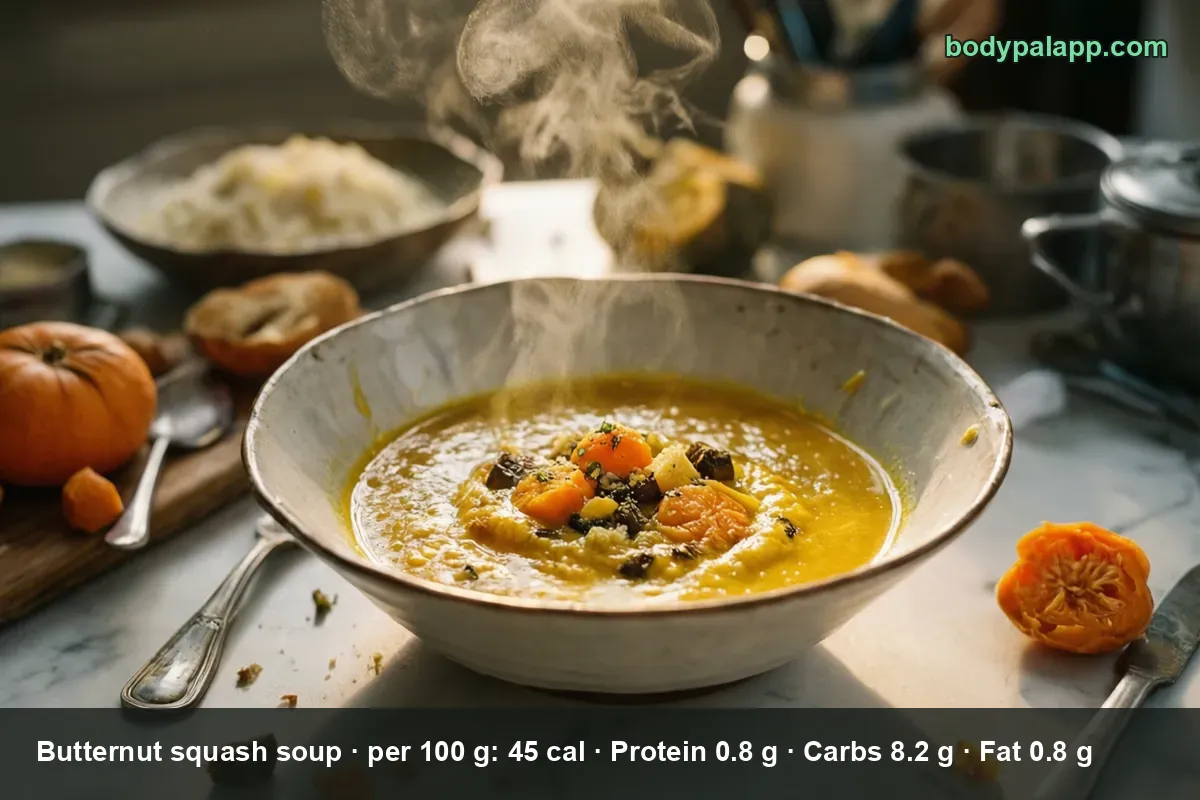
A 1-cup serving of butternut squash soup is 110 calories, and per 100 g the soup runs 45 calories — lighter than almost anything else you would call a first course. Fill a real soup bowl with two cups and you are at 221. The squash is not what moves that number. The cream is.
On this page
- Butternut squash soup quick facts
- US servings, from one ounce to a two-cup bowl
- Sage, apple and cream-style versions
- Sodium is the row to watch
- How does butternut squash soup compare?
- Most popular butternut squash soup brands
- FAQ
Butternut squash soup quick facts
There is no Foundation, SR Legacy or FNDDS entry for this soup — two searches of USDA FoodData Central return no generic record at all, because butternut squash soup is something you buy in a carton far more often than something a survey respondent describes. So the headline number here comes off a label: FDC 2015207, "Butternut Squash Soup" from Amy's, the most widely stocked plain version in US grocery stores.
That choice holds up against the field. At 45 calories per 100 g it sits exactly on the median of the twelve store soups in the Branded database, which run from 24 to 73. If you are holding a carton of something else, the plain soup below is still the right anchor, and the variant table further down shows how far your version can drift.
| Nutrient | Per 100 g | Per 1 cup (245 g) | % Daily Value |
|---|---|---|---|
| Calories | 45 | 110 | — |
| Total fat | 0.82 g | 2.0 g | 3% |
| Saturated fat | 0 g | 0 g | 0% |
| Carbohydrate | 8.16 g | 20.0 g | 7% |
| Dietary fiber | 0.8 g | 2.0 g | 7% |
| Total sugars | 1.63 g | 4.0 g | — |
| Protein | 0.82 g | 2.0 g | 4% |
| Sodium | 118 mg | 289 mg | 13% |
| Cholesterol | 0 mg | 0 mg | 0% |
% Daily Value is based on a 2,000-calorie diet.
Verified nutrition data
Numbers on this page come from USDA FoodData Central, the U.S. Department of Agriculture’s food composition database, and from manufacturer labels where a branded product is named. Last verified September 2026. How we verify our data →
Two rows you will not find above. Added sugars are missing because this label does not declare them, and potassium is missing for the same reason — a packaged food only has to list what it lists, and neither figure appears on this record. Trans fat is 0 g and adds nothing, so it is left out too. Total sugars have no Daily Value under the FDA's label rules, which is why that cell shows a dash rather than a percentage.
US servings, from one ounce to a two-cup bowl
| Serving | Weight | Calories |
|---|---|---|
| 1 oz | 28 g | 13 kcal |
| 1/2 cup | 123 g | 55 kcal |
| 1 cup, the label serving | 245 g | 110 kcal |
| 8 oz, a cup-size deli portion | 227 g | 102 kcal |
| 1 bowl, 2 cups | 490 g | 221 kcal |
| Per 100 g | 100 g | 45 kcal |
Only the 1-cup row is a serving USDA actually lists. Everything else is our own arithmetic from the 45-calories-per-100-g figure, scaled straight up or down — useful, but not a number you will find printed anywhere.
The row that trips people is the bowl. A restaurant cup of soup is about 8 oz and a bowl is about twice that, so what feels like "a serving" at the table is usually two label servings and 221 calories. The carton, meanwhile, is portioned in cups. If you pour until the bowl looks full and log one cup, you have understated it by half.
Sage, apple and cream-style versions
| Version | Per 100 g | Typical serving | Calories |
|---|---|---|---|
| Light store-brand butternut squash soup | 24 kcal | 1 cup (245 g) | 59 kcal |
| Organic butternut squash soup | 29 kcal | 1 cup (245 g) | 71 kcal |
| Autumn squash soup | 40 kcal | 1 cup (227 g) | 91 kcal |
| Plain butternut squash soup (the record above) | 45 kcal | 1 cup (245 g) | 110 kcal |
| Butternut squash soup with sage | 48 kcal | 8 oz (227 g) | 109 kcal |
| Cream-style butternut squash soup | 69 kcal | 1 cup (245 g) | 169 kcal |
| Butternut squash, sweet potato and apple soup | 73 kcal | 1 cup (245 g) | 179 kcal |
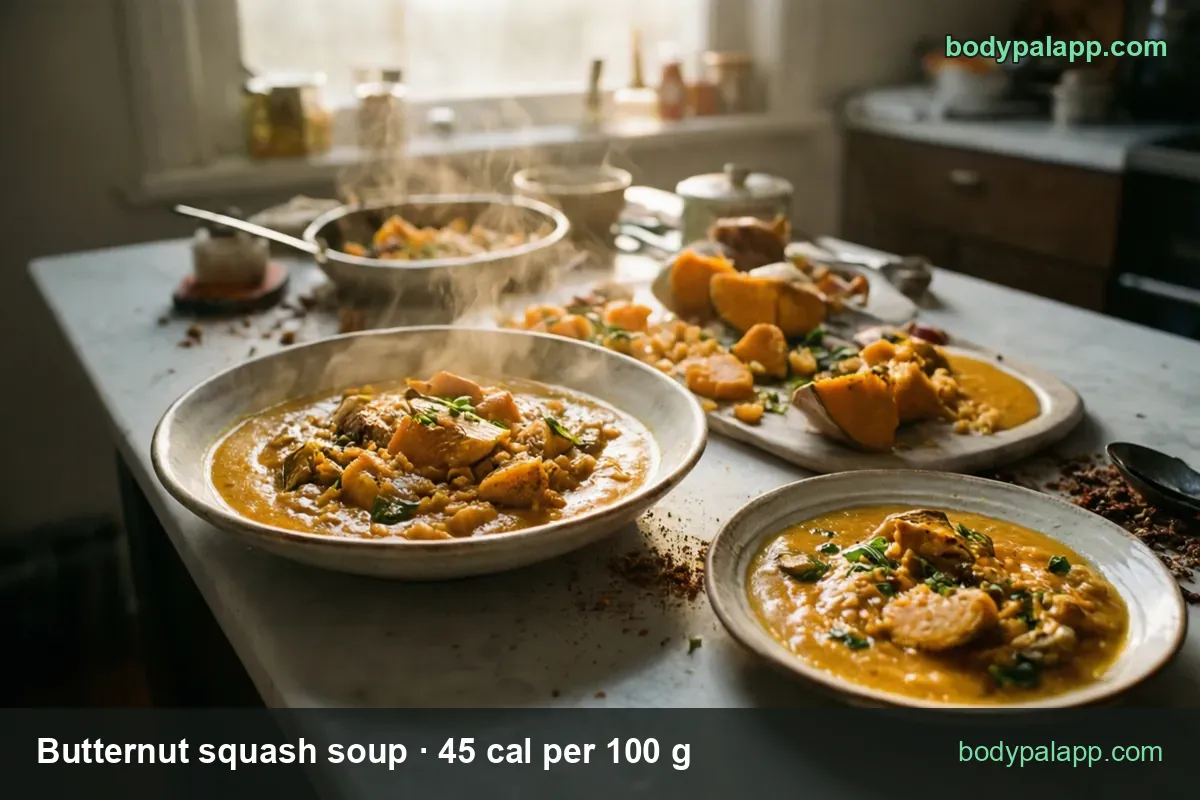
Top to bottom that is 24 to 73 calories per 100 g — just over threefold, from the same orange soup. Per cup it is 59 against 179, a gap of 120 calories that has nothing to do with how much squash went in.
Two ingredients explain almost all of it. Cream lifts the cream-style version to 69 per 100 g, with 3.27 g of fat and 2.04 g of saturated fat in every 100 g against zero saturated fat in the plain soup. Sweet potato and apple lift the third-party organic version to 73 by adding sugars and starch rather than fat. The sage version sits close to plain at 48, because herbs are free; its 109 calories only look lower than the plain cup because the serving is 8 oz rather than a full cup.
Brand names track the same spread. Archer Farms at Target is 33 per 100 g and Simply Balanced 41; Whole Foods Market's own soup is 38 and Boulder Organic's sage version 48. Kroger's Simple Truth Organic with sweet potato and apple is the outlier at 73. Read the per-100-g line on the carton before you assume yours behaves like the plain one.
Sodium is the row to watch
Calories are not the interesting number on this label. Sodium is. A cup of the plain soup carries 289 mg, 13% of the 2,300 mg Daily Value, which is unremarkable. But the same cup of one store version works out to 711 mg — 31% of the DV, two and a half times as much salt for a difference of only 30 calories a cup. That is about a third of a teaspoon of table salt in one cup.
Within the Branded records the low end is Boulder Organic at 145 mg per 100 g and the high end Our Family at 290 mg per 100 g. Per cup those become roughly 355 mg and 711 mg respectively, and over 1,400 mg for a two-cup bowl of the saltier one. If you are watching sodium, the carton's per-100-g sodium figure is a better screen than its calorie count.
The other row worth noticing is protein: 2.0 g a cup, 4% of the DV. That is a vegetable side masquerading as a main course. The fiber is real but modest at 2.0 g, 7% of the DV, and the soup counts toward the vegetable group that MyPlate asks you to fill a quarter of the plate with. Treat it as the vegetable, not the meal, and it earns its place.
How does butternut squash soup compare?
| Food | Per 100 g | US serving | Calories |
|---|---|---|---|
| Butternut squash soup | 45 kcal | 1 cup (245 g) | 110 kcal |
| Butternut squash, baked | 40 kcal | 1 cup cubes (205 g) | 82 kcal |
| Butternut squash, raw | 45 kcal | 1 cup cubes (140 g) | 63 kcal |
| Butternut squash, frozen, boiled | 39 kcal | 1 cup mashed (240 g) | 94 kcal |
Here is the cup trap in one table. Per 100 g the soup and the raw squash are identical at 45, and the baked cubes are actually lighter at 40 — yet a cup of soup is 110 and a cup of baked cubes only 82. Nothing was added to make that true. A cup of liquid soup weighs 245 g while a cup of loose cubes weighs 205 g, and raw cubes only 140 g. The cup is the variable, not the food.
Our take: for pure calorie value, baked squash cubes win — 82 a cup, with 10.49 g of carbohydrate per 100 g and essentially no fat. But nobody eats a cup of plain baked squash on a cold evening, and the soup at 110 a cup is still one of the cheapest hot dishes you can put in a bowl. Buy the plain carton rather than the apple-and-sweet-potato one, keep the portion honest at one cup, and add the protein separately. That single swap is worth more than 60 calories a serving before you have changed anything else about the meal.
Most popular butternut squash soup brands in the United States
Ranked by how widely each product appears among foods sold in the United States, from the BodyPal food database of over 3.3 million products. Calories are the figures printed on each Nutrition Facts label, checked against USDA FoodData Central.
| Product | Calories (per 100 g) |
|---|---|
| Archer Farms Butternut Squash Soup | 33 cal |
| Boulder Organic! Butternut Squash Soup with Sage | 48 cal |
| Simple Truth Organic Butternut Squash Soup with Sweet Potato & Apple | 73 cal |
| Amy's Butternut Squash Soup | 45 cal |
| Whole Foods Market Butternut Squash Soup | 38 cal |
| Simply Balanced Butternut Squash Soup | 41 cal |
Brand popularity: BodyPal food database. Nutrition: manufacturer labels / USDA FoodData Central.
Butternut squash soup FAQs
How many calories in 1 cup of butternut squash soup?
110 calories for a 1-cup (245 g) serving, the label serving on Amy's Butternut Squash Soup, which works out to 45 calories per 100 g. Store brands move that number: the lightest in USDA's data lands near 59 a cup, the cream-style one near 169.
How many calories are in a bowl of butternut squash soup?
About 221 calories for a two-cup bowl (490 g). That is our own arithmetic from the 45 calories per 100 g on the USDA record, not a listed serving. A smaller 8 oz cup of soup (227 g) is 102 calories, and half a cup is 55.
How many carbs are in butternut squash soup?
20.0 grams of carbohydrate in a 1-cup (245 g) serving, 7% of the Daily Value, from 8.16 g per 100 g. Two of those grams are fiber and four are total sugars, so the rest is starch from the squash itself. A two-cup bowl doubles it to 40 g.
Does butternut squash soup have a lot of sodium?
289 mg in a 1-cup serving, 13% of the 2,300 mg Daily Value, which is moderate for a packaged soup. The range is wide, though. One store version works out to 711 mg a cup, 31% of the DV, roughly two and a half times as much salt in the same cup.
Is butternut squash soup high in sugar?
4.0 grams of total sugars in a 1-cup serving, most of it from the squash. Total sugars carry no Daily Value on the US label, so there is no percentage to quote, and this record's label does not declare added sugars at all. Sweetened versions with apple reach 179 calories a cup.
Is butternut squash soup good for weight loss?
At 110 calories a cup and 45 per 100 g it is one of the cheapest hot dishes you can put in a bowl, and a full two-cup bowl is still only 221. The catch is staying power: 2 g of protein per cup is not much, so pair it with a protein rather than eating it alone.
How many calories in homemade butternut squash soup with cream?
USDA does not publish a record for a homemade recipe, so the closest stand-in is a cream-style deli soup at 69 calories per 100 g, or 169 a cup. That is about 60 calories a cup above the plain version, and every extra splash of cream pushes it further up.
How many calories in Panera autumn squash soup?
The nearest packaged autumn squash soup in USDA's data runs 40 calories per 100 g, or 91 for a 1-cup (227 g) serving. USDA does not carry restaurant-chain records for this soup, so there is no verified figure to quote for Panera's own version. Check the chain's posted nutrition for theirs.
Similar foods
- Carrot — 53 cal per cup chopped
- Onion — 46 cal per cup sliced
- Broccoli — 55 cal per cup chopped
- Bamboo Shoots — 41 cal per cup sliced
- Bell Pepper — 31 cal per medium
- Bell Pepper — 24 cal green, 31 red
Count it without the math
Point the camera at the bowl and BodyPal counts the soup for you, cream and all.


How long does it take to burn off 110 kcal of butternut squash soup?
A 1-cup (245 g) serving is 110 kcal. Enter your weight and the amount you ate to see how long it takes you to burn that off:
lb
| Activity | Time to burn 110 kcal |
|---|---|
| Walking, brisk | 22 min |
| Cycling, moderate | 14 min |
| Swimming, moderate | 16 min |
| Jogging | 13 min |
| Weight training, moderate | 24 min |
Times are for a 155 lb adult at a steady pace; change the weight to see yours. The amount is set to the portion in the text (245 g); change it to what you actually ate. BodyPal works this out from your steps automatically.
Burning it off is one side of it. The other is knowing your number: work out how many calories you need a day, with macros and a goal date.