
How many calories are in a bell pepper?
One medium red bell pepper weighs 119 g and carries 31 calories. Per 100 g the raw flesh is 26 calories. A whole cup of chopped red pepper still lands at 39, and a green one of the same size is 24. Color moves the number by a few calories, and the pan can multiply it by five.
On this page
- Bell pepper quick facts
- US servings from one ounce to a large pepper
- What color does to the calorie count
- Roasted and sauteed peppers
- Jalapenos and black pepper
- Fiber and potassium do the heavy lifting
- How does a bell pepper compare?
- Most popular pepper brands
- FAQ
Bell pepper quick facts
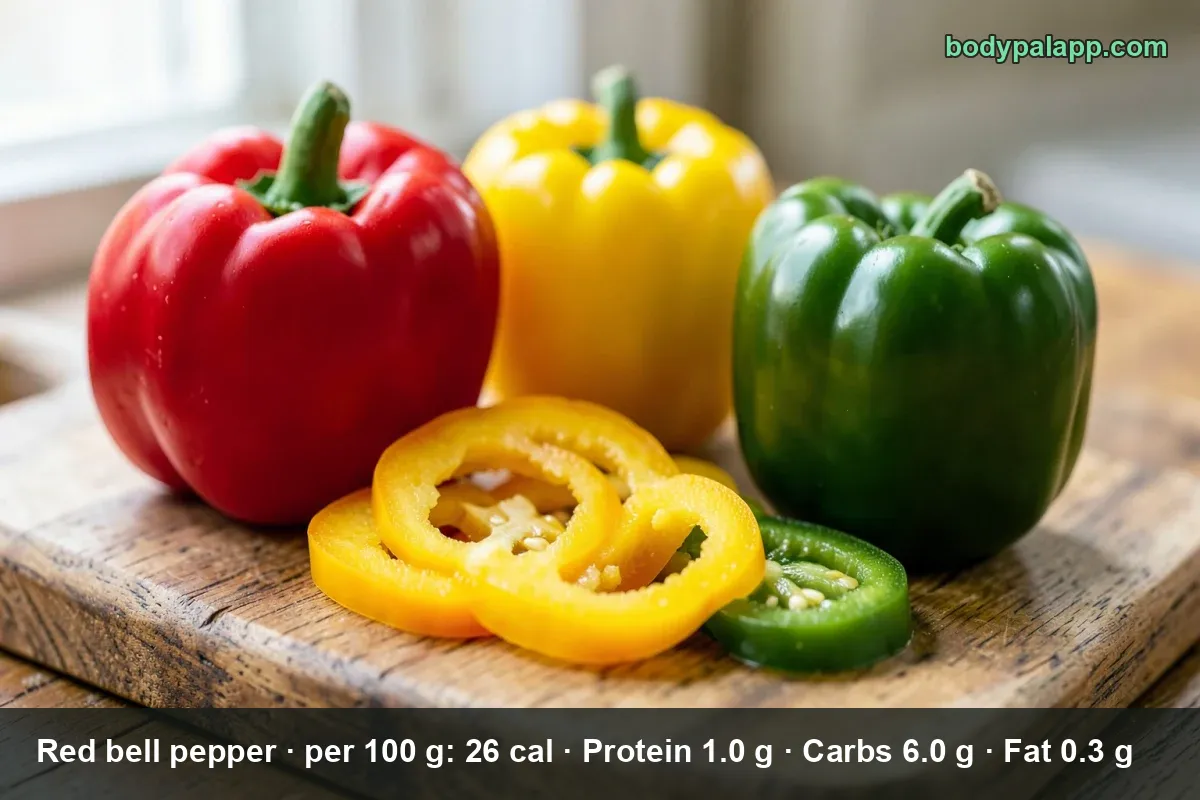
The record behind this page is USDA SR Legacy 170108, "Peppers, sweet, red, raw". Red is the sweet pepper Americans buy most, and it is the one in the photo above, next to a steaming roasted half. SR Legacy is also the only USDA edition that carries the full label for this vegetable, fiber and sugars and sodium together, with household serving weights attached to the same record.
That last part matters more than it sounds. Plenty of pepper entries in FoodData Central give you calories per 100 g and nothing you can weigh in a kitchen. This one gives you a medium pepper, a large pepper, a cup chopped and a cup sliced, all measured rather than guessed.
| Nutrient | Per 100 g | Per 1 medium (119 g) | % Daily Value |
|---|---|---|---|
| Calories | 26 | 31 | — |
| Total fat | 0.3 g | 0.4 g | 0% |
| Saturated fat | 0.06 g | 0.1 g | 0% |
| Carbohydrate | 6.03 g | 7.2 g | 3% |
| Dietary fiber | 2.1 g | 2.5 g | 9% |
| Total sugars | 4.2 g | 5.0 g | — |
| Protein | 0.99 g | 1.2 g | 2% |
| Sodium | 4 mg | 5 mg | 0% |
% Daily Value is based on a 2,000-calorie diet.
Verified nutrition data
Numbers on this page come from USDA FoodData Central, the U.S. Department of Agriculture’s food composition database, and from manufacturer labels where a branded product is named. Last verified September 2026. How we verify our data →
There is no added sugars row here, because the SR Legacy edition does not publish that field and a raw pepper has none to publish. Cholesterol is 0 mg, as it is in every vegetable. Potassium is the one line that quietly does work: 211 mg per 100 g, or 251 mg in a medium pepper, which is 5% of the Daily Value from something that costs you 31 calories.
US servings from one ounce to a large pepper
| Serving | Weight | Calories |
|---|---|---|
| 1 oz | 28 g | 7 kcal |
| 1 cup, sliced | 92 g | 24 kcal |
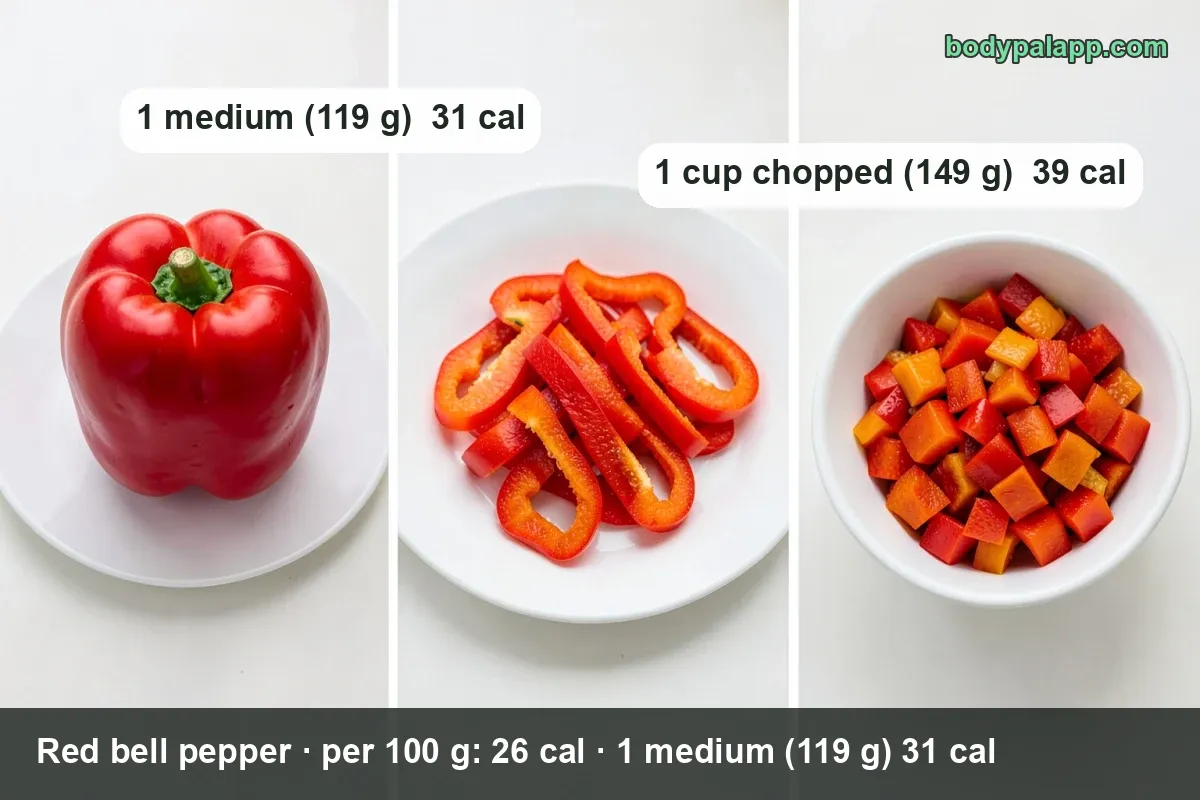
| 1 medium pepper | 119 g | 31 kcal |
| 1 cup, chopped | 149 g | 39 kcal |
| 1 large pepper | 164 g | 43 kcal |
| Per 100 g | 100 g | 26 kcal |
Everything except the ounce is a USDA household measure attached to record 170108. The 1 oz line is our own arithmetic from the USDA 100 g figure, not a USDA serving, and it exists mainly because deli counters and meal-prep recipes still talk in ounces.
Look at the two cup rows. A cup of chopped pepper is 149 g; a cup of sliced pepper is 92 g. Same cup, same vegetable, 57 g apart, because strips leave air between them and diced cubes do not. That single difference is 15 calories, which is nothing on its own and stops being nothing when a recipe says "two cups of peppers" and you are logging it three times a week. If you own a scale, use it here.
The other trap is the word medium. A medium pepper in the USDA sense is about 2-3/4 inches long and 2-1/2 inches across. The glossy bell peppers sold in three-packs are usually closer to the large row at 164 g, so 43 calories is the safer default for those.
What color does to the calorie count
Green, yellow, orange and red bell peppers are the same plant caught at different points of ripening. The calorie spread is small but consistent, and it runs in the direction you would expect: the longer the fruit stays on the plant, the more sugar it builds.
| Version | Per 100 g | Typical piece | Calories |
|---|---|---|---|
| Green bell pepper, raw | 20 kcal | 1 medium (119 g) | 24 kcal |
| Red bell pepper, raw | 26 kcal | 1 medium (119 g) | 31 kcal |
| Yellow bell pepper, raw | 27 kcal | 1 medium (119 g) | 32 kcal |
| Orange bell pepper, raw | 31.7 kcal | 1 medium (119 g) | 38 kcal |
Green is the outlier at 20 calories per 100 g, and its sugar is 2.4 g against 4.2 g in red. Yellow is the surprise in the other direction: at 27 calories per 100 g it is fractionally above red, but it carries only 0.9 g of fiber per 100 g compared with red's 2.1 g. If you are picking peppers for fiber rather than color, red wins the aisle.
The orange row comes from a Foundation Foods sample, which is a newer sampling program with calories calculated by the Atwater method, and it does not publish saturated fat. It sits highest of the four at 31.7 calories per 100 g. The medium-pepper columns for yellow and orange are our own arithmetic from the USDA 100 g figures, since those records carry no 119 g household serving of their own.
None of this is a reason to change what you buy. A whole pepper of the worst-case color is still 38 calories.
Roasted and sauteed peppers
Here is where a pepper stops being trivial. Cooking method changes the count by a factor of five, and it has nothing to do with the pepper.
| Version | Per 100 g | Typical portion | Calories |
|---|---|---|---|
| Red bell pepper, boiled and drained, no salt | 28 kcal | half a cup chopped (92 g) | 26 kcal |
| Jarred roasted bell peppers | 33 kcal | 30 g (1.5 Tbsp) label serving | 10 kcal |
| Red bell pepper, sauteed | 133 kcal | half a cup (92 g) | 122 kcal |
Boiling barely moves anything: 26 calories raw becomes 28 per 100 g, and the small rise is water leaving the flesh and concentrating what is left, not calories arriving from somewhere. The boiled and sauteed portion figures above are our own arithmetic scaled from the USDA 100 g figures; the jarred row is the label serving.
Sauteed red pepper is 133 calories per 100 g. The fat line goes from 0.3 g to 12.75 g. That is roughly a tablespoon of oil per half-cup of pepper soaking into the flesh, and it turns a 26-calorie side into a 122-calorie one. Peppers behave like sponges in a hot pan. Roast them dry on a sheet pan instead and you stay near the raw number.
Jarred roasted peppers are the cheap version of that trick: about 33 calories per 100 g, so the 1.5 tablespoon label serving is 10 calories. The catch is not calories, it is brine. Raw pepper carries 4 mg of sodium per 100 g. The jarred product carries roughly 367 mg per 100 g, close to a hundred times more, which is about a sixth of the FDA Daily Value for sodium in a small handful. Rinsing helps.
Jalapenos and black pepper
Two other things answer to the name pepper, and both behave differently.
A raw jalapeno is 29 calories per 100 g, slightly above a red bell pepper, with 2.8 g of fiber. Because the fruit is small, the practical number is tiny: an ounce, 28 g, is 8 calories, and that is our own scaling from the USDA 100 g value. Two or three sliced jalapenos on a bowl are a rounding error. Canned jalapenos packed in liquid come in at 27 calories per 100 g, so the calorie cost is the same, and the brine is again the part worth reading.
Black pepper, the spice, is a different food entirely: 251 calories per 100 g. Nobody eats 100 g of it, and the grinder on the table will never register in a food log, but the number is a useful reminder that a dried, ground seed and a fresh fruit share a word and nothing else. For what it is worth, black pepper is 25.3 g fiber per 100 g, the densest fiber source in this whole article.
Fiber and potassium do the heavy lifting
A medium red pepper gives you 2.5 g of fiber, 9% of the Daily Value, for 31 calories. Almost nothing else in the produce aisle delivers that much fiber at that price. Potassium adds 251 mg, or 5% of the Daily Value, and the 2020-2025 Dietary Guidelines name potassium and fiber as two of the four nutrients Americans consistently under-consume.
Protein is 1.2 g, which is 2% of the Daily Value, so peppers are not a protein food and never claim to be. Fat is 0.4 g and saturated fat 0.1 g, both rounding to 0% on a label.
The practical read: peppers are a volume food. A cup of chopped red pepper adds real bulk to a bowl for 39 calories, which is why they show up in so many logged lunches next to something heavier. MyPlate counts one cup of raw chopped pepper as one cup toward the vegetable group, so a single medium pepper covers a decent slice of a day's target. If you are watching sodium, buy them whole rather than jarred and the 4 mg per 100 g stays 4 mg.
How does a bell pepper compare?
| Pepper | Per 100 g | US serving | Calories |
|---|---|---|---|
| Red bell pepper, raw | 26 kcal | 1 cup chopped (149 g) | 39 kcal |
| Green bell pepper, raw | 20 kcal | 1 cup chopped (149 g) | 30 kcal |
| Banana pepper, raw | 27 kcal | 1 cup (124 g) | 33 kcal |
| Jalapenos, canned, solids and liquids | 27 kcal | 1 cup sliced (104 g) | 28 kcal |
Our take: the four rows sit inside 7 calories of each other per 100 g, so choosing between peppers on calories is not a real decision. Green is the lightest of the four, and red carries 2.1 g of fiber per 100 g. Banana peppers carry the most protein of the group at 1.66 g per 100 g, which still means almost nothing on a plate. Pick by taste, then watch the oil, because the pan is the only thing on this page that can multiply the number by five.
Most popular pepper brands in the United States
Ranked by how widely each product appears among foods sold in the United States, from the BodyPal food database of over 3.3 million products. Calories are the figures printed on each Nutrition Facts label, checked against USDA FoodData Central.
| Product | Calories (per 100 g) |
|---|---|
| Mezzetta Roasted Bell Peppers | 33 cal |
Brand popularity: BodyPal food database. Nutrition: manufacturer labels / USDA FoodData Central.
Bell pepper FAQs
How many calories are in one bell pepper?
A medium red bell pepper of 119 g is 31 calories, and a large one at 164 g is 43. The raw flesh runs 26 calories per 100 g. A green pepper of the same medium size is 24, since green peppers are picked before they finish ripening and hold less sugar.
How many calories in a green pepper?
One medium green bell pepper of 119 g is 24 calories, against 31 for a red one the same size. Per 100 g green sits at 20 and red at 26. Green also carries less sugar, 2.4 g per 100 g versus 4.2 g, because it is harvested before it ripens.
Do red peppers have more calories than green peppers?
Yes, by 6 calories per 100 g: red is 26 and green is 20. On a medium pepper the gap is 31 against 24, so seven calories. Yellow is 27 per 100 g and orange 31.7, so the ripest colors sit highest. It is not a difference worth shopping around.
How many carbs are in a bell pepper?
A medium red pepper of 119 g has 7.2 g of carbohydrate, 3% of the Daily Value, and 2.5 g of that is fiber. Per 100 g the count is 6.03 g carbohydrate with 2.1 g fiber. Green peppers are lower again, at 4.64 g of carbohydrate per 100 g.
How many calories in a cup of chopped peppers?
One cup of chopped raw red pepper weighs 149 g and is 39 calories. A cup of slices is lighter, 92 g and 24 calories, because strips pack loosely. Chopped green pepper in the same cup measure is 30 calories. The two cups differ by 57 g, so weighing beats measuring.
How many calories in roasted red peppers?
Jarred roasted bell peppers run about 33 calories per 100 g, so the 30 g label serving of 1.5 tablespoons is 10 calories. Peppers roasted dry barely move from raw. Peppers sauteed in oil are another food: 133 calories per 100 g, which makes half a cup 122 calories.
Are peppers good for weight loss?
At 26 calories per 100 g, raw red pepper adds a lot of bulk to a plate for very little, and a medium one brings 2.5 g of fiber, 9% of the Daily Value. If you are watching calories, keep the pan dry: oil takes the same pepper from 26 to 133 per 100 g.
Do bell peppers contain sugar?
Yes, 4.2 g per 100 g in raw red pepper, which works out to 5.0 g in a medium 119 g pepper. All of it occurs naturally; the USDA record lists no added sugars, and a raw vegetable has none. Green peppers hold 2.4 g per 100 g because they are picked unripe.
Similar foods
- Green Bell Pepper — 19 cal per medium pepper
- Bell Pepper — 24 cal green, 31 red
- Arugula — 5 cal per cup
- Bamboo Shoots — 41 cal per cup sliced
- Banana Pepper — 12 cal per pepper
- Broccoli Rabe — 21 cal per cup
Count it without the math
Point the camera at the cutting board and BodyPal counts the peppers for you, color and all.


How long does it take to burn off pepper?
One medium pepper (119 g) is 31 kcal. Enter your weight and the amount you ate to see how long it takes you to burn that off:
lb
| Activity | Time to burn 31 kcal |
|---|---|
| Walking, brisk | 6 min |
| Cycling, moderate | 4 min |
| Swimming, moderate | 4 min |
| Jogging | 4 min |
| Weight training, moderate | 7 min |
Times are for a 155 lb adult at a steady pace; change the weight to see yours. The amount is set to the portion in the text (119 g); change it to what you actually ate. BodyPal works this out from your steps automatically.
This table assumes you know your daily total. If you do not, the daily calorie calculator works it out from five numbers.