
How Many Calories in a Bell Pepper?
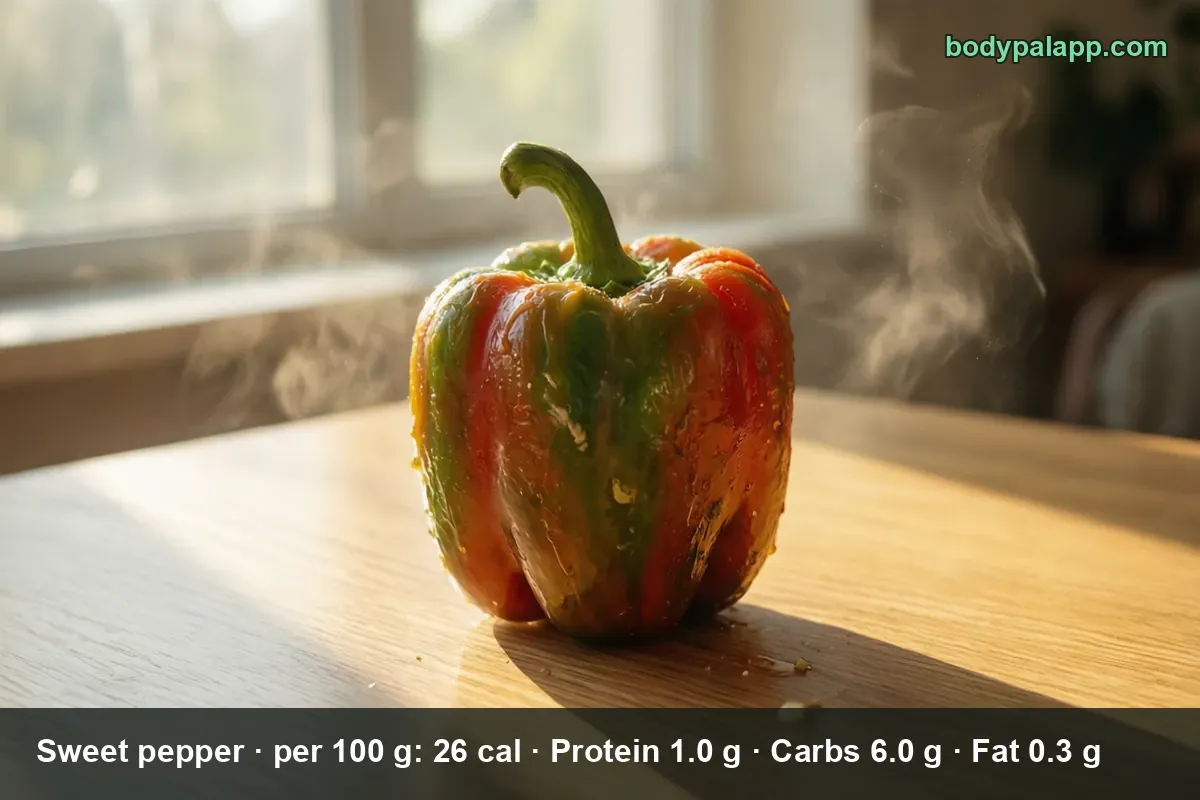
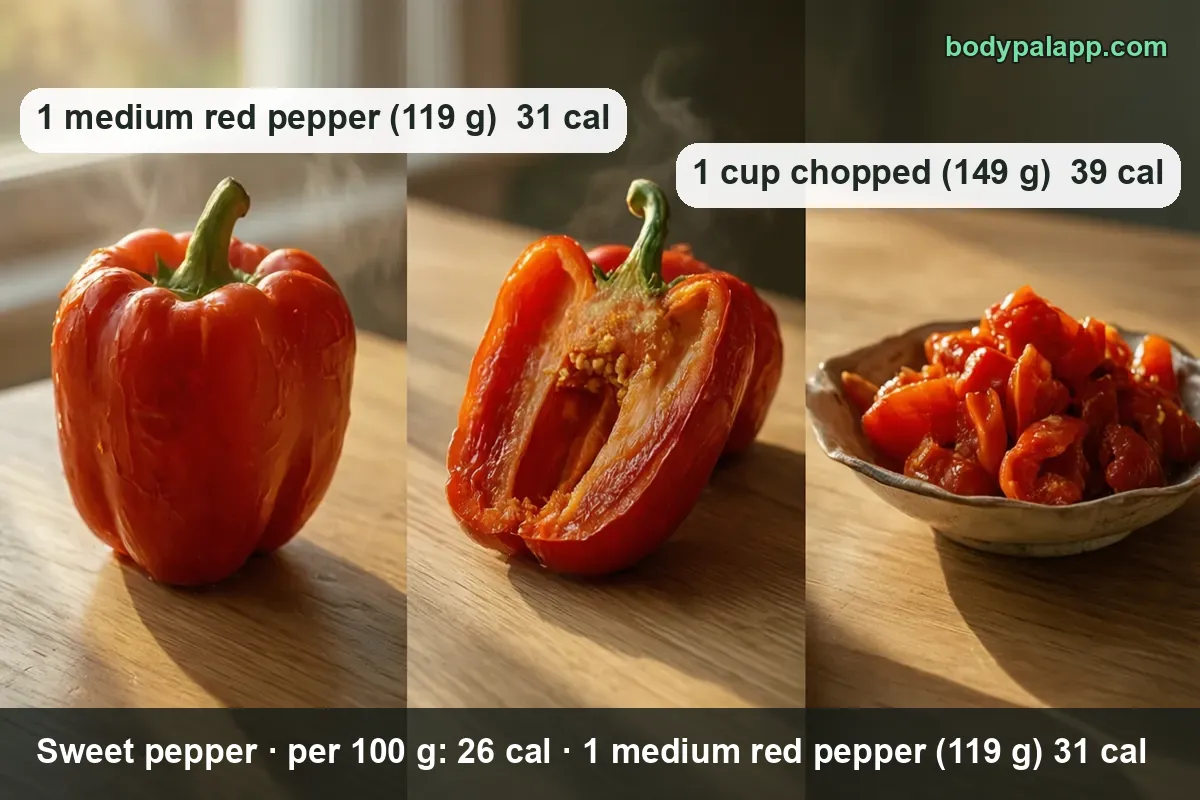
A medium bell pepper weighs 119 g and comes to 24 calories when it's green and 31 when it's red. Per 100 g that is 20 calories green, 26 red. A cup of chopped red pepper (149 g) is 39 calories, and one mini sweet pepper is about 9. On a sweet pepper, the color does most of the arithmetic.
On this page
- Bell pepper quick facts
- The color is the calorie
- Two USDA numbers for one red pepper
- Serving sizes: peppers, cups and rings
- Green, yellow and orange peppers
- Mini sweet peppers
- Cooked, sauteed, canned and pickled
- Stuffed bell peppers
- Vitamin C, fiber and weight loss
- How does a bell pepper compare
- Most popular bell pepper brands
- FAQ
Bell pepper quick facts
The reference here is the raw red bell pepper: USDA's SR Legacy record 170108, "Peppers, sweet, red, raw". That row carries its own household weights — small 74 g, medium 119 g, large 164 g — so "one medium pepper" is a measured figure, not a guess.
| Nutrient | Per 100 g | Per 1 medium pepper (119 g) | % Daily Value |
|---|---|---|---|
| Calories | 26 | 31 | — |
| Total fat | 0.3 g | 0.4 g | 0% |
| Saturated fat | 0.1 g | 0.1 g | 0% |
| Carbohydrate | 6.0 g | 7.2 g | 3% |
| Dietary fiber | 2.1 g | 2.5 g | 9% |
| Total sugars | 4.2 g | 5.0 g | — |
| Protein | 1.0 g | 1.2 g | 2% |
| Sodium | 4 mg | 5 mg | 0% |
| Potassium | 211 mg | 251 mg | 5% |
| Vitamin C | 127.7 mg | 152 mg | 169% |
% Daily Value is based on a 2,000-calorie diet.
Verified nutrition data
Numbers on this page come from USDA FoodData Central, the U.S. Department of Agriculture’s food composition database, and from manufacturer labels where a branded product is named. Last verified September 2026. How we verify our data →
There is no added sugars line because USDA does not record one for a whole raw vegetable, and printing "0 g" where the database is silent would be an invention rather than a fact. Cholesterol is zero in every raw and boiled pepper row, so it stays out of the table too.
One row is doing something remarkable. A single medium red pepper carries 152 mg of vitamin C — 169% of the FDA Daily Value of 90 mg — for the price of 31 calories.
The color is the calorie
Green, red, yellow and orange bell peppers are not four vegetables. They are one vegetable at four stages of ripeness: the green pepper is picked early, and if it stays on the plant it turns yellow, then orange, then red. Sugars climb as it ripens, from 2.4 g per 100 g in the green pepper to 4.2 g in the red, and the calories follow.
| Color | Per 100 g | 1 medium (119 g) | USDA record |
|---|---|---|---|
| Green | 20 | 24 calories | SR 170427 |
| Red | 26 | 31 calories | SR 170108 |
| Yellow | 27 | 32 calories | SR 169383 |
| Orange | 32 | 38 calories | Foundation 2258591 |
Green to orange is a 55% jump per 100 g. On the plate it is smaller than it sounds — 14 calories between the lightest and the heaviest medium pepper. Swapping green peppers for red in a salad adds about seven calories per pepper, which is nothing; logging a red pepper as 24 because a chart said "bell pepper" under-counts by the same seven.
Two footnotes belong on that table, because most calorie sites hide them. The yellow row has no medium weight of its own — USDA gives it only a large pepper at 186 g (50 calories) — so the 32 above uses the 119 g medium weight from the red and green rows. That borrows a physical size, not a nutrient. And the orange pepper does not exist in SR Legacy at all; its only USDA entry is the Foundation record 2258591, which has no energy value, just an Atwater General Factors calculation of 31.74 calories per 100 g. Any site quoting an orange bell pepper at 26 calories per 100 g is showing you the red pepper with a different label.
Two USDA numbers for one red pepper
USDA publishes two figures for the same raw red bell pepper, and both are correct. SR Legacy 170108, the archival measurement, gives 26 calories per 100 g; the 2022 Foundation sampling gives 31.33 by Atwater General Factors, and the 2024 FNDDS release (record 2709801) adopted the newer number at 31. Per pepper that is 31 calories against 37 — the same gap runs through the green rows, 20 against 23.
This page leads with SR Legacy for one practical reason: it is the only version that carries saturated fat, total sugars and the small/medium/large household weights. The Foundation rows have none of the three. Averaging the two would produce a number that describes neither measurement, so the numbers stay separate and named.
Serving sizes: peppers, cups and rings
| Serving (raw red pepper) | Weight | Calories |
|---|---|---|
| 1 small pepper | 74 g | 19 |
| 1 medium pepper | 119 g | 31 |
| 1 large pepper | 164 g | 43 |
| 1 cup, chopped | 149 g | 39 |
| 1 cup, sliced | 92 g | 24 |
| 1 ring, 3-inch | 10 g | 3 |
| 1 tbsp, chopped | 9.3 g | 2 |
| 1 oz | 28.35 g | 7 |
Look at the two cup rows. USDA gives 149 g for a cup of chopped pepper and 92 g for a cup of sliced pepper — a 62% difference in weight behind one word. In calories: 39 against 24. Slice a pepper into strips for hummus, write down "1 cup bell pepper," and you have logged 39 calories for what was actually 24.
The check is easy to remember. A cup of chopped pepper is 149 g, which is one and a quarter medium peppers. A cup of strips is 92 g, or about three quarters of one.
Green peppers scale the same way at their own density: 15 calories for a small, 24 for a medium, 33 for a large, 30 for a cup chopped, 18 for a cup sliced, and 5 for ten strips (27 g).
Green, yellow and orange peppers
Green (SR 170427) is the lightest pepper on the shelf: 20 calories per 100 g, 24 for a medium. A medium green pepper brings 1.0 g of protein, 5.5 g of carbohydrate, 2.0 g of fiber (7% DV) and 2.9 g of sugars — barely more than half the sugar of a red one. Vitamin C is still 96 mg, or 106% DV.
Yellow (SR 169383) is 27 calories per 100 g. The large pepper USDA measures, at 186 g, is 50 calories with 1.9 g protein, 11.8 g carbohydrate and 1.7 g fiber. Its headline nutrient is vitamin C: 341 mg in that one pepper, 379% DV, the highest of any bell pepper serving on this page. USDA has no total sugars value for the yellow row at all, so that cell stays empty rather than borrowing the red pepper's 4.2 g.
Orange is the odd one. Foundation record 2258591 is the only USDA entry, published in 2022, and it lists 0.88 g protein, 6.70 g carbohydrate, 0.16 g fat, 0.97 g fiber and 158.3 mg vitamin C per 100 g — the highest vitamin C of the four colors in that dataset. It has no saturated fat and no total sugars figure, which is why there is no quick-facts table for orange peppers anywhere on this page. Its energy value, calculated from Atwater General Factors, is 32 calories per 100 g and 38 for a 119 g medium pepper.
Mini sweet peppers
FNDDS gives mini sweet peppers a serving of their own: "1 miniature" at 30 g. Against the FNDDS red pepper row (2709801, 31 calories per 100 g) that comes to 9 calories a pepper. Using SR Legacy's red pepper instead, the same 30 g works out to 8. Two databases, two defensible answers, no average.
Supermarket bags count differently again. The label is usually built on three peppers to an 85 g serving — about 28 g each — and per-serving calories on those bags run from 25 to 40 depending on how ripe the peppers in the pack are. That is 8 to 20 calories per mini pepper across real labels, and the redder the bag, the higher the number.
Nine calories is the right default for a snack-size pepper, so a handful of five stays under 50.
Other FNDDS servings on the same row: one regular pepper (120 g) is 37 calories and a cup is 47.
Cooked, sauteed, canned and pickled
Boiling raises the calories per 100 g. A raw green pepper is 20; boiled and drained it is 28 (SR 170428). Nothing was added — water left, and what remained got denser. Per serving the effect reverses, because a cup of cooked strips (135 g) is 38 calories while a cup of raw chopped pepper (149 g) is 30.
The pan is the only real cost. One cup of sauteed green peppers (115 g, SR 170024) is 133 calories; sauteed red (106 g, SR 168550) is 141. Raw peppers carry 0.17 g and 0.30 g of fat per 100 g; the sauteed rows carry 11.85 g and 12.75 g. Four to five times the calories, and virtually all of it is oil.
| Preparation | Per 100 g | Serving | Calories |
|---|---|---|---|
| Red, raw | 26 | 1 medium (119 g) | 31 |
| Green, boiled, drained | 28 | 1 cup strips (135 g) | 38 |
| Red, boiled, drained | 28 | ½ cup chopped (68 g) | 19 |
| Green, sauteed | 116 | 1 cup chopped (115 g) | 133 |
| Red, sauteed | 133 | 1 cup chopped (106 g) | 141 |
| Red, frozen, chopped, unprepared | 20 | 1 package, 10 oz (284 g) | 57 |
| Red, frozen, boiled, drained | 16 | 1 cup (135 g) | 22 |
| Red, canned, solids and liquids | 18 | 1 cup halves (140 g) | 25 |
| Sweet peppers, pickled | 43 | 1 whole (30 g) | 13 |
Canned peppers look like the diet option and are the sodium trap of the category. That cup of canned halves is 25 calories and 1,917 mg of sodium — 83% of the Daily Value. The fresh medium pepper next to it holds 5 mg, which rounds to 0%. Half a cup still runs 958 mg, or 42% of the day. Even plain boiling with salt does it: two otherwise identical USDA rows differ only in the salt, and sodium goes from 2 mg to 238 mg per 100 g. Pickled peppers are milder but not innocent — 283 mg (12% DV) in a single 30 g pepper, and 1,416 mg in a cup.
Stuffed bell peppers
A stuffed pepper is a meal, and the pepper is the smallest part of it. USDA does not publish a whole stuffed pepper; the FNDDS serving is "1/2 pepper with filling" at 149 g, so a whole one is 298 g.
| Version | Per 100 g | ½ pepper (149 g) | Whole pepper (298 g) |
|---|---|---|---|
| With rice and meat (2709073) | 178 | 265 | 530 |
| With meat, no rice (2709072) | 198 | 295 | 590 |
| With rice, meatless (2709074) | 166 | 247 | 495 |
| Puerto Rican style, green (2706633) | 152 | — | 380 |
The pepper itself accounts for roughly 30 of those calories. The other 500 are filling. Sodium on one whole stuffed pepper with rice and meat is 954 mg (41% DV) and saturated fat is 10.4 g (52% DV), so the seasoning and the ground meat, not the vegetable, are what the number is measuring.
Vitamin C, fiber and weight loss
One medium red pepper beats two oranges on vitamin C. It holds 152 mg against roughly 70 mg in an average orange, and the NIH Office of Dietary Supplements puts the adult recommended intake at 75–90 mg a day. A cup of chopped red pepper takes it to 190 mg, or 211% DV.
Vitamin A splits by color in the same way sugar does. The red pepper gives 187 µg RAE per medium pepper (21% DV); the green one gives 21 µg (2% DV), because the beta-carotene only appears as the pepper ripens.
Fiber is modest but real: 2.5 g in a medium red pepper, 9% of the Daily Value, and 3.1 g (11%) in a cup chopped. Protein is 1.2 g, which is not why anyone eats a pepper.
For anyone counting calories, the case for bell peppers is volume. A medium pepper is 119 g of food for 31 calories, and a cup of strips fills a snack bowl for 24. MyPlate counts a cup of raw peppers as a full cup toward the vegetable group, and few foods hit that mark for so little. The number only moves when a pan and oil arrive — that is the difference between 24 calories and 133.
How does a bell pepper compare
| Food | Per 100 g | US serving | Calories | P / C / F per serving |
|---|---|---|---|---|
| Red bell pepper | 26 | 1 medium (119 g) | 31 | 1.2 / 7.2 / 0.4 |
| Green bell pepper | 20 | 1 medium (119 g) | 24 | 1.0 / 5.5 / 0.2 |
| Cucumber, with peel | 15 | ½ cup slices (52 g) | 8 | 0.3 / 1.9 / 0.1 |
| Tomato, raw | 18 | 1 medium (123 g) | 22 | 1.1 / 4.8 / 0.2 |
| Carrot, raw | 41 | 1 medium (61 g) | 25 | 0.6 / 5.8 / 0.1 |
| Broccoli, raw | 34 | 1 cup chopped (91 g) | 31 | 2.6 / 6.0 / 0.3 |
Our take: for sheer bulk per calorie, cucumber wins and always will — it is mostly water. For a raw vegetable that gives something back, the red bell pepper is the pick on this list, because 31 calories buying 169% of a day's vitamin C is a return nothing else here matches. Broccoli is the choice when protein matters, at 2.6 g per cup against 1.2 g for a pepper. Carrot is the one to watch if you eat handfuls: 41 calories per 100 g makes it the densest thing in the table, even though a single carrot is small enough to hide that.
Most popular bell pepper brands in the United States
Ranked by how widely each product appears among foods sold in the United States, from the BodyPal food database of over 3.3 million products. Calories are the figures printed on each Nutrition Facts label, checked against USDA FoodData Central.
| Product | Calories (per 100 g) |
|---|---|
| Wegmans Mini Sweet Peppers | 29 cal |
| Pero Family Farms Mini Sweet Peppers | 41 cal |
| Bailey Farms Baby Bell Peppers | 47 cal |
| Pero Family Farms Bell Peppers | 18 cal |
| Wellsley Farms Green Peppers (BJ’s) | 17 cal |
| Divine Flavor Organic Mixed Bell Pepper | 20 cal |
Brand popularity: BodyPal food database. Nutrition: manufacturer labels / USDA FoodData Central.
Bell pepper FAQs
How many calories in a bell pepper?
A medium bell pepper weighs 119 g and is 24 calories if it is green, 31 if it is red. Per 100 g that is 20 calories for green and 26 for red. A small pepper (74 g) runs 15 to 19 calories, and a large one (164 g) is 33 to 43.
How many calories in a green bell pepper?
24 calories for a medium green pepper (119 g), at 20 calories per 100 g. It is the lightest bell pepper because it is picked before it ripens, with 2.9 g of sugars against 5.0 g in a red one. A cup of chopped green pepper (149 g) is 30 calories.
How many calories in a red sweet pepper?
31 calories for a medium red pepper (119 g), at 26 calories per 100 g. That serving carries 1.2 g protein, 7.2 g carbohydrate, 2.5 g fiber and 152 mg of vitamin C — 169% of the Daily Value. A cup of chopped red pepper (149 g) is 39 calories.
How many calories in an orange bell pepper?
About 32 calories per 100 g, or 38 for a 119 g medium pepper. Orange peppers have no SR Legacy record at all; the only USDA entry is Foundation 2258591, and its energy figure comes from Atwater General Factors rather than a direct measurement. The same record has no saturated fat or total sugars value.
How many calories in a yellow bell pepper?
27 calories per 100 g. USDA measures only a large yellow pepper, 186 g, at 50 calories with 341 mg of vitamin C — 379% of the Daily Value. Applying the 119 g medium weight from the red and green rows gives 32 calories for a medium yellow pepper.
How many calories in a mini sweet pepper?
About 9 calories each. FNDDS lists a serving of "1 miniature" at 30 g, which against its red pepper row (31 calories per 100 g) gives 9; the SR Legacy row gives 8 for the same weight. Supermarket bags label three peppers at 85 g for 25 to 40 calories, so 8 to 20 apiece depending on ripeness.
How many calories in a stuffed bell pepper?
530 calories for a whole stuffed pepper with rice and meat. USDA measures half a pepper with filling at 149 g and 265 calories, so a whole one is 298 g. Meat with no rice is 590, and the meatless rice version is 495. Sodium reaches 954 mg, or 41% of the Daily Value.
Are bell peppers good for weight loss?
A medium red pepper is 119 g of food for 31 calories, with 2.5 g of fiber (9% DV) and 152 mg of vitamin C (169% DV). Protein is only 1.2 g, so peppers add volume rather than staying power. The calories change only in the pan: a cup of sauteed peppers is 133 to 141 calories, most of it oil.
Similar foods
- Green Bell Pepper — 19 cal per medium pepper
- Bell Pepper — 31 cal per medium
- Arugula — 5 cal per cup
- Bamboo Shoots — 41 cal per cup sliced
- Banana Pepper — 12 cal per pepper
- Broccoli Rabe — 21 cal per cup
Count it without the maths
Point the camera at the cutting board and BodyPal tells the red pepper from the green one, then logs the calories and the vitamin C for you.


One food is easy to picture; a whole day is harder. See how many calories you need a day and what a deficit actually looks like.