
How many calories are in cantaloupe melon?
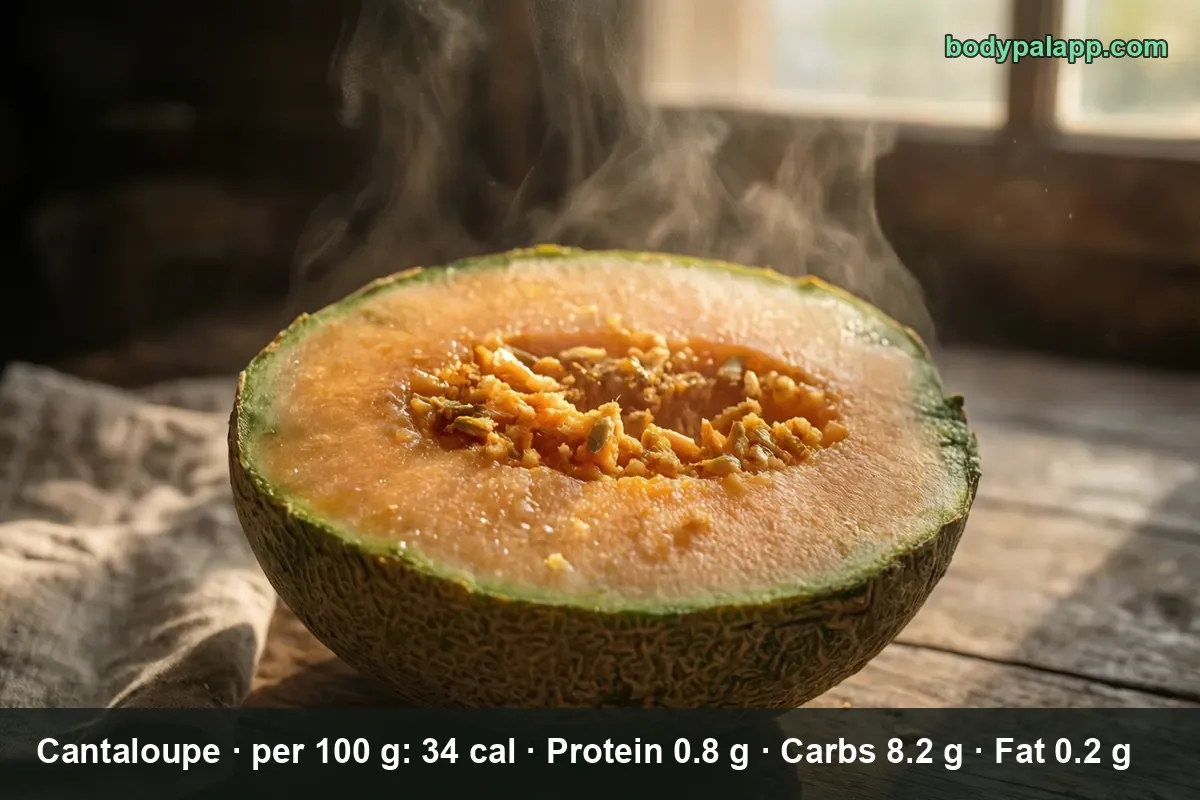
A 1-cup serving of cantaloupe cubes weighs 160 g and carries 54 calories. Raw, the melon runs 34 calories per 100 g, which puts it at the light end of the fruit bowl. Half a medium melon comes to 94 calories, and a large wedge is only 35.
On this page
- Cantaloupe quick facts
- US servings, from one ounce to a whole melon
- Wedges, halves and the whole melon
- Frozen melon balls and honeydew
- Potassium is the big number here
- How does cantaloupe compare?
- Most popular cantaloupe melon brands
- FAQ
Cantaloupe quick facts
The numbers below come from the USDA record SR Legacy 169092, "Melons, cantaloupe, raw". That is the melon a shopper actually holds: uncooked flesh, rind and seeds removed. FoodData Central carries two newer analytical entries for the same raw fruit as well, and the newer Foundation record 327198 agrees on the headline, 34 calories per 100 g and 8.16 g of carbohydrate. It simply never measured sugars or saturated fat, so the older SR Legacy record is the only one that fills every row of a Nutrition Facts panel.
| Nutrient | Per 100 g | Per 1 cup cubes (160 g) | % Daily Value |
|---|---|---|---|
| Calories | 34 | 54 | — |
| Total fat | 0.19 g | 0.3 g | 0% |
| Saturated fat | 0.05 g | 0.1 g | 0% |
| Carbohydrate | 8.16 g | 13.1 g | 5% |
| Dietary fiber | 0.9 g | 1.4 g | 5% |
| Total sugars | 7.86 g | 12.6 g | — |
| Protein | 0.84 g | 1.3 g | 3% |
| Sodium | 16 mg | 26 mg | 1% |
| Potassium | 267 mg | 427 mg | 9% |
% Daily Value is based on a 2,000-calorie diet.
Verified nutrition data
Numbers on this page come from USDA FoodData Central, the U.S. Department of Agriculture’s food composition database, and from manufacturer labels where a branded product is named. Last verified September 2026. How we verify our data →
There is no added sugars row on this page, because the SR Legacy edition does not publish that nutrient for raw fruit — nothing is added to a melon you cut yourself. Cholesterol is 0 mg, as it is for every plant food, and the Daily Values used in the column above are the FDA reference amounts published with the Nutrition Facts label.
One more wrinkle worth knowing: the two Foundation records list 30 mg of sodium per 100 g against SR Legacy's 16 mg. Both are trivial next to a 2,300 mg Daily Value, but it is a reminder that a melon is a piece of farm produce, not a manufactured food with a fixed recipe.
US servings, from one ounce to a whole melon
| Serving | Weight | Calories |
|---|---|---|
| 1 oz | 28 g | 10 kcal |
| 1 wedge, large (one-eighth of a large melon) | 102 g | 35 kcal |
| 1 cup, diced | 156 g | 53 kcal |
| 1 cup, cubes | 160 g | 54 kcal |
| Half a medium melon | 276 g | 94 kcal |
| Per 100 g | 100 g | 34 kcal |
The wedge, the diced cup and the cubed cup are USDA household measures attached to record 169092. The half melon is our own arithmetic from the USDA 100 g figure, not a USDA serving, and so is the ounce.
Here is the trap that catches people logging fruit: "one cup" is not one weight. Cubes fill a cup at 160 g, diced flesh packs a little tighter at 156 g, and USDA also lists a cup of melon balls at 177 g, which works out to 60 calories. Same cup, same melon, a 6-calorie spread purely from how you held the knife. On something this light it hardly matters. On denser foods, the same habit costs you a hundred calories a day.
Cut cantaloupe sold ready to eat lands in the same place. A Walgreens fresh-cut cantaloupe cup labels a 255.1 g serving at 89 calories, which is 35 per 100 g — within a rounding error of the loose melon you cut at home.
Wedges, halves and the whole melon
| Version | Per 100 g | Typical piece | Calories |
|---|---|---|---|
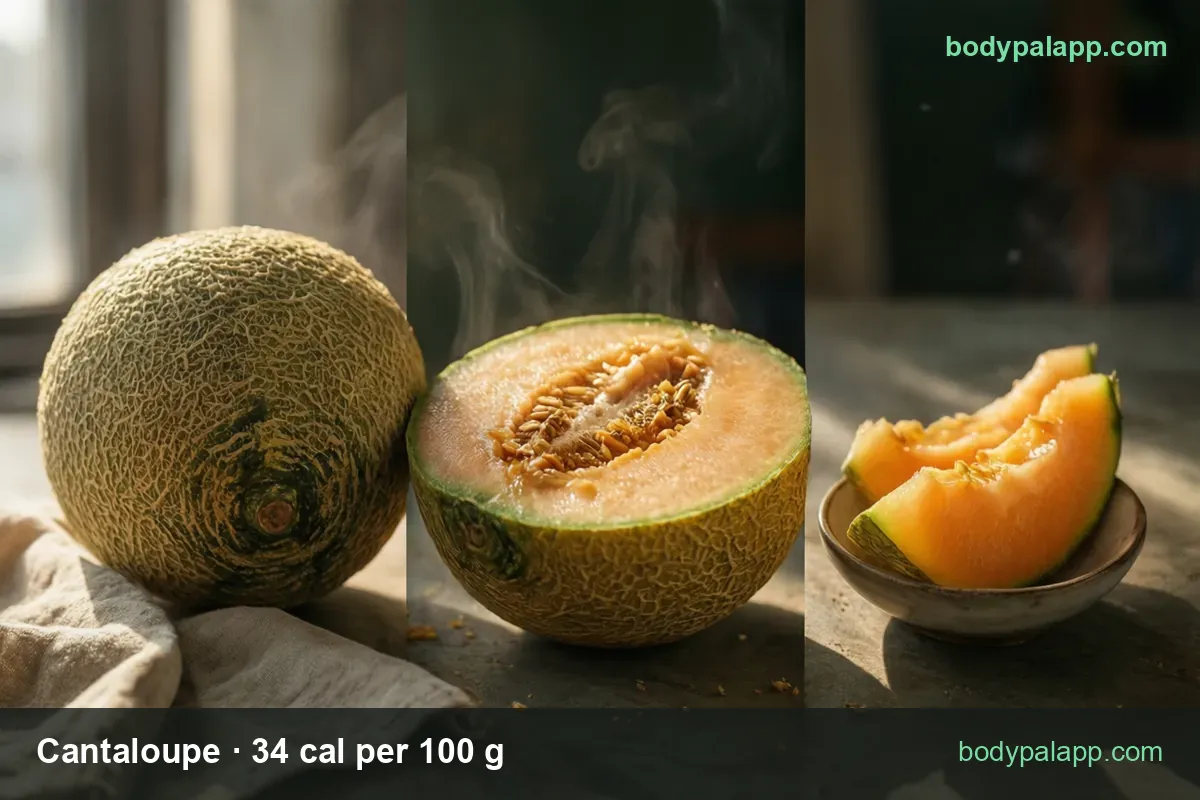
| Cantaloupe cubes | 34 kcal | 1 cup, cubes (160 g) | 54 kcal |
| One cantaloupe wedge | 34 kcal | 1 wedge, large (102 g) | 35 kcal |
| Half a cantaloupe | 34 kcal | half a medium melon (276 g) | 94 kcal |
| A whole medium cantaloupe | 34 kcal | one melon (552 g) | 188 kcal |
The wedge is the everyday portion: an eighth of a large melon, 102 g of flesh, 35 calories. That is the piece on a breakfast plate next to eggs, and it costs less than most people assume.
Halves and whole melons are our own scaling from the USDA 100 g value rather than listed USDA servings, so treat them as good estimates rather than label figures. A medium melon yields roughly 552 g of edible flesh once the rind and seeds are gone, which is 188 calories for the entire fruit. Eating a whole cantaloupe in an afternoon is a real thing people do, and it still costs less than a granola bar and a latte.
Half a melon, scooped straight out of the shell with a spoon, is 94 calories, about 22.5 g of carbohydrate and 2.5 g of fiber. It is one of the few foods where the plain-looking portion — half of an entire fruit — sits under a hundred calories.
Frozen melon balls and honeydew
| Version | Per 100 g | Typical serving | Calories |
|---|---|---|---|
| Frozen melon balls | 33 kcal | 1 cup, unthawed (173 g) | 57 kcal |
| Honeydew, raw | 36 kcal | 1 cup, diced (170 g) | 61 kcal |
Frozen melon balls are a mixed bag of cantaloupe and watermelon, and freezing changes the record more than you would expect: fiber drops to 0.5 g per 100 g against 0.9 g in the fresh melon, and sodium doubles to 32 mg. The calories barely move, 33 against 34, but the cup weighs 173 g, so a frozen cup lands at 57.
Honeydew is the other melon in the bin and the heavier one on paper: 36 calories per 100 g, 9.09 g of carbohydrate, and only 0.54 g of protein against cantaloupe's 0.84 g. Neither melon is a protein food. If you are choosing between them on calories alone, cantaloupe wins by a nose, and by a slightly wider margin once cup weights are involved.
Potassium is the big number here
Cantaloupe is a nothing food on the calorie line and a serious one on the potassium line. A cup of cubes carries 427 mg, which is 9% of the 4,700 mg Daily Value — from a serving that costs 54 calories. Half a melon runs to roughly 737 mg, about 16%. Cut into a large melon of 814 g and you are looking at some 2,173 mg of potassium, 46% of the Daily Value, for 277 calories.
Very few foods deliver that ratio. If potassium is something you are watching, this is the cheapest way to move the number that exists in the produce aisle, and it fits neatly inside the MyPlate fruit group guidance of one cup of fruit counting as one cup-equivalent.
The rows people expect to be a problem are not. Sodium is 26 mg a cup, 1% of the Daily Value. Total fat is 0.3 g and saturated fat 0.1 g, both rounding to 0%. Total sugars are 12.6 g a cup, but total sugars have no Daily Value on the label — that limit, 50 g, applies only to added sugars, and a melon has none.
How does cantaloupe compare?
| Fruit | Per 100 g | US serving | Calories |
|---|---|---|---|
| Cantaloupe | 34 kcal | 1 cup, cubes (160 g) | 54 kcal |
| Honeydew, raw | 36 kcal | 1 cup, diced (170 g) | 61 kcal |
| Melon balls, frozen | 33 kcal | 1 cup, unthawed (173 g) | 57 kcal |
| Strawberries, raw | 32 kcal | 1 cup, halves (152 g) | 49 kcal |
Our take: two of these four fruits are lighter than cantaloupe per gram — strawberries at 32 and frozen melon balls at 33 — yet cantaloupe still turns in the second-lowest cup in the table, at 54. The reason is weight, not density: a cup of cantaloupe cubes is 160 g while a cup of frozen balls is 173 g. Strawberries stay the lightest serving at 49 because the halves pack loosely, 152 g to a cup. For a cold, sweet bowl you will actually finish, cantaloupe is the pick over honeydew; for the absolute lowest number, it is strawberries by five calories.
Most popular cantaloupe melon brands in the United States
Ranked by how widely each product appears among foods sold in the United States, from the BodyPal food database of over 3.3 million products. Calories are the figures printed on each Nutrition Facts label, checked against USDA FoodData Central.
| Product | Calories (per 100 g) |
|---|---|
| Good & Delish Cantaloupe Melon | 35 cal |
Brand popularity: BodyPal food database. Nutrition: manufacturer labels / USDA FoodData Central.
Cantaloupe FAQs
How many calories are in a cup of cantaloupe?
A cup of cubes, 160 g, is 54 calories, and a cup of diced melon at 156 g is 53. Cantaloupe runs 34 calories per 100 g raw, so the cup weight is what moves the number rather than the fruit. A cup of melon balls, 177 g, comes to 60.
How many calories in half a cantaloupe?
Half a medium cantaloupe, about 276 g of flesh, is 94 calories. That is our own arithmetic from the USDA 100 g figure of 34 calories, not a listed USDA serving. The same half carries roughly 22.5 g of carbohydrate and 737 mg of potassium, about 16% of the Daily Value.
How many calories in a whole cantaloupe?
A whole medium cantaloupe, around 552 g of edible flesh, is 188 calories, and a large one at 814 g comes to 277. Both figures are our own scaling from the USDA 100 g value rather than USDA servings. The large melon also holds about 2,173 mg of potassium, 46% of the Daily Value.
How many carbs are in cantaloupe?
A cup of cubes has 13.1 g of carbohydrate, of which 1.4 g is fiber, leaving about 11.7 g net by our own subtraction. Per 100 g that is 8.16 g of carbohydrate against 0.9 g of fiber. One large wedge of 102 g holds 8.3 g. It is sugar and water, not starch.
How much sugar is in cantaloupe?
A cup of cubes has 12.6 g of total sugars, and 7.86 g per 100 g. None of it is added sugar, and the USDA SR Legacy record does not publish an added sugars figure for raw fruit. Total sugars carry no Daily Value on the Nutrition Facts label, so that percentage stays blank.
Is cantaloupe good for weight loss?
At 34 calories per 100 g, cantaloupe is one of the lightest things you can put in a bowl, and a full cup costs 54 calories while bringing 1.4 g of fiber. If you are swapping it in for a packaged snack, the volume is the whole point. It is not a low-carb food.
Cantaloupe vs honeydew: which has fewer calories?
Cantaloupe is lighter, 34 calories per 100 g against 36 for honeydew. The gap widens per serving: a cup of cantaloupe cubes weighs 160 g at 54 calories, while a cup of diced honeydew weighs 170 g at 61. Honeydew also carries more carbohydrate, 9.09 g per 100 g, and less protein.
How much potassium is in cantaloupe?
A cup of cubes carries 427 mg of potassium, 9% of the 4,700 mg Daily Value, and 100 g holds 267 mg. Half a melon is roughly 737 mg, or 16%. Potassium, not calories, is the number worth noticing here. Cantaloupe also has no cholesterol and only 26 mg of sodium per cup.
Similar foods
- Melon — 35 cal per wedge, large
- 5 Strawberries — 19 cal per 5 medium strawberries
- Honeydew Melon — 45 cal per wedge
- Orange Bell Pepper — 38 cal per medium pepper
- Strawberries — 49 cal per cup halves
- Lime — 20 cal per medium lime
Count it without the math
Point the camera at the plate and BodyPal counts the melon for you, wedge or cup.


How long does it take to burn off cantaloupe?
A 1-cup (160 g) serving of cubes is 54 kcal. Enter your weight and the amount you ate to see how long it takes you to burn that off:
lb
| Activity | Time to burn 54 kcal |
|---|---|
| Walking, brisk | 11 min |
| Cycling, moderate | 7 min |
| Swimming, moderate | 8 min |
| Jogging | 6 min |
| Weight training, moderate | 12 min |
Times are for a 155 lb adult at a steady pace; change the weight to see yours. The amount is set to the portion in the text (160 g); change it to what you actually ate. BodyPal works this out from your steps automatically.
Burning it off is one side of it. The other is knowing your number: work out how many calories you need a day, with macros and a goal date.