
How many calories are in melon?
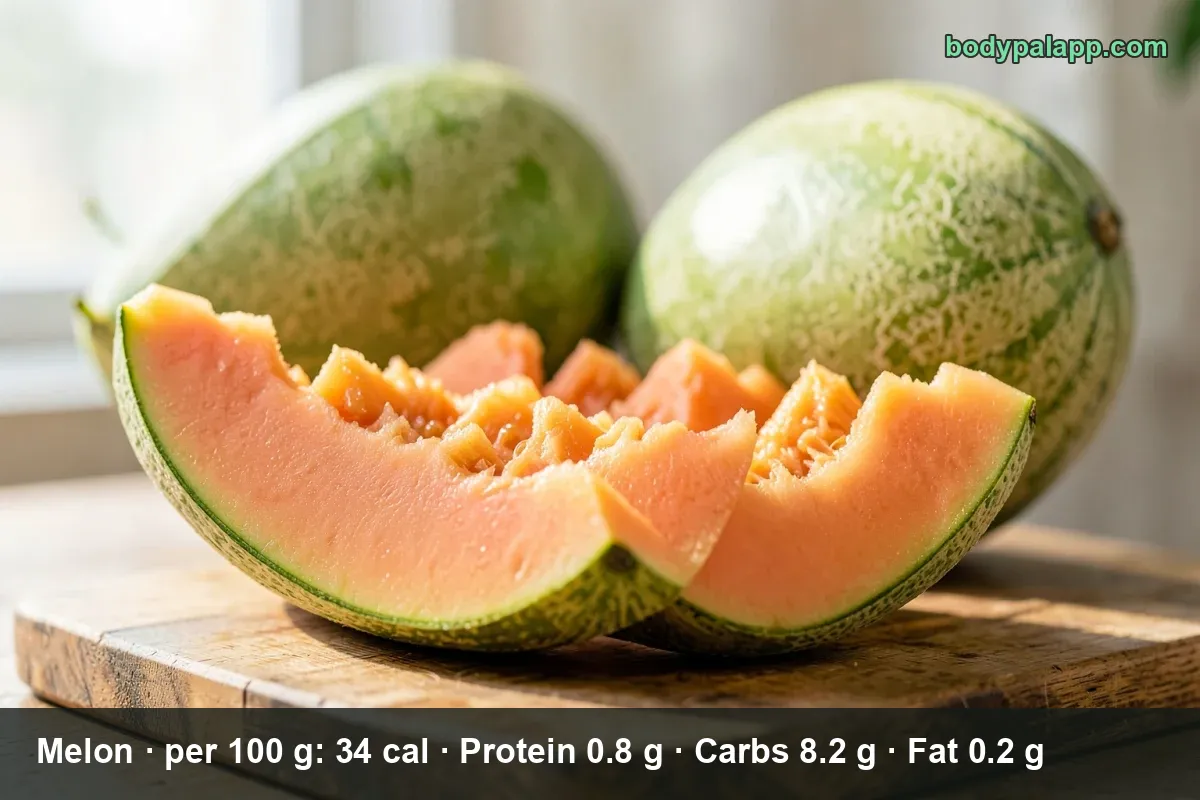
One large wedge of cantaloupe, an eighth of a big melon at 102 g, carries 35 calories. Raw melon runs 34 calories per 100 g, one of the lowest numbers in the fruit aisle. Cut that same melon into dice and a cup comes to 53 calories, because a cup packs more fruit than a wedge does.
On this page
- Melon quick facts
- US servings from one ounce to a cup of melon balls
- Other melons and how they differ
- Potassium is the row that earns its keep
- How does melon compare?
- Most popular melon brands
- FAQ
Melon quick facts
The record behind every number here is SR Legacy 169092, "Melons, cantaloupe, raw". Cantaloupe is what most Americans mean by melon at the grocery store, and 169092 is the only cantaloupe entry with the full label set: total sugars, saturated fat, fiber, sodium and potassium in one place. Two newer Foundation entries, 327198 and 746770, agree on 34 calories per 100 g but leave sugars and saturated fat blank, so they cannot fill a Nutrition Facts table on their own.
Weights below are edible flesh. Rind and seeds are cut away before the melon is weighed, which is why a "102 g wedge" is a much bigger piece of fruit than it sounds.
| Nutrient | Per 100 g | Per 1 large wedge (102 g) | % Daily Value |
|---|---|---|---|
| Calories | 34 | 35 | — |
| Total fat | 0.19 g | 0.2 g | 0% |
| Saturated fat | 0.05 g | 0.1 g | 0% |
| Carbohydrate | 8.16 g | 8.3 g | 3% |
| Dietary fiber | 0.9 g | 0.9 g | 3% |
| Total sugars | 7.86 g | 8.0 g | — |
| Protein | 0.84 g | 0.9 g | 2% |
| Sodium | 16 mg | 16 mg | 1% |
% Daily Value is based on a 2,000-calorie diet.
Verified nutrition data
Numbers on this page come from USDA FoodData Central, the U.S. Department of Agriculture’s food composition database, and from manufacturer labels where a branded product is named. Last verified September 2026. How we verify our data →
There is no added sugars row on this page. The SR Legacy edition does not publish added sugars at all, and raw melon has none to publish. Cholesterol is 0 mg, as it is in every fruit. Potassium is the number worth carrying: 267 mg per 100 g, which works out to 272 mg in the wedge, or 6% of the Daily Value. Daily Value percentages follow the FDA reference amounts for a 2,000-calorie day.
One quirk worth knowing if you compare USDA records yourself: the Foundation cantaloupe entries list 30 mg of sodium per 100 g against 16 mg here. Different analytical batches, same fruit. Either way it is a rounding error on a 2,300 mg daily limit.
US servings from one ounce to a cup of melon balls
| Serving | Weight | Calories |
|---|---|---|
| 1 oz | 28 g | 10 kcal |
| 1 wedge, large (1/8 of a large melon) | 102 g | 35 kcal |
| 1 cup, diced | 156 g | 53 kcal |
| 1 cup, cubes | 160 g | 54 kcal |
| 1 cup, balls | 177 g | 60 kcal |
| Per 100 g | 100 g | 34 kcal |
The wedge, the diced cup, the cubed cup and the ball cup are all USDA household measures for this record, weights included. The ounce is our own arithmetic from the USDA 100 g figure, not a USDA serving.
Here is the trap. A wedge looks like a serious piece of fruit and a cup of diced melon looks like a snack, yet the cup is 156 g against the wedge's 102 g. That makes the cup 53 calories against 35, about 51% more for something that reads smaller on a plate. Three cup measures for one fruit is unusual, and the reason is shape: dice leave air gaps, cubes pack a little tighter at 160 g, and a melon baller presses round scoops into 177 g of fruit per cup. Same melon, same knife work, 7 calories of difference between the loosest and the tightest cup.
If you log melon by eye, log it by the cup. A wedge cut for a fruit plate is usually smaller than the USDA's large wedge, and two of those thin slices still land under a cup.
Other melons and how they differ
| Version | Per 100 g | Typical serving | Calories |
|---|---|---|---|
| Cantaloupe, raw | 34 kcal | 1 wedge, large (102 g) | 35 kcal |
| Honeydew, raw | 36 kcal | 1 cup, diced (170 g) | 61 kcal |
| Casaba, raw | 28 kcal | 1 cup, cubes (170 g) | 48 kcal |
| Watermelon, raw | 30 kcal | 1 oz (28 g) | 9 kcal |
| Frozen melon balls | 33 kcal | 1 cup, unthawed (173 g) | 57 kcal |
| Frozen melon (FNDDS) | 35 kcal | 1 cup, diced-equivalent (156 g) | 55 kcal |
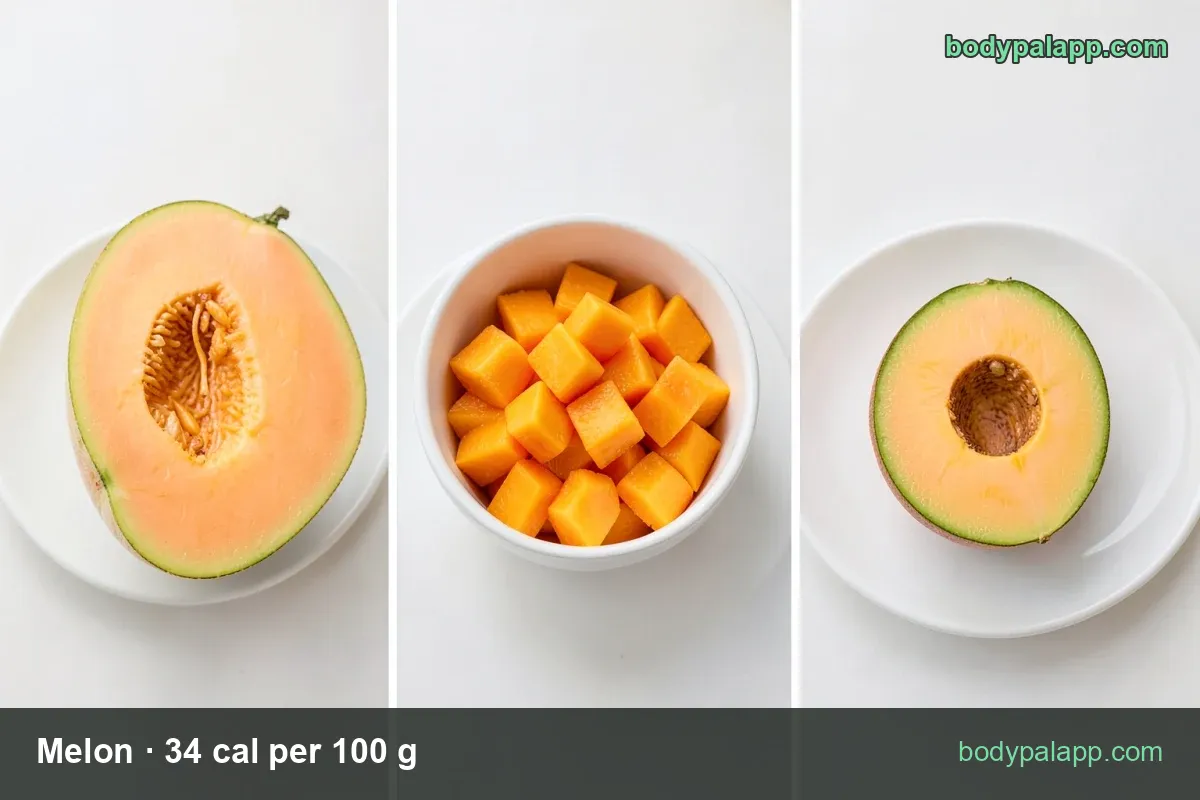
| Whole medium cantaloupe | 34 kcal | 1 melon, 5-inch diameter (552 g) | 188 kcal |
Honeydew is the sweeter melon: 8.12 g of total sugars per 100 g against cantaloupe's 7.86 g, and 36 calories against 34. That two-calorie gap per 100 g turns into eight per cup, because honeydew's firmer flesh fills a measuring cup at 170 g while diced cantaloupe fills it at 156 g. The density does more damage than the sugar does.
Casaba is the lightest melon on this page at 28 calories per 100 g, and it quietly carries the most protein of the group at 1.11 g per 100 g against cantaloupe's 0.84 g. Nobody eats melon for protein, but if you are building a fruit plate to a calorie budget, casaba buys the most volume.
Watermelon sits at 30 calories per 100 g and is a separate fruit with its own record, listed here only so the comparison is honest. Frozen melon behaves almost exactly like fresh: melon balls come in at 33 calories per 100 g, the general FNDDS frozen melon entry at 35. Freezing does not concentrate anything: gram for gram, frozen melon costs what fresh melon costs. The watermelon ounce and the frozen-melon diced-equivalent cup in that table are our own scaling from the USDA 100 g figures, not USDA servings.
The whole-melon line is the one people underestimate. A medium cantaloupe yields about 552 g of flesh, which is 188 calories, roughly 45.0 g of carbohydrate and about 5.0 g of fiber, 18% of the Daily Value. Those whole-melon figures are our own arithmetic from the USDA 100 g record, not a USDA serving.
There are no useful store-brand melon products to list. Searching US Branded records for melon returns sodas, energy drinks, kombucha and ice bars carrying melon flavor, none of which is fruit.
Potassium is the row that earns its keep
Melon's nutrition case is not vitamins, it is potassium per calorie. A cup of melon balls delivers about 473 mg, which is 10% of the 4,700 mg Daily Value, for 60 calories. The diced cup gives about 417 mg, or 9%, for 53. Both are our own arithmetic from the USDA 100 g figure of 267 mg. Very few foods hand over a tenth of a mineral target for the price of a slice of bread's worth of calories.
Potassium is one of the nutrients the Dietary Guidelines for Americans flag as underconsumed in the US, and fruit is the group most Americans fall short on according to MyPlate. A cup of melon counts as a full cup toward that fruit target, which is not true of dried or juiced fruit at the same volume.
The rows that stay near zero matter too. Total fat is 0.19 g per 100 g and saturated fat 0.05 g, so a wedge rounds to 0% of both Daily Values. Sodium is 16 mg in a wedge, about 1%. If you're watching sodium, fruit is never the problem; melon just makes that unusually clear.
How does melon compare?
| Melon | Per 100 g | US serving | Calories |
|---|---|---|---|
| Cantaloupe, raw | 34 kcal | 1 wedge, large (102 g) | 35 kcal |
| Honeydew, raw | 36 kcal | 1 cup, diced (170 g) | 61 kcal |
| Casaba, raw | 28 kcal | 1 cup, cubes (170 g) | 48 kcal |
| Frozen melon balls | 33 kcal | 1 cup, unthawed (173 g) | 57 kcal |
Our take: for a calorie budget, casaba wins on paper at 28 per 100 g and 48 per cup, but it is a special-order melon in most stores, so cantaloupe at 34 is the realistic pick. Buy cantaloupe, cut it into dice rather than balls, and a generous cup costs 53 calories. Honeydew is the one to watch: it is only two calories heavier per 100 g, yet a cup of it runs 61 because the cup holds more fruit. Frozen melon balls are the convenience option and cost almost nothing extra, 57 calories a cup against 53 for fresh dice.
Most popular melon brands in the United States
Ranked by how widely each product appears among foods sold in the United States, from the BodyPal food database of over 3.3 million products. Calories are the figures printed on each Nutrition Facts label, checked against USDA FoodData Central.
| Product | Calories (per 100 g) |
|---|---|
| Del Monte Cantaloupe Chunks | 35 cal |
| Taylor Farms Cantaloupe Cup | 35 cal |
| Harris Teeter Cantaloupe Chunks | 35 cal |
| Crazy Fresh Cantaloupe Chunks | 36 cal |
| Legend Produce Cantaloupe | 37 cal |
| Great For You Cantaloupe Spears | 36 cal |
Brand popularity: BodyPal food database. Nutrition: manufacturer labels / USDA FoodData Central.
Melon FAQs
How many calories are in a slice of melon?
A large wedge, one eighth of a big cantaloupe at 102 g, is 35 calories. Thinner fruit-plate slices weigh less; a sliver of about 50 g lands near 17 calories, our own arithmetic from the USDA figure of 34 calories per 100 g. Rind and seeds are not counted in either number.
How many calories are in 1 cup of melon?
A cup of diced melon (156 g) is 53 calories, a cup of cubes (160 g) is 54, and a cup of melon balls (177 g) is 60. The scoop shape packs the most fruit into the same cup, which is why balls cost seven calories more than dice do.
Is cantaloupe or honeydew lower in calories?
Cantaloupe is lower: 34 calories per 100 g against 36 for honeydew. The gap widens by the cup, because honeydew's denser flesh fills a measuring cup at 170 g while diced cantaloupe fills it at 156 g. That works out to 61 calories against 53, eight calories per cup.
How much sugar is in melon?
A large wedge holds 8.0 g of total sugars, and 100 g of raw melon holds 7.86 g. All of it occurs naturally in the fruit. The USDA record lists no added sugars, because raw cantaloupe has none. Honeydew is the sweeter melon at 8.12 g per 100 g.
Is melon good for weight loss?
At 34 calories per 100 g, melon is one of the cheapest fruits by weight, and a full cup of dice costs 53. Water and 0.9 g of fiber per 100 g make it filling for the calories. If you're watching carbohydrate rather than calories, that cup still brings 12.7 g.
How many carbs are in melon?
100 g of raw melon has 8.16 g of carbohydrate, of which 0.9 g is fiber. A large wedge is 8.3 g, 3% of the Daily Value, and a cup of diced melon is about 12.7 g, our own arithmetic from the USDA 100 g figure. Casaba is lowest at 6.58 g.
Does melon have potassium?
Yes, 267 mg per 100 g. A large wedge gives 272 mg, 6% of the Daily Value, and a cup of melon balls about 473 mg, 10% of it, for 60 calories. That ratio is melon's strongest nutrition line. The cup figure is our own arithmetic from the USDA record.
How many calories are in a whole cantaloupe?
A medium cantaloupe, about 552 g of edible flesh, is 188 calories, with roughly 45.0 g of carbohydrate and about 1,474 mg of potassium. Those are our own arithmetic from the USDA 100 g figures, not a USDA serving. Rind and seeds are excluded from the weight.
Similar foods
- Cantaloupe Melon — 35 cal per wedge
- 5 Strawberries — 19 cal per 5 medium strawberries
- Honeydew Melon — 45 cal per wedge
- Orange Bell Pepper — 38 cal per medium pepper
- Strawberries — 49 cal per cup halves
- Lime — 20 cal per medium lime
Count it without the math
Point the camera at the plate and BodyPal counts the melon for you, wedge or cup.


How long does it take to burn off melon?
One large wedge (102 g) is 35 kcal. Enter your weight and the amount you ate to see how long it takes you to burn that off:
lb
| Activity | Time to burn 35 kcal |
|---|---|
| Walking, brisk | 7 min |
| Cycling, moderate | 4 min |
| Swimming, moderate | 5 min |
| Jogging | 4 min |
| Weight training, moderate | 8 min |
Times are for a 155 lb adult at a steady pace; change the weight to see yours. The amount is set to the portion in the text (102 g); change it to what you actually ate. BodyPal works this out from your steps automatically.
This table assumes you know your daily total. If you do not, the daily calorie calculator works it out from five numbers.