
How many calories are in an orange bell pepper?
One medium orange bell pepper weighs 119 g raw and carries 38 calories. Per 100 g the pepper runs about 32 calories, one of the lowest figures for anything you can eat by the handful. Slice that same pepper into strips and a full cup comes to 29.
On this page
- Orange bell pepper quick facts
- US servings from three rings to a large pepper
- Whole sliced and chopped peppers side by side
- Why the store label says 20 calories
- Potassium beats fiber on this pepper
- How does an orange bell pepper compare?
- Most popular orange bell pepper brands
- FAQ
Orange bell pepper quick facts
The record behind every number on this page is USDA Foundation 2258591, "Peppers, bell, orange, raw". It is the only USDA entry measured on an orange bell pepper specifically, and it describes the pepper in the form most people buy it: whole, raw, seeds still in. Foundation entries are laboratory measurements rather than label math, which matters here more than it does for most produce.
The per-serving column below is one medium pepper at 119 g. That weight is the standard US household size for a sweet pepper, not a USDA serving row, so the serving figures are our own arithmetic scaled from the USDA 100 g measurement.
| Nutrient | Per 100 g | Per one medium pepper (119 g) | % Daily Value |
|---|---|---|---|
| Calories | 31.7 | 38 | — |
| Total fat | 0.16 g | 0.2 g | 0% |
| Carbohydrate | 6.7 g | 8.0 g | 3% |
| Dietary fiber | 0.97 g | 1.2 g | 4% |
| Protein | 0.88 g | 1.0 g | 2% |
| Sodium | 0 mg | 0 mg | 0% |
| Potassium | 200.8 mg | 239 mg | 5% |
% Daily Value is based on a 2,000-calorie diet.
Verified nutrition data
Numbers on this page come from USDA FoodData Central, the U.S. Department of Agriculture’s food composition database, and from manufacturer labels where a branded product is named. Last verified September 2026. How we verify our data →
Four rows a US label would normally show are missing here on purpose. Total sugars, added sugars, saturated fat and cholesterol are not measured in this Foundation record, so publishing a figure for any of them would mean guessing. Percent Daily Values follow the current FDA reference amounts: 275 g of carbohydrate, 28 g of fiber, 50 g of protein, 2,300 mg of sodium, 4,700 mg of potassium.
US servings from three rings to a large pepper
Peppers get logged in three different ways: as a piece, as a cup, or as a garnish. The numbers separate more than you would expect, because a cup of pepper can weigh more than the pepper it came from.
| Serving | Weight | Calories |
|---|---|---|
| 1 oz | 28 g | 9 kcal |
| Three rings on a salad | 30 g | 10 kcal |
| Half a medium pepper, seeds out | 60 g | 19 kcal |
| 1 cup sliced strips | 92 g | 29 kcal |
| One medium pepper, whole | 119 g | 38 kcal |
| One large pepper, whole | 164 g | 52 kcal |
| Per 100 g | 100 g | 32 kcal |
Every line except the last is our own arithmetic from the USDA 100 g figure, using standard US household weights for sweet peppers. USDA publishes the composition, not the piece size, and pepper piece size is genuinely variable: a supermarket orange pepper can land 20 g either side of 119 g without looking unusual. If you own a kitchen scale, weigh it once and you will never need this table again.
The one to watch is the ounce. At 9 calories, an ounce of pepper is small enough that logging it precisely is wasted effort, while a large pepper stuffed and baked is a real 52-calorie base before anything goes inside it.
Whole sliced and chopped peppers side by side
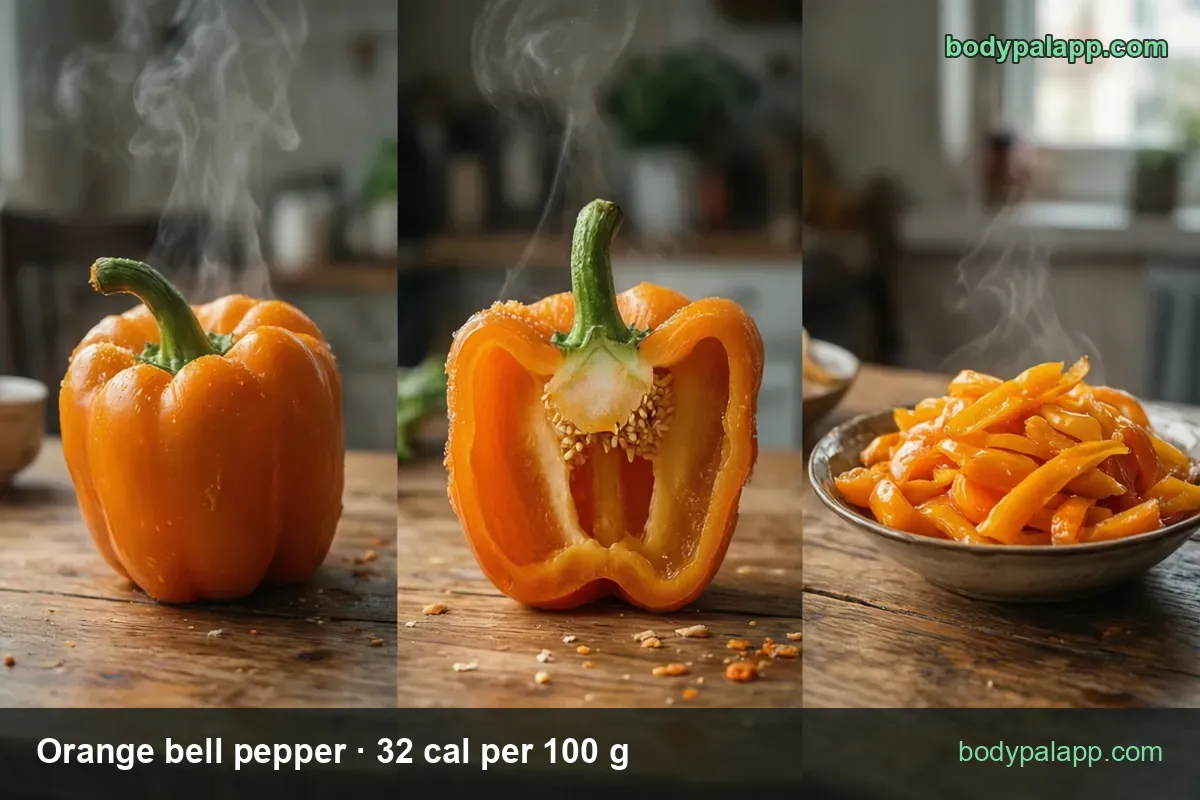
Cutting a pepper does not change its calories per gram. It changes how many grams fit in a cup, and that is where food logs go wrong.
| Version | Per 100 g | Typical piece | Calories |
|---|---|---|---|
| Whole medium pepper | 31.7 kcal | 1 medium (119 g) | 38 kcal |
| Sliced into strips | 31.7 kcal | 1 cup sliced (92 g) | 29 kcal |
| Chopped | 31.7 kcal | 1 cup chopped (149 g) | 47 kcal |
| Half a pepper, snack size | 31.7 kcal | 1/2 medium (60 g) | 19 kcal |
| Rings on a salad | 31.7 kcal | 3 rings (30 g) | 10 kcal |
| Store-label whole pepper | 20 kcal | 1 pepper (100 g) | 20 kcal |
Long strips leave air gaps, so a cup of them holds only 92 g. Chopped pieces nest, and the same cup holds 149 g. That chopped cup is 47 calories, which is more than the whole 119 g pepper it was cut from. Anyone logging "1 cup peppers" for a stir-fry is quietly recording a pepper and a quarter.
The last row is a store label rather than a laboratory measurement, and it is the reason for the next section.
Why the store label says 20 calories
Pick up a shrink-wrapped orange pepper at the store and the tag may read 20 calories per 100 g, as the Food Lion orange pepper label does. USDA measured 31.7. Neither one is wrong.
Nutrition labels are allowed to round, and for foods this light the rounding rules are blunt: calories under 50 round to the nearest 5, fat under 0.5 g is declared as 0, and gram values for carbohydrate and protein round to whole numbers. Those rules alone take 31.7 to 30, not to 20, so the tag steps down further than the rounding requires. The USDA figure is the measurement; the label is a permitted declaration, not a second lab result.
For a 38-calorie vegetable the gap is 12 calories per 100 g, so it never decides a day. It matters because the habit generalizes: for anything dense, a label rounded down and a lab number differ in the direction that flatters the package. When both exist, log the lab number.
Potassium beats fiber on this pepper
One medium pepper gives you 239 mg of potassium, 5% of the 4,700 mg Daily Value. That is a larger share than its fiber (4%) or its carbohydrate (3%), and it costs 38 calories to get. Potassium is one of the nutrients the Dietary Guidelines for Americans singles out as underconsumed in the US, and vegetables are where most of the shortfall gets closed.
Sodium is the other side of the same coin: 0 mg in the raw pepper. Whatever ends up on your peppers - ranch, hummus, a sprinkle of salt in the pan - supplies the entire sodium total, and a couple of tablespoons of dressing can outweigh the pepper in both calories and sodium. If you are watching sodium, raw strips with lemon are the cleaner version of the same snack.
Two medium peppers chopped clear a cup and a half toward the vegetable target on MyPlate for 76 calories, which is the practical case for keeping a bag of them in the fridge.
How does an orange bell pepper compare?
| Vegetable | Per 100 g | US serving | Calories |
|---|---|---|---|
| Orange bell pepper | 32 kcal | one medium, 119 g | 38 kcal |
| Broccoli, raw | 32 kcal | 1 cup chopped, 91 g | 29 kcal |
| Roma tomato | 22 kcal | one tomato, 62 g | 14 kcal |
| Celery, raw | 17 kcal | one stalk, 40 g | 7 kcal |
Our take: per gram the orange pepper and raw broccoli are a dead heat at roughly 32 calories, and tomato and celery are the two lighter options in this group. The serving column tells a different story, because a whole pepper is simply a bigger object than a stalk of celery, and 38 calories is the highest number in the table. If you want raw volume for almost nothing, celery wins. If you want something that eats like food, the pepper wins, and it is the one people finish. The single argument for broccoli is protein: 2.57 g per 100 g against the pepper's 0.88 g, close to three times as much.
Most popular orange bell pepper brands in the United States
Ranked by how widely each product appears among foods sold in the United States, from the BodyPal food database of over 3.3 million products. Calories are the figures printed on each Nutrition Facts label, checked against USDA FoodData Central.
| Product | Calories (per 100 g) |
|---|---|
| Food Lion Orange Pepper | 20 cal |
Brand popularity: BodyPal food database. Nutrition: manufacturer labels / USDA FoodData Central.
Orange bell pepper FAQs
How many calories are in one orange bell pepper?
A medium orange bell pepper, 119 g whole and raw, is 38 calories. A large one at 164 g is 52, and half a pepper eaten as a snack is 19. The USDA Foundation record measures the raw pepper at 31.7 calories per 100 g, so the size of the pepper decides everything else.
How many calories in a cup of sliced orange bell pepper?
A cup of sliced strips weighs 92 g and comes to 29 calories. A cup of chopped pepper packs tighter at 149 g and lands at 47. That chopped cup outweighs the whole medium pepper it was cut from, which is why cup measures and whole peppers rarely match in a food log.
How many carbs are in an orange bell pepper?
A medium pepper carries 8.0 g of carbohydrate, 3% of the Daily Value, and 1.2 g of that is fiber. Per 100 g the raw pepper holds 6.7 g of carbohydrate and 0.97 g of fiber. The USDA Foundation record does not measure total sugars here, so we publish no sugar figure.
How much protein is in an orange bell pepper?
A medium orange bell pepper has 1.0 g of protein, 2% of the Daily Value, scaled from 0.88 g per 100 g. That is small next to raw broccoli at 2.57 g per 100 g, close to three times as much. Peppers earn their place on the plate for bulk and crunch, not protein.
How much potassium is in an orange bell pepper?
One medium pepper delivers 239 mg of potassium, 5% of the 4,700 mg Daily Value, from 200.8 mg per 100 g. That is a bigger share than its fiber at 4% or its carbohydrate at 3%, and it arrives for 38 calories. Potassium is a nutrient the Dietary Guidelines flags as underconsumed.
Is orange bell pepper good for weight loss?
At 38 calories for a whole medium pepper, orange bell peppers are among the cheapest ways to add volume to a meal, and a cup of strips is only 29. Sodium is 0 mg raw, so the dip or dressing decides the real total. If you are counting, the sauce matters more than the pepper.
Do roasted orange peppers have more calories than raw?
Raw is the figure we publish: 31.7 calories per 100 g, or 38 for a medium pepper. USDA has no Foundation record for a roasted orange bell pepper, so we do not quote one. Roasting itself adds nothing; the oil in the pan does, and water loss concentrates the calories per gram.
How much does a medium orange bell pepper weigh?
A medium orange bell pepper weighs about 119 g, a large one about 164 g, and half a pepper with the seeds removed about 60 g. Those are standard US household weights for sweet peppers rather than USDA serving rows, so a pepper on your scale can run 20 g either side of them.
Similar foods
- 5 Strawberries — 19 cal per 5 medium strawberries
- Strawberries — 49 cal per cup halves
- Cantaloupe Melon — 35 cal per wedge
- Lime — 20 cal per medium lime
- Melon — 35 cal per wedge, large
- Watermelon Chunks — 46 cal per cup
Count it without the math
Point the camera at the cutting board and BodyPal counts the pepper for you, strips and all.


How long does it take to burn off 38 kcal of orange Bell pepper?
One medium pepper (119 g) is 38 kcal. Enter your weight and the amount you ate to see how long it takes you to burn that off:
lb
| Activity | Time to burn 38 kcal |
|---|---|
| Walking, brisk | 8 min |
| Cycling, moderate | 5 min |
| Swimming, moderate | 5 min |
| Jogging | 4 min |
| Weight training, moderate | 8 min |
Times are for a 155 lb adult at a steady pace; change the weight to see yours. The amount is set to the portion in the text (119 g); change it to what you actually ate. BodyPal works this out from your steps automatically.
Burning it off is one side of it. The other is knowing your number: work out how many calories you need a day, with macros and a goal date.