
How many calories are in a lime?
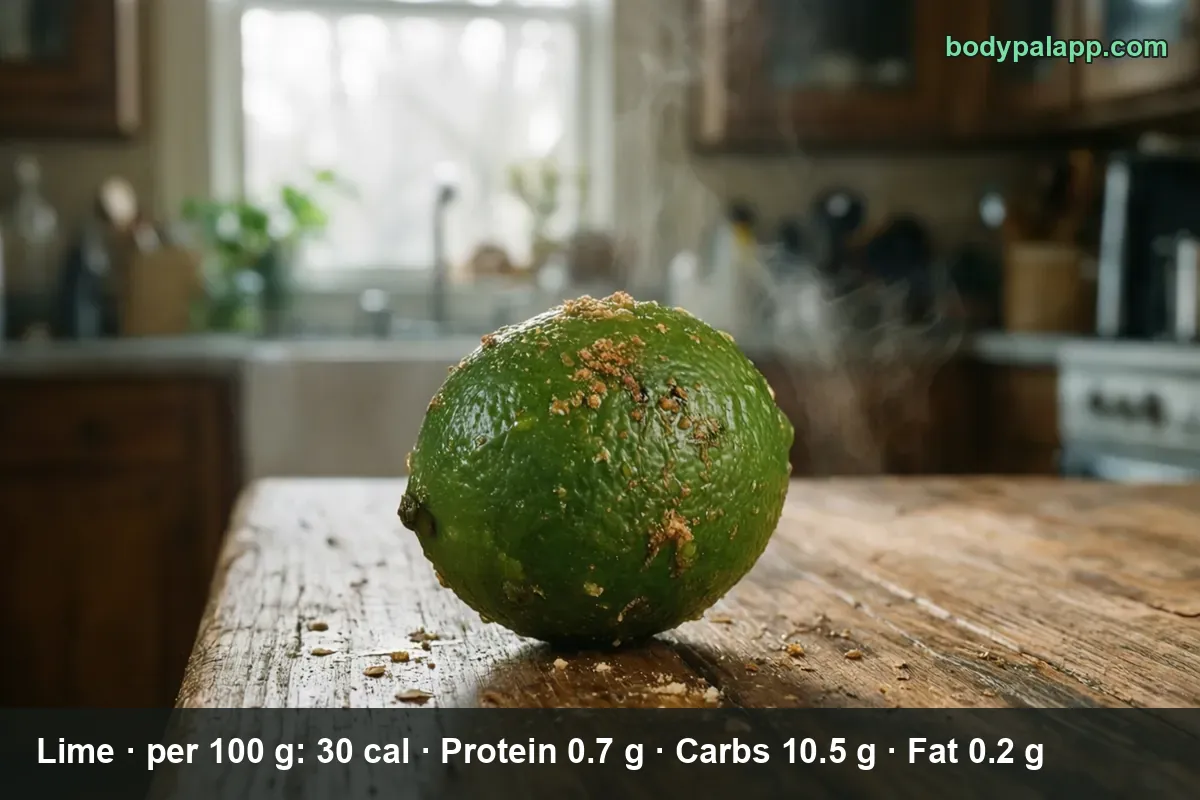
One medium lime, about 2 inches across and 67 g, has 20 calories. Per 100 g the fruit runs 30 calories, which makes it one of the lightest things you can squeeze onto a plate. Nearly all of those calories are carbohydrate, and more than a quarter of that carbohydrate is fiber.
On this page
- Lime quick facts
- US servings from a wedge to a whole lime
- Lime juice and key lime pie
- Fiber is the row that beats the calories
- How does a lime compare?
- Lime FAQs
Lime quick facts
The numbers below come from the USDA record for Limes, raw (SR Legacy 168155). That is the record for the whole fruit — peel included in the weight, the way a lime sits in your hand and the way a grocery scale reads it. USDA attaches a household measure to it, "1 fruit, 2 inches in diameter," at 67 g, so the serving column here is a real USDA portion rather than something scaled.
There is a second USDA record with identical values, a FNDDS mirror of the same raw fruit. Picking either one gives the same answer, so this page stays with SR Legacy, which carries the fuller nutrient profile. Juice records are a different food entirely and get their own section further down.
| Nutrient | Per 100 g | Per 1 lime (67 g) | % Daily Value |
|---|---|---|---|
| Calories | 30 | 20 | — |
| Total fat | 0.2 g | 0.1 g | 0% |
| Saturated fat | 0.02 g | 0.0 g | 0% |
| Carbohydrate | 10.54 g | 7.1 g | 3% |
| Dietary fiber | 2.8 g | 1.9 g | 7% |
| Total sugars | 1.69 g | 1.1 g | — |
| Protein | 0.7 g | 0.5 g | 1% |
| Sodium | 2 mg | 1 mg | 0% |
% Daily Value is based on a 2,000-calorie diet.
Verified nutrition data
Numbers on this page come from USDA FoodData Central, the U.S. Department of Agriculture’s food composition database, and from manufacturer labels where a branded product is named. Last verified September 2026. How we verify our data →
Two rows you would see on a packaged label are missing on purpose. Added sugars and trans fat are not published in this SR Legacy record, and for a raw fruit both are zero anyway, so listing them would be padding. Cholesterol is 0 mg, as it is in every plant food. Potassium comes to 68 mg in one lime, which is about 1% of the 4,700 mg Daily Value — a lime is a flavor tool, not a potassium source.
Sodium deserves one line of its own: 1 mg in a whole lime. That is the reason a squeeze of lime is the standard trick for cutting back on the salt shaker without the food tasting flat.
US servings from a wedge to a whole lime
| Serving | Weight | Calories |
|---|---|---|
| 1 wedge, one-eighth of a lime | 8.4 g | 3 kcal |
| 1 oz | 28.4 g | 9 kcal |
| Half a lime | 33.5 g | 10 kcal |
| One medium lime, 2 inches across | 67 g | 20 kcal |
| Per 100 g | 100 g | 30 kcal |
Only two of those rows come straight from USDA: the 67 g fruit and the flat 100 g. The wedge, the half and the ounce are our own arithmetic from the USDA 100 g figure, not USDA servings — we took 30 calories per 100 g and scaled down by weight.
The practical takeaway is how small the numbers stay. A wedge on the rim of a glass is 3 calories. Two wedges squeezed over a taco plate is 6. Even the whole fruit, rind and all, is 20 — less than a single teaspoon of olive oil. If you are logging a meal and wondering whether the lime is worth an entry, the honest answer is that it moves your day by less than a rounding error, unless you are eating limes by the bag.
Where limes do get counted is in drinks and dressings, because nobody eats the peel. A lime cut for a pitcher of water contributes only the juice that actually leaves the fruit, which is a fraction of the 67 g on the scale. That is the gap the next section closes.
Lime juice and key lime pie
| Version | Per 100 g | Typical serving | Calories |
|---|---|---|---|
| Whole lime, raw | 30 kcal | one medium lime, 67 g | 20 kcal |
| Fresh-squeezed lime juice | 25 kcal | juice of 1 lime, 44 g | 11 kcal |
| Bottled unsweetened lime juice | 21 kcal | 1 fl oz, 30.8 g | 6 kcal |
| Limeade from frozen concentrate | 52 kcal | per 100 g | 52 kcal |
| Key lime pie | 322 kcal | per 100 g | 322 kcal |
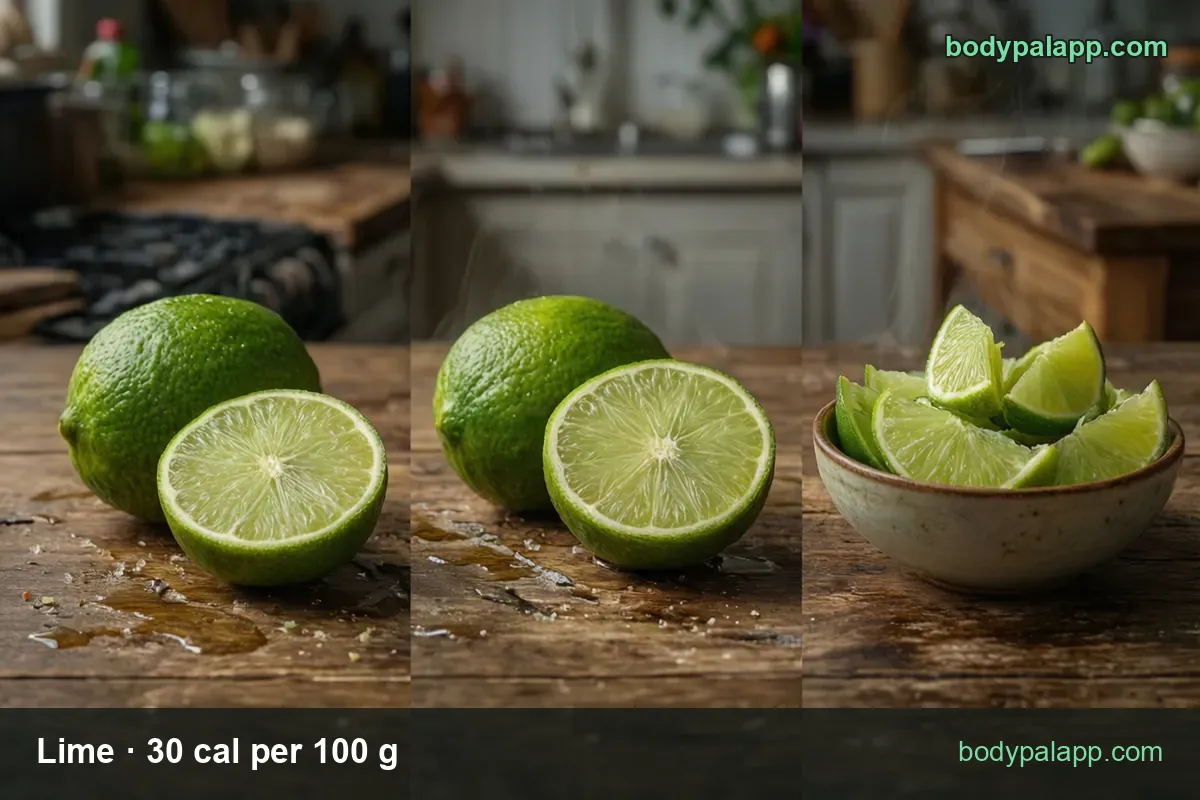
Fresh-squeezed juice. The USDA record for Lime juice, raw (168156) is 25 calories per 100 g. One lime yields roughly 44 g of juice, which works out to 11 calories — our own arithmetic from the 100 g figure rather than a USDA serving. So the juice is a little over half the calories of the fruit it came from, and the rest stays behind in the peel and pulp you throw away.
Bottled unsweetened juice. Lime juice, canned or bottled, unsweetened (168157) is lighter still at 21 calories per 100 g, or 6 calories in a fluid ounce. It is more dilute than fresh, and it carries 16 mg of sodium per 100 g against 2 mg in the fresh-squeezed version. Neither number is large, but if you are cooking with half a cup of bottled juice, the difference is real.
Limeade from frozen concentrate. Prepared with water it lands at 52 calories per 100 g, with 13.27 g of sugars in that same 100 g. USDA does not attach a household portion to this record, so we have left it at 100 g rather than invent a glass size. The comparison worth making: the sugars in 100 g of limeade are roughly eight times the 1.69 g of total sugars in 100 g of the fruit. Almost all of that difference is added sweetener, not lime.
Key lime pie. At 322 calories per 100 g, the dessert has nothing in common with the fruit nutritionally. It also brings 7.59 g of saturated fat and 182 mg of sodium per 100 g. Again, USDA lists no standard slice weight for this record, so we report per 100 g only rather than guess at a slice.
Fiber is the row that beats the calories
This is the number most calorie pages skip. One lime delivers 1.9 g of fiber, or 7% of the 28 g Daily Value the FDA uses on the Nutrition Facts label. Its 20 calories are 1% of a 2,000-calorie day. In other words, a lime pulls about seven times more weight in your fiber budget than it takes out of your calorie budget.
The catch is that the fiber lives in the pulp, not the liquid. Whole fruit runs 2.8 g of fiber per 100 g; raw juice runs 0.4 g per 100 g. Squeeze one lime into a glass and you get 11 calories and about 0.2 g of fiber — the vitamin-and-flavor part survives, the fiber mostly does not. If you want the fiber, the lime has to go in as pulp: zest in a marinade, slices in a salad, the whole squeezed half dropped into the pot.
For most people this is a small edge rather than a strategy. MyPlate counts fruit in cups, and it takes a lot of limes to fill one. But if you are watching sodium, a lime is the cheapest swap on the counter: 1 mg of sodium and 20 calories to replace a shake of salt.
How does a lime compare?
| Food | Per 100 g | US serving | Calories |
|---|---|---|---|
| Whole lime, raw | 30 kcal | one medium lime, 67 g | 20 kcal |
| Lime juice, raw | 25 kcal | 1 fl oz, 30.8 g | 8 kcal |
| Lime juice, bottled unsweetened | 21 kcal | 1 fl oz, 30.8 g | 6 kcal |
| Lemon juice, raw | 22 kcal | 1 fl oz, 30.8 g | 7 kcal |
The whole fruit is the heaviest thing in this table per 100 g at 30 calories, and every juice below it is lighter — that is what happens when you take out the pulp and leave mostly water and acid. The lemon-versus-lime question people ask has a boring answer: raw lemon juice is 22 calories per 100 g and raw lime juice is 25, a gap of 3 calories that disappears the moment you pour either one. That 7 calories per fluid ounce is our own scaling from the USDA 100 g figure, not a USDA serving.
Our take: pick by flavor, not by calories. If the goal is fiber and volume, use the whole lime — 20 calories and 1.9 g of fiber beats 8 calories and almost no fiber. If the goal is acid in a dressing or a marinade, fresh juice and bottled juice are close enough that convenience wins, with the one caveat that bottled brings eight times the sodium per 100 g. The only lime product that actually costs you anything is the sweetened one: limeade is 52 calories per 100 g and key lime pie is 322.
Lime FAQs
How many calories are in one lime?
One medium lime, 2 inches across and 67 g, has 20 calories, which is 30 calories per 100 g of fruit. Nearly all of it is carbohydrate — 7.1 g — and 1.9 g of that arrives as fiber. There is half a gram of protein and essentially no fat.
How many calories in half a lime?
Half a lime weighs about 33.5 g and carries 10 calories. That is our own arithmetic from the USDA 100 g figure rather than a USDA serving. It brings roughly 3.5 g of carbohydrate and 0.9 g of fiber. Squeezed over tacos or a salad, it is a rounding error in a day.
How many calories in a lime wedge?
A wedge cut as one-eighth of a lime weighs about 8.4 g and comes to 3 calories, scaled by us from the USDA figure of 30 calories per 100 g. It carries about 0.9 g of carbohydrate and 0.2 g of fiber. Two wedges on a plate of tacos is 6 calories total.
How many carbs are in a lime?
One medium lime has 7.1 g of carbohydrate, or 3% of the Daily Value, and 10.54 g per 100 g. Fiber accounts for 1.9 g of that, so the digestible remainder is about 5.2 g. Total sugars are only 1.1 g in the whole fruit, which is why limes taste sour rather than sweet.
How many calories in the juice of one lime?
About 11 calories. One lime yields roughly 44 g of juice, and raw lime juice is 25 calories per 100 g, so the figure is our arithmetic rather than a USDA serving. The juice keeps the acid and loses the pulp: only about 0.2 g of fiber makes it into the glass.
Is lime juice zero calories?
No: raw lime juice is 25 calories per 100 g and bottled unsweetened juice is 21, which works out to 8 and 6 calories in a fluid ounce. A teaspoon is small enough that a package label rounds it to zero, but the juice itself is not calorie-free — a quarter cup of it is worth counting.
Lime vs lemon: which has fewer calories?
Lemon, barely: raw lemon juice is 22 calories per 100 g against 25 for raw lime juice, a difference of 3 calories that vanishes at the serving sizes anyone actually pours: 7 calories per fluid ounce versus 8. Choose by flavor. Neither one changes a meal's total in any meaningful way.
How much fiber is in a lime?
One medium lime has 1.9 g of fiber, 7% of the 28 g Daily Value, from 2.8 g per 100 g of fruit. That is seven times its share of a 2,000-calorie day. Juice keeps almost none of it: raw lime juice holds just 0.4 g of fiber per 100 g.
Similar foods
- Watermelon Chunks — 46 cal per cup
- Watermelon Cubes — 46 cal per cup
- Watermelon Whole — 1355 cal per watermelon
- Lemon — 17 cal per lemon
- 5 Strawberries — 19 cal per 5 medium strawberries
- Orange Bell Pepper — 38 cal per medium pepper
Count it without the math
Point the camera at the plate and BodyPal counts the lime along with everything else on it.


This table assumes you know your daily total. If you do not, the daily calorie calculator works it out from five numbers.