
How many calories are in a lemon?
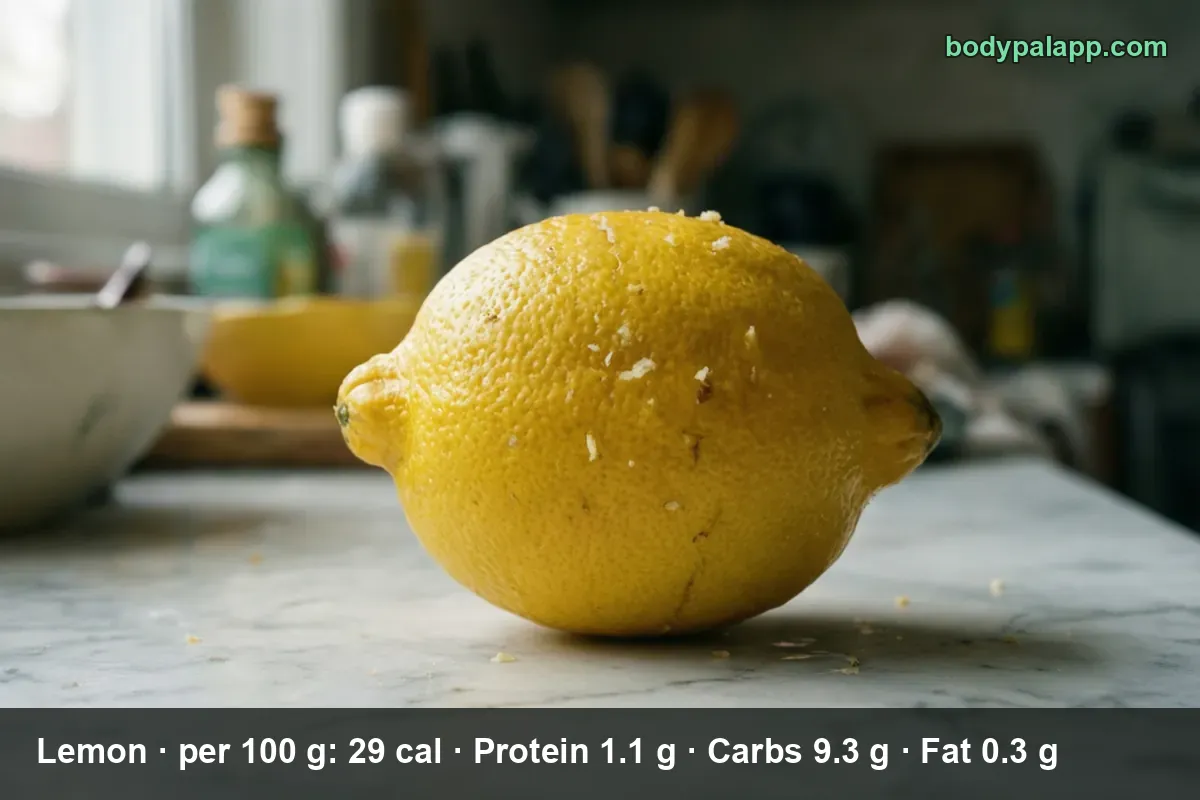
One medium lemon weighs 58 g once you drop the peel, and it carries 17 calories. Per 100 g the flesh runs 29 calories, a touch under both lime and grapefruit. A wedge in your glass of water is 2. Sugar is only 1.5 g in the whole fruit, and fiber beats it.
On this page
- Lemon quick facts
- US servings, from one wedge to a cup of sections
- Juice, zest, half a lemon and lemonade
- Fiber is the row that carries a lemon
- How does a lemon compare?
- Most popular lemon brands
- Lemon FAQs
Lemon quick facts
The number people actually want is for the fruit in their hand: a fresh lemon, peel removed, nothing done to it. That is SR Legacy 167746, "Lemons, raw, without peel", and it is the record every column below is built from. USDA also carries the same food in its FNDDS survey set (2709168) with an identical profile, but SR Legacy is the original measurement and it is the one that ships with household portions, including the 58 g medium and the 7 g wedge.
Two rows you would see on a US package are missing here. USDA does not publish added sugars or trans fat for this SR Legacy record, so those lines are gone; a raw lemon has no added sugar by definition anyway. Cholesterol is 0 mg, and potassium is 138 mg per 100 g, which works out to 80 mg in a medium lemon, or 2% of the Daily Value.
| Nutrient | Per 100 g | Per 1 medium lemon (58 g) | % Daily Value |
|---|---|---|---|
| Calories | 29 | 17 | — |
| Total fat | 0.3 g | 0.2 g | 0% |
| Saturated fat | 0.04 g | 0.0 g | 0% |
| Carbohydrate | 9.32 g | 5.4 g | 2% |
| Dietary fiber | 2.8 g | 1.6 g | 6% |
| Total sugars | 2.5 g | 1.5 g | — |
| Protein | 1.1 g | 0.6 g | 1% |
| Sodium | 2 mg | 1 mg | 0% |
% Daily Value is based on a 2,000-calorie diet.
Verified nutrition data
Numbers on this page come from USDA FoodData Central, the U.S. Department of Agriculture’s food composition database, and from manufacturer labels where a branded product is named. Last verified September 2026. How we verify our data →
We don't quote a vitamin C figure on this page. It sits outside the eight Nutrition Facts rows we cost from the USDA record, and mixing a lab value into a calorie table is how pages start disagreeing with each other.
US servings, from one wedge to a cup of sections
Lemons are one of the few foods where the household measures USDA publishes match how people really use them. A wedge, a whole fruit, a cup of sections: all three are in the record.
| Serving | Weight | Calories |
|---|---|---|
| 1 wedge or slice, one eighth of a lemon | 7 g | 2 kcal |
| 1 oz | 28 g | 8 kcal |
| Half a medium lemon | 29 g | 8 kcal |
| 1 medium lemon, 2-1/8 inch across | 58 g | 17 kcal |
| 1 large lemon, 2-3/8 inch across | 84 g | 24 kcal |
| 1 cup sections | 212 g | 61 kcal |
| Per 100 g | 100 g | 29 kcal |
The wedge, the medium, the large and the cup are USDA household measures. The 1 oz row and the half lemon are our own arithmetic from the USDA 100 g figure, not USDA servings, which is why they both land on 8 despite being different weights.
Store labels tell a slightly different story, and the gap is worth knowing if you scan barcodes. Four of the six national retail listings in USDA's Branded set come in at 26 to 28 calories per 100 g rather than 29: Wegmans, Ahold, Price Chopper and Melissa's Seedless. Two organic listings sit higher, at 31 and 34. Every one of those is a manufacturer's own rounding of the same fruit, so if your app shows 15 for a medium lemon instead of 17, nothing is broken. Across the whole shelf the listings run from 26 to 34 calories per 100 g.
Juice, zest, half a lemon and lemonade
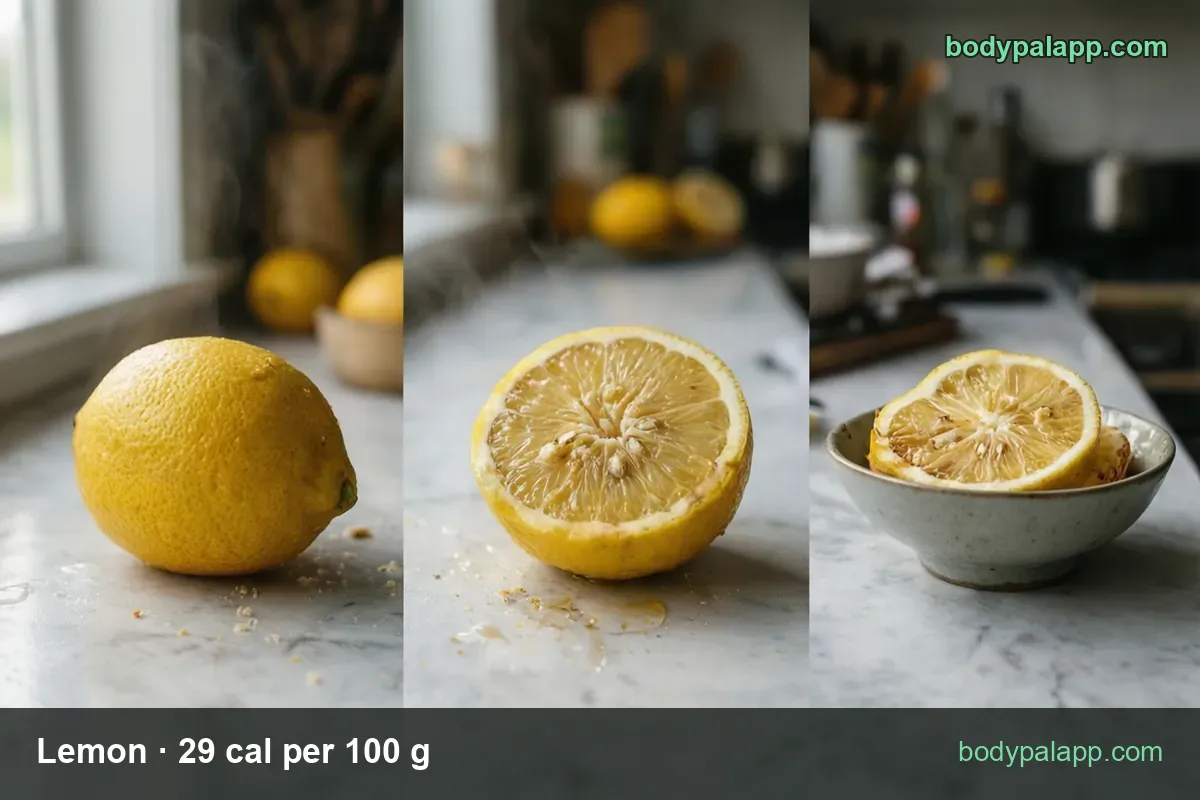
Squeeze the fruit and the number drops, because you leave the pulp behind. Fresh lemon juice is 22 calories per 100 g against 29 for the flesh. Zest goes the other way: raw lemon peel is 47 per 100 g, the densest thing on this page, though nobody eats it by the ounce.
| Version | Per 100 g | Typical serving | Calories |
|---|---|---|---|
| Whole lemon, raw, without peel | 29 kcal | 1 medium (58 g) | 17 kcal |
| Half a lemon | 29 kcal | half a medium (29 g) | 8 kcal |
| Lemon wedge | 29 kcal | 1 wedge (7 g) | 2 kcal |
| Lemon juice, freshly squeezed | 22 kcal | 1 cup (244 g) | 54 kcal |
| Lemon juice, bottled from concentrate | 17 kcal | 1 tbsp (15 g) | 3 kcal |
| Lemon peel, zest, raw | 47 kcal | 1 tbsp (6 g) | 3 kcal |
| Lemonade, prepared from frozen concentrate | 40 kcal | 1 cup (248 g) | 99 kcal |
Here is the comparison nobody runs: a cup of fresh juice is 54 calories and a cup of lemon sections is 61, so the juice saves you seven. What it costs is fiber. The cup of sections carries 5.9 g; the cup of juice carries 0.7 g. That is the whole argument for cooking with the fruit instead of the bottle, and it has nothing to do with calories.
Bottled juice from concentrate is lighter still at 17 calories per 100 g, because it is diluted. The catch is sodium. Fresh juice is 1 mg per 100 g and the bottled version is 24 mg, rising to 26 mg for the branded REAL LEMON record. That is still tiny against a 2,300 mg Daily Value, but it is the one line where the bottle and the fruit genuinely differ.
Lemonade is a different food and deserves the separate line it gets. Prepared from frozen concentrate it is 40 calories per 100 g, and a cup is 99. A store-bought lemonade drink runs 46 per 100 g with 11.67 g of sugar, nearly all of it added by the manufacturer. A cup of the frozen-concentrate version, at 99 calories, is close to six times a whole lemon.
Fiber is the row that carries a lemon
A medium lemon hits 6% of the Daily Value for fiber while contributing only 2% of the day's carbohydrate. Fruits rarely tip that way. Most of them deliver two or three times as much carbohydrate as fiber in DV terms; a lemon delivers three times more fiber than carbohydrate.
In grams: 5.4 g of carbohydrate, of which 1.6 g is fiber and 1.5 g is sugar. Subtract the fiber and you are left with roughly 3.8 g of net carbohydrate in a whole lemon, which is our own arithmetic rather than a USDA row. If you are tracking carbs closely, that is the figure that matters, and it is small enough that a lemon rarely needs logging at all.
Sodium is 1 mg in a medium lemon, close enough to zero that lemon juice is the standard substitute when you are cutting salt from a dressing or a piece of fish. Fat is 0.2 g and saturated fat rounds to 0.0 g. Protein is 0.6 g, or 1% DV, which is to say a lemon is not a protein food.
For the fruit group targets themselves, MyPlate counts by cup equivalents rather than by piece, and a cup of lemon sections is 212 g and 61 calories. Nobody eats that, which is the honest limit of counting lemons as fruit servings.
How does a lemon compare?
| Fruit | Per 100 g | US serving | Calories |
|---|---|---|---|
| Lemon, raw, without peel | 29 kcal | 1 oz (28 g) | 8 kcal |
| Lime, raw | 30 kcal | 1 oz (28 g) | 9 kcal |
| Grapefruit, raw, pink and red | 30 kcal | 1 oz (28 g) | 9 kcal |
| Watermelon, raw | 30 kcal | 1 oz (28 g) | 9 kcal |
Our take: lemon is the lightest of the four per 100 g, but only by a single calorie, so choosing between them on calories is a waste of attention. The real difference is carbohydrate. Watermelon and grapefruit sit around 7.5 g per 100 g, lemon at 9.32 g, lime at 10.54 g. If you are watching carbs, grapefruit is the better pick per bite; if you want fiber, the lemon brings 2.8 g per 100 g. And if you are only ever using a wedge or a squeeze, all four are effectively free.
Most popular lemon brands in the United States
Ranked by how widely each product appears among foods sold in the United States, from the BodyPal food database of over 3.3 million products. Calories are the figures printed on each Nutrition Facts label, checked against USDA FoodData Central.
| Product | Calories (per 100 g) |
|---|---|
| Wegmans Lemons | 26 cal |
| Wegmans Organic Lemons | 31 cal |
| Marketside Organic Lemons | 34 cal |
| Melissa's Seedless Lemons | 28 cal |
| Ahold Fresh Lemons | 26 cal |
| Price Chopper Lemons | 26 cal |
Brand popularity: BodyPal food database. Nutrition: manufacturer labels / USDA FoodData Central.
Lemon FAQs
How many calories are in one lemon?
17 calories in a medium lemon of 58 g, peel not included. A large one at 84 g is 24. The flesh runs 29 calories per 100 g, so even a large lemon stays under 25 calories. Fiber accounts for 1.6 g of its 5.4 g of carbohydrate.
How many calories are in half a lemon?
8 calories for half a medium lemon, about 29 g of flesh. That is our own arithmetic from the USDA 100 g figure of 29 calories, since USDA lists whole lemons rather than halves. Squeeze that half over a salad and you add roughly 5 calories, because juice alone is lighter.
How many calories are in a lemon wedge?
2 calories per wedge. USDA sizes a wedge at one eighth of a lemon, or 7 g, which makes it the smallest serving on this page. Eight of them make up the fruit, 17 calories in total. A wedge on the rim of a glass rounds to nothing in a daily total.
How many calories in fresh lemon juice?
54 calories in a cup of fresh-squeezed juice, 244 g, at 22 calories per 100 g. One tablespoon is 3. A whole lemon yields roughly 48 g of juice, about 11 calories, so the juice carries most of the flavor and about two thirds of the fruit's calories.
Do lemons have carbs?
Yes, 5.4 g of carbohydrate in a medium 58 g lemon, which is 2% of the Daily Value. Of that, 1.6 g is fiber and 1.5 g is sugar, leaving roughly 3.8 g of net carbohydrate. Per 100 g the figure is 9.32 g, more than grapefruit's 7.5 g but under lime's 10.54 g.
How much fiber is in a lemon?
1.6 g of fiber in a medium lemon, 6% of the 28 g Daily Value, against only 2% for carbohydrate. That ratio is unusual for fruit. The peel is the richer source at 10.6 g per 100 g, so a tablespoon of zest adds about 0.6 g of fiber for 3 calories.
Is lemon water zero calories?
Not quite, but close: a wedge dropped in a glass is 2 calories, and juice squeezed from a whole lemon adds about 11. A pitcher made with two lemons lands near 22 for the whole pitcher. Nothing there moves a daily total, unless the recipe brings sugar, which is where lemonade starts.
Bottled lemon juice vs fresh: which has fewer calories?
Bottled juice from concentrate is lighter, 17 calories per 100 g against 22 for fresh, though both round to 3 calories per tablespoon. The real trade is sodium: 24 mg per 100 g bottled versus 1 mg fresh, from the preservative. On calories the difference is too small to matter.
Similar foods
- Lime — 20 cal per medium lime
- Watermelon Chunks — 46 cal per cup
- Watermelon Cubes — 46 cal per cup
- Watermelon Whole — 1355 cal per watermelon
- 5 Strawberries — 19 cal per 5 medium strawberries
- Orange Bell Pepper — 38 cal per medium pepper
Count it without the math
Point the camera at the plate and BodyPal counts the lemon, the juice and everything under it.


Burning it off is one side of it. The other is knowing your number: work out how many calories you need a day, with macros and a goal date.