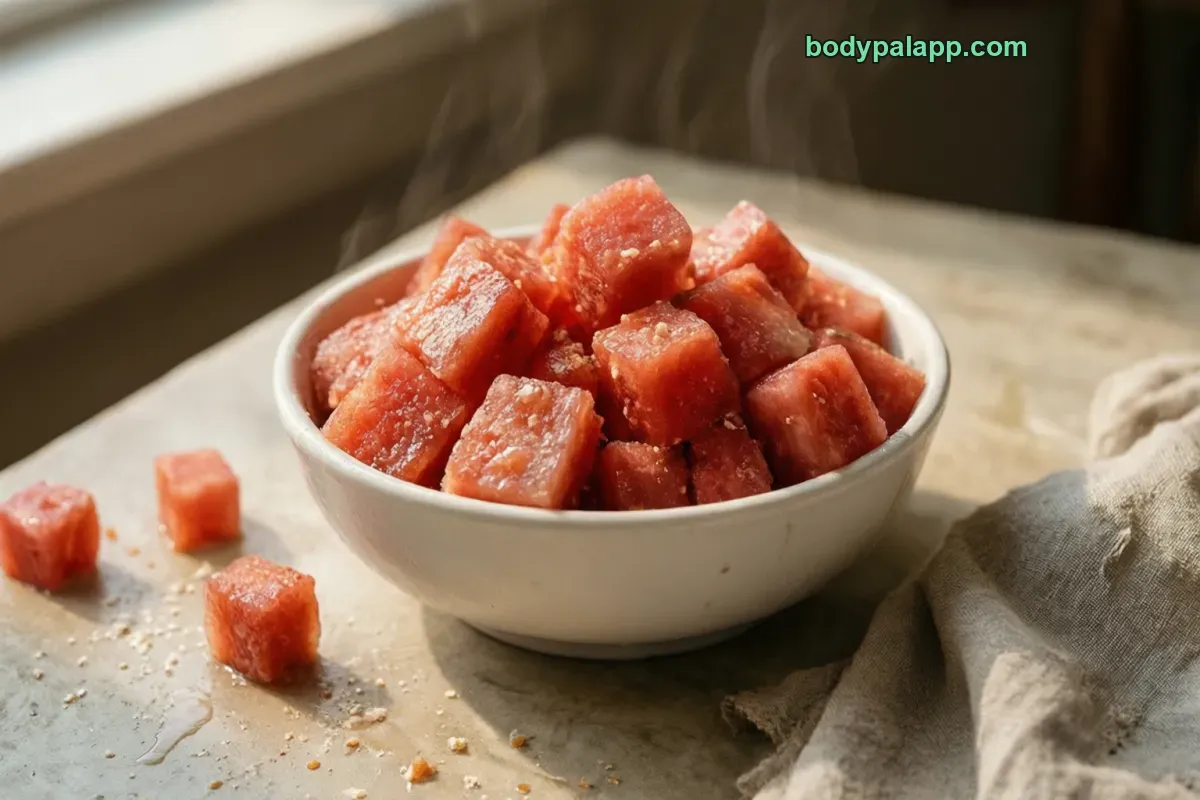
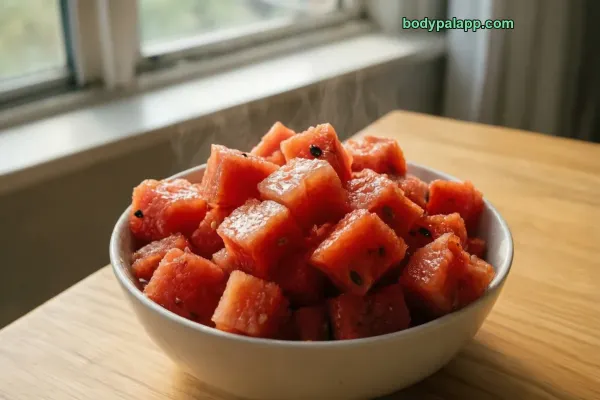
Watermelon cube calories come to 46 for 1 cup cubed (152 g) and 30 per 100 g. The thing to notice is how little sits behind that number: carbs supply 89% of the calories, fat and sodium barely register, and you need to eat a lot of melon before the total climbs past a light snack.
46kcal
1 cup of cubes · 152 g, raw, cubed
7%protein
0.9 gProtein
11 gCarbs
0.2 gFat
How to burn off 46 kcal
—Walking, brisk
—Jogging
—Cycling, moderate
—Swimming
Skip the math. BodyPal counts these calories from your steps and workouts automatically.
Nutrition facts
Raw, cubed · per 152 g
Calories
46 kcal
Protein
0.9 g
Carbohydrate
11.5 g
Fat
0.2 g
Saturated fat
0 g
Cholesterol
0 mg
Sodium
2 mg
Potassium
170 mg
Iron
0.4 mg
Source: USDA FoodData Central
🛡️
Verified nutrition data
Numbers on this page come from USDA FoodData Central, the U.S. Department of Agriculture’s food composition database, and from manufacturer labels where a branded product is named. Last verified September 2026. How we verify our data →
Watermelon cube: calories, protein and sodium by serving
Percent of daily value uses the FDA reference of 2,000 kcal a day.
Serving
kcal
Protein
Carbs
Fat
Sodium
% DV kcal
1 cup cubed (152 g)
46
0.9 g
11.5 g
0.2 g
2 mg
2%
1 cube (15 g)
5
0.1 g
1.1 g
0 g
0 mg
0%
1 cup balls (154 g)
46
0.9 g
11.6 g
0.2 g
2 mg
2%
100 g
30
0.6 g
7.6 g
0.2 g
1 mg
2%
3 × 1 cup cubed (152 g)
137
2.8 g
5 mg
5 × 1 cup cubed (152 g)
228
4.6 g
8 mg
A cup of cubes is a 46-calorie snack
The standard measure is 1 cup cubed (152 g), and it lands at 46 calories. A single cube of about 15 g is 5 calories, so picking at a plate of melon one piece at a time adds up slowly. If you scoop the fruit with a melon baller instead, 1 cup balls (154 g) is still 46 calories. Shape changes the look of the bowl, not the count.
Because watermelon is mostly water, the weight climbs much faster than the calories. Two cups cubed weigh 304 g and come to 91 calories. Three cups, or 456 g, reach 137. Even a big summer portion of 5 cups, a full 760 g of fruit, sits at 228 calories, which is less than many single packaged snacks.
That is the practical case for cubes. They are easy to measure by the cup, easy to portion into containers, and hard to overdo in calorie terms. The main way the total moves is volume, so if you are tracking, count cups rather than guessing from a shared platter.
Carbs supply 89% of the calories
Per 100 g, watermelon has 7.6 g of carbohydrate, 0.6 g of protein and 0.2 g of fat. Run that through the calorie split and carbs account for 89%, protein for 7% and fat for 4%. This is a carbohydrate food in the plainest sense, just a very diluted one.
Most of that carbohydrate is sugar. Of the 7.6 g of carbs per 100 g, 6.2 g are sugars and only 0.4 g is fiber. A cup cubed carries 11.5 g of carbs, 9.4 g of sugars and 0.6 g of fiber. The sugar is the natural fruit kind, but the low fiber means there is little bulk beyond the water itself.
Fat is essentially absent. A cup has 0.2 g, saturated fat reads 0 and cholesterol reads 0. Nothing in the macro row needs watching except the carbs, and even those stay modest because the portion is so watery.
Sodium is near zero, potassium is modest
Watermelon has 1 mg of sodium per 100 g and 2 mg per cup cubed. Against a daily value of 2300 mg, that rounds to 0%. Even the 5-cup portion only reaches 8 mg. If you are keeping an eye on salt, fresh cubes are one of the easiest foods on the list.
Potassium is the mineral that shows up in a meaningful amount: 112 mg per 100 g. Measured against the 4700 mg daily value it is a small slice per serving, but it does add up across several cups more than sodium ever will.
The contrast is worth noting because processed melon products can look very different. The watermelon rind entry on our site lists 143 mg of sodium per 100 g, far above the 1 mg in plain fruit. Raw cubes keep the sodium row essentially blank.
Pair it with protein to make it a meal
A cup cubed gives you 0.9 g of protein, which is 2% of the daily value. Even 3 cups only provide 2.8 g. Watermelon is refreshing and light, but on its own it will not hold you for long, and it does little to cover protein for the day.
That makes it a better side than a centerpiece. Set a cup next to something that brings protein and some fat, like yogurt, cottage cheese, eggs or a handful of nuts, and the plate becomes far more balanced while the melon adds volume for very few calories. On a salad with feta and greens, the same logic applies.
If you are snapping a photo of a fruit bowl or a mixed plate, BodyPal can log the watermelon from the picture, which helps when the portion is a pile of cubes rather than a neat cup.
How does watermelon cube compare?
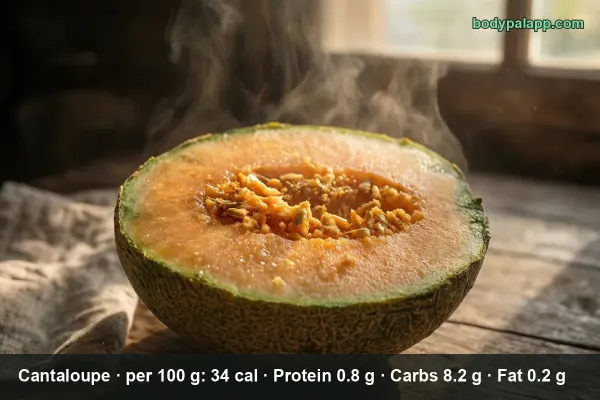
Here is how watermelon cubes stack up against watermelon chunks, watermelon rind and cantaloupe melon, per 100 g and per usual serving.
Verdict: For the fewest calories pick plain cubes or chunks, which are the same fruit at 30 calories per 100 g and 46 per cup, with cantaloupe close behind at 34. Skip the watermelon rind entry if you are counting, since it runs 250 calories per 100 g, about 8.3 times as much, with 143 mg of sodium.
Watermelon cube FAQs
How many calories are in a cup of watermelon cubes?
A cup of diced watermelon (152 g) is about 46 calories. One small 15 g cube is about 5 calories.
Is watermelon good for weight loss?
Raw watermelon is 30 calories per 100 g, so a full 152 g cup of cubes adds 46 calories, 11.5 g of carbs and 0.6 g of fiber.
How does watermelon compare to cantaloupe?
Watermelon is 30 calories per 100 g and cantaloupe is 34, so a 152 g cup of watermelon cubes lands at 46 calories.
How much sugar is in watermelon cubes?
Watermelon has 6.2 g of sugar per 100 g, which is about 9.4 g in a 152 g cup of cubes.
How many calories are in one watermelon cube?
One watermelon cube of about 15 g has 5 calories. It carries 1.1 g of carbs, 0.9 g of sugars and essentially no fat, so you can eat several cubes before the total becomes noticeable.
How many calories are in 100 g of watermelon?
There are 30 calories in 100 g of raw watermelon. That weight also holds 7.6 g of carbs, 6.2 g of sugars, 0.6 g of protein, 0.2 g of fat and 1 mg of sodium.
Do watermelon balls have the same calories as cubes?
Yes, 1 cup of watermelon balls (154 g) has 46 calories, the same as 1 cup cubed (152 g). The melon baller changes the shape and adds a couple of grams per cup, not meaningful calories.
How many calories are in 2 cups of watermelon?
Two cups of cubed watermelon, about 304 g, have 91 calories. That portion also brings 1.9 g of protein and 3 mg of sodium, so it stays a light snack even at double size.
How much protein is in a cup of watermelon?
A cup of cubed watermelon has 0.9 g of protein, which is 2% of the daily value. Protein supplies only 7% of its calories, so pair it with a protein food if you want it to keep you full.