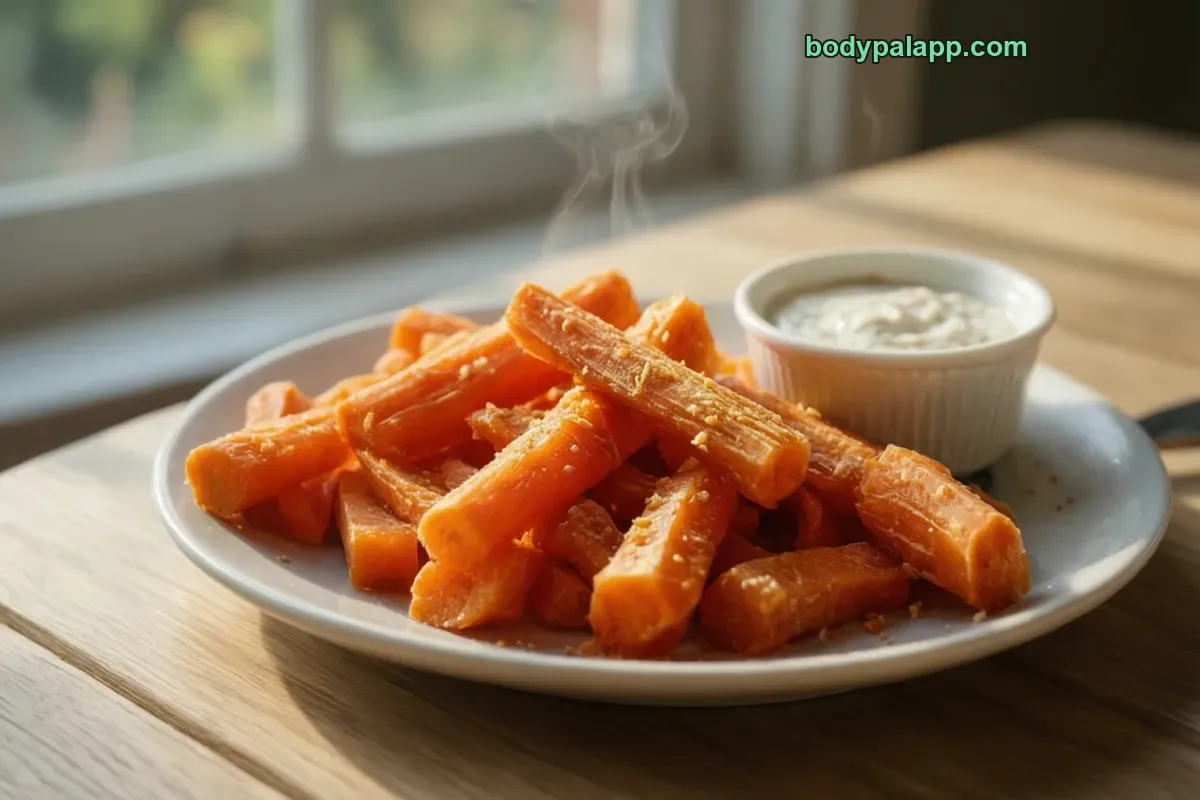
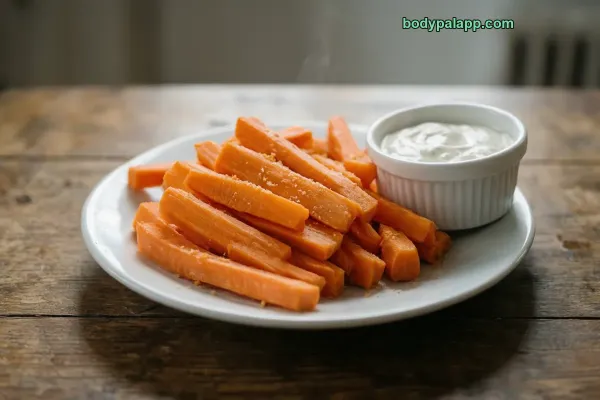
Carrot sticks calories come to 50 for a 1 cup (122 g) serving and 41 per 100 g. That is only 3% of a daily calorie budget for a full cup, so the carrots are rarely the problem. The number that actually moves your total is the dip you pair them with.
50kcal
1 cup · 122 g, raw
8%protein
1.1 gProtein
12 gCarbs
0.3 gFat
How to burn off 50 kcal
—Walking, brisk
—Jogging
—Cycling, moderate
—Swimming
Skip the math. BodyPal counts these calories from your steps and workouts automatically.
Nutrition facts
Raw · per 122 g
Calories
50 kcal
Protein
1.1 g
Carbohydrate
11.7 g
Fat
0.3 g
Saturated fat
0 g
Cholesterol
0 mg
Sodium
84 mg
Potassium
390 mg
Iron
0.4 mg
Source: USDA FoodData Central
🛡️
Verified nutrition data
Numbers on this page come from USDA FoodData Central, the U.S. Department of Agriculture’s food composition database, and from manufacturer labels where a branded product is named. Last verified September 2026. How we verify our data →
Carrot sticks: calories, protein and sodium by serving
Percent of daily value uses the FDA reference of 2,000 kcal a day.
Serving
kcal
Protein
Carbs
Fat
Sodium
% DV kcal
1 cup (122 g)
50
1.1 g
11.7 g
0.3 g
84 mg
3%
3 oz portion (85 g)
35
0.8 g
8.1 g
0.2 g
59 mg
2%
1 large stick (7 g)
3
0.1 g
0.7 g
0 g
5 mg
0%
100 g
41
0.9 g
9.6 g
0.2 g
69 mg
2%
3 × 1 cup (122 g)
150
3.4 g
253 mg
5 × 1 cup (122 g)
250
5.7 g
421 mg
A full cup of sticks is a 50-calorie snack
Raw carrot sticks are one of the few snacks where the portion barely matters. A 1 cup (122 g) serving holds 50 calories, a 3 oz portion (85 g) holds 35, and a single large stick (7 g) adds just 3. You can eat a handful of sticks and barely move the calorie column.
Scaling up shows how slowly the total climbs. Two cups (244 g) come to 100 calories, three cups (366 g) reach 150, and even five cups (610 g) total only 250. Few people eat that many in one sitting, which is the point: volume runs out long before calories do.
That makes carrot sticks useful for anyone who likes to eat with their hands while working or watching something. A bowl on the desk is hard to overdo. If you log food, a rough cup estimate is close enough here, because the gap between one cup and a slightly bigger pile is only a few calories.
Carbs supply 87% of the energy
Almost all of the energy in raw carrots comes from carbohydrate. The calorie split is 87% carbs, 8% protein and 5% fat. Per 100 g that means 9.6 g of carbs, 0.9 g of protein and 0.2 g of fat, with 0 g of saturated fat and 0 mg of cholesterol.
Do not count on carrots for protein. A full cup gives 1.1 g, which is 2% of the 50 g daily value. Even five cups only reach 5.7 g. If you want a snack that holds you over until dinner, the protein has to come from something on the side.
The fat is close to zero too, at 0.3 g per cup. That keeps the calories low, but it also means carrots alone are light and quick to digest. Treat them as the crunchy, high-volume part of a snack rather than the whole thing.
Fiber and natural sugar are the rows worth reading
Of the carbs in a cup, 3.4 g are fiber and 5.8 g are sugars. Against a 28 g fiber daily value, one cup makes a modest but real dent, and it comes with very few calories attached. Per 100 g the numbers are 2.8 g of fiber and 4.7 g of sugars.
The sugar is naturally present in the vegetable, not added. Carrots taste sweet because of it, which is why kids often accept them before other raw vegetables. At 5.8 g per cup the amount is small, and it arrives packed inside a lot of water and crunch.
Sodium is low in plain sticks: 84 mg per cup, or 4% of the 2300 mg daily value. Potassium is the larger mineral at 320 mg per 100 g. Flavored packs are a different story. Seasoned or pickled options such as Rhythm Sea Salt Organic Carrot Sticks or Oh Snap! Carrot Cuties Pickled Carrot Sticks can change the sodium line, so check the label if you watch salt.
The dip decides the total, not the carrots
Carrot sticks rarely get eaten plain. Ranch, hummus, peanut butter and cheese dips are the usual partners, and any of them can carry more calories than the carrots underneath. A cup of sticks with a heavy scoop of dip is a different snack from a cup of sticks on its own.
That is not a reason to skip the dip. A spread with protein or fat makes the snack more filling, which carrots alone struggle to do with 1.1 g of protein per cup. Just measure the dip, not the carrots, if you are counting. That is where the real variation lives.
Carrot sticks also work well as a side that adds volume to a sandwich or wrap lunch without adding much to the total. BodyPal can log the plate from a photo, so the carrots and the dip land in your diary as separate items.
How does carrot sticks compare?
Here is how raw carrot sticks compare with carrot chips and cooked carrots, per 100 g and per usual serving.
Verdict: Raw sticks and carrot chips are essentially the same food at 41 calories per 100 g, so pick whichever shape you enjoy crunching. If you want the smallest number per serving, cooked carrots win at 35 per 100 g and 27 for a half cup sliced (78 g).
Most popular carrot sticks brands in the United States
Ranked by popularity in the BodyPal database
# Productkcal / 100 g
1Rhythm Ranch Organic Carrot Sticks1 bag · 17 g353 kcal
2Rhythm Naked Organic Carrot Sticks1 bag · 40 g350 kcal
3Rhythm Sea Salt Organic Carrot Sticks40 g375 kcal
Rhythm sticks are dried snacks labeled per dry weight, so they read far higher than fresh carrot sticks, while pickled sticks read slightly lower. Source: manufacturer labels / USDA FoodData Central.
Carrot sticks FAQs
How many calories are in a cup of carrot sticks?
A cup of raw carrot sticks (122 g) has about 50 calories, and one large stick (7 g) about 3.
Are carrot sticks good for weight loss?
Raw carrots have 41 calories and 2.8 g of fiber per 100 g, so a cup gives 50 calories with 3.4 g of fiber.
Raw vs cooked carrots: which has fewer calories?
Raw carrots have 41 calories per 100 g, while boiled, drained carrots have 35 per 100 g.
How much sugar is in carrot sticks?
A cup of raw carrot sticks has 5.8 g of sugar and 11.7 g of carbs, or 4.74 g of sugar per 100 g.
How many calories are in one carrot stick?
One large carrot stick (7 g) has about 3 calories. It carries 0.7 g of carbs and 0.2 g of fiber, so individual sticks are close to negligible in a food log.
How many calories are in 100 g of raw carrot sticks?
100 g of raw carrot sticks has 41 calories. That weight also provides 9.6 g of carbs, 2.8 g of fiber, 4.7 g of sugars and 0.9 g of protein, with only 0.2 g of fat.
How many calories are in a 3 oz serving of carrot sticks?
A 3 oz portion (85 g) of raw carrot sticks has 35 calories, or 2% of a daily calorie budget. It includes 2.4 g of fiber, 4 g of sugars and 59 mg of sodium.
How much fiber do carrot sticks have?
A cup of raw carrot sticks has 3.4 g of fiber, measured against a 28 g daily value. Per 100 g the figure is 2.8 g, alongside just 41 calories.
Are carrot sticks high in sodium?
Plain carrot sticks have 84 mg of sodium per cup, which is 4% of the 2300 mg daily value. That is low, though seasoned or pickled packs can contain more, so read the label.