
How many calories are in chestnuts?
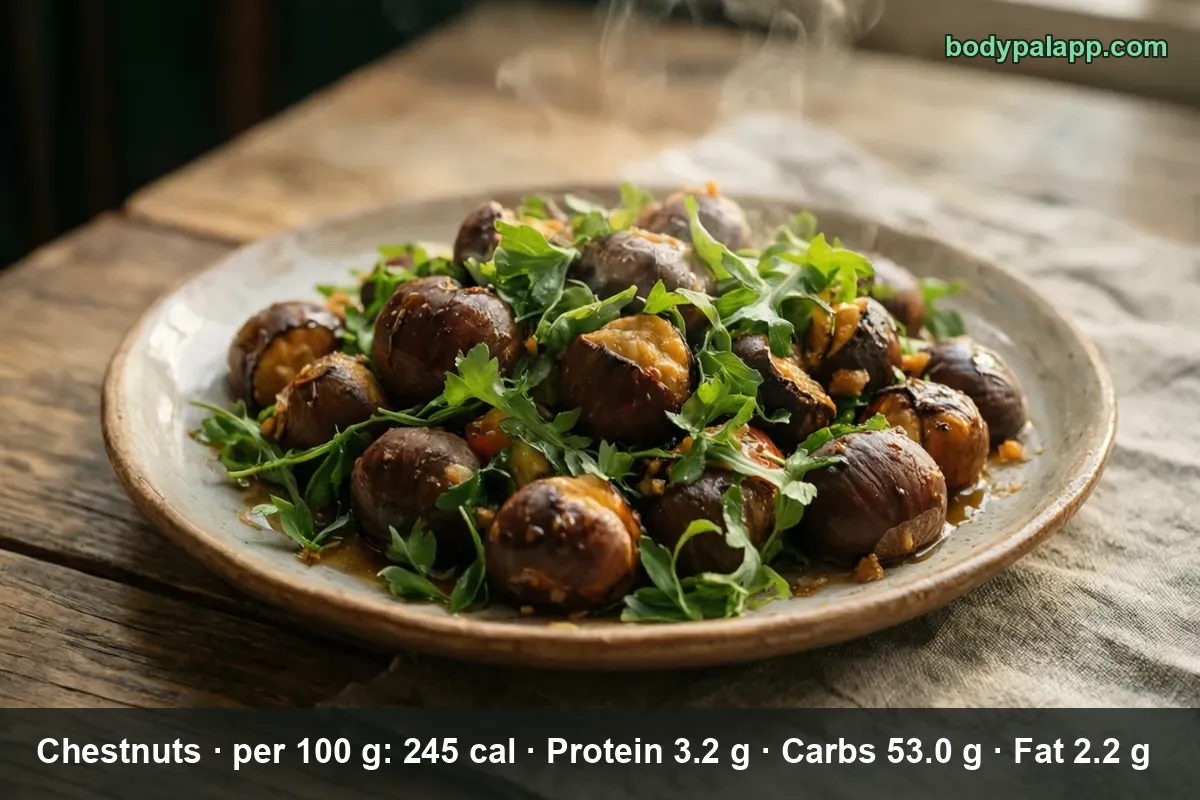
Ten roasted, peeled chestnuts weigh about 84 g and carry 206 calories. Per 100 g roasted chestnuts run 245 calories, low for a nut, because most of what sits inside the shell is starch and water rather than oil. A full cup, 143 g, comes to 350.
On this page
- Chestnut quick facts
- US servings, from one kernel to a full cup
- Raw, boiled, dried and the other chestnut species
- Fiber is the row that surprises people
- How do chestnuts compare to other nuts?
- Most popular chestnut brands
- Chestnut FAQs
Chestnut quick facts
The numbers below come from SR Legacy 170190, "Nuts, chestnuts, european, roasted". That is the record for the chestnut most Americans actually eat: European, roasted, shell and papery skin removed, the kind sold hot in a paper cone in December or vacuum-packed year round. FNDDS carries a second chestnut entry with identical values, so the choice of record moves nothing.
The serving column is 10 kernels, 84 g, which is the USDA household measure for this record and a realistic handful once the shells are off.
| Nutrient | Per 100 g | Per 10 kernels (84 g) | % Daily Value |
|---|---|---|---|
| Calories | 245 | 206 | — |
| Total fat | 2.2 g | 1.8 g | 2% |
| Saturated fat | 0.41 g | 0.3 g | 2% |
| Carbohydrate | 52.96 g | 44.5 g | 16% |
| Dietary fiber | 5.1 g | 4.3 g | 15% |
| Total sugars | 10.6 g | 8.9 g | — |
| Protein | 3.17 g | 2.7 g | 5% |
| Sodium | 2 mg | 2 mg | 0% |
% Daily Value is based on a 2,000-calorie diet.
Verified nutrition data
Numbers on this page come from USDA FoodData Central, the U.S. Department of Agriculture’s food composition database, and from manufacturer labels where a branded product is named. Last verified September 2026. How we verify our data →
Two rows you would see on a package are missing here on purpose: USDA does not publish added sugars or trans fat for this record, so there is nothing honest to print. The 10.6 g of total sugars per 100 g are the chestnut's own, formed as the starch converts during storage and roasting, and total sugars have no Daily Value at all.
Cholesterol is 0 mg, as it is in every plant food. Potassium is the quiet win: 592 mg per 100 g, or 497 mg in ten kernels, which is 11% of the FDA Daily Value of 4,700 mg. Sodium is 2 mg, so unsalted chestnuts are effectively a sodium-free food; street vendors and canned versions are the ones that add salt.
US servings, from one kernel to a full cup
| Serving | Weight | Calories |
|---|---|---|
| 1 kernel | 8.4 g | 21 kcal |
| 5 kernels | 42 g | 103 kcal |
| 10 kernels | 84 g | 206 kcal |
| 1 oz | 28 g | 69 kcal |
| 1 cup | 143 g | 350 kcal |
| Per 100 g | 100 g | 245 kcal |
Only two of these are USDA household measures: 10 kernels and 1 cup. The single kernel and the five-kernel row are our own arithmetic from the USDA 100 g figure, not USDA servings, split evenly at 8.4 g a kernel.
That single-kernel number is the useful one. At 21 calories apiece, chestnuts are one of the few nuts you can count instead of weigh, and the count keeps you honest. Where people go wrong is the cup. A cup of peeled chestnuts is 143 g, roughly five times an ounce, so it lands at 350 calories while the ounce sits at 69. If you are logging from a bag on the counter and reaching in repeatedly, the cup is closer to what you ate than the ounce is.
Vacuum-packed brands come in a little lighter than the USDA roasted record because they are cooked with steam and still hold water. Gefen's organic roasted and peeled whole chestnuts list 90 calories for five pieces (40 g), Tazah lists 100 for 50 g, and Laforestiere's chestnut puree is 30 calories for 2 tablespoons (30 g). If your package prints a number, use the package.
Raw, boiled, dried and the other chestnut species
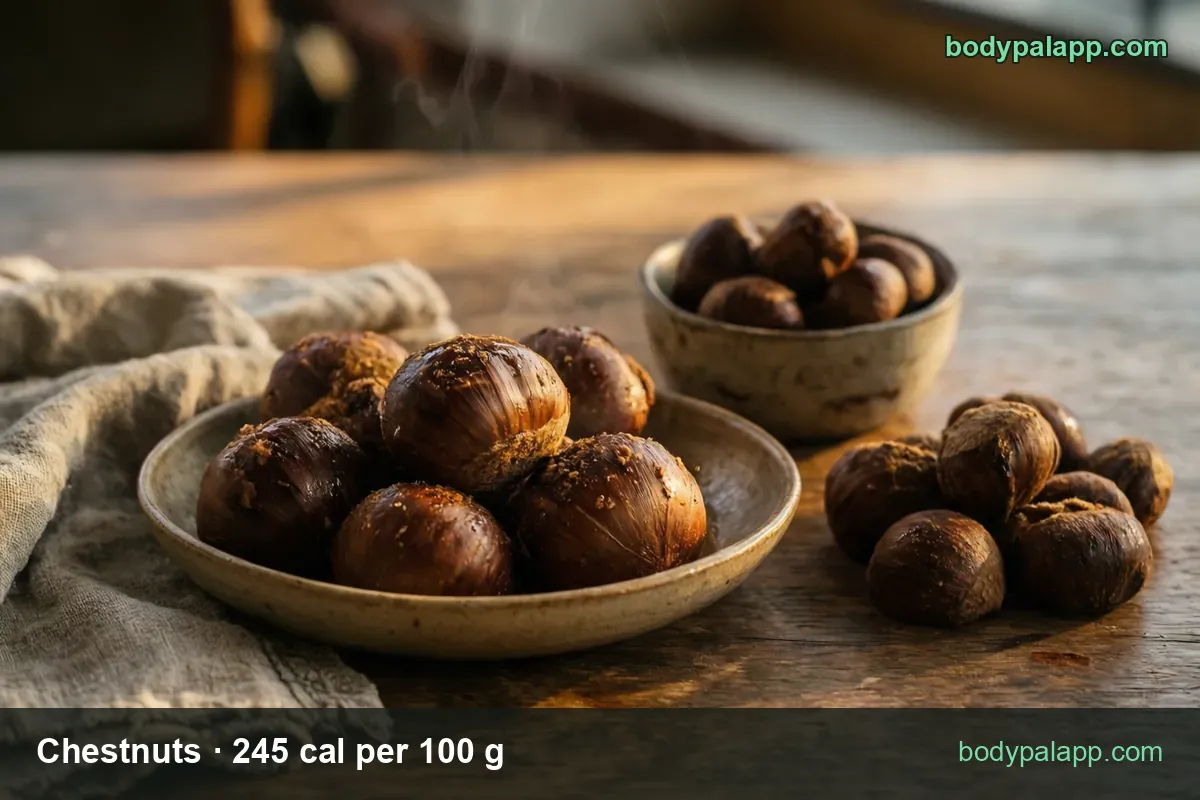
Nothing separates these rows except water and species. It is the same nut throughout.
| Version | Per 100 g | Typical piece | Calories |
|---|---|---|---|
| Roasted, peeled (main record) | 245 kcal | 1 oz (28.35 g) | 69 kcal |
| Raw, unpeeled | 213 kcal | 1 oz (28.35 g) | 60 kcal |
| Raw, peeled | 196 kcal | 1 oz (28.35 g) | 56 kcal |
| Boiled or steamed | 131 kcal | 1 oz (28.35 g) | 37 kcal |
| Dried, peeled | 369 kcal | 1 oz (28.35 g) | 105 kcal |
| Chinese, roasted | 239 kcal | 1 oz (28.35 g) | 68 kcal |
| Japanese, roasted | 201 kcal | 1 oz (28.35 g) | 57 kcal |
Roasting does not add calories, it removes water. Raw peeled chestnuts are 196 per 100 g; drive off the moisture in an oven and the same nut concentrates to 245. Boiling and steaming push the other way, and boiled chestnuts land at 131 per 100 g, about 46% below roasted. Dry them fully and you get 369, half again as many as roasted, which is why dried chestnuts and chestnut flour deserve a scale rather than a handful.
The species matters less than the cooking. Chinese roasted chestnuts sit at 239 per 100 g and Japanese at 201, both inside the range you get just by changing how long the European ones stay in the oven. Japanese chestnuts are the wettest of the three.
One row that looks related and is not: water chestnuts. They are the corm of an aquatic sedge, not a tree nut, and raw Chinese water chestnuts run 97 calories per 100 g with almost no fat. If your stir-fry has crunchy white discs in it, this is the number you want, not anything on this page.
Fiber is the row that surprises people
Ten kernels deliver 4.3 g of dietary fiber, 15% of the Daily Value, for 1.8 g of fat, which is 2%. That ratio does not exist anywhere else in the nut aisle. Boiled peanuts and fresh coconut carry 22 g and 33.5 g of fat per 100 g respectively; chestnuts carry 2.2 g.
The trade is starch. Chestnuts are 52.96 g of carbohydrate per 100 g, closer to a cooked grain than to an almond, and 44.5 g of that lands in a ten-kernel serving, 16% of the Daily Value. Protein is the weak column at 3.17 g per 100 g, only 5% DV in a serving, so chestnuts do not do the job that MyPlate counts protein foods for. Treat them as a starchy side that happens to grow on a tree.
If you are watching saturated fat, chestnuts are the easiest nut on the list at 0.41 g per 100 g, 2% DV in a serving. If you are watching total carbohydrate, they are the hardest.
How do chestnuts compare to other nuts?
| Food | Per 100 g | US serving | Calories |
|---|---|---|---|
| Chestnuts, roasted | 245 kcal | 1 oz, 28.35 g | 69 kcal |
| Peanuts, boiled | 318 kcal | 1 oz, 28.35 g | 90 kcal |
| Coconut, fresh | 354 kcal | 1 oz, 28.35 g | 100 kcal |
| Trail mix | 454 kcal | 1 oz, 28.35 g | 129 kcal |
Our take: chestnuts are the lightest of these four per ounce and by a wide margin, 69 calories against 129 for trail mix. If you are cutting, they are the snack where a handful is genuinely a handful, because ten of them cost 206 calories and you can count them instead of guessing. For fullness on a long afternoon, the fiber helps but the low fat and low protein mean they clear faster than peanuts do, so pair them with something that has staying power. Roast rather than boil if you want them to taste like anything; boil rather than roast if you want the calories cut nearly in half.
Most popular chestnut brands in the United States
Ranked by how widely each product appears among foods sold in the United States, from the BodyPal food database of over 3.3 million products. Calories are the figures printed on each Nutrition Facts label, checked against USDA FoodData Central.
| Product | Calories (per 100 g) |
|---|---|
| Gefen Organic Roasted & Peeled Whole Chestnuts | 225 cal |
| Gefen Organic Roasted Peeled Chestnuts | 200 cal |
| Tazah Chestnut | 200 cal |
| Laforestiere Chestnut Puree | 100 cal |
Brand popularity: BodyPal food database. Nutrition: manufacturer labels / USDA FoodData Central.
Chestnut FAQs
How many calories are in one roasted chestnut?
About 21 calories for a single peeled roasted kernel of roughly 8.4 g. That is our own arithmetic from the USDA figure of 245 calories per 100 g, since USDA lists 10 kernels rather than one. Ten kernels come to 206 calories, so counting them is easy.
How many calories in 10 chestnuts?
206 calories for 10 peeled roasted kernels weighing 84 g, the USDA household measure for this record. That serving also brings 44.5 g of carbohydrate, 4.3 g of fiber, 2.7 g of protein and only 1.8 g of fat. Boiled chestnuts at the same weight would be closer to 110.
How many calories in a cup of chestnuts?
350 calories in one cup of peeled roasted chestnuts, 143 g. A cup weighs about five times an ounce, so it costs five times the 69 calories an ounce carries. This is the measure people underestimate most, because loose peeled kernels pack into a cup quickly.
Are roasted chestnuts higher in calories than raw?
Yes, 245 calories per 100 g roasted against 196 raw and peeled, or 213 raw with the skin on. Roasting adds nothing; it drives off water, so the same nut weighs less and concentrates. Per kernel the difference is small, since the kernel itself shrinks in the oven.
Are chestnuts high in carbs?
Yes, 52.96 g of carbohydrate per 100 g, which is 44.5 g in a ten-kernel serving and 16% of the Daily Value. That is grain territory rather than nut territory. Of the total, 10.6 g per 100 g are the chestnut's own sugars and 5.1 g are fiber.
How much fiber is in chestnuts?
5.1 g per 100 g roasted, or 4.3 g in ten kernels, which is 15% of the 28 g Daily Value. Raw unpeeled chestnuts test higher at 8.1 g per 100 g, because the papery skin counted in that record is almost entirely fiber.
Are water chestnuts the same as chestnuts?
No, water chestnuts are the corm of an aquatic plant and raw Chinese water chestnuts run 97 calories per 100 g with 0.1 g of fat. Tree chestnuts run 245 roasted. If you are logging stir-fry, the crunchy white discs are the 97-calorie food.
Are chestnuts good for weight loss?
They are the lightest common nut per ounce: 69 calories against 90 for boiled peanuts, 100 for fresh coconut and 129 for trail mix. The fiber helps and the fat is only 1.8 g a serving. The catch is protein, just 2.7 g, so hunger returns sooner.
Similar foods
- Pizza Hot Pocket — 317 cal per hot pocket
- Quarter Pounder — 417 cal per burger
- Tuna Wrap — 488 cal per wrap
- Square Cut Pizza — 420 cal per slice
- Fried Potatoes — 315 cal per cup
- Supreme Pizza — 305 cal per slice
Count it without the math
Point the camera at the bowl and BodyPal counts the chestnuts for you, shells or no shells.


How long does it take to burn off chestnuts?
A 10-kernel (84 g) serving is 206 kcal. Enter your weight and the amount you ate to see how long it takes you to burn that off:
lb
| Activity | Time to burn 206 kcal |
|---|---|
| Walking, brisk | 41 min |
| Cycling, moderate | 26 min |
| Swimming, moderate | 29 min |
| Jogging | 24 min |
| Weight training, moderate | 46 min |
Times are for a 155 lb adult at a steady pace; change the weight to see yours. The amount is set to the portion in the text (84 g); change it to what you actually ate. BodyPal works this out from your steps automatically.
Want the bigger picture? Calculate your daily calorie needs — your maintenance figure, a target for losing or gaining, and the date you get there.