
How many calories are in chicken alfredo?
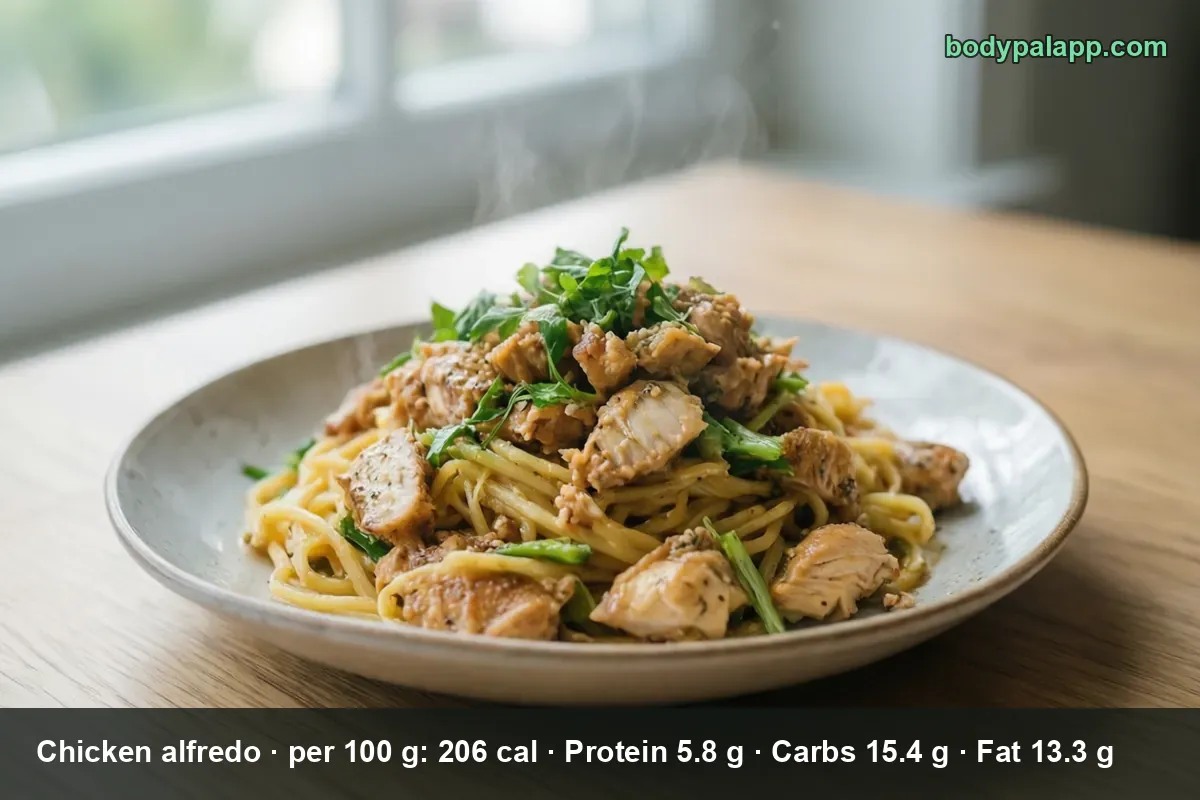
A 1-cup serving of chicken alfredo is 515 calories. Per 100 g the dish runs 206 calories, and the restaurant kitchen is the reason: butter and heavy cream push it past every homemade version on this page. Order the entree and you are usually looking at two cups, not one.
On this page
- Chicken alfredo quick facts
- US servings, from one ounce to a restaurant entree
- Homemade, frozen and sauce-only alfredo
- Sodium and saturated fat are the rows to watch
- How does chicken alfredo compare?
- Most popular chicken alfredo brands
- FAQ
Chicken alfredo quick facts
The number most people need is the one for the plate they were handed at a restaurant or a takeout counter, so the base record here is FNDDS 2708867, "Pasta with cream sauce and poultry, restaurant". That is chicken alfredo as a kitchen with a stick of butter and a quart of cream makes it. Cook the same dish at home and the numbers drop hard; that version gets its own section below.
USDA measures this as a mixed dish, not as pasta plus sauce plus chicken, which is why the protein per 100 g looks lower than a plate of chicken suggests. Most of the weight on the fork is pasta and sauce.
| Nutrient | Per 100 g | Per 1 cup (250 g) | % Daily Value |
|---|---|---|---|
| Calories | 206 | 515 | — |
| Total fat | 13.33 g | 33.3 g | 43% |
| Saturated fat | 4.235 g | 10.6 g | 53% |
| Carbohydrate | 15.41 g | 38.5 g | 14% |
| Dietary fiber | 0.9 g | 2.3 g | 8% |
| Total sugars | 0.59 g | 1.5 g | — |
| Protein | 5.83 g | 14.6 g | 29% |
| Sodium | 561 mg | 1403 mg | 61% |
% Daily Value is based on a 2,000-calorie diet.
Verified nutrition data
Numbers on this page come from USDA FoodData Central, the U.S. Department of Agriculture’s food composition database, and from manufacturer labels where a branded product is named. Last verified September 2026. How we verify our data →
There is no added sugars row and no trans fat row above, because USDA does not publish either value for survey mixed dishes like this one. Two rows that do exist are worth naming: a cup carries 60 mg of cholesterol (20% DV) and only 150 mg of potassium (3% DV). Daily Value percentages follow the FDA reference amounts for a 2,000-calorie day.
US servings, from one ounce to a restaurant entree
| Serving | Weight | Calories |
|---|---|---|
| 1 oz | 28 g | 58 kcal |
| Half cup | 125 g | 258 kcal |
| 1 cup | 250 g | 515 kcal |
| 8 oz by weight | 227 g | 468 kcal |
| Restaurant entree, about 2 cups | 500 g | 1030 kcal |
| Per 100 g | 100 g | 206 kcal |
The 1-cup, 250 g line is the USDA household measure. Everything else in that table is our own arithmetic from the USDA 100 g figure, not a USDA serving, including the two-cup entree.
That entree line is the one that matters. A cup of pasta is a modest scoop, roughly the size of a tennis ball; the bowl that arrives at a table is usually two to three of them. At two cups you are at 1,030 calories and 2,806 mg of sodium, which is already more than the 2,300 mg Daily Value for a whole day. Weighing is the honest fix here, since "a cup" and "a plate" are not close to the same thing.
Note also the difference between 8 oz by weight (227 g, 468 calories) and 1 cup by volume (250 g, 515 calories). Creamy pasta packs differently in a measuring cup than it does on a scale, and the gap between the two is about 47 calories.
Homemade, frozen and sauce-only alfredo
| Version | Per 100 g | Typical serving | Calories |
|---|---|---|---|
| Restaurant chicken alfredo | 206 kcal | 1 cup (250 g) | 515 kcal |
| Chicken alfredo with broccoli, restaurant | 196 kcal | 1 cup (250 g) | 490 kcal |
| Frozen or ready-to-heat chicken alfredo | 170 kcal | 1 cup (250 g) | 425 kcal |
| Alfredo sauce with chicken, no pasta | 156 kcal | 1 cup (260 g) | 406 kcal |
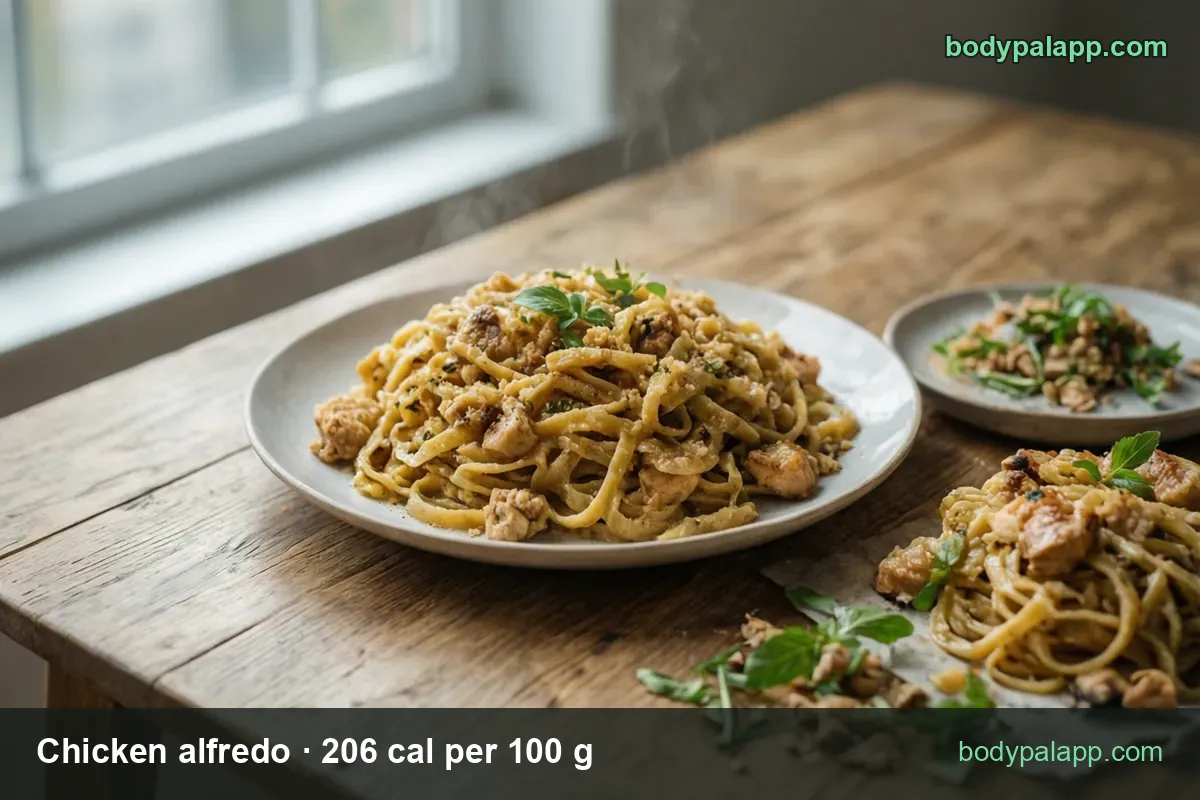
| Homemade chicken alfredo | 157 kcal | 1 cup (250 g) | 393 kcal |
| Fettuccine alfredo, no meat, home recipe | 154 kcal | 1 cup (250 g) | 385 kcal |
| Alfredo sauce only, no pasta | 150 kcal | 1 cup (260 g) | 390 kcal |
The home-recipe record is 157 calories per 100 g against 206 for the restaurant version, a 31% difference in the same dish. Fat is where it lives: 7.03 g per 100 g at home, 13.33 g out. Home cooks reach for milk, a splash of cream and a smaller pat of butter; a line cook finishes the pan with butter because that is what makes the sauce cling.
Frozen and ready-to-heat trays land in the middle at 170 calories per 100 g, and retail boxes go lower still. Among USDA Branded entries, a Healthy Choice Chicken Alfredo Florentine meal is 92 calories per 100 g and 221 for the tray, a Barilla ready meal 129 per 100 g and 311 for the tray, and a canned Chef Boyardee version 81 per 100 g. Those meals win on calories by carrying less sauce per gram of pasta, not by any trick.
Adding broccoli helps a little, but less than people expect: 196 calories per 100 g instead of 206, because the vegetables dilute the sauce rather than replace it.
The sauce is the interesting row. Alfredo sauce on its own is 150 calories per 100 g, lower per gram than the finished restaurant dish, and yet it is the ingredient doing the damage: 8.523 g of saturated fat per 100 g, twice what the plated dish carries. Pasta dilutes the sauce. It does not make it lighter.
Sodium and saturated fat are the rows to watch
Carbohydrate is the row people brace for, and it is the least alarming one here: 38.5 g in a cup, 14% of the Daily Value. The two rows that actually move are saturated fat at 10.6 g, 53% of a day, and sodium at 1,403 mg, 61% of a day, or roughly two-thirds of a teaspoon of table salt in one cup.
The Dietary Guidelines for Americans put saturated fat under 10% of daily calories, which is about 22 g on a 2,000-calorie day. One cup of restaurant chicken alfredo uses nearly half of that. Two cups uses almost all of it. If you are watching sodium in particular, the home recipe is the clear better pick: 250 mg per 100 g against 561 mg, so a homemade cup lands near 625 mg instead of 1,403 mg.
Protein is the other honest disappointment. A cup gives 14.6 g, 29% of the 50 g Daily Value, which is decent for a pasta dish but modest for something named after chicken. If the goal is protein per calorie, MyPlate style advice applies here: add chicken, don't add sauce.
How does chicken alfredo compare?
| Dish | Per 100 g | US serving | Calories |
|---|---|---|---|
| Chicken alfredo, restaurant | 206 kcal | 1 cup (250 g) | 515 kcal |
| With added vegetables, restaurant | 196 kcal | 1 cup (250 g) | 490 kcal |
| Ready-to-heat chicken alfredo | 170 kcal | 1 cup (250 g) | 425 kcal |
| Homemade chicken alfredo | 157 kcal | 1 cup (250 g) | 393 kcal |
Our take: the restaurant version is the heaviest per gram of every record on this page, and the four rows above are the same dish, cooked in four kitchens. If you are trying to lose weight, cook it at home and measure a cup, which saves 122 calories and about 778 mg of sodium against the restaurant cup, for a dish that tastes close to identical. If you are eating out and want to stay full on the calories you spend, the version with vegetables is the smarter order, because it costs 25 fewer calories per cup and puts something on the plate other than pasta. The variable nobody controls at a restaurant is portion size, so a half order or a box for the second cup does more for the total than any swap on the menu.
Most popular chicken alfredo brands in the United States
Ranked by how widely each product appears among foods sold in the United States, from the BodyPal food database of over 3.3 million products. Calories are the figures printed on each Nutrition Facts label, checked against USDA FoodData Central.
| Product | Calories (per 100 g) |
|---|---|
| Signature Cafe Chicken Alfredo | 143 cal |
| Signature Cafe Chicken Alfredo with Fettuccini | 158 cal |
| Barilla Chicken Alfredo Ready Meal | 129 cal |
| Healthy Choice Chicken Alfredo Florentine | 92 cal |
| Michael Angelo's Chicken Alfredo with Broccoli | 127 cal |
| Chef Boyardee Chicken Alfredo Pasta | 81 cal |
Brand popularity: BodyPal food database. Nutrition: manufacturer labels / USDA FoodData Central.
Chicken alfredo FAQs
How many calories are in a cup of chicken alfredo?
A 1-cup serving weighs 250 g and carries 515 calories, based on the USDA record for restaurant pasta with cream sauce and poultry at 206 calories per 100 g. Half a cup is 258. Most restaurant plates hold two cups or more, so the plate is closer to 1,030.
How many calories are in restaurant chicken alfredo?
Restaurant chicken alfredo runs 206 calories per 100 g, so a two-cup entree of 500 g lands at 1,030 calories, our own arithmetic scaled from the USDA 100 g figure. That single plate also carries 2,806 mg of sodium, more than the full-day Daily Value of 2,300 mg.
How many calories are in homemade chicken alfredo?
Homemade chicken alfredo is 157 calories per 100 g, or 393 per 1-cup serving, using the USDA home-recipe record. That is 122 calories less than the same cup ordered out, and it comes almost entirely from less butter and cream: fat drops from 13.33 g per 100 g to 7.03 g.
How much protein is in chicken alfredo?
A 1-cup serving has 14.6 g of protein, 29% of the 50 g Daily Value. Per 100 g that is 5.83 g, which is low for a dish people think of as a chicken meal, because pasta and cream sauce make up most of the weight. The sauce alone is 2.12 g per 100 g.
How much sodium is in chicken alfredo?
One cup carries 1,403 mg of sodium, 61% of the 2,300 mg Daily Value and roughly two-thirds of a teaspoon of table salt. The home-recipe version is 250 mg per 100 g against 561 mg in the restaurant record, so a homemade cup lands near 625 mg instead.
Is chicken alfredo healthy?
One cup is 515 calories with 10.6 g of saturated fat, 53% of the Daily Value, and 61% of the day's sodium limit. That is a portion problem more than an ingredient problem. One measured cup next to a vegetable side, instead of two cups, keeps the plate inside a normal lunch.
Is chicken alfredo good for weight loss?
At 206 calories per 100 g it is a hard dish to fit into a tight calorie target, since one cup is 515 and restaurant plates run double that. The homemade cup at 393, or a retail tray such as Healthy Choice Florentine at 221, fits a 400 to 500 calorie lunch far more easily.
How many calories are in frozen chicken alfredo?
Frozen and ready-to-heat chicken alfredo averages 170 calories per 100 g, or 425 per 1-cup serving, sitting between homemade and restaurant. Retail trays vary widely: a canned Chef Boyardee version is 81 calories per 100 g and a Barilla tray 129, because there is less sauce per gram of pasta.
Similar foods
- Salmon — 350 cal per fillet, 6 oz cooked
- Dosa — 326 cal per large dosa
- Flat iron steak — 391 cal per steak
- Chicken Taco — 222 cal per taco
- Meatloaf — 215 cal per slice
- T-Bone Steak — 537 cal per steak
Count it without the math
Point the camera at the plate and BodyPal counts the pasta, the sauce and the chicken for you.


How long does it take to burn off 515 kcal of chicken alfredo?
A 1-cup (250 g) serving is 515 kcal. Enter your weight and the amount you ate to see how long it takes you to burn that off:
lb
| Activity | Time to burn 515 kcal |
|---|---|
| Walking, brisk | 1 hr 43 min |
| Cycling, moderate | 1 hr 4 min |
| Swimming, moderate | 1 hr 14 min |
| Jogging | 1 hr 1 min |
| Weight training, moderate | 1 hr 54 min |
Times are for a 155 lb adult at a steady pace; change the weight to see yours. The amount is set to the portion in the text (250 g); change it to what you actually ate. BodyPal works this out from your steps automatically.
One food is easy to picture; a whole day is harder. See how many calories you need a day and what a deficit actually looks like.