
How Many Calories in Flat Iron Steak?
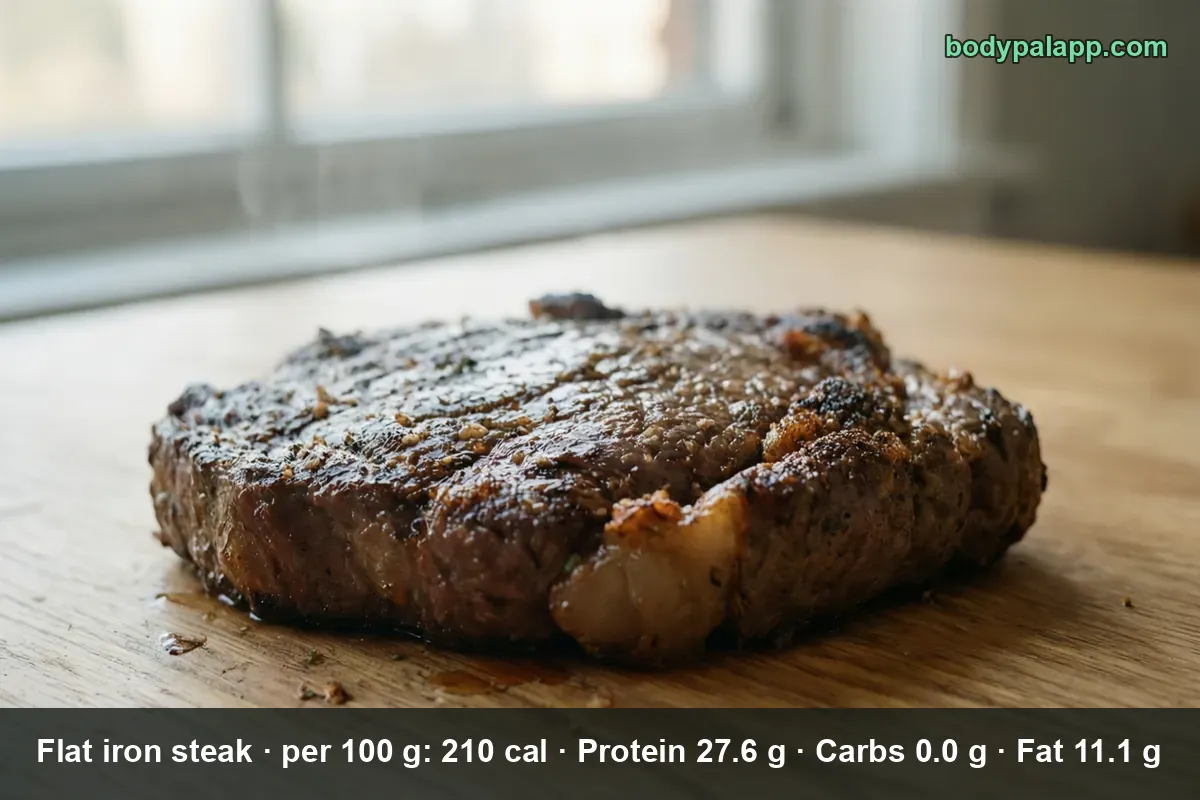
One grilled flat iron steak, 186 g on the plate, is 391 calories, or 210 calories per 100 g. A 3 oz slice carved off it is 179. A 6 oz restaurant portion is 357. Raw, before it ever met the heat, the same meat ran 146 calories per 100 g, and that gap is where most flat iron logs go wrong.
On this page
- Flat iron steak quick facts
- What USDA calls a flat iron steak
- US portions, from an ounce to a whole steak
- Raw or cooked: weigh it the way you log it
- Trimming the fat saves 26 calories
- Choice, select and what the grade costs
- Why the store label says 179
- The sodium arrives with the rub
- How does flat iron steak compare?
- Most popular flat iron steak brands
- FAQ
Flat iron steak quick facts
The reference here is the steak as it lands on the plate: grilled, fat left on, ungraded, one whole steak of 186 g. That is USDA entry 169479, listed under the butcher's name rather than the menu one.
| Nutrient | Per 100 g | Per 1 steak (186 g) | % Daily Value |
|---|---|---|---|
| Calories | 210 cal | 391 cal | — |
| Total fat | 11.07 g | 20.6 g | 26% |
| Saturated fat | 4.53 g | 8.4 g | 42% |
| Carbohydrate | 0 g | 0 g | 0% |
| Dietary fiber | 0 g | 0 g | 0% |
| Total sugars | 0 g | 0 g | — |
| Protein | 27.59 g | 51.3 g | 103% |
| Sodium | 85 mg | 158 mg | 7% |
% Daily Value is based on a 2,000-calorie diet.
Verified nutrition data
Numbers on this page come from USDA FoodData Central, the U.S. Department of Agriculture’s food composition database, and from manufacturer labels where a branded product is named. Last verified September 2026. How we verify our data →
Two rows are worth a second look, and they point in opposite directions. Protein clears the whole day in a single steak: 51.3 g, or 103% of the Daily Value. Saturated fat is at 42% of the day from one piece of meat, while the calories themselves are only about a fifth of a 2,000-calorie budget. The number that limits how often you eat this steak is the saturated fat, not the 391.
Three more figures sit outside the label block. Cholesterol is 95 mg per 100 g, so 177 mg in the steak, which is 59% of the Daily Value. Potassium is 379 mg per 100 g, 705 mg in the steak, about 15%. Trans fat comes in at 0.9 g for the steak, naturally occurring in ruminant fat rather than added.
There is no added sugars row above, and that is deliberate. USDA's SR Legacy beef entries carry no added-sugars value at all, so printing a zero there would be a guess dressed up as data.
What USDA calls a flat iron steak
Search the federal database for "flat iron steak" and you get nothing. The cut is a marketing name, coined in the early 2000s to sell a muscle butchers used to grind. USDA files it as shoulder top blade steak, boneless — the infraspinatus, taken off the shoulder blade and split down the middle to remove the sheet of gristle running through it.
That matters for logging, because the database holds two different families of rows for the same muscle and they do not agree.
The boneless top blade rows, priced out and sold as a steak, grill up at 210 calories per 100 g. The rows for a top blade steak cut from the whole shoulder clod come in at 222, with 12.79 g of fat per 100 g instead of 11.07. Same muscle, different butchering: the clod version keeps more of the surrounding fat, so it carries about 12 more calories per 100 g.
This page runs on the boneless family. It is the one sold as a flat iron in an American grocery store, and it is the only one for which USDA publishes household portions instead of just a per-100-g row.
US portions, from an ounce to a whole steak
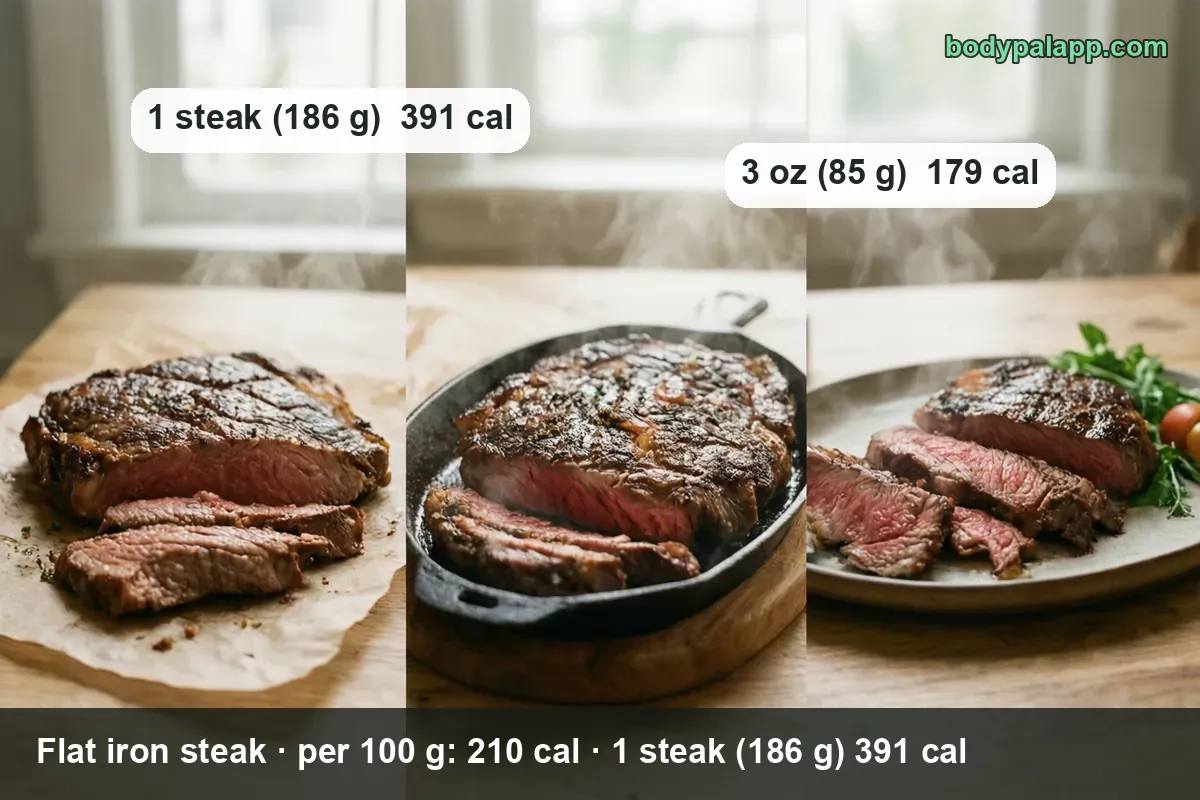
| Portion | Weight | Calories |
|---|---|---|
| 1 oz, cooked | 28 g | 59 cal |
| 3 oz, cooked | 85 g | 179 cal |
| 6 oz restaurant portion | 170 g | 357 cal |
| 1 whole steak, grilled | 186 g | 391 cal |
| 100 g, cooked | 100 g | 210 cal |
The number to memorize is the ounce: 59 calories, cooked. Everything else falls out of it without a calculator, and steak is the one food Americans genuinely do buy and order by the ounce. Only the 3 oz slice and the whole steak are USDA's own household portions; the ounce and the 6 oz restaurant plate are our own scaling from the 210-per-100-g row.
USDA's "1 steak" is 186 g, a shade over 6.5 oz cooked. Menu weights of 6 oz or 8 oz are almost always raw, so the steak that arrives is lighter than the card promised.
Raw or cooked: weigh it the way you log it
Here is the single biggest source of error on this cut, and it runs in both directions depending on which mistake you make.
Raw flat iron, fat on, is 146 calories per 100 g. Grilled, the same trimmed cut is 210. Nothing was added on the grill; water left. A steak loses somewhere near a quarter of its weight over a hot fire, so what remains is denser per gram even though the total barely moves.
Follow one steak through and the two entries agree. Four ounces raw, 113 g, is 165 calories at the raw entry. That piece comes off the grill at roughly 85 g, which the cooked entry puts at 179. Same meal, read two ways, within a rounding error of each other.
Cross the two and it falls apart fast:
- Weigh 239 g raw and log the cooked figure: 502 calories instead of 349. You have overstated the steak by 44%.
- Weigh 186 g cooked and log the raw figure: 272 calories instead of 391. You have thrown away 119 calories, nearly a third of the meal.
The rule fits on a sticky note. Raw weight goes with a raw entry, cooked weight with a cooked entry, and the package in the refrigerator is a raw entry no matter what the grill did to it later.
Trimming the fat saves 26 calories
Every steak guide tells you to trim the fat. On a flat iron, that advice buys you almost nothing.
USDA lists the same grilled steak with the visible fat removed at 196 calories per 100 g against 210 with it left on. Across a whole 186 g steak that is 365 calories instead of 391 — a saving of 26 calories, about the same as a teaspoon of butter. On a 3 oz slice the difference shrinks to 12.
The reason is anatomical. A flat iron is bought for its marbling, and marbling sits inside the muscle fibers where a knife cannot reach it. The trimmable fat on a top blade steak is a thin edge, not a cap. Trim a brisket or a ribeye and you can move the number by a third; trim a flat iron and you move it by 7%.
You do gain a little protein by trimming, since you removed pure fat and left everything else: 28.15 g per 100 g instead of 27.59 g. If your reason for trimming is saturated fat rather than calories, that case is stronger — 3.77 g per 100 g against 4.53 g, which takes the whole steak from 42% of the Daily Value down to 35%.
Choice, select and what the grade costs
Grade is the thing on the package label, and unlike the trim, it does move the number.
| Grilled flat iron, fat on | Per 100 g | 3 oz (85 g) | 1 steak (186 g) |
|---|---|---|---|
| Choice | 220 cal | 187 cal | 409 cal |
| All grades (this page) | 210 cal | 179 cal | 391 cal |
| Select | 194 cal | 165 cal | 361 cal |
Choice against select is 26 calories per 100 g, nearly twice the spread that trimming gives you, and it happens before the steak reaches your kitchen. In steak terms it is 409 against 361: a 48-calorie decision made in the meat case.
Take the fat off as well and the range widens at both ends. Choice trimmed lean is 202 calories per 100 g, select trimmed lean 187. The leanest grilled flat iron USDA lists is 187 per 100 g; the fattiest, a choice-grade top blade steak cut from the whole clod, is 228. Everything a normal shopper can buy sits inside that 41-calorie band.
That band is narrow enough to be good news: unless you eat flat iron weekly, how the steak gets weighed matters more than which grade it was.
Why the store label says 179
Pull a flat iron out of the case at Kroger or Safeway and the panel usually reads about 179 calories per 100 g, or 200 calories per 4 oz serving. That is not a contradiction of the 210 on this page, and it is not the store rounding in its own favor.
Two things are different. The package number is raw, and the steak in the package has not been trimmed to the bare muscle the way USDA's laboratory samples are. Store flat irons from Full Circle Market, Simple Truth and Grass Run Farms all land at 179 calories per 100 g raw, and that figure matches USDA's untrimmed clod-cut row at 176 almost exactly. USDA's own raw number of 146 is for a steak trimmed to zero inches of fat, which is not what anybody sells.
So the label is describing the same food at a different moment in its life. A 4 oz raw package portion, 112 g, is about 200 calories going into the pan. What comes out weighs closer to 3 oz and belongs against the cooked entry at 179. The two numbers are 21 calories apart, most of it fat that ran into the pan and stayed there.
If you log from the package, log the raw weight against the package number and stop there. Do not weigh the cooked steak and then reach for the label.
The sodium arrives with the rub
Plain flat iron is one of the lowest-sodium foods you can put on a plate. One whole steak carries 158 mg, which is 7% of the FDA's Daily Value of 2,300 mg. That is a rounding error in an American day.
Then somebody seasons it. A pre-marinated retail flat iron sold with Italian-style spices runs 616 mg of sodium per 100 g, so a 4 oz package portion carries about 690 mg — 30% of the Daily Value, from the marinade alone. The meat underneath contributed maybe 90 mg of that.
Everything else on that seasoned package moves too, but far less than you would guess: 170 calories per 100 g raw against 179 for the plain version, and 3.57 g of carbohydrate where the plain steak has none. Sodium is the only number the rub really rewrites, and it multiplies it by more than seven.
Season it yourself and you keep control of that. Buy it pre-marinated and the one axis where beef is normally blameless stops being blameless.
How does flat iron steak compare?
All four rows are cooked USDA entries at the same household unit, 3 oz, which is the serving MyPlate uses for the protein foods group.
| Cut (3 oz cooked, 85 g) | Calories | Per 100 g | Protein | Fat |
|---|---|---|---|---|
| Flat iron steak, grilled | 179 cal | 210 cal | 23.5 g | 9.4 g |
| Flank steak, broiled | 172 cal | 202 cal | 23.4 g | 7.9 g |
| Tenderloin steak, grilled | 172 cal | 202 cal | 26.3 g | 6.5 g |
| New York strip, grilled | 172 cal | 202 cal | 25.1 g | 7.1 g |
Look at the calorie column first and then relax about it. Three of these cuts are identical at 202 calories per 100 g, and flat iron is eight above them. Seven calories separate a 3 oz slice of the cheapest cut here from the most expensive. Steak choice is not a calorie decision.
Protein per calorie is where they actually separate. Tenderloin delivers 15.3 g of protein per 100 calories, New York strip 14.6 g, flank 13.7 g, flat iron 13.1 g. Flat iron finishes last on that measure because it carries the most fat: 9.4 g in a 3 oz slice against 6.5 g for tenderloin.
Our take: if you are building a plate around protein, tenderloin wins and flat iron is the weakest of the four — the same 3 oz gives you 2.8 g less protein for 7 more calories. If you are buying dinner, flat iron wins on everything the table cannot show: it costs a fraction of tenderloin, and the marbling that loses it this comparison is what makes it taste expensive. Log a slice at 179 and watch the 8.4 g of saturated fat rather than the 391 calories.
Most popular flat iron steak brands in the United States
Ranked by how widely each product appears among foods sold in the United States, from the BodyPal food database of over 3.3 million products. Calories are the figures printed on each Nutrition Facts label, checked against USDA FoodData Central.
| Product | Calories (per 100 g) |
|---|---|
| Full Circle Market Angus Beef Flat Iron Steak | 179 cal |
| Simple Truth Angus Beef Flat Iron Steak | 179 cal |
| Grass Run Farms 100% Grass Fed Flat Iron Steak | 179 cal |
| Private Selection Culinary Cuts Prime Beef Flat Iron Steak | 165 cal |
| Concord Farms 100% Grass Fed Flat Iron Steak | 177 cal |
| Clear River Farms Flat Iron Steak with Italian Style Spices | 170 cal |
Brand popularity: BodyPal food database. Nutrition: manufacturer labels / USDA FoodData Central.
Flat iron steak FAQs
How many calories in flat iron steak?
391 calories in one whole grilled steak, 186 g, at 210 calories per 100 g. A 3 oz slice is 179 calories and a 6 oz restaurant portion is 357. Raw, the same steak is only 146 calories per 100 g, so the weighing method matters more than the cut.
How many calories in a 6 oz flat iron steak?
357 calories for 6 oz of cooked flat iron, 170 g, at 210 calories per 100 g. If the 6 oz on the menu is a raw weight, which it usually is, the steak reaching your table will be lighter and closer to 300. Cooked ounces are 59 calories each.
How many calories in 3 oz of flat iron steak?
179 calories for 3 oz, 85 g, of grilled flat iron. Trim the visible fat off first and it drops to 167. A choice-grade slice of the same size is 187 and a select-grade one is 165, so the whole realistic range for 3 oz is 165 to 187.
How much protein is in a flat iron steak?
51.3 g in one whole 186 g steak, which is 103% of the Daily Value, at 27.59 g per 100 g. A 3 oz slice carries 23.5 g. Trimming the visible fat lifts the concentration slightly to 28.15 g per 100 g, since you removed fat and left the protein behind.
Is flat iron steak a lean cut?
Moderately: at 11.07 g of fat per 100 g it is fattier than tenderloin at 7.7 g or New York strip at 8.4 g, and trimming barely helps because the marbling sits inside the muscle. The lean-only version is 9.23 g of fat and 196 calories per 100 g.
How many calories in raw flat iron steak?
146 calories per 100 g for a trimmed raw steak, so 165 calories in 4 oz, 113 g, and 349 in a whole 239 g raw steak. Untrimmed retail steaks read higher, around 179 per 100 g. Never weigh raw and log the cooked figure: that overstates the meal by 44%.
Why does the package say 179 calories per 100 g?
Because the package number is raw and untrimmed, while 210 is cooked. Grocery flat irons from Full Circle Market, Simple Truth and Grass Run Farms all print 179 per 100 g, close to USDA's untrimmed raw figure of 176. A 4 oz package portion is about 200 calories.
Flat iron or tenderloin, which has fewer calories?
Tenderloin, by seven calories in a 3 oz serving: 172 against 179. Per 100 g it is 202 against 210. The real gap is protein density, where tenderloin gives 26.3 g per 3 oz to flat iron's 23.5 g, and fat, at 6.5 g against 9.4 g.
Similar foods
- Chicken Cordon Bleu — 481 cal per roll (1/2 breast)
- Pork Loin — 178 cal per 3 oz
- Lamb Steak — 240 cal per 4 oz
- Top Sirloin Steak — 360 cal for 6 oz cooked
- 85/15 Ground Beef — 215 kcal per 100 g raw
- Chicken Feet — 301 cal for 4 feet
Count it without the math
Point the camera at the plate and BodyPal reads the cut, sizes the slice and logs the calories, the protein and the saturated fat for you.


How long does it take to burn off flat iron steak?
One grilled steak (186 g) is 391 kcal. Enter your weight and the amount you ate to see how long it takes you to burn that off:
lb
| Activity | Time to burn 391 kcal |
|---|---|
| Walking, brisk | 1 hr 18 min |
| Cycling, moderate | 49 min |
| Swimming, moderate | 56 min |
| Jogging | 46 min |
| Weight training, moderate | 1 hr 27 min |
Times are for a 155 lb adult at a steady pace; change the weight to see yours. The amount is set to the portion in the text (186 g); change it to what you actually ate. BodyPal works this out from your steps automatically.
One food is easy to picture; a whole day is harder. See how many calories you need a day and what a deficit actually looks like.