
How many calories are in chicken cordon bleu?
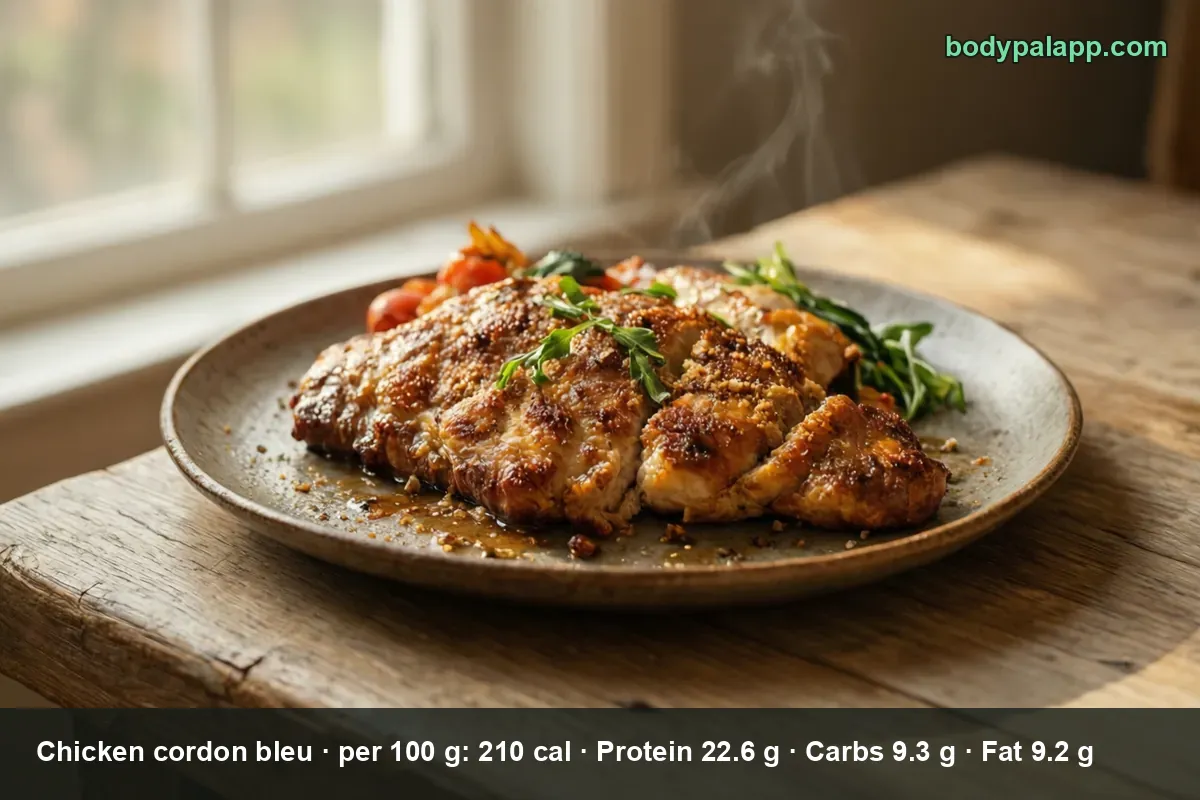
One roll of chicken cordon bleu — half a breast rolled around ham and cheese, breaded, baked and sauced — weighs 229 g and carries 481 calories. Cooked, the dish runs 210 calories per 100 g. That single roll also delivers 51.8 g of protein and 1,349 mg of sodium, which is the number that actually constrains it.
On this page
- Chicken cordon bleu quick facts
- US servings, from one ounce to a whole roll
- Frozen, baked and bite-sized versions
- Sodium is the row to watch, not the calories
- How does chicken cordon bleu compare?
- Most popular chicken cordon bleu brands
- FAQ
Chicken cordon bleu quick facts
The reference row here is FNDDS 2706441, "Chicken or turkey cordon bleu" — the finished dish, breading and sauce included. That is the version people put on a plate and photograph, so it is the version this page is built on. The frozen retail rows in the freezer aisle describe a raw, uncooked portion and land much lower per 100 g; they get their own section below rather than being blended in.
USDA's own household measure for this record is one roll, described as half a breast with ham and sauce, weighing 229 g. That is the main serving in every table on this page.
| Nutrient | Per 100 g | Per 1 roll (229 g) | % Daily Value |
|---|---|---|---|
| Calories | 210 | 481 | — |
| Total fat | 9.17 g | 21.0 g | 27% |
| Saturated fat | 3.33 g | 7.6 g | 38% |
| Carbohydrate | 9.29 g | 21.3 g | 8% |
| Dietary fiber | 0.6 g | 1.4 g | 5% |
| Total sugars | 0.63 g | 1.4 g | — |
| Protein | 22.64 g | 51.8 g | 104% |
| Sodium | 589 mg | 1349 mg | 59% |
% Daily Value is based on a 2,000-calorie diet.
Verified nutrition data
Numbers on this page come from USDA FoodData Central, the U.S. Department of Agriculture’s food composition database, and from manufacturer labels where a branded product is named. Last verified September 2026. How we verify our data →
Two rows you would see on a package are missing above: added sugars and trans fat. The FNDDS edition behind this record does not publish either value for cooked mixed dishes, so rather than guess, they are left out. Cholesterol and potassium are published: one roll carries 195 mg of cholesterol (65% DV) and 584 mg of potassium (12% DV). Daily Values follow the FDA reference amounts for the Nutrition Facts label.
US servings, from one ounce to a whole roll
| Serving | Weight | Calories |
|---|---|---|
| 1 oz | 28 g | 60 kcal |
| 4 oz portion | 113 g | 237 kcal |
| 1 cup, cut into pieces | 140 g | 294 kcal |
| 1 roll, half a breast with ham and sauce | 229 g | 481 kcal |
| Per 100 g | 100 g | 210 kcal |
Two of those are USDA household measures: the 229 g roll and the 1 cup portion at 140 g, which is also the weight USDA falls back on when a diner reports the dish without saying how much. The 4 oz and 1 oz lines are our own arithmetic from the USDA 100 g figure, not USDA servings — useful if you cut the roll down or weigh a slice off a family-sized tray.
The gap between those two USDA measures is the trap. A cup of cut cordon bleu weighs 140 g against the roll's 229 g — 39% less food — so logging "1 cup" when you actually plated the whole half-breast costs you 187 calories of accuracy. Cut chicken packs badly into a cup; the breading holds air. If the piece is intact, weigh it or log the roll.
Frozen, baked and bite-sized versions
| Version | Per 100 g | Typical piece | Calories |
|---|---|---|---|
| Cooked cordon bleu, USDA reference | 210 kcal | 1 roll, 229 g | 481 kcal |
| Frozen raw breaded portion | 148 kcal | 1 portion, 142 g | 210 kcal |
| Cordon bleu bites | 200 kcal | 4 pieces, 85 g | 170 kcal |
| Cordon bleu sandwich | 285 kcal | 1 sandwich, 185 g | 527 kcal |
| Cordon bleu mac and cheese bowl | 162 kcal | 1 package, 297 g | 481 kcal |
| Cordon bleu orzo bowl | 122 kcal | 1 package, 255 g | 311 kcal |
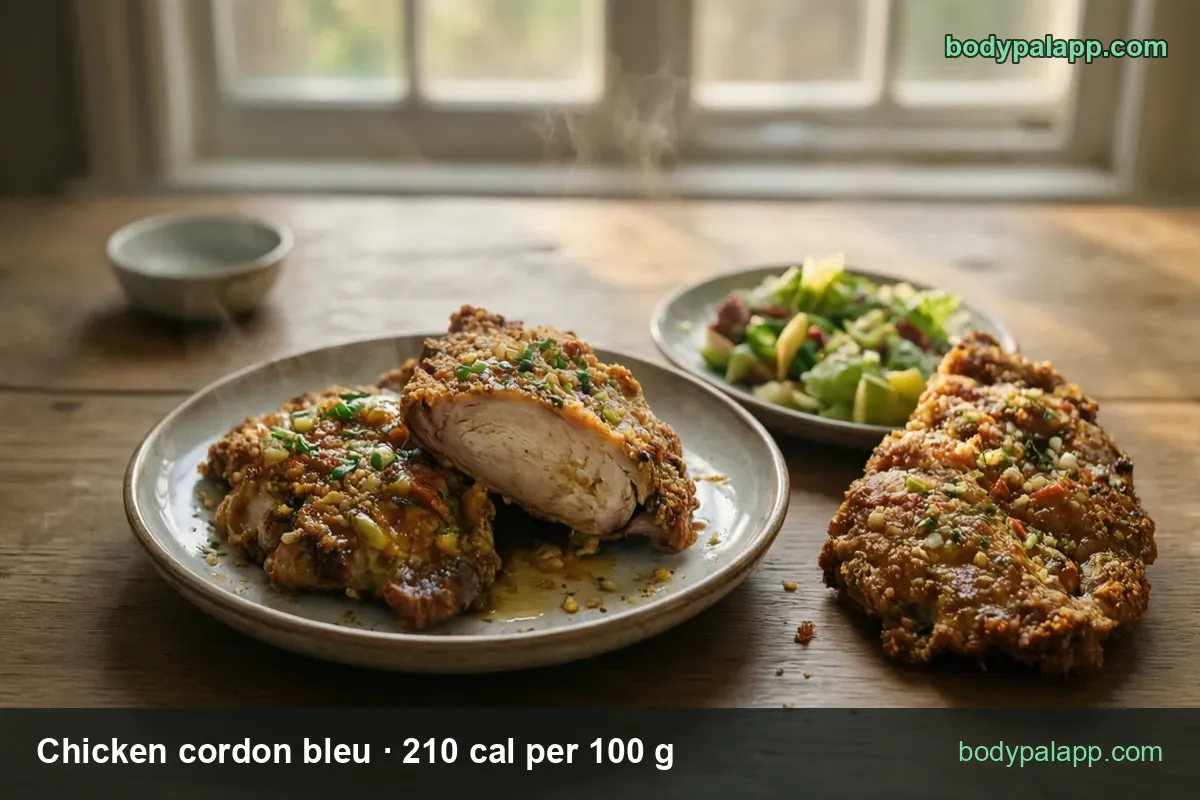
The frozen line is the one that confuses people at the freezer door. A raw breaded portion from a national brand reads 148 calories per 100 g, and the box prints 210 for a 142 g piece. Weigh the same 142 g of the finished dish and the USDA cooked row puts it at 298 calories — our arithmetic from the 210 per 100 g figure. Nothing was added at home; the raw portion simply carries water and no sauce, and the label is measured before either changes. Across US retail, raw breaded cordon bleu portions sit between 143 and 197 calories per 100 g, always under the 210 of the cooked record.
Bites are the friendliest format for portion control: 4 pieces at 85 g come to 170 calories, and a single cocktail-sized mini piece of 26 g is 45. That is the only version of this dish that fits a snack rather than a dinner.
The two composed bowls tell a different story. A mac and cheese bowl is a milder 162 calories per 100 g, but the package holds 297 g, so it lands at exactly the same 481 calories as one plain roll — the pasta buys volume, not savings. The orzo bowl is the lightest thing on the table at 122 per 100 g and 311 per package. The sandwich is the heaviest per gram at 285, and 527 calories for 185 g, because the bun is dense and the breaded cutlet is already fried.
Sodium is the row to watch, not the calories
At 481 calories, one roll is an ordinary dinner entree. The sodium is not ordinary. One roll carries 1,349 mg — 59% of the 2,300 mg Daily Value, or a bit over half a teaspoon of table salt in a single piece of chicken. Cured ham and processed cheese are salted before they ever touch the breast, and the sauce adds a third layer.
That means two rolls in one day clear the whole daily limit on their own, before bread, snacks or anything else on the plate. If you are watching sodium, this is the dish where the side matters: plain vegetables and an unsalted starch, not a second helping. The Dietary Guidelines for Americans keep 2,300 mg as the adult ceiling, and most Americans are already over it.
The protein row goes the other way. 51.8 g in one roll is 104% of the 50 g Daily Value — the only line on the label that exceeds 100%, and higher even than the cholesterol at 65%. Three protein sources are stacked into one piece, which is why MyPlate's protein foods guidance would count this roll as most of a day's protein group in one go. Saturated fat is the quieter cost: 7.6 g is 38% of the daily 20 g, and nearly all of it comes from the cheese and the sauce rather than the chicken.
How does chicken cordon bleu compare?
| Dish | Per 100 g | US serving | Calories |
|---|---|---|---|
| Chicken cordon bleu | 210 kcal | 4 oz, 113 g | 237 kcal |
| Chicken fricassee, no sauce or potatoes | 200 kcal | 4 oz, 113 g | 226 kcal |
| Fried chicken frozen meal with sides | 201 kcal | 4 oz, 113 g | 227 kcal |
| Chicken a la king with vegetables | 187 kcal | 4 oz, 113 g | 211 kcal |
Our take: on a per-gram basis these four cooked chicken dishes are almost interchangeable — 23 calories separate the heaviest from the lightest across 100 g, which is nothing. Every 4 oz (113 g) line in that table is our own scaling from each USDA 100 g figure, not a USDA serving. What separates them is what you get for those calories. Cordon bleu returns 22.64 g of protein per 100 g and only 9.29 g of carbohydrate; the frozen fried-chicken meal returns 10.88 g of protein and 18.05 g of carbohydrate for the same energy, because half the tray is potatoes and dessert. Fricassee beats cordon bleu on protein density, 25.15 g against 22.64 g, with zero carbohydrate, since it has no breading at all. A la king is the fattiest of the four at 13.8 g per 100 g despite being the lowest in calories, because the sauce is cream. If protein per calorie is what you are after, fricassee wins narrowly; if you want the dish people actually crave, cordon bleu is the better trade of the four, provided you can afford the salt.
Most popular chicken cordon bleu brands in the United States
Ranked by how widely each product appears among foods sold in the United States, from the BodyPal food database of over 3.3 million products. Calories are the figures printed on each Nutrition Facts label, checked against USDA FoodData Central.
| Product | Calories (per 100 g) |
|---|---|
| Milford Valley Chicken Cordon Bleu Value Pack | 148 cal |
| Wentzel Farms Chicken Cordon Bleu | 169 cal |
| Milford Valley Raw Breaded Chicken Patty with Ham & Cheese | 197 cal |
| Dierbergs EZ Meals Chicken Cordon Bleu | 143 cal |
| Stuffed Foods Chicken Cordon Bleu Bites | 200 cal |
| Gourmet Bites of the World Mini Chicken Cordon Bleu | 173 cal |
Brand popularity: BodyPal food database. Nutrition: manufacturer labels / USDA FoodData Central.
Chicken cordon bleu FAQs
How many calories are in chicken cordon bleu?
A 229 g roll — half a breast with ham, cheese and sauce — is 481 calories, and the dish runs 210 calories per 100 g cooked. That single serving also carries 51.8 g of protein, so it lands like a full dinner entree rather than a side. A 1 cup portion of cut pieces is 294.
How much protein is in chicken cordon bleu?
51.8 g of protein in a 229 g roll, which is 104% of the 50 g Daily Value — more than any other number on the label. Per 100 g the dish holds 22.64 g. Chicken breast, ham and cheese all stack protein into the same piece, and the breading adds little.
How many carbs are in chicken cordon bleu?
21.3 g of carbohydrate in a 229 g roll, 8% of the Daily Value, with only 1.4 g of that as sugars. Per 100 g the figure is 9.29 g. Almost all of it is breading and sauce; the chicken, ham and cheese inside contribute close to nothing.
Is chicken cordon bleu high in sodium?
1,349 mg of sodium sits in one 229 g roll, 59% of the 2,300 mg Daily Value — a bit over half a teaspoon of table salt. Cured ham and processed cheese do most of that, and the sauce adds more. Two rolls in a day would clear the limit on their own.
How many calories in frozen chicken cordon bleu?
148 calories per 100 g for a raw breaded frozen portion, so a 142 g piece is 210 calories on the box. The cooked USDA record runs 210 per 100 g instead. Frozen packs are weighed raw and usually skip the sauce, which is why the box number looks so much lower.
How many calories in a cup of chicken cordon bleu?
294 calories in 1 cup of cut chicken cordon bleu, which USDA weighs at 140 g, against 481 for a whole 229 g roll. A cup of pieces weighs 39% less than the roll, so a cup measure under-counts the meal badly if you plated the whole half-breast. Weigh it when you can.
How many calories in baked vs fried chicken cordon bleu?
210 calories per 100 g either way — USDA publishes a single cooked record for this dish, fdc_id 2706441, and does not split baked from pan-fried. Deep-frying adds oil that the record does not track, so treat 481 for a 229 g roll as an oven-finished figure rather than a fried one.
Is chicken cordon bleu good for weight loss?
481 calories for one roll with 51.8 g of protein is a workable dinner if the rest of the plate is vegetables. Cut it to a 4 oz portion of 113 g and it is 237 calories. If you are watching sodium, the 1,349 mg in a full roll is the harder limit to respect.
Similar foods
- Flat iron steak — 391 cal per steak
- Pork Loin — 178 cal per 3 oz
- Lamb Steak — 240 cal per 4 oz
- Top Sirloin Steak — 360 cal for 6 oz cooked
- 85/15 Ground Beef — 215 kcal per 100 g raw
- Chicken Feet — 301 cal for 4 feet
Count it without the math
Point the camera at the plate and BodyPal counts the roll, breading and sauce for you.


How long does it take to burn off 481 kcal of chicken cordon bleu?
One roll (229 g) is 481 kcal. Enter your weight and the amount you ate to see how long it takes you to burn that off:
lb
| Activity | Time to burn 481 kcal |
|---|---|
| Walking, brisk | 1 hr 36 min |
| Cycling, moderate | 1 hr |
| Swimming, moderate | 1 hr 9 min |
| Jogging | 57 min |
| Weight training, moderate | 1 hr 47 min |
Times are for a 155 lb adult at a steady pace; change the weight to see yours. The amount is set to the portion in the text (229 g); change it to what you actually ate. BodyPal works this out from your steps automatically.
Burning it off is one side of it. The other is knowing your number: work out how many calories you need a day, with macros and a goal date.