
How Many Calories Are in Chicken Fettuccine Alfredo?
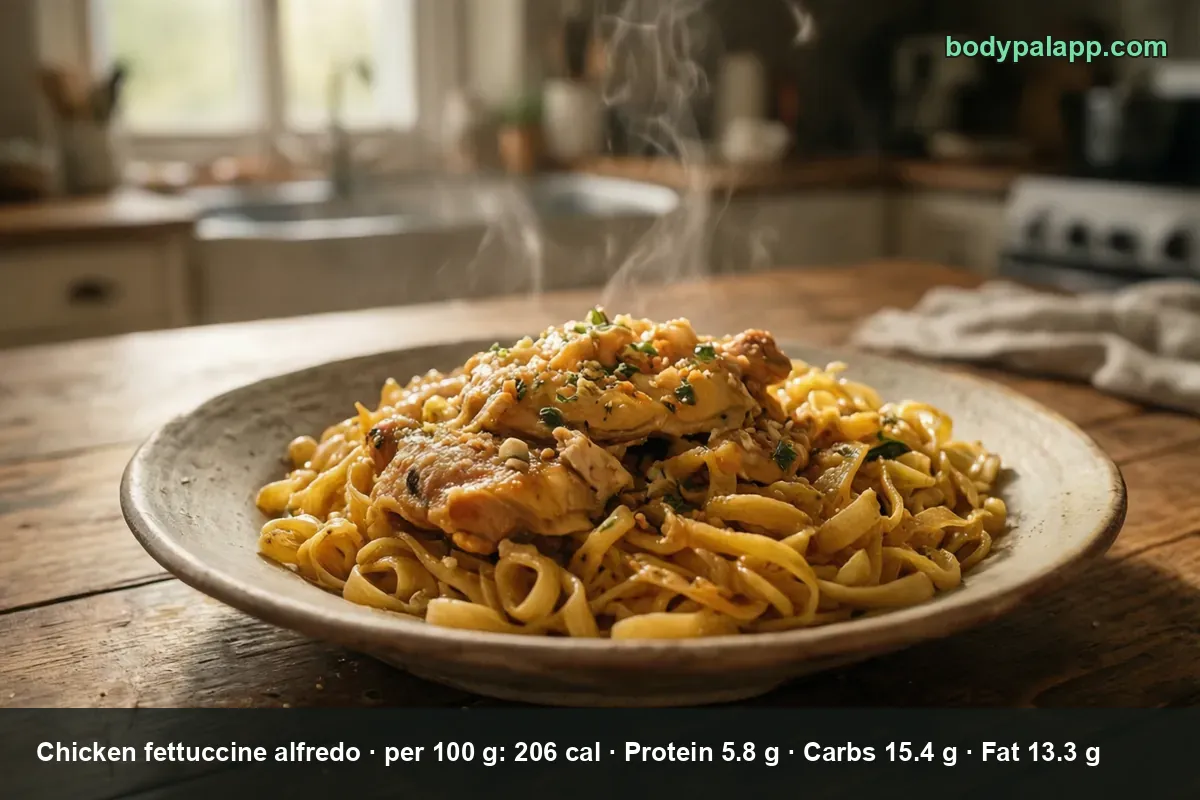
A 1-cup (250 g) serving of restaurant-style chicken fettuccine alfredo is 515 calories, and the dish runs 206 calories per 100 g. Nearly 60% of those calories are fat: 33.3 g a cup against 14.6 g of protein. Cook the same cup at home and it falls to 393.
On this page
- Chicken fettuccine alfredo quick facts
- US servings, from one ounce to a restaurant plate
- Homemade, frozen and the versions in between
- Sodium, not fat, is the row to watch
- How does chicken alfredo compare?
- Most popular chicken fettuccine alfredo brands
- FAQ
Chicken fettuccine alfredo quick facts
USDA does not publish a food called "chicken fettuccine alfredo." The record that matches what lands on the table is FNDDS 2708867, "Pasta with cream sauce and poultry, restaurant" — pasta, a cream sauce and poultry, prepared the way a restaurant kitchen prepares it. That is the plate people are usually searching for, whether it came from a chain menu or a takeout container.
Everything below is per 100 g and per the USDA cup of 250 g. If you cook it yourself, jump ahead: the home-recipe record is a genuinely different food, not a rounding difference.
| Nutrient | Per 100 g | Per 1 cup (250 g) | % Daily Value |
|---|---|---|---|
| Calories | 206 | 515 | 26% |
| Total fat | 13.33 g | 33.3 g | 43% |
| Saturated fat | 4.235 g | 10.6 g | 53% |
| Carbohydrate | 15.41 g | 38.5 g | 14% |
| Dietary fiber | 0.9 g | 2.3 g | 8% |
| Total sugars | 0.59 g | 1.5 g | — |
| Protein | 5.83 g | 14.6 g | 29% |
| Sodium | 561 mg | 1403 mg | 61% |
% Daily Value is based on a 2,000-calorie diet.
Verified nutrition data
Numbers on this page come from USDA FoodData Central, the U.S. Department of Agriculture’s food composition database, and from manufacturer labels where a branded product is named. Last verified September 2026. How we verify our data →
Two rows you will not find here: added sugars and trans fat. FNDDS does not publish either one for mixed restaurant dishes, so listing them would mean inventing numbers. Cholesterol comes in at 24 mg per 100 g, or 60 mg a cup — 20% of the Daily Value. Potassium is low for a plate this size, 60 mg per 100 g and 150 mg a cup, about 3%.
US servings, from one ounce to a restaurant plate
| Serving | Weight | Calories |
|---|---|---|
| 1 oz | 28 g | 58 kcal |
| 1/2 cup | 125 g | 258 kcal |
| 1 cup | 250 g | 515 kcal |
| 1.5 cups, restaurant plate | 375 g | 773 kcal |
| 2 cups | 500 g | 1030 kcal |
| Per 100 g | 100 g | 206 kcal |
Only the 1-cup line is a USDA household measure. The half cup, the cup and a half, the two cups and the ounce are our own arithmetic from the USDA 100 g figure, not USDA servings.
Here is the trap in that table. A USDA cup of this dish is 250 g — heavier than a cup of most things, because cream sauce is dense and fettuccine packs tightly. A restaurant entree is rarely one cup. Plate a cup and a half and you are at 773 calories; a full two cups, which is a normal chain-restaurant portion, is 1,030 calories and 2,805 mg of sodium, or 122% of the day's sodium before the breadstick. Logging "one serving" of alfredo without weighing it is one of the easiest ways to be 500 calories off.
Homemade, frozen and the versions in between
| Version | Per 100 g | Serving | Calories |
|---|---|---|---|
| Restaurant (main record) | 206 kcal | 1 cup, 250 g | 515 kcal |
| Homemade | 157 kcal | 1 cup, 250 g | 393 kcal |
| Frozen, ready to heat | 170 kcal | 1 cup, 250 g | 425 kcal |
| With broccoli, restaurant | 196 kcal | 1 cup, 250 g | 490 kcal |
| Whole grain fettuccine, restaurant | 202 kcal | 1 cup, 250 g | 505 kcal |
| Fettuccine alfredo, no chicken | 204 kcal | 1 cup, 250 g | 510 kcal |
| Alfredo sauce with chicken, no pasta | 156 kcal | 1 cup, 260 g | 406 kcal |
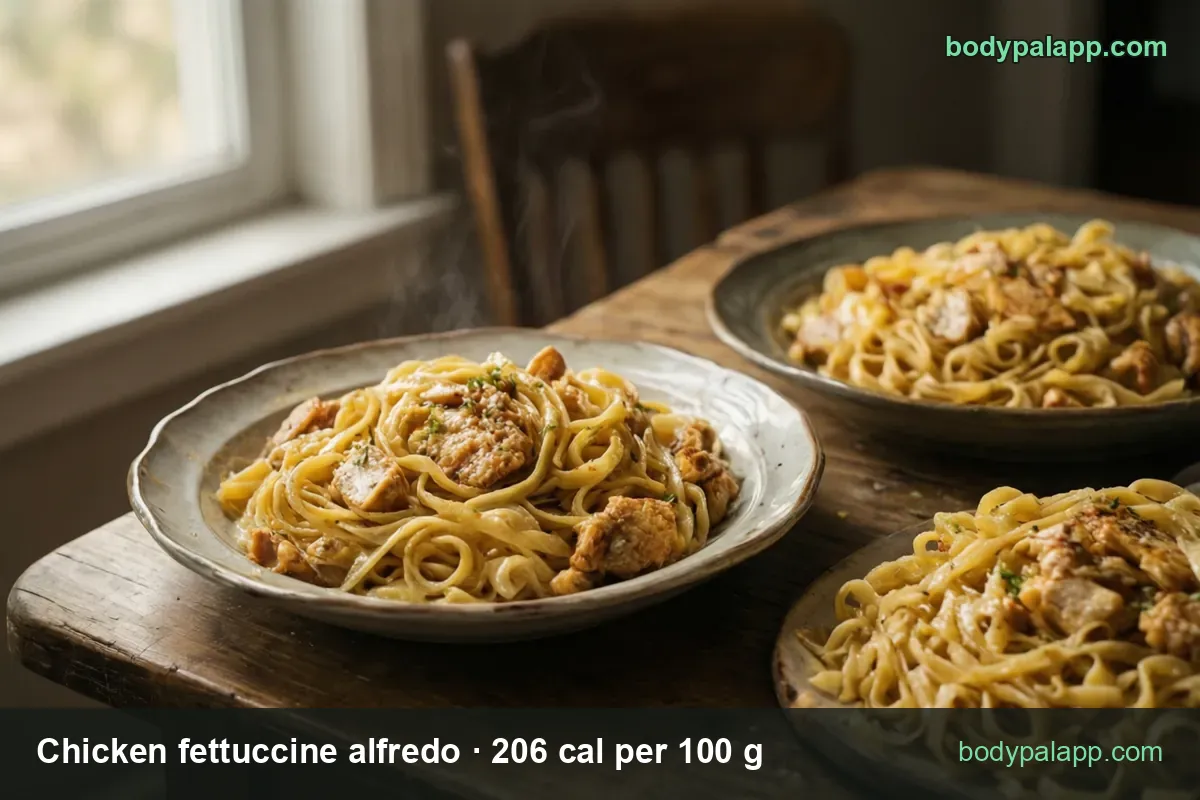
The restaurant plate and the home pot are not the same food. 206 against 157 calories per 100 g means 515 against 393 for an identical cup — 122 calories that come from nothing but extra butter and cream. Sodium splits even wider: 561 mg per 100 g in the restaurant version against 250 mg at home, so the home cup lands near 625 mg instead of 1,403 (per-cup sodium here is our arithmetic from the USDA 100 g rows).
Frozen trays sit in the middle at 170 calories per 100 g, about 425 a cup, with sodium around 963 mg — lighter on fat than the restaurant plate, saltier than anything you would make yourself. Retail packages are portioned smaller than a restaurant plate, which is why most read low: a Great Value tray of 283 g is 331 calories and a Giovanni Rana cup of 171 g is 299, while a Whole Foods Market container with broccoli, at 340 g, still reaches 571.
Two swaps barely move the calorie line. Broccoli takes a cup from 515 to 490, and whole grain fettuccine takes it to 505. The whole grain version earns its place on a different row: fiber doubles from 0.9 g to 1.9 g per 100 g, so a cup gives 4.8 g instead of 2.3 g, or 17% of the Daily Value instead of 8%.
Skipping the pasta is the change that transforms the plate, and not in the direction people expect. A cup of alfredo sauce with chicken and no noodles is 406 calories with carbohydrate down near 3.7 g — but saturated fat climbs to roughly 18.9 g, close to 95% of the Daily Value in one bowl. The pasta was diluting the cream.
Sodium, not fat, is the row to watch
Everyone braces for the fat in alfredo, and the fat is real: 10.6 g of saturated fat a cup, 53% of the FDA Daily Value of 20 g. But the sharper number is salt. One cup carries 1,403 mg of sodium, 61% of the 2,300 mg Daily Value — roughly two-thirds of a teaspoon of table salt in a single serving of pasta.
Line the percentages up and the plate looks lopsided. A cup of restaurant chicken alfredo delivers 61% of the day's sodium, 53% of the saturated fat and 26% of the calories, while returning 29% of the protein. The Dietary Guidelines for Americans put saturated fat and sodium at the top of the list of things most people overshoot, and this dish hits both in one bowl.
If you are watching sodium, the home recipe is the pick with no argument: it cuts the calories by 122 a cup and the sodium by more than half. If you are eating out, the useful lever is portion size, not menu choice — a half order of alfredo beats a full order of anything else in this family.
For protein, chicken alfredo is a passable but not strong source. The 14.6 g in a cup is about what MyPlate counts as two ounces of cooked poultry, spread across a 515-calorie plate. Grilled chicken on its own would give you the same protein for a fifth of the calories.
How does chicken alfredo compare?
| Dish, restaurant style | Per 100 g | US serving | Calories |
|---|---|---|---|
| Chicken fettuccine alfredo | 206 kcal | 1 cup, 250 g | 515 kcal |
| Pasta with cream sauce and meat | 213 kcal | 1 cup, 250 g | 533 kcal |
| Fettuccine alfredo, no meat | 204 kcal | 1 cup, 250 g | 510 kcal |
| Pasta with cream sauce and seafood | 202 kcal | 1 cup, 250 g | 505 kcal |
Our take: these four plates sit within 28 calories of each other per cup, because the cream sauce is doing the work and the protein on top is almost incidental to the total. That makes the choice a protein question, not a calorie question. Plain fettuccine alfredo saves you 5 calories against the chicken version and costs you 5.3 g of protein per cup — 9.3 g instead of 14.6 g — which is the worst trade on the table. The seafood version is the lightest of the four at 505, but only 5 calories under plain fettuccine alfredo, which is not a reason to order it. Order the one you want and cut the portion instead.
Most popular chicken fettuccine alfredo brands in the United States
Ranked by how widely each product appears among foods sold in the United States, from the BodyPal food database of over 3.3 million products. Calories are the figures printed on each Nutrition Facts label, checked against USDA FoodData Central.
| Product | Calories (per 100 g) |
|---|---|
| Great Value Chicken Fettuccine Alfredo | 117 cal |
| Whole Foods Market Grilled Chicken Fettuccine Alfredo with Broccoli | 168 cal |
| Giovanni Rana Grilled White Chicken Fettuccine Alfredo | 175 cal |
| Kitchen Table Grilled Chicken Fettuccine Alfredo | 134 cal |
| Clover Valley Chicken Fettuccine Alfredo with Broccoli | 94 cal |
Brand popularity: BodyPal food database. Nutrition: manufacturer labels / USDA FoodData Central.
Chicken fettuccine alfredo FAQs
How many calories are in 1 cup of chicken fettuccine alfredo?
One cup of restaurant-style chicken fettuccine alfredo weighs 250 g and carries 515 calories, at 206 calories per 100 g. Half a cup is 258 and a 1.5-cup restaurant plate is 773. Most of that comes from the cream sauce, not the chicken: fat alone contributes 33.3 g per cup.
Is chicken fettuccine alfredo high in protein?
A cup gives 14.6 g of protein, 29% of the Daily Value. That is real protein, but it lags the 61% of the sodium Daily Value in the same bowl. Against plain fettuccine alfredo at 9.3 g per cup, the chicken adds about 5 g — useful, not transformative.
How much sodium is in chicken alfredo?
One cup carries 1,403 mg of sodium, 61% of the FDA Daily Value of 2,300 mg, or roughly two-thirds of a teaspoon of table salt. Two cups, a normal restaurant portion, reach 2,805 mg, which is 122% of the day's value before anything else on the table.
Is homemade chicken alfredo healthier than restaurant chicken alfredo?
Homemade runs 157 calories per 100 g against 206 for the restaurant version, so a cup is 393 instead of 515. Sodium drops harder still: 250 mg per 100 g against 561. The gap is butter, cream and salt, not the pasta or the chicken itself.
How many carbs are in chicken fettuccine alfredo?
A cup has 38.5 g of carbohydrate, 14% of the Daily Value, with only 1.5 g of sugars and 2.3 g of fiber. That is modest for a pasta dish, because the cream sauce takes up volume that would otherwise be noodles. Fat, at 33.3 g, outweighs the carbs in calories.
How many calories are in frozen chicken fettuccine alfredo?
Frozen, ready-to-heat chicken alfredo is 170 calories per 100 g, so a 250 g cup is 425 — about 90 fewer than the restaurant plate. Retail trays run smaller: a Great Value tray of 283 g is 331 calories and a Giovanni Rana cup of 171 g is 299.
Does adding broccoli lower the calories in chicken alfredo?
Slightly. Chicken alfredo with added vegetables is 196 calories per 100 g against 206, so a cup is 490 instead of 515, a 25-calorie difference. Fiber ticks up from 0.9 g to 1.0 g per 100 g. Broccoli displaces some pasta and sauce; it does not undo the cream.
How many calories are in alfredo sauce with chicken without pasta?
Alfredo sauce with chicken and no pasta is 156 calories per 100 g, so a 260 g cup is 406. Carbs collapse to about 3.7 g and saturated fat climbs to roughly 18.9 g, near 95% of the Daily Value — our own arithmetic from the USDA 100 g row.
Similar foods
- Salmon — 350 cal per fillet, 6 oz cooked
- Dosa — 326 cal per large dosa
- Flat iron steak — 391 cal per steak
- Chicken Taco — 222 cal per taco
- Meatloaf — 215 cal per slice
- T-Bone Steak — 537 cal per steak
Count it without the math
Point the camera at the plate and BodyPal counts the fettuccine, the sauce and the chicken together.


How long does it take to burn off 515 kcal of chicken alfredo?
A 1-cup (250 g) serving is 515 kcal. Enter your weight and the amount you ate to see how long it takes you to burn that off:
lb
| Activity | Time to burn 515 kcal |
|---|---|
| Walking, brisk | 1 hr 43 min |
| Cycling, moderate | 1 hr 4 min |
| Swimming, moderate | 1 hr 14 min |
| Jogging | 1 hr 1 min |
| Weight training, moderate | 1 hr 54 min |
Times are for a 155 lb adult at a steady pace; change the weight to see yours. The amount is set to the portion in the text (250 g); change it to what you actually ate. BodyPal works this out from your steps automatically.
Burning it off is one side of it. The other is knowing your number: work out how many calories you need a day, with macros and a goal date.