
How many calories are in chicken milanese?
A medium breaded cutlet weighs about 165 g and carries 361 calories. Per 100 g, chicken milanese runs 219 calories — lean breast meat doing most of the work, with the egg-and-crumb crust adding the fat. That one cutlet also hands you 40.5 g of protein, or 81% of a day's Daily Value.
On this page
- Chicken milanese quick facts
- US servings, from one slice to a large cutlet
- Breading on, breading off, and the freezer aisle
- Protein is the win, sodium is the catch
- How does chicken milanese compare?
- Most popular chicken milanese brands
- FAQ
Chicken milanese quick facts
There is no USDA line called "milanese." The dish is a thin skinless breast, pounded flat, dipped in egg and crumbs, and pan-fried from raw — and you eat the crust. That is exactly the record used here: FNDDS 2705975, "Chicken breast, fried, coated, prepared skinless, coating eaten, from raw". Records that strip the coating off, or leave the skin on underneath it, describe a different way of cooking the same bird, not a different database.
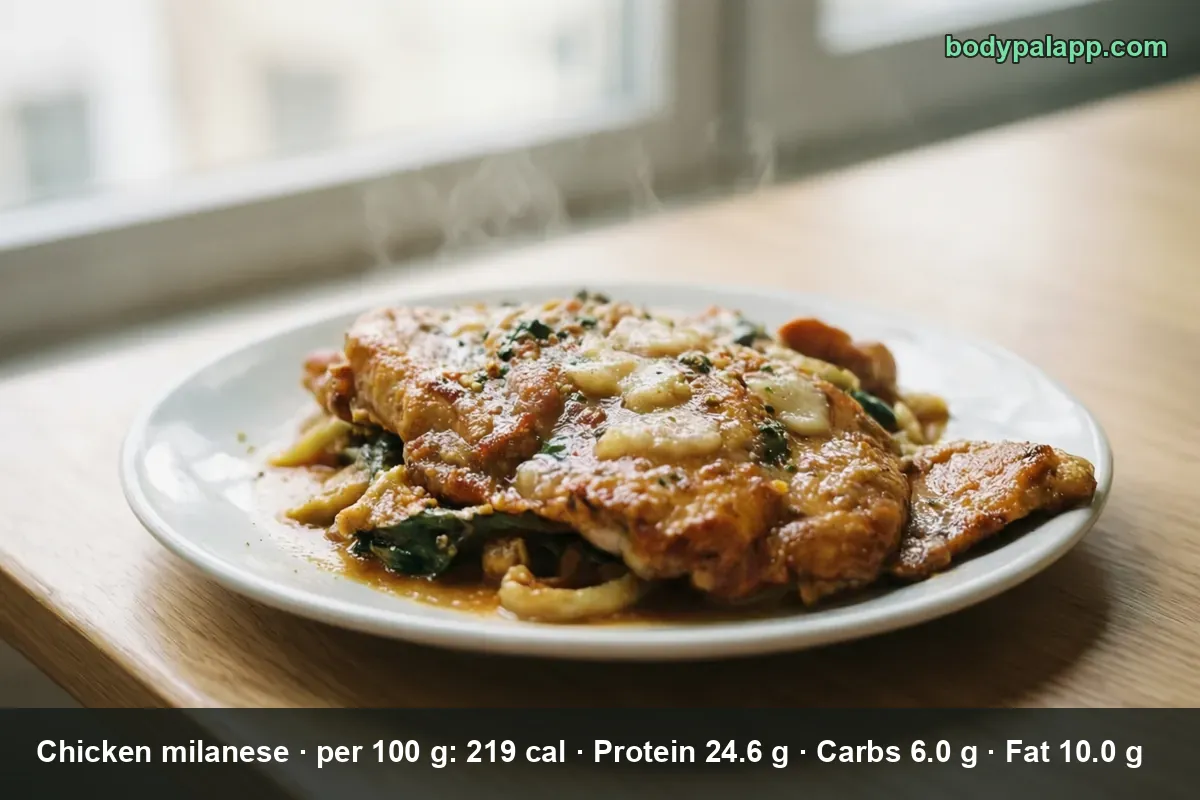
One note on the photo above: that plate is dressed parmigiana style, with cheese, sauce and greens on top. The numbers below are for the cutlet alone, crust included, with nothing spooned over it.
| Nutrient | Per 100 g | Per one medium cutlet (165 g) | % Daily Value |
|---|---|---|---|
| Calories | 219 | 361 | — |
| Total fat | 9.99 g | 16.5 g | 21% |
| Saturated fat | 1.576 g | 2.6 g | 13% |
| Carbohydrate | 6.01 g | 9.9 g | 4% |
| Dietary fiber | 0.2 g | 0.3 g | 1% |
| Total sugars | 0.1 g | 0.2 g | — |
| Protein | 24.56 g | 40.5 g | 81% |
| Sodium | 318 mg | 525 mg | 23% |
% Daily Value is based on a 2,000-calorie diet.
Verified nutrition data
Numbers on this page come from USDA FoodData Central, the U.S. Department of Agriculture’s food composition database, and from manufacturer labels where a branded product is named. Last verified September 2026. How we verify our data →
Two rows you would see on a package are missing here: added sugars and trans fat. FNDDS does not report either for this dish, so they are left out rather than guessed at. Cholesterol and potassium are published: 80 mg and 292 mg per 100 g, which works out to 132 mg of cholesterol (44% DV) and 482 mg of potassium (10% DV) in the cutlet. The FDA Daily Value reference is what those percentages are measured against.
US servings, from one slice to a large cutlet
| Serving | Weight | Calories |
|---|---|---|
| 1 oz, cooked | 28 g | 62 kcal |
| One medium slice | 60 g | 131 kcal |
| 1 cup, cooked and diced | 135 g | 296 kcal |
| One medium cutlet | 165 g | 361 kcal |
| One large cutlet | 185 g | 405 kcal |
| Per 100 g | 100 g | 219 kcal |
Every weight in that table except the flat 100 g line is a USDA household measure for this record, so the calories come straight from the database rather than from our own scaling.
The cup is the trap. "One cup, cooked, diced" sounds like a full plate, but it holds 135 g and lands at 296 calories, while the whole cutlet it was cut from is 165 g and 361. Log the cup instead of the cutlet and you are 65 calories light before anything else goes wrong. Slicing the cutlet into strips, the way milanese is usually served over arugula, does not shrink it.
Raw weight is the other gap. Breast meat loses roughly a quarter of its weight in the pan, so about 4 oz of raw breast becomes about 3 oz of finished cutlet — the crumb coating adds a little back, but not enough to close that gap. Weigh the plate, not the package. If you only have the raw number, 4 oz of cooked coated breast is roughly 248 calories, which is our own arithmetic from the USDA 100 g figure rather than a USDA serving.
Breading on, breading off, and the freezer aisle
| Version | Per 100 g | Typical piece | Calories |
|---|---|---|---|
| Milanese, crust eaten (skinless, from raw) | 219 kcal | one medium cutlet, 165 g | 361 kcal |
| Breading peeled off | 176 kcal | one medium cutlet, 120 g | 211 kcal |
| Skin left on under the coating | 243 kcal | one medium cutlet, 175 g | 425 kcal |
| Frozen breaded chicken fillet | 240 kcal | one fillet, 120 g | 288 kcal |
| Breaded chicken patty | 287 kcal | one patty, 75 g | 215 kcal |
| Breaded tenders, fast food | 271 kcal | one tender, 50 g | 136 kcal |
Peeling the crust off is the single biggest lever on this page. It takes the cutlet from 219 to 176 calories per 100 g, and because the coating itself weighs something, the piece on your plate goes from 165 g to about 120 g — 361 calories down to 211. Protein per 100 g moves the other way, from 24.56 g to 29.62 g in the skinless, coating-not-eaten record. The crust is carrying fat and starch, not protein.
Leaving the skin on before you bread it is the quiet upgrade nobody counts: 243 calories per 100 g and 425 on a 175 g piece, with saturated fat jumping from 1.576 g to 2.77 g per 100 g. Restaurant milanese made from a whole butterflied breast often falls here.
The freezer aisle is a different animal. A factory-formed breaded fillet is 240 calories per 100 g but only 14.62 g of protein, because it is thicker on breading and lighter on meat than anything you would pound out at home. Branded cutlets in US supermarkets run about 170 to 264 calories per 100 g depending on how much coating is on them, and an air-fried strip product sits near 179 — the coating-to-meat ratio, not the bird, sets the number.
Protein is the win, sodium is the catch
Forty and a half grams of protein in one cutlet is 81% of the FDA Daily Value, and it arrives for 361 calories. That is a strong ratio by any standard, and it is the reason milanese survives on a calorie-counting menu at all when a fried food normally would not. MyPlate's protein guidance treats poultry as a lean choice, and the record backs it: 2.6 g of saturated fat in the cutlet, 13% of the day.
Sodium is where it turns. One cutlet carries 525 mg, 23% of the 2,300 mg Daily Value — about a quarter teaspoon of table salt, in a dish most people eat two of. The store-bought version is worse per bite: the frozen breaded fillet hits 527 mg of sodium in just 100 g, before you salt the arugula on top.
Carbohydrate is smaller than people expect. The whole crumb coating contributes 9.9 g in the cutlet, 4% DV, with 0.2 g of sugar. If you are counting carbs rather than calories, breaded chicken is a mild expense; if you are counting sodium, it is an expensive one.
How does chicken milanese compare?
| Dish | Per 100 g | US serving | Calories |
|---|---|---|---|
| Chicken milanese, crust eaten | 219 kcal | one medium cutlet, 165 g | 361 kcal |
| Same cutlet, breading removed | 176 kcal | one medium cutlet, 120 g | 211 kcal |
| Breaded chicken fillet, frozen | 240 kcal | one fillet, 120 g | 288 kcal |
| Batter-fried breast with skin | 260 kcal | 3 oz, 85 g | 221 kcal |
Our take: milanese is the densest number on the plate here — 361 calories, more than any other row — but only because the portion is bigger, not because the food is richer. Per 100 g it is the second-lightest of the four. If you want the calories down without losing the meal, thin the cutlet rather than the crust: a 120 g piece cooked the same way is 263 calories, our own arithmetic from the USDA 100 g figure. For weight loss, one cutlet over greens is a genuinely efficient 361; for fullness on a training day, the 185 g cutlet at 405 calories buys 45 g of protein and is still cheaper than most sandwiches.
Most popular chicken milanese brands in the United States
Ranked by how widely each product appears among foods sold in the United States, from the BodyPal food database of over 3.3 million products. Calories are the figures printed on each Nutrition Facts label, checked against USDA FoodData Central.
| Product | Calories (per 100 g) |
|---|---|
| AdvancePierre Breaded Chicken Breast Cutlets | 264 cal |
| Ahold Breaded Chicken Parmesan | 181 cal |
| Tyson Air Fried Chicken Breast Strips | 179 cal |
| Meal Mart Breaded Chicken & Turkey Cutlets | 170 cal |
Brand popularity: BodyPal food database. Nutrition: manufacturer labels / USDA FoodData Central.
Chicken milanese FAQs
How many calories are in chicken milanese?
361 calories in one medium 165 g cutlet, breading eaten, at 219 calories per 100 g. A large 185 g cutlet is 405. A single medium slice off the cutlet, the way it is served over greens, is 60 g and 131 calories.
How much protein is in one chicken milanese cutlet?
40.5 g of protein in a 165 g cutlet, which is 81% of the FDA Daily Value, from 24.56 g per 100 g. That comes with 16.5 g of fat and 9.9 g of carbohydrate. Very few fried foods return that much protein for 361 calories.
How many calories if I remove the breading?
211 calories. Without the coating the USDA record drops to 176 calories per 100 g, and the piece itself weighs about 120 g instead of 165 g. Protein density rises to 29.62 g per 100 g, so you lose 150 calories and keep most of the meat.
How many calories in a 4 oz chicken cutlet?
About 248 calories for 4 oz of cooked breaded cutlet, which is our own arithmetic from the USDA figure of 219 per 100 g. Careful with raw weight: 4 oz raw breast cooks down to roughly 3 oz, so a raw 4 oz portion finishes closer to 190.
Is chicken milanese healthier than chicken parmesan?
Per 100 g, no: a supermarket breaded chicken parmesan reads 181 calories against 219 for plain milanese, because sauce and cheese add water and weight. Per plate, yes: that parmesan portion is 254 g and 460 calories, about 99 more than the 361 cutlet.
Does air frying chicken milanese cut calories?
USDA publishes no air-fried milanese record to set against the 219 calories per 100 g here, so this is indirect. A branded air-fried breaded chicken strip lands near 179 calories per 100 g, against 271 for deep-fried fast-food tenders. Less absorbed oil is the whole mechanism, and the coating still supplies the carbohydrate.
How much sodium is in breaded chicken cutlets?
525 mg in a home-style 165 g cutlet, 23% of the 2,300 mg Daily Value, or about a quarter teaspoon of table salt. Frozen breaded fillets are saltier: 527 mg in 100 g, so a 120 g fillet passes 630 mg before any sauce goes on it.
Is chicken milanese good for weight loss?
At 361 calories for 40.5 g of protein, one cutlet fits most lunch budgets comfortably. The risk is quantity and company, not the food: two cutlets is 722, and the sides usually cost more than the chicken. If you are watching sodium, the peeled version at 211 is the better pick.
Similar foods
- Lamb Liver — 187 cal per 3 oz
- Skirt Steak — 187 cal for 3 oz cooked
- Steak Tartare — 365 cal per serving
- 85/15 Ground Beef — 215 kcal per 100 g raw
- Chicken Feet — 301 cal for 4 feet
- Chuck Steak — 360 cal per steak
Count it without the math
Point the camera at the plate and BodyPal counts the cutlet for you, crust and all.


How long does it take to burn off chicken milanese?
One medium cutlet (165 g) is 361 kcal. Enter your weight and the amount you ate to see how long it takes you to burn that off:
lb
| Activity | Time to burn 361 kcal |
|---|---|
| Walking, brisk | 1 hr 12 min |
| Cycling, moderate | 45 min |
| Swimming, moderate | 52 min |
| Jogging | 42 min |
| Weight training, moderate | 1 hr 20 min |
Times are for a 155 lb adult at a steady pace; change the weight to see yours. The amount is set to the portion in the text (165 g); change it to what you actually ate. BodyPal works this out from your steps automatically.
Want the bigger picture? Calculate your daily calorie needs — your maintenance figure, a target for losing or gaining, and the date you get there.