
How many calories are in steak tartare?
A restaurant serving of steak tartare weighs 169 g and carries 365 calories. Per 100 g the raw seasoned beef runs 216 calories, with 29.5 g of protein and only 0.6 g of carbohydrate in that serving. Order it as a shared cup instead, 225 g, and the same dish becomes 486.
You'd need to walk about 73 minutes to burn the 365 calories in one restaurant serving (169 g).
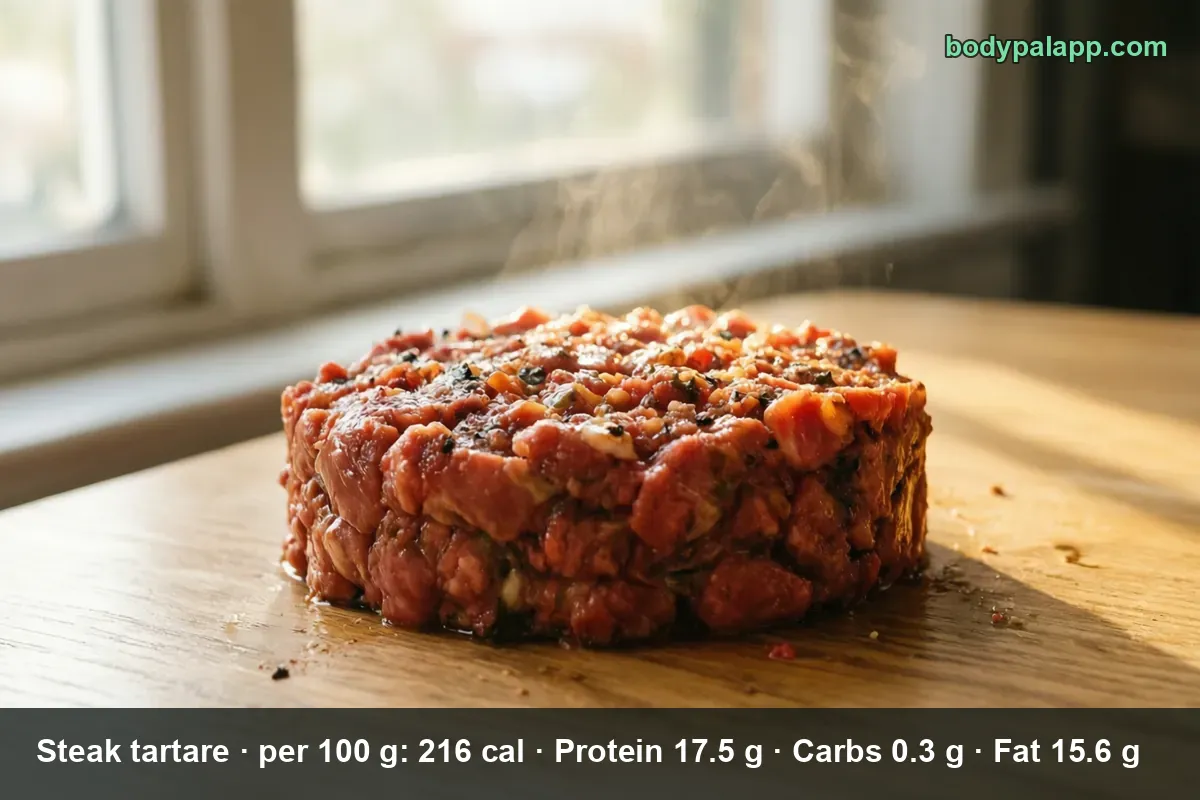
How long does it take to burn off steak tartare?
One restaurant serving (169 g) is 365 kcal. Enter your weight and the amount you ate to see how long it takes you to burn that off:
lb
| Activity | Time to burn 365 kcal |
|---|---|
| Walking, brisk | 1 hr 13 min |
| Cycling, moderate | 46 min |
| Swimming, moderate | 52 min |
| Jogging | 43 min |
| Weight training, moderate | 1 hr 21 min |
Times are for a 155 lb adult at a steady pace; change the weight to see yours. The amount is set to the portion in the text (169 g); change it to what you actually ate. BodyPal works this out from your steps automatically.
On this page
- Steak tartare quick facts
- US servings, from one ounce to a full cup
- Appetizer, cup, or four-ounce portion
- Cholesterol is the row to watch
- How does steak tartare compare?
- FAQ
Steak tartare quick facts
There is exactly one USDA line for the finished dish: FNDDS 2706394, "Steak tartare", filed under mixed meat dishes. That matters, because tartare is not a cut of beef. It is chopped raw steak already carrying egg yolk, capers, onion, mustard and seasoning, and the survey line measures the plate as it arrives, not the meat before the kitchen touched it. Scaling raw sirloin numbers yourself would understate the fat and badly understate the sodium.
The serving column below is the USDA serving line of 169 g, which is close to 6 oz and matches a standard appetizer plating.
| Nutrient | Per 100 g | Per 1 serving (169 g) | % Daily Value |
|---|---|---|---|
| Calories | 216 | 365 | — |
| Total fat | 15.6 g | 26.4 g | 34% |
| Saturated fat | 5.8 g | 9.8 g | 49% |
| Carbohydrate | 0.34 g | 0.6 g | 0% |
| Dietary fiber | 0.2 g | 0.3 g | 1% |
| Total sugars | 0.08 g | 0.1 g | — |
| Protein | 17.45 g | 29.5 g | 59% |
| Sodium | 370 mg | 625 mg | 27% |
| Cholesterol | 165 mg | 279 mg | 93% |
| Potassium | 262 mg | 443 mg | 9% |
% Daily Value is based on a 2,000-calorie diet.
Verified nutrition data
Numbers on this page come from USDA FoodData Central, the U.S. Department of Agriculture’s food composition database, and from manufacturer labels where a branded product is named. Last verified September 2026. How we verify our data →
Two rows you would see on a packaged label are missing here. This FNDDS edition does not carry added sugars or trans fat for any of its records, so both are left out rather than guessed at. You also will not find a grocery-aisle version of this dish to compare against: raw beef tartare is made in a restaurant or at home, not sold sealed in a tray.
US servings, from one ounce to a full cup
| Serving | Weight | Calories |
|---|---|---|
| 1 oz | 28.4 g | 61 kcal |
| 3 oz tasting portion | 85 g | 184 kcal |
| 4 oz portion | 113 g | 244 kcal |
| 1 serving, appetizer plate | 169 g | 365 kcal |
| 1 cup, shared bowl | 225 g | 486 kcal |
| Per 100 g | 100 g | 216 kcal |
Only two of those are USDA household measures: the 169 g serving and the 1 cup at 225 g. The ounce rows are our own arithmetic from the USDA 100 g figure, not USDA serving lines, which is why they land on clean multiples.
The gap between a full cup and a 4 oz plating is where most people get their count wrong. A cup of tartare is 486 calories and a 4 oz plating is 244 — just about double, for a dish that looks the same in both cases because it is always pressed into the same flat disc. The plate is wider, not taller, and width is hard to read across a table.
Here is the other thing worth knowing, and it runs opposite to every other beef page you have read. Cooked beef loses water and shrinks, which is why 4 oz raw ground beef lands near 3 oz on the plate. Tartare never cooks, so the weight you order is the weight you eat. When a menu says 4 oz of tartare, that is 244 calories of actual food, whereas 4 oz on a burger menu usually describes the patty before the grill took a quarter of it away.
Appetizer, cup, or four-ounce portion
The recipe does not change much from kitchen to kitchen. The portion does, by a factor of nearly three.
| Version | Per 100 g | Typical portion | Calories |
|---|---|---|---|
| Restaurant appetizer serving | 216 kcal | 1 serving (169 g) | 365 kcal |
| Full cup, shared bowl | 216 kcal | 1 cup (225 g) | 486 kcal |
| 4 oz portion | 216 kcal | 113 g | 244 kcal |
| 3 oz tasting portion | 216 kcal | 85 g | 184 kcal |
The 3 oz tasting portion is the one to ask for if you are eating a full dinner afterward. At 184 calories it brings about 14.8 g of protein and 140 mg of cholesterol, both scaled from the USDA 100 g figure rather than read off a USDA serving line.
The shared cup is the opposite end. At 225 g it works out to roughly 39.3 g of protein, 35.1 g of fat, 833 mg of sodium and 371 mg of cholesterol — again our own scaling — which puts the cholesterol at about 124% of a day's Daily Value before anything else on the table. If two people split it, halve all of that.
For weight loss, the 4 oz plate at 244 calories is the pick: it is the smallest portion that still eats like a course. For staying full, the 169 g appetizer serving wins, because 29.5 g of protein in 365 calories is an unusually good ratio for something served as a starter.
Cholesterol is the row to watch
Most people brace for the fat here and are surprised by the cholesterol. One 169 g serving carries 279 mg, which is 93% of the FDA Daily Value of 300 mg, and it does that inside only 365 calories. Raw egg yolk stirred through the beef is doing most of that work; the beef alone would not get there.
Saturated fat is the second row. The serving holds 9.8 g against a 20 g Daily Value, so half a day's allowance in one starter, and the Dietary Guidelines keep saturated fat under 10% of daily calories. Total fat is 15.6 g per 100 g, which supplies roughly 65% of the calories in this dish. "Raw" reads as lean, and it is not.
What the dish does not have is carbohydrate. At 0.34 g per 100 g and 0.6 g in the whole serving, tartare is about as close to zero-carb as a restaurant course gets, and the protein return is strong enough that MyPlate would count the serving as a full protein-foods contribution on its own. If you are watching sodium, note the 625 mg — about a quarter teaspoon of table salt, contributed by the capers, mustard and Worcestershire rather than the meat.
The toast points are the invisible line item. They carry every carbohydrate on the plate, and nothing above accounts for them.
How does steak tartare compare?
Three USDA mixed-meat dishes sit within four calories per 100 g of tartare, which makes them a fair test of what "raw" actually buys you.
| Dish | Per 100 g | US serving | Calories |
|---|---|---|---|
| Steak tartare | 216 kcal | 3 oz (85 g) | 184 kcal |
| Veal cordon bleu | 219 kcal | 3 oz (85 g) | 186 kcal |
| Lamb or mutton with gravy | 219 kcal | 3 oz (85 g) | 186 kcal |
| Beef stew with potatoes, Puerto Rican style | 220 kcal | 3 oz (85 g) | 187 kcal |
Our take: tartare is the lightest of the four per gram, but only by four calories per 100 g at the widest — an energy difference nobody will feel. The split is in composition. Tartare gives 17.45 g of protein per 100 g with 0.34 g of carbohydrate, while veal cordon bleu reaches 23.66 g of protein by carrying 9.34 g of carbohydrate in its breading, and the beef stew drops to 14.57 g of protein because potatoes take up the room. If you want protein with no starch attached, tartare wins. If you want the same calories to keep you full for longer, the stew and its starch will do more of that job.
Steak tartare FAQs
How many calories are in steak tartare?
365 calories in the USDA serving of 169 g, which works out to 216 calories per 100 g. A shared cup of 225 g comes to 486, and a 3 oz tasting portion sits at 184. The dish is essentially beef, fat and egg yolk, with no starch padding the count.
How much protein is in a serving of steak tartare?
29.5 g of protein in the 169 g serving, or 59% of the FDA Daily Value of 50 g. Per 100 g the figure is 17.45 g. That is a strong protein return for an appetizer, since almost none of the 365 calories arrive as carbohydrate.
Does steak tartare have carbs?
Barely: 0.6 g of carbohydrate in a 169 g serving, scaled from 0.34 g per 100 g. Total sugars are 0.08 g per 100 g and fiber is 0.2 g. The capers, onion and yolk add only traces, so any toast or fries served alongside carry all the real carbs.
How many calories are in 4 oz of steak tartare?
244 calories for 4 oz, or 113 g, scaled from the USDA figure of 216 calories per 100 g rather than read off a USDA serving line. That plate also holds about 17.6 g of fat and 19.7 g of protein. It is a common restaurant plating, half the size of the shared cup.
Is steak tartare high in cholesterol?
279 mg of cholesterol in a 169 g serving, which is 93% of the 300 mg Daily Value, inside just 365 calories. Raw egg yolk stirred through the beef does most of it, and the 100 g figure is 165 mg. A 3 oz tasting portion drops it to about 140 mg.
How much sodium is in steak tartare?
625 mg of sodium in the 169 g serving, 27% of the 2,300 mg Daily Value, scaled from 370 mg per 100 g. That is about a quarter teaspoon of table salt, and it comes from the capers, mustard and Worcestershire in the mix rather than from the beef itself.
Is steak tartare healthier than a cooked steak dish?
216 calories per 100 g puts tartare just under veal cordon bleu and lamb with gravy, both 219. The bigger difference is weight. Cooked beef loses moisture, so 4 oz on the plate began as more meat, while tartare is weighed and served raw at the same 4 oz.
How big is a standard steak tartare serving?
169 g is the USDA serving line, close to 6 oz, and that plate is 365 calories. Kitchens run anywhere from a 3 oz tasting portion at 184 calories up to a full cup of 225 g at 486. Ask which size the menu means before you log it.
Similar foods
- Steak — 368 cal per regular steak
- Eggnog — 112 cal for 1/2 cup
- Protein Shake — 156 cal per cup
- Bubble Tea — 239 cal per drink
- Apple cider — 114 cal per cup
- Root beer — 152 cal for 12 fl oz glass
Count it without the math
Point the camera at the plate and BodyPal counts the tartare for you, yolk and capers included.

