
How Many Calories in Chuck Steak?
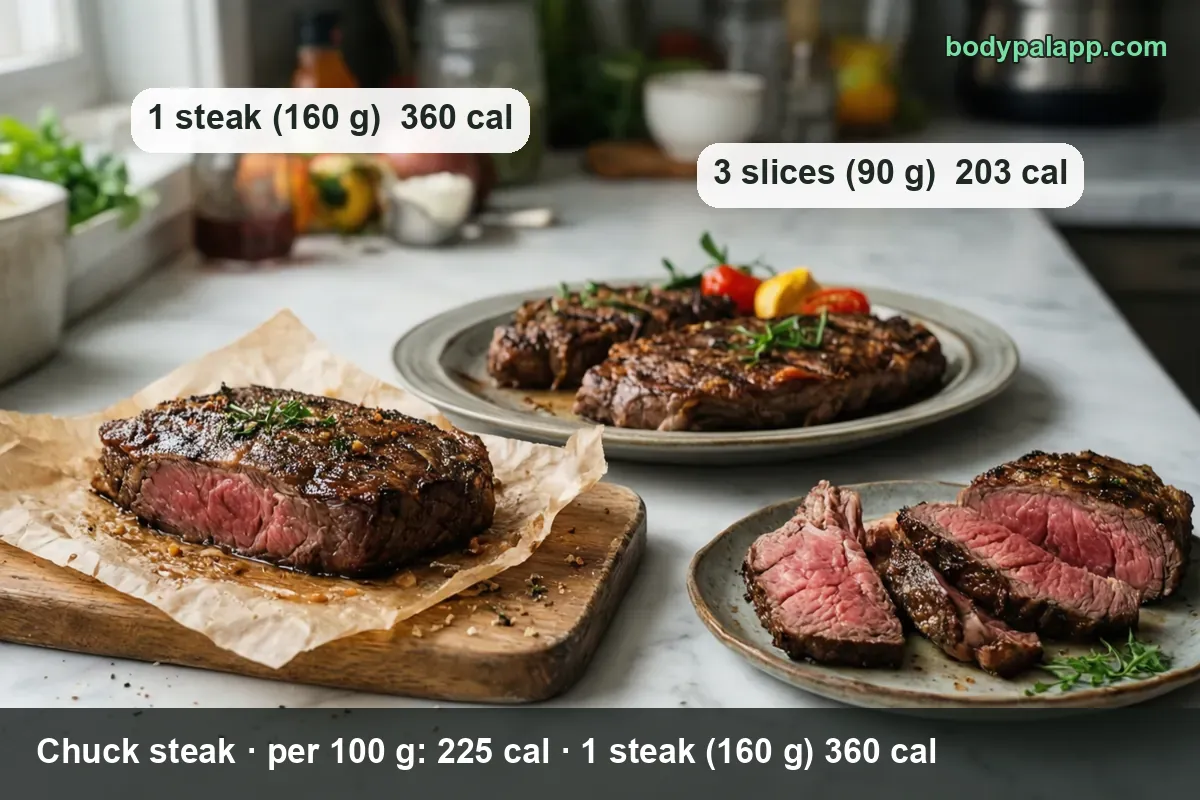
One cooked chuck steak of the regular size, 160 g on the plate, is 360 calories — 225 calories per 100 g. Carve it and eat three slices, about 90 g, and you are at 203. A 4 oz serving comes to 254. Chuck is the cheap steak at the meat counter, and the price is the only thing about it that is low: the calories in chuck steak land within eight of a lean ribeye.
On this page
- Chuck steak quick facts
- Chuck steak portions, slice by slice
- Which chuck steak did you actually buy?
- Trimming beats grading
- Raw weight and cooked weight are two different numbers
- Where the sodium comes from
- How does chuck steak compare?
- FAQ
Chuck steak quick facts
The reference on this page is the steak as it reaches the table: USDA FNDDS 2705825, "Beef, steak, chuck," from the 2021-2023 survey release. Cooked, seasoned, ready to cut. Not a raw slab on butcher paper.
| Nutrient | Per 100 g | Per 1 steak (160 g) | % Daily Value |
|---|---|---|---|
| Calories | 225 | 360 | — |
| Total fat | 13.43 g | 21.5 g | 28% |
| Saturated fat | 5.65 g | 9.0 g | 45% |
| Carbohydrate | 0.21 g | 0.3 g | 0% |
| Dietary fiber | 0 g | 0 g | 0% |
| Total sugars | 0 g | 0 g | — |
| Protein | 25.97 g | 41.6 g | 83% |
| Sodium | 380 mg | 608 mg | 26% |
% Daily Value is based on a 2,000-calorie diet.
Verified nutrition data
Numbers on this page come from USDA FoodData Central, the U.S. Department of Agriculture’s food composition database, and from manufacturer labels where a branded product is named. Last verified September 2026. How we verify our data →
Two rows pull in opposite directions, and they pull hard. Protein is enormous for a single item: 41.6 g in one steak, 83% of the FDA Daily Value, from a serving worth 18% of a 2,000-calorie day. Saturated fat is the cost of that: 9.0 g, or 45% of the day, from the same 160 g.
Two rows an American label would show are missing here, and the gap is deliberate. Added sugars and trans fat were never recorded for this beef entry, so there is nothing to print. Beef with no marinade and no coating carries no added sugar anyway, and typing a zero would report a measurement nobody made.
Around the edges of the panel: one steak carries 147 mg of cholesterol, 49% of the Daily Value, and 493 mg of potassium, about 10%.
Chuck steak portions, slice by slice
| Portion | Weight | Calories |
|---|---|---|
| One slice, any size | 30 g | 68 |
| Three carved slices | 90 g | 203 |
| 4 oz cooked | 113 g | 254 |
| One thin steak | 120 g | 270 |
| One cup, diced or chopped | 135 g | 304 |
| One regular steak | 160 g | 360 |
| One thick steak | 240 g | 540 |
The thin, regular, thick, single-slice and cup weights are USDA household portions; the three-slice and 4 oz rows are our own scaling of the same 225 calories per 100 g.
The thin-to-thick spread is the first thing worth noticing. The same cut, from the same case, is 270 calories or 540 depending only on how the butcher set the blade. Nothing about the meat changed. A thick chuck steak is two thin ones.
The cup row is the trap. "One cup, diced" sounds like a generous helping — a whole cup of beef — and it lands at 304 calories, which is fewer than one ordinary steak. A cup of diced chuck weighs 135 g; the regular steak weighs 160 g. Cups measure volume, and cubes of meat leave air between them. For anything solid and dense, weigh it in grams or ounces and leave the measuring cup in the drawer.
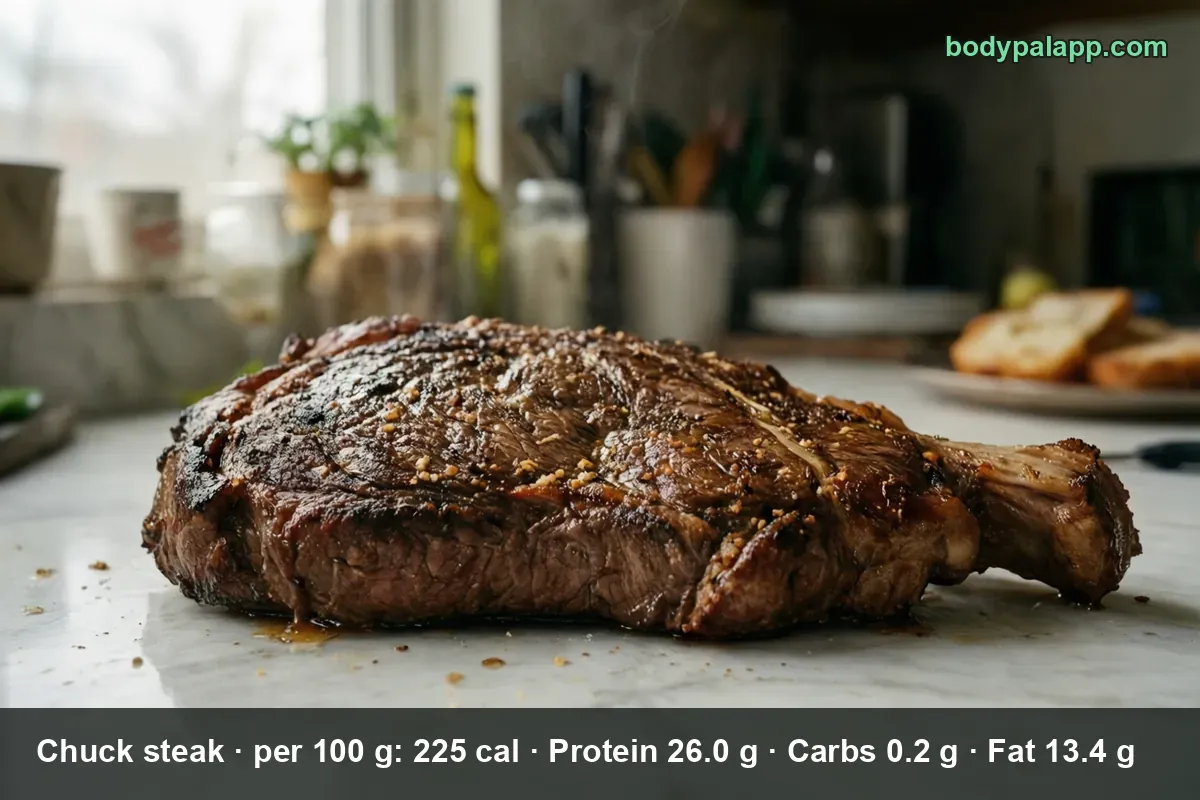
One more thing the photo above will not tell you. Every USDA chuck record is boneless, and the steak in the hero shot has its bone in. Bone is not beef. Weigh the meat off the bone, or trim the number to the meat you actually eat, otherwise a bone-in steak logs high by whatever the bone weighs.
Which chuck steak did you actually buy?
"Chuck steak" is not one steak. It is a shoulder region sold under half a dozen names, and the range between them is wider than the range between beef and pork.
| Cut and cooking | Per 100 g | Per 4 oz (113 g) |
|---|---|---|
| Mock tender steak, broiled, lean only | 159 | 180 |
| Shoulder clod (ranch) steak, grilled | 182 | 206 |
| Chuck eye steak, grilled, lean only | 209 | 236 |
| Under blade steak, braised, lean only | 219 | 247 |
| Flat iron (top blade), grilled | 222 | 251 |
| Denver cut, grilled | 227 | 257 |
| Under blade steak, braised, lean and fat | 275 | 311 |
| Chuck eye steak, grilled, lean and fat | 277 | 313 |
Every row is a separate USDA SR Legacy record, trimmed to 0 inches of fat, all grades. From the lightest to the heaviest is a 74% jump: mock tender at 159 calories per 100 g against chuck eye with the fat left on at 277.
The mock tender is the outlier worth knowing. It is a lean, cone-shaped muscle that gets sold under names promising tenderness it does not have, and it comes in around 30% below the chuck steak average. If your grocery store label says mock tender or chuck tender, log it lower.
At the other end, chuck eye earns its nickname of "poor man's ribeye" in the calorie column as much as on the plate. Untrimmed and grilled it hits 277 per 100 g, 20% above the lean ribeye in the table below.
The one-number answer of 225 per 100 g sits deliberately in the middle of that field. It is the survey figure for chuck steak as Americans actually eat it, across all these cuts and every way of cooking them. Use it when you do not know which cut you bought. Use the table when you do.
Trimming beats grading
Here is the finding that surprised me most in the USDA rows, and it runs against the way beef is marketed.
Take chuck eye steak, raw. Lean only is 153 calories per 100 g. Lean and fat, the identical cut with the visible fat left on, is 223. That is a 46% difference bought with a knife.
Now take the same cut and change the grade instead of the trim. Choice is 160 calories per 100 g, Select is 143. A 12% difference — and grade is the thing on the sticker, the thing you pay extra for.
So the marbling tier printed on the package moves your calorie number by about a tenth. Five minutes with a paring knife moves it by nearly half. If you are watching the number, buy whatever grade is on sale and spend the effort on trimming.
That matters most for the saturated fat row. The Dietary Guidelines for Americans put the ceiling for saturated fat at under 10% of daily calories, and the Daily Value on the label is 20 g. One 160 g chuck steak spends 9.0 g of it. Trimmed chuck eye, lean only and grilled, carries 4.83 g per 100 g against 8.66 g untrimmed — the knife nearly halves that row too.
Raw weight and cooked weight are two different numbers
This is the single biggest source of wrong beef entries in any food log, and it has nothing to do with the database.
A raw boneless chuck steak, lean only, is 140 calories per 100 g. The same beef cooked runs 209 to 277 per 100 g depending on the cut and the trim. Meat does not gain calories in the pan. It loses water — a quarter of its weight or more — so what is left is the same energy packed into fewer grams.
The practical rule is simple and it is the one thing to take away from this page: match the weight to the number. Weigh the steak on the cutting board before it cooks, use a raw figure. Weigh it on the plate, use 225.
Mixing the two is how an 8 oz raw chuck steak, which is about 318 calories as lean raw beef, gets logged at 511 by pairing raw grams with a cooked-per-100 g number. That is a 193-calorie error on one steak, and it repeats every time you cook.
Where the sodium comes from
Raw chuck steak runs 60 to 83 mg of sodium per 100 g. The cooked survey figure is 380 mg. Beef does not manufacture sodium in a hot pan, so the roughly 300 mg difference per 100 g is entirely what went on it: salt, rub, marinade, a pat of salted butter at the end.
That works out to 608 mg in one steak, or 26% of the Daily Value — about a quarter teaspoon of table salt. The CDC puts most of American sodium intake in packaged and restaurant food rather than the shaker, and a home-cooked steak is one of the rare places where the shaker really is the whole story.
Which makes it the easiest row on the page to move. Season the steak after searing rather than before, or salt the surface and skip the finishing butter, and the sodium column falls without touching a single calorie. Nothing else on this page responds that well to one change.
The protein side needs no adjusting at all. MyPlate counts a cooked ounce of beef as one ounce-equivalent from the protein foods group, and a regular chuck steak is nearly six of them in one item.
How does chuck steak compare?
| Steak, cooked | Per 100 g | Per 1 steak (160 g) | Protein per steak |
|---|---|---|---|
| Chuck | 225 | 360 | 41.6 g |
| Ribeye, lean only | 230 | 368 | 42.4 g |
| T-bone, lean only | 230 | 368 | 43.4 g |
| Sirloin, lean only | 216 | 346 | 44.9 g |
All four are survey figures for the same 160 g steak, so the middle column compares like for like. And it demolishes the assumption chuck is bought on.
Chuck is the budget cut. It is not the light cut. Eight calories separate it from a lean ribeye and eight from a lean T-bone; it sits 4% above sirloin. Anyone switching from ribeye to chuck to save calories is saving about 2%, which is inside the noise of how thick the butcher cut it.
Our take: if the calorie number is what you are managing, sirloin is the pick — lowest calories, highest protein per steak, 346 for 44.9 g. If you are managing the grocery bill, chuck is the pick and costs you almost nothing in calories to choose. What actually decides your total is the trim and the thickness, not the name on the label. A trimmed chuck steak beats an untrimmed ribeye by a distance no cut-versus-cut comparison can close.
Chuck steak FAQs
How many calories are in a chuck steak?
A regular cooked chuck steak of 160 g is 360 calories, from 225 calories per 100 g. A thin 120 g steak comes to 270 and a thick 240 g steak reaches 540. Three carved slices, about 90 g, are 203 calories.
How many calories are in a 4 oz chuck steak?
254 calories for 4 oz (113 g) of cooked chuck steak, carrying 29.3 g of protein and 15.2 g of fat. If you weighed the steak raw at 4 oz instead, lean boneless chuck is 140 calories per 100 g, so the same 113 g is 158 calories.
Does chuck steak have more calories cooked or raw?
Cooked, and by a wide margin per 100 g: 225 calories cooked against 140 raw for lean boneless chuck. The beef gains nothing in the pan; it loses water, so the same meat weighs less and concentrates. Weigh it raw, use a raw figure. Weigh it on the plate, use 225.
How much protein is in chuck steak?
41.6 g in a 160 g cooked steak, which is 83% of the Daily Value in one item, or 25.97 g per 100 g. Braised under blade chuck trimmed lean is denser still at 31.35 g per 100 g, and braised mock tender tops the chuck cuts at 33.31 g.
Chuck steak or ribeye - which has fewer calories?
Chuck, by five calories per 100 g: 225 against 230 for lean ribeye. On the same 160 g steak that is 360 calories against 368, a gap of eight. The two are close enough that the cut barely matters next to how thick the steak was cut and how much fat was trimmed.
How many calories are in a chuck eye steak?
209 calories per 100 g grilled with the fat trimmed off, or 236 in a 4 oz serving. Left untrimmed, the same chuck eye runs 277 per 100 g and 313 for 4 oz. Chuck eye is the fattiest of the common chuck cuts, which is why it gets called the poor man's ribeye.
Is chuck steak healthy?
One 160 g steak delivers 41.6 g of protein, 83% of the Daily Value, alongside 9.0 g of saturated fat at 45% and 147 mg of cholesterol at 49%. Trimming the visible fat, or picking a leaner chuck cut such as shoulder clod at 182 calories per 100 g, lowers the second pair without touching the first.
How many calories are in a whole chuck steak?
Between 270 and 540 calories, set entirely by thickness: 270 for a thin 120 g steak, 360 for the regular 160 g, 540 for a thick 240 g cut. Weigh the meat off the bone before logging, because every USDA chuck record is boneless and bone adds weight without adding calories.
Similar foods
- Leg Of Lamb — 191 cal per 3 oz
- Lamb Shank — 605 cal per shank
- Pork Barbecue — 542 cal per cup
- Chicken Shawarma — 190 cal for 3 oz sliced
- Turkey Kielbasa — 127 cal for 2 oz serving
- Pork Egg Roll — 193 cal per egg roll
Count it without the math
Point the camera at the steak and BodyPal logs the calories, the protein and the sodium in one shot.


How long does it take to burn off chuck steak?
One regular steak, 160 g is 360 kcal. Enter your weight and the amount you ate to see how long it takes you to burn that off:
lb
| Activity | Time to burn 360 kcal |
|---|---|
| Walking, brisk | 1 hr 12 min |
| Cycling, moderate | 45 min |
| Swimming, moderate | 51 min |
| Jogging | 42 min |
| Weight training, moderate | 1 hr 20 min |
Times are for a 155 lb adult at a steady pace; change the weight to see yours. The amount is set to the portion in the text (160 g); change it to what you actually ate. BodyPal works this out from your steps automatically.
This table assumes you know your daily total. If you do not, the daily calorie calculator works it out from five numbers.