
How many calories are in a pork egg roll?
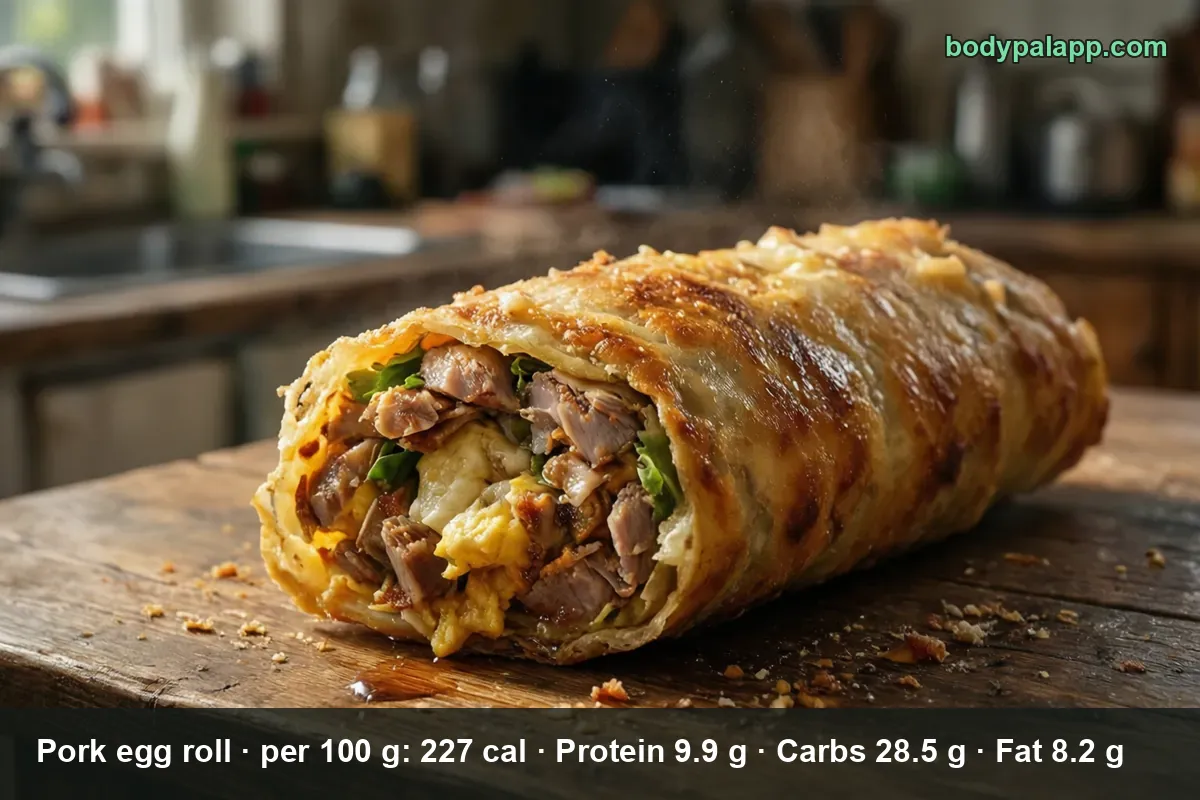
One store-bought pork egg roll weighs 85 g and carries 193 calories. Per 100 g the same roll runs 227 calories, which is lighter than almost anything else that comes out of a Chinese takeout container. The wrapper does most of the damage: 24.2 g of carbohydrate against 8.4 g of protein.
On this page
- Pork egg roll quick facts
- US servings, from one ounce to two rolls
- Takeout, chicken, shrimp and meatless rolls
- Sodium is the row to watch, not fat
- How does a pork egg roll compare?
- Most popular pork egg roll brands
- Pork egg roll FAQs
Pork egg roll quick facts
The reference row here is SR Legacy 172103, "Egg rolls, pork, refrigerated, heated". It is the only non-branded USDA entry built specifically around a pork egg roll, and its household measure — one roll, 85 g — matches what is actually in the freezer case, where boxed rolls weigh 77 to 86 g apiece. It is also the roll most people are holding: heated at home in an oven, air fryer or microwave rather than dropped in restaurant oil.
Two rows that appear on a US Nutrition Facts panel are missing from this record. Added sugars and trans fat are not published in the SR Legacy edition, so those lines are left out rather than guessed at. Cholesterol and potassium are published: 12 mg and 180 mg per roll, which is 4% of the Daily Value for each.
| Nutrient | Per 100 g | Per 1 egg roll (85 g) | % Daily Value |
|---|---|---|---|
| Calories | 227 | 193 | — |
| Total fat | 8.18 g | 7.0 g | 9% |
| Saturated fat | 1.65 g | 1.4 g | 7% |
| Carbohydrate | 28.49 g | 24.2 g | 9% |
| Dietary fiber | 0 g | 0 g | 0% |
| Total sugars | 1.67 g | 1.4 g | — |
| Protein | 9.94 g | 8.4 g | 17% |
| Sodium | 407 mg | 346 mg | 15% |
% Daily Value is based on a 2,000-calorie diet.
Verified nutrition data
Numbers on this page come from USDA FoodData Central, the U.S. Department of Agriculture’s food composition database, and from manufacturer labels where a branded product is named. Last verified September 2026. How we verify our data →
The shape of that table is worth a second look. Fat is modest at 9% of the Daily Value, protein is the highest percentage on the list at 17%, and sodium follows at 15%, well ahead of the fat line. That ordering is the opposite of what most people expect from a fried-looking food, and it holds because the reference roll is heated, not submerged in oil.
US servings, from one ounce to two rolls
| Serving | Weight | Calories |
|---|---|---|
| 1 oz | 28 g | 64 kcal |
| One egg roll, store size | 85 g | 193 kcal |
| 4 oz | 113 g | 257 kcal |
| Two egg rolls | 170 g | 386 kcal |
| Per 100 g | 100 g | 227 kcal |
Only the 85 g roll is a USDA household measure. The 4 oz portion, the two-roll line and the ounce are our own arithmetic from the USDA 100 g figure, scaled straight from 227 calories per 100 g rather than lifted from a USDA serving.
There is one measuring trap here that costs people real calories. Chopped egg roll measured by the cup is not the same food as a whole roll: the FNDDS cup of restaurant egg roll weighs 125 g, which works out to 340 calories at that record's 272 per 100 g. A whole 64 g takeout roll is 174. Cutting the roll up and scooping it into a measuring cup nearly doubles the number, because a cup of dense fried pastry packs far more mass than the single piece it came from. Log rolls by the piece, or weigh them.
Takeout, chicken, shrimp and meatless rolls
| Version | Per 100 g | Typical piece | Calories |
|---|---|---|---|
| Store pork roll, heated | 227 kcal | one roll, 85 g | 193 kcal |
| Takeout roll, beef and/or pork | 272 kcal | one roll, 64 g | 174 kcal |
| Chicken or turkey egg roll | 266 kcal | one roll, 85 g | 226 kcal |
| Shrimp egg roll | 258 kcal | one roll, 85 g | 219 kcal |
| Meatless (vegetable) egg roll | 270 kcal | one roll, 85 g | 230 kcal |
| Fried pork wonton or pot sticker | 192 kcal | one piece, 85 g | 163 kcal |
| Steamed bao bun | 273 kcal | one bun, 85 g | 232 kcal |
Every 85 g figure in that table except the first is our arithmetic from the matching USDA 100 g row; the 64 g takeout roll is USDA's own household measure for that record.
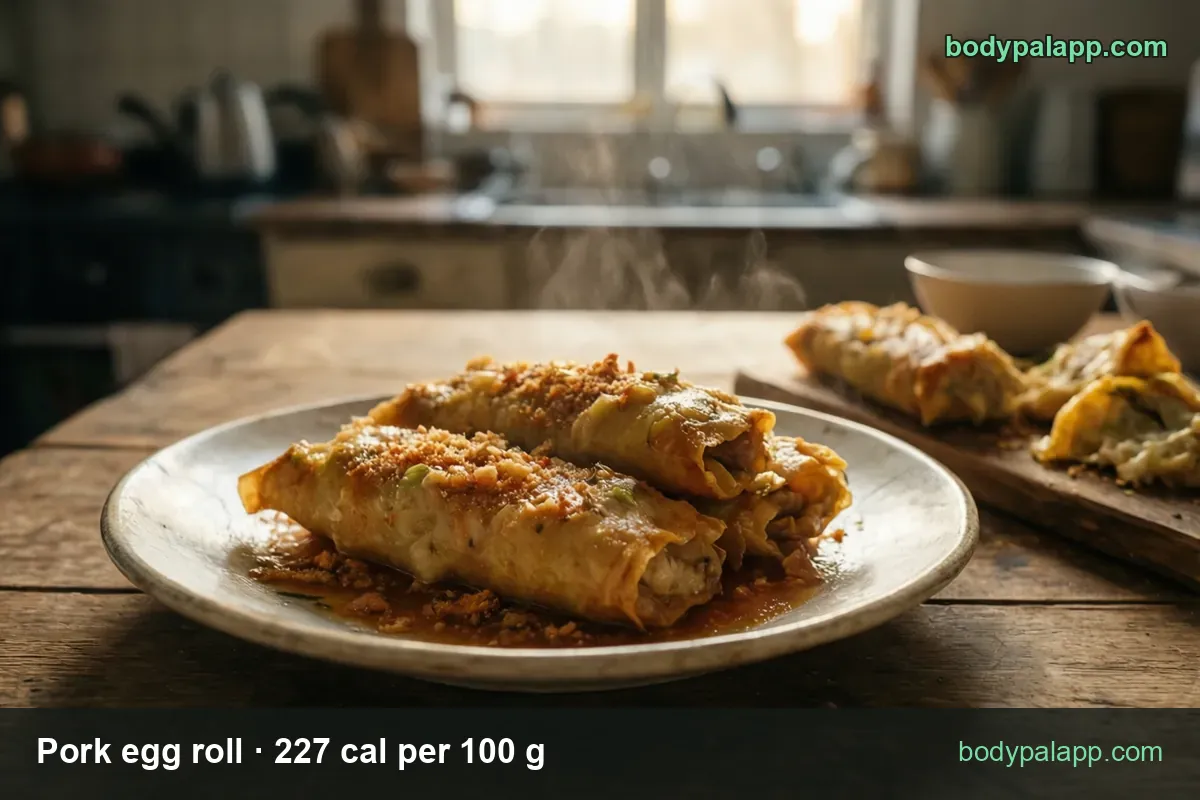
The single most useful line is the gap between the first two. Heated store roll, 227 per 100 g. Restaurant roll from the fryer, 272. That 45-calorie difference is oil absorbed by the wrapper, not a difference in filling or in how USDA measured it — scaled to the same 85 g roll it is 193 against 231. Filling matters far less than people assume: dropping the pork for vegetables actually raises the number to 270 per 100 g, because the meatless roll is still deep-fried and loses the pork's protein without losing any wrapper.
The wonton is the outlier worth knowing. At 192 calories per 100 g it is the lightest thing on the list, and it gets there by having less dough per bite than a rolled wrapper. The steamed bao bun is the opposite lesson: steaming skips the fryer entirely, yet at 273 per 100 g it is the densest item here, because the bun is nearly all soft bread.
Frozen supermarket boxes track the reference row reasonably well. Across the major national brands in the USDA Branded database, labeled rolls run from 143 to 233 calories per 100 g, or 110 to 200 calories for a single roll depending on whether a sauce packet is counted in the serving. If the box is already in the trash, 193 for an 85 g roll is a fair default.
Sodium is the row to watch, not fat
Seven grams of fat per roll is a non-event. The sodium line is not. One roll is 346 mg, 15% of the FDA's 2,300 mg Daily Value, and two rolls come to 692 mg — 30% of the day's sodium before any soy sauce, dipping sauce or fried rice arrives. The Dietary Guidelines for Americans put the same 2,300 mg figure as the limit for adults, and most Americans are already over it. If you are watching sodium, the appetizer order is the thing to shrink, not the entree.
That roll is about a sixth of a teaspoon of table salt, which sounds trivial and is exactly why it slips past people two and three rolls at a time.
The other number that changes how the roll behaves is 0 g of fiber. The USDA row lists none at all, so 24.2 g of carbohydrate arrives with nothing to slow it down. The protein does help: 8.4 g is 17% of the Daily Value, which puts one roll in the same protein territory as a large egg and makes it a genuine contributor to the MyPlate protein foods group rather than pure filler. If you want the roll to hold you, pair it with something that has fiber — a plain vegetable side does the job the wrapper cannot.
How does a pork egg roll compare?
| Roll | Per 100 g | US serving | Calories |
|---|---|---|---|
| Pork egg roll, heated | 227 kcal | one roll, 85 g | 193 kcal |
| Beef and/or pork, takeout | 272 kcal | one roll, 64 g | 174 kcal |
| Chicken or turkey egg roll | 266 kcal | one roll, 85 g | 226 kcal |
| Shrimp egg roll | 258 kcal | one roll, 85 g | 219 kcal |
Our take: the pork roll is the lightest of these four per gram, at 227 calories per 100 g against 258, 266 and 272 for the others, and that is the number to trust when you are comparing foods. The takeout roll shows the smallest per-serving figure at 174, but only because USDA's household roll for that record weighs 64 g — a smaller piece of a heavier food. Swapping pork for shrimp or chicken to save calories does not work; both are denser than the pork row, because they are fried and it is not. If you want a lighter plate, order fewer rolls or take the steamed dumplings instead of chasing the filling.
Most popular pork egg roll brands in the United States
Ranked by how widely each product appears among foods sold in the United States, from the BodyPal food database of over 3.3 million products. Calories are the figures printed on each Nutrition Facts label, checked against USDA FoodData Central.
| Product | Calories (per 100 g) |
|---|---|
| Pagoda Pork Egg Rolls | 231 cal |
| Crav'n Flavor Pork Egg Rolls | 233 cal |
| Minh Pork Egg Rolls | 231 cal |
| H-E-B Pork Egg Rolls | 224 cal |
| Chung's Pork Egg Rolls | 198 cal |
| Great Value Pork Egg Rolls | 143 cal |
Brand popularity: BodyPal food database. Nutrition: manufacturer labels / USDA FoodData Central.
Pork egg roll FAQs
How many calories are in one pork egg roll?
One store-bought pork egg roll weighs 85 g and carries 193 calories, since the USDA row runs 227 calories per 100 g. That single roll brings 8.4 g of protein, 24.2 g of carbohydrate, 7 g of fat and 346 mg of sodium. A restaurant roll straight out of the fryer is denser, at 272 calories per 100 g.
How many calories are in 2 pork egg rolls?
Two rolls come to 386 calories, our own arithmetic from the USDA 100 g figure rather than a USDA serving. The pair also carries 692 mg of sodium, 30% of the Daily Value, plus 16.8 g of protein and 48.4 g of carbohydrate. Two fried takeout rolls of the same 85 g size would land nearer 462.
Are pork egg rolls high in sodium?
One roll delivers 346 mg of sodium, 15% of the 2,300 mg Daily Value, and the plain 100 g figure is 407 mg. Sodium is the row that moves fastest here: two rolls reach 30% of the day's limit before any dipping sauce, soy sauce or side of fried rice joins them.
How much protein is in a pork egg roll?
A single 85 g roll holds 8.4 g of protein, 17% of the 50 g Daily Value, from the pork and egg in the filling. Per 100 g the figure is 9.94 g, ahead of the meatless roll at 5.62 g and the takeout beef-and-pork roll at 7.58 g per 100 g.
How many carbs are in a pork egg roll?
One roll carries 24.2 g of carbohydrate, 9% of the Daily Value, from 28.49 g per 100 g. Almost all of it is wrapper starch and cabbage: total sugars are only 1.4 g per roll, and the USDA row lists 0 g of dietary fiber, so nothing slows those carbs down.
Are baked egg rolls lower in calories than fried?
USDA has no separate baked row, so the closest honest comparison is the refrigerated roll heated through at 227 calories per 100 g against the deep-fried restaurant roll at 272. On a matched 85 g roll that is 193 versus 231 calories. The 38-calorie gap is frying oil in the wrapper, nothing else.
How many calories are in a frozen pork egg roll?
Frozen supermarket rolls label between 110 and 200 calories each, and their per-100 g figures run from 143 to 233. The USDA reference row sits in the middle of that range at 227 per 100 g, so 193 calories for an 85 g roll is a reasonable default once the box has gone in the trash.
Which has fewer calories, a pork or a shrimp egg roll?
The pork roll is lighter: 227 calories per 100 g against 258 for the shrimp version. Scaled to the same 85 g roll, that is 193 calories versus 219. The catch is that the pork row is a store roll heated through while the shrimp row is deep-fried, so the fryer explains most of the 26-calorie gap.
Similar foods
- Pork Barbecue — 542 cal per cup
- Chicken Shawarma — 190 cal for 3 oz sliced
- Turkey Kielbasa — 127 cal for 2 oz serving
- Chuck Steak — 360 cal per steak
- Leg Of Lamb — 191 cal per 3 oz
- Lamb Shank — 605 cal per shank
Count it without the math
Point the camera at the plate and BodyPal counts the rolls for you, sauce packet and all.


How long does it take to burn off 193 kcal of pork egg roll?
One egg roll (85 g) is 193 kcal. Enter your weight and the amount you ate to see how long it takes you to burn that off:
lb
| Activity | Time to burn 193 kcal |
|---|---|
| Walking, brisk | 39 min |
| Cycling, moderate | 24 min |
| Swimming, moderate | 28 min |
| Jogging | 23 min |
| Weight training, moderate | 43 min |
Times are for a 155 lb adult at a steady pace; change the weight to see yours. The amount is set to the portion in the text (85 g); change it to what you actually ate. BodyPal works this out from your steps automatically.
Want the bigger picture? Calculate your daily calorie needs — your maintenance figure, a target for losing or gaining, and the date you get there.