
How many calories are in turkey kielbasa?
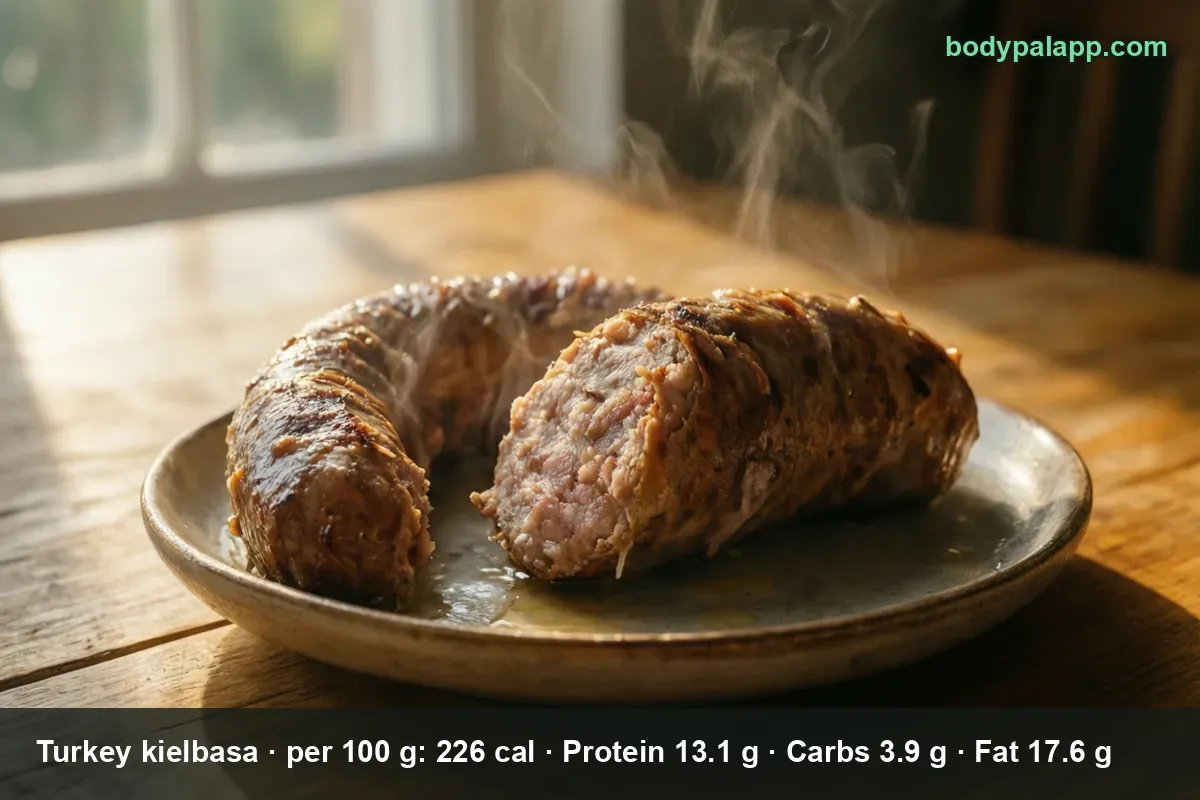
A 2 oz serving of smoked turkey kielbasa, the portion printed on almost every rope in the meat case, carries 127 calories. Per 100 g the same sausage runs 226 calories, with 13.1 g of protein and 17.6 g of fat. The fat, not the meat, is doing most of the work here.
On this page
- Turkey kielbasa quick facts
- US servings from one ounce to the whole rope
- Store ropes are lighter than the USDA row
- Sodium is the row to watch
- How does turkey kielbasa compare?
- Most popular turkey kielbasa brands
- Turkey kielbasa FAQs
Turkey kielbasa quick facts
The row behind these numbers is SR Legacy 174607, "Kielbasa, Polish, turkey and beef, smoked". It is the only generic USDA entry for smoked turkey kielbasa, and it is the only one that ships with a household measure of 2 oz — the same serving size printed on the store ropes people actually buy. It describes the sausage as sold: already smoked, already cooked, ready to slice.
One thing worth saying out loud before you log it: that record is turkey and beef, not pure turkey. Most supermarket ropes today are all turkey, and they land lower. The variants section below has those numbers.
| Nutrient | Per 100 g | Per 2 oz serving (56 g) | % Daily Value |
|---|---|---|---|
| Calories | 226 | 127 | — |
| Total fat | 17.6 g | 9.9 g | 13% |
| Saturated fat | 6.23 g | 3.5 g | 17% |
| Carbohydrate | 3.9 g | 2.2 g | 1% |
| Dietary fiber | 0 g | 0 g | 0% |
| Total sugars | 0 g | 0 g | — |
| Protein | 13.1 g | 7.3 g | 15% |
| Sodium | 1200 mg | 672 mg | 29% |
| Cholesterol | 70 mg | 39 mg | 13% |
% Daily Value is based on a 2,000-calorie diet.
Verified nutrition data
Numbers on this page come from USDA FoodData Central, the U.S. Department of Agriculture’s food composition database, and from manufacturer labels where a branded product is named. Last verified September 2026. How we verify our data →
Three label lines are missing from the table on purpose. USDA's SR Legacy edition of this record does not publish added sugars, trans fat or potassium at all, so there is nothing to report rather than a zero to invent. Total sugars are a flat 0 g, which is why the sugar cell has no percentage next to it — total sugars have no Daily Value under the FDA rules. Percentages here follow the FDA Daily Values for a 2,000-calorie day.
US servings from one ounce to the whole rope
| Serving | Weight | Calories |
|---|---|---|
| 1 oz, two thin coins | 28 g | 63 kcal |
| 2 oz serving, USDA household measure | 56 g | 127 kcal |
| 3 oz sliced, a diner-style side | 85 g | 192 kcal |
| 4 oz link, one dinner portion | 113 g | 255 kcal |
| 14 oz rope, the whole package | 397 g | 897 kcal |
| Per 100 g | 100 g | 226 kcal |
Only the 2 oz line is a USDA serving. The 1 oz, 3 oz, 4 oz and full-rope figures are our own arithmetic from the USDA 100 g value, not USDA servings, so treat them as clean scaling rather than measured entries.
The trap in this food is the gap between the printed serving and the way people eat it. A 14 oz rope sliced into a skillet with peppers and onions is one dinner for two, which puts roughly 449 calories of sausage on each plate before anything else goes in the pan. Cut two to four coins for a snack and you are at 63 to 127 calories, which is a different food entirely. Weigh it once and you will never have to guess again.
Store ropes are lighter than the USDA row
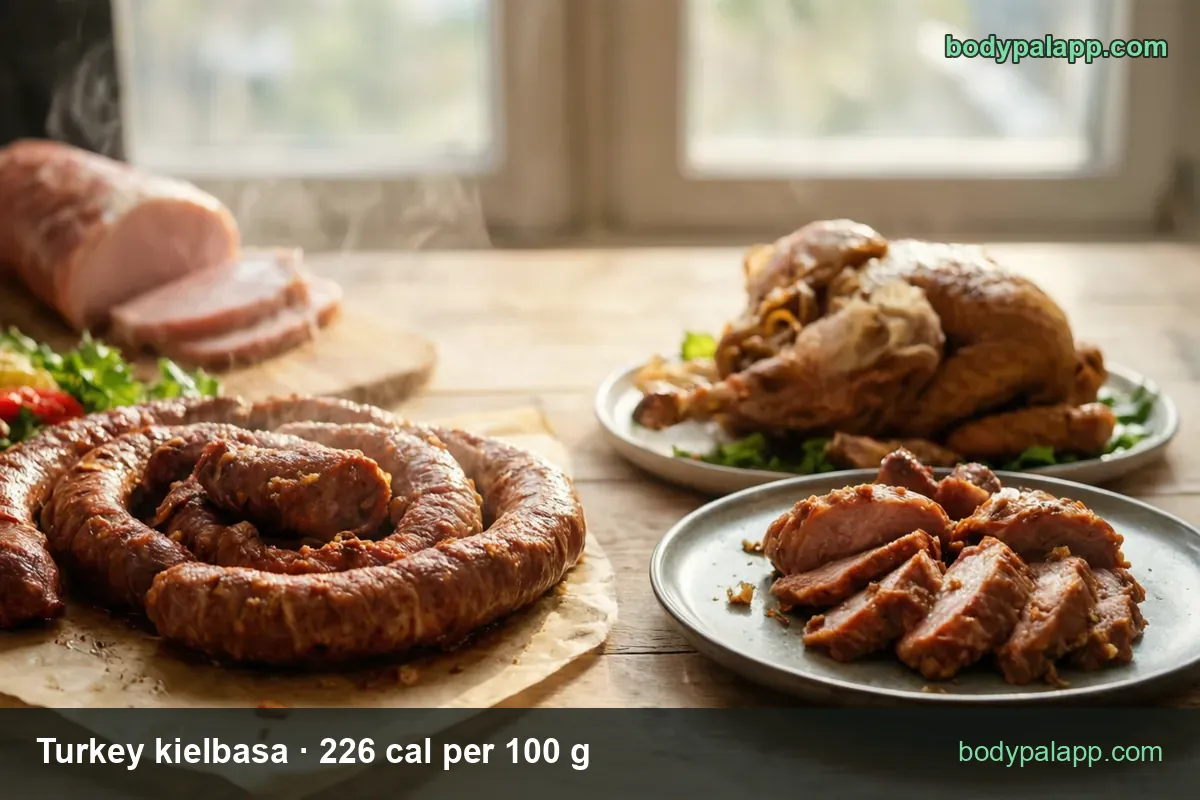
This is where the generic number and the label in your hand part ways. Every rope below is a straight turkey product, and every one of them is lighter per 100 g than USDA's turkey-and-beef entry at 226.
| Version | Per 100 g | Typical serving | Calories |
|---|---|---|---|
| USDA generic, turkey and beef, smoked | 226 kcal | 2 oz (56 g) | 127 kcal |
| Jennie-O Hardwood Smoked | 161 kcal | 2 oz (56 g) | 90 kcal |
| Market Pantry Hardwood Smoked | 161 kcal | 2 oz (56 g) | 90 kcal |
| Garrett Valley Farms Smoked Fresh | 196 kcal | 2 oz (56 g) | 110 kcal |
| Open Nature Wood Smoked Fresh | 196 kcal | 2 oz (56 g) | 110 kcal |
| ShopRite Turkey Kielbasa | 125 kcal | 2 oz (56 g) | 70 kcal |
ShopRite's rope is the lightest of the five at 125 calories per 100 g, about 45% below the generic USDA figure, and Jennie-O and Market Pantry share the same 161. Two brands sit in the middle at 196. In practice that means a 2 oz serving of turkey kielbasa in the United States is anywhere from 70 to 127 calories depending on which package came home with you — a spread of 57 calories on a food most people log as a single number.
The rule of thumb: if the package is in front of you, trust the package. Use the USDA row when you are eating deli kielbasa with no label, or when a recipe just says "kielbasa" and you have no idea whose it was.
Sodium is the row to watch
Calories are not the interesting story in this sausage. Sodium is. One 2 oz serving carries 672 mg, which is 29% of the 2,300 mg Daily Value — roughly a quarter teaspoon of table salt in two ounces of meat. Eat two servings, a perfectly ordinary dinner portion of about 4 oz, and you are at 1,344 mg for 254 calories. That is more than half a day's sodium from a plate component that has not filled anyone up yet. The CDC's sodium pages put most of the country's intake in exactly this category: processed and packaged meats, not the salt shaker.
The second number people misread is protein. "Turkey" reads lean, and the label does not agree: 7.3 g of protein per serving is 15% of the Daily Value, while 9.9 g of fat is 13% and 3.5 g of that is saturated, at 17%. Run the arithmetic on the 100 g row and fat supplies about 158 of the 226 calories, roughly 70% of the energy. Turkey kielbasa is a smoked, emulsified sausage that happens to be made of poultry, and it prices like one.
None of this makes it a food to avoid. It makes it a food to portion. If you are watching sodium, the 2 oz serving with a big pile of vegetables is the better build; if you want protein per calorie, chicken breast or a lean cut will beat it comfortably. The Dietary Guidelines for Americans frame it the same way — room for it, inside a pattern.
How does turkey kielbasa compare?
| Sausage | Per 100 g | Protein per 100 g | US serving | Calories |
|---|---|---|---|---|
| Turkey kielbasa, smoked | 226 kcal | 13.1 g | 2 oz (56 g) | 127 kcal |
| Turkey frankfurter | 223 kcal | 12.23 g | 2 oz (56 g) | 125 kcal |
| Berliner, pork and beef | 230 kcal | 15.27 g | 2 oz (56 g) | 129 kcal |
| Bologna, beef and pork, low fat | 230 kcal | 11.5 g | 2 oz (56 g) | 129 kcal |
Our take: swapping between these four is not a calorie decision. All four sit within 7 calories of each other per 100 g, and within 4 calories on a 2 oz serving — the turkey frankfurter is the only one that comes in under kielbasa, by two calories on the plate. Protein is where they separate: the pork-and-beef Berliner leads at 15.27 g per 100 g, and the low-fat bologna trails at 11.5 g while carrying the most fat of the group at 19.3 g, which is a good reminder that "low fat" on a package is a claim about the original recipe, not about the category. If you like kielbasa, eat kielbasa and control the slice count. Choosing a different smoked sausage to save calories is effort spent for nothing.
Most popular turkey kielbasa brands in the United States
Ranked by how widely each product appears among foods sold in the United States, from the BodyPal food database of over 3.3 million products. Calories are the figures printed on each Nutrition Facts label, checked against USDA FoodData Central.
| Product | Calories (per 100 g) |
|---|---|
| Jennie-O Hardwood Smoked Turkey Kielbasa | 161 cal |
| Garrett Valley Farms Smoked Fresh Turkey Kielbasa | 196 cal |
| Market Pantry Hardwood Smoked Turkey Kielbasa | 161 cal |
| Open Nature Wood Smoked Fresh Turkey Kielbasa | 196 cal |
| ShopRite Turkey Kielbasa | 125 cal |
Brand popularity: BodyPal food database. Nutrition: manufacturer labels / USDA FoodData Central.
Turkey kielbasa FAQs
How many calories are in turkey kielbasa?
226 calories per 100 g, or 127 calories in the standard 2 oz (56 g) serving, using USDA's smoked turkey-and-beef kielbasa record. A full 14 oz rope works out to about 897 calories. Store brands made from straight turkey run lighter, between 125 and 196 calories per 100 g.
How many calories are in 2 oz of turkey kielbasa?
127 calories in 2 oz (56 g), the USDA household serving and the size printed on most packages. One ounce is 63 calories, a 3 oz side is 192, and a 4 oz link is 255. Everything except the 2 oz line is our own scaling of the USDA 100 g figure.
How much sodium is in turkey kielbasa?
672 mg in a 2 oz serving, which is 29% of the 2,300 mg Daily Value, and 1,200 mg per 100 g. Two servings reach 1,344 mg for only 254 calories. That is about a quarter teaspoon of table salt in each two-ounce portion, so sodium hits its limit long before calories do.
How much protein is in turkey kielbasa?
7.3 g of protein in a 2 oz serving, 15% of the Daily Value, and 13.1 g per 100 g. Fat outweighs it: 9.9 g per serving, of which 3.5 g is saturated. Fat supplies roughly 70% of the calories in this sausage, so poultry does not make it a lean protein source.
Is turkey kielbasa healthier than pork kielbasa?
The gap is smaller than the name suggests. USDA's kielbasa entry is already turkey and beef at 226 calories per 100 g, and the nearest pork-and-beef sausage in the same dataset, Berliner, is 230 with more protein at 15.27 g. We have no straight pork kielbasa record to quote, so we will not guess one.
How many calories are in Jennie-O turkey kielbasa?
90 calories in a 2 oz (56 g) serving, or 161 calories per 100 g, per the USDA Branded entry for the hardwood smoked rope. That is 37 calories less per serving than the generic USDA figure. Target's Market Pantry rope matches it exactly at 161 per 100 g.
Is turkey kielbasa already cooked?
Yes. The USDA record is for smoked kielbasa, which is fully cooked at the plant and safe to eat cold at 226 calories per 100 g. Heating it in a skillet is about texture, not safety. Fresh, uncooked turkey kielbasa exists but is sold clearly labeled and needs to be cooked through.
Does cooking change turkey kielbasa calories?
Not the total. Two ounces is 127 calories whether you eat it cold or pan-fry it, because the sausage is already cooked and nothing is added. Searing drives off some water, so 100 g of browned slices can test slightly denser than 226 calories. Any oil in the pan does count.
Similar foods
- Pork Barbecue — 542 cal per cup
- Chicken Shawarma — 190 cal for 3 oz sliced
- Chuck Steak — 360 cal per steak
- Leg Of Lamb — 191 cal per 3 oz
- Lamb Shank — 605 cal per shank
- Pork Egg Roll — 193 cal per egg roll
Count it without the math
Point the camera at the plate and BodyPal counts the slices for you, rope or coins.


How long does it take to burn off 127 kcal of turkey kielbasa?
A 2 oz serving (56 g) is 127 kcal. Enter your weight and the amount you ate to see how long it takes you to burn that off:
lb
| Activity | Time to burn 127 kcal |
|---|---|
| Walking, brisk | 25 min |
| Cycling, moderate | 16 min |
| Swimming, moderate | 18 min |
| Jogging | 15 min |
| Weight training, moderate | 28 min |
Times are for a 155 lb adult at a steady pace; change the weight to see yours. The amount is set to the portion in the text (56 g); change it to what you actually ate. BodyPal works this out from your steps automatically.
Want the bigger picture? Calculate your daily calorie needs — your maintenance figure, a target for losing or gaining, and the date you get there.