
How many calories are in pork barbecue?
A 1-cup serving of barbecue pork with sauce weighs 240 g and carries 542 calories. Per 100 g the same dish runs 226 calories, with 17.57 g of protein and 603 mg of sodium. Sauce is why the number moves: it dilutes the meat, then loads the plate with sugar and salt.
On this page
- Pork barbecue quick facts
- US servings, from one ounce to a full cup
- Sauce or no sauce, and what a cup really weighs
- Sandwiches, deli loaf and barbecue pork skins
- Protein wins the cup, sodium takes it back
- How does pork barbecue compare?
- Most popular pork barbecue brands
- FAQ
Pork barbecue quick facts
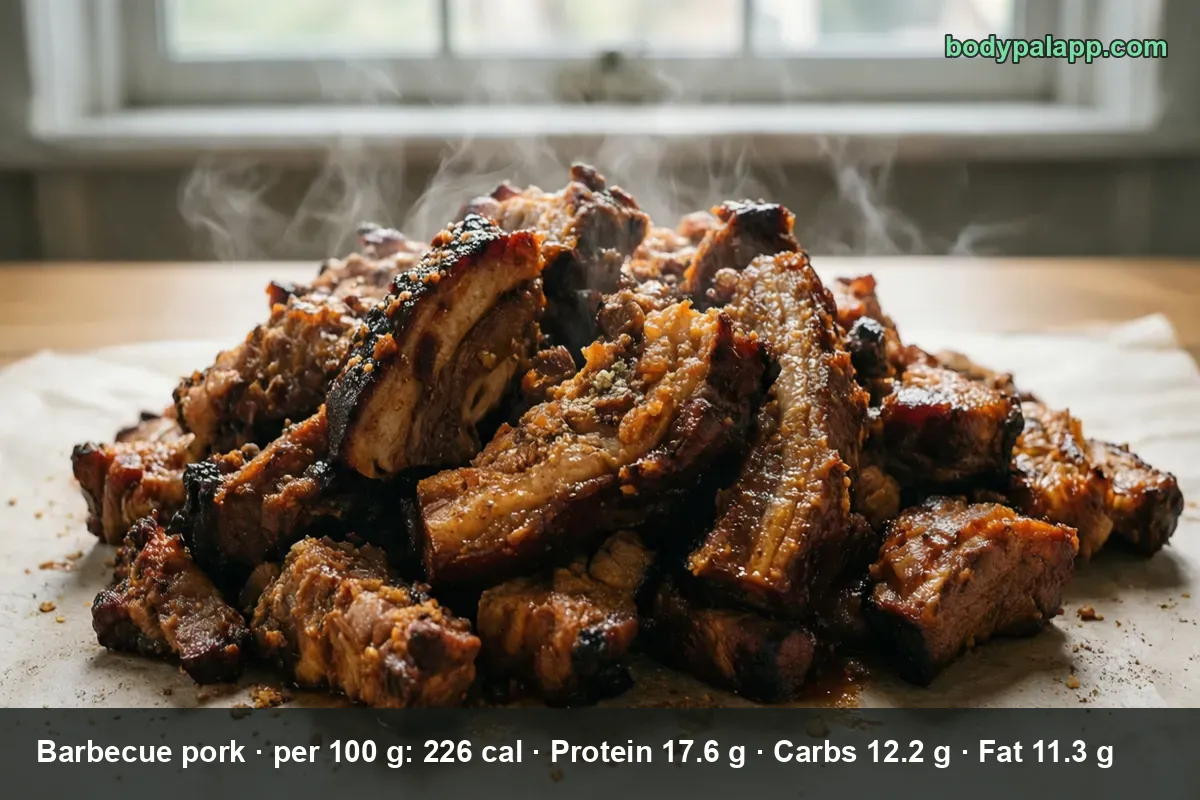
The row behind every number here is FNDDS 2706399, "Barbecue pork, with sauce", from the 2021-2023 survey release. That is glazed, sauced pork served on its own — sliced, chopped or pulled — which is what most people mean when they say pork barbecue and what sits on the paper in the photo above. Sandwich records measure bread plus meat, so they live further down the page as their own sections rather than getting blended into this table.
Two label lines are missing on purpose. USDA does not publish added sugars or trans fat for this FNDDS record, so those rows would be guesses and they are left out instead.
| Nutrient | Per 100 g | Per 1 cup (240 g) | % Daily Value |
|---|---|---|---|
| Calories | 226 | 542 | — |
| Total fat | 11.3 g | 27.1 g | 35% |
| Saturated fat | 3.98 g | 9.6 g | 48% |
| Carbohydrate | 12.23 g | 29.4 g | 11% |
| Dietary fiber | 0.3 g | 0.7 g | 3% |
| Total sugars | 9.97 g | 23.9 g | — |
| Protein | 17.57 g | 42.2 g | 84% |
| Sodium | 603 mg | 1447 mg | 63% |
% Daily Value is based on a 2,000-calorie diet.
Verified nutrition data
Numbers on this page come from USDA FoodData Central, the U.S. Department of Agriculture’s food composition database, and from manufacturer labels where a branded product is named. Last verified September 2026. How we verify our data →
Cholesterol runs 64 mg per 100 g, so a full cup lands at 154 mg — 51% of the 300 mg Daily Value. Potassium is more cheerful: 299 mg per 100 g, 718 mg in the cup, 15% DV. Total sugars have no Daily Value on the US label, which is why that cell stays empty; the FDA reference values set a 50 g target for added sugars only, and this record does not separate them.
US servings, from one ounce to a full cup
| Serving | Weight | Calories |
|---|---|---|
| 1 oz, a taste off the cutting board | 28 g | 64 kcal |
| 1 slice | 60 g | 136 kcal |
| 3 oz cooked, a deck-of-cards portion | 85 g | 192 kcal |
| Typical plated portion | 180 g | 407 kcal |
| 1 cup, chopped or pulled | 240 g | 542 kcal |
| Per 100 g | 100 g | 226 kcal |
The cup, the slice and the 180 g plated portion are USDA household measures for this record. The 1 oz and 3 oz lines are our own arithmetic from the USDA 100 g figure, not USDA servings — useful because restaurant menus and meal plans still talk in ounces.
One thing you do not have to do here is a raw-to-cooked conversion. The record is already cooked meat with sauce on it, unlike a butcher-case shoulder, where roughly 4 oz raw shrinks to about 3 oz on the plate. If you weigh your barbecue after it comes off the smoker, weigh it and stop.
Sauce or no sauce, and what a cup really weighs
| Version | Per 100 g | Typical serving | Calories |
|---|---|---|---|
| Barbecue pork, with sauce | 226 kcal | 1 cup (240 g) | 542 kcal |
| Barbecue pork, no sauce | 249 kcal | 1 cup (135 g) | 336 kcal |
| Pulled pork in barbecue sauce | 168 kcal | 1 oz (28 g) | 48 kcal |
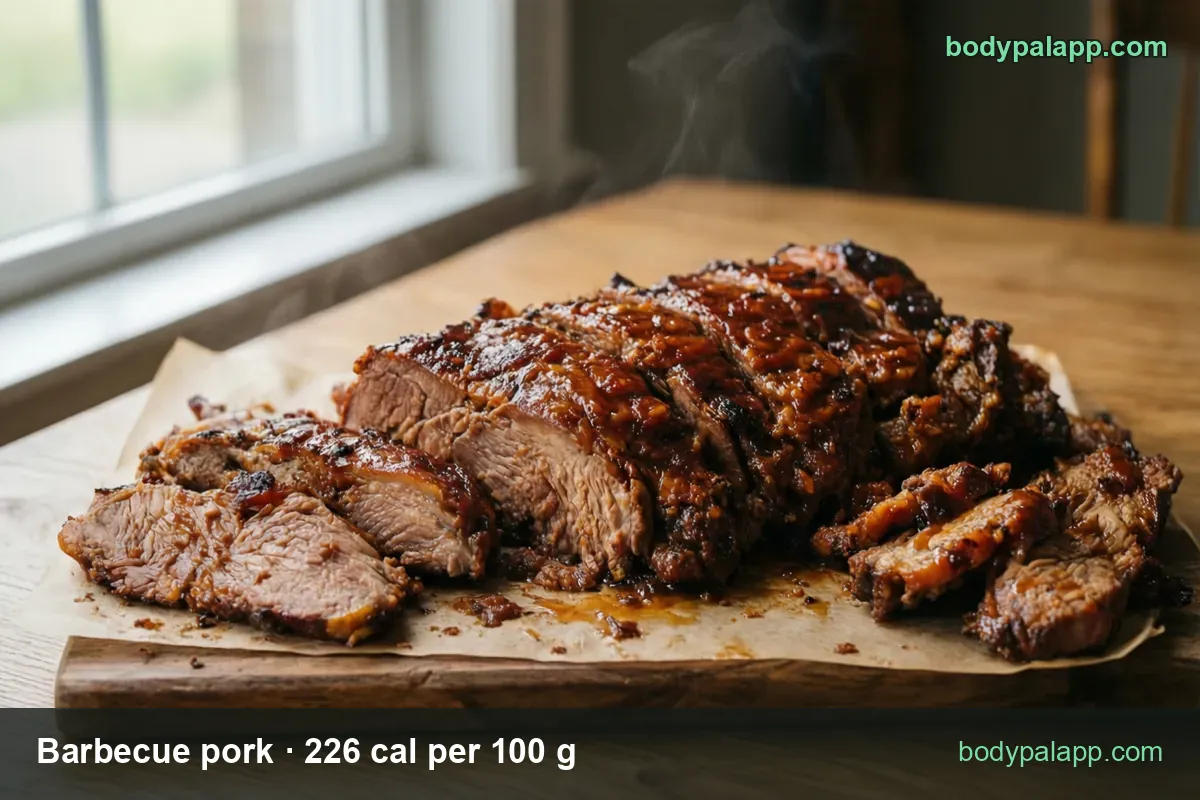
Here is the counterintuitive part. Per 100 g, dry barbecue pork with no sauce is the denser food: 249 calories against 226. Sauce is mostly water and sugar, so it drags the per-gram number down while adding sugar and salt. Going sauceless takes total sugars from 9.97 g per 100 g to zero and sodium from 603 mg to 422 mg, and pushes protein up to 24.75 g per 100 g — the highest protein density of any barbecue pork dish on this page.
The bigger trap is the word "cup." USDA's cup of sauced barbecue pork weighs 240 g. USDA's cup of the no-sauce version weighs 135 g, because dry chopped meat packs loosely and there is no sauce filling the gaps. Same measuring cup, 105 g apart, and 206 calories between them. If you log by cup instead of by scale, that difference is invisible.
Pulled pork simmered in barbecue sauce is the lightest row of the seven USDA publishes for this food, at 168 calories per 100 g. It uses leaner meat and more sauce per bite, which shows up as 15.2 g of total sugars and 666 mg of sodium per 100 g — more sugar and more salt than the main record, on fewer calories. An ounce off the serving fork is 48 calories.
Sandwiches, deli loaf and barbecue pork skins
| Version | Per 100 g | Typical serving | Calories |
|---|---|---|---|
| Barbecue pork sandwich, white bun | 243 kcal | 1 sandwich (180 g) | 437 kcal |
| Barbecue pork sandwich, wheat bun | 238 kcal | 1 sandwich (180 g) | 428 kcal |
| Barbecue loaf, pork and beef | 173 kcal | 1 slice (23 g) | 40 kcal |
| Pork skins, barbecue-flavor | 538 kcal | 1 oz (28 g) | 153 kcal |
A regular barbecue pork sandwich on a white bun is 437 calories, and swapping to a wheat bun saves 9 of them — 428. Nine calories is not a decision. The fiber is: 2 g per 100 g on the wheat bun against 0.8 g on white, so the wheat version is the better pick for a reason that has nothing to do with the calorie count.
Two rows carry the barbecue name but are not the dish. Barbecue loaf is sliced sandwich meat at 173 calories per 100 g and 40 per slice, with 1,334 mg of sodium per 100 g. Barbecue-flavor pork skins are a fried snack at 538 calories per 100 g — the heaviest of the seven rows, more than double the plated barbecue — and 2,667 mg of sodium per 100 g. If a food tracker suggests one of these when you scan a plate of pulled pork, it has the wrong record.
Packaged barbecue pork is generally lighter than the FNDDS dish because processors carry more sauce and, in foodservice tubs, some soy protein. Doughtie's Barbecue Pork with Classic Vinegar Sauce lists 207 calories per 100 g and 290 for its 140 g (5 oz) serving; two Chandler Foods tomato-sauce tubs come in at 156 and 130 calories per 100 g. The vinegar-sauce tub is the heaviest of the three at 207 calories per 100 g; the tomato-sauce tubs are the lightest, down to 130.
Protein wins the cup, sodium takes it back
That 1-cup serving delivers 42.2 g of protein — 84% of the 50 g Daily Value, from one bowl. For a lunch built around protein foods, it is hard to beat per dollar or per bite.
The same cup brings 1,447 mg of sodium, 63% of the 2,300 mg limit the Dietary Guidelines set for adults. That is about two-thirds of a teaspoon of table salt in one serving. Add 154 mg of cholesterol (51% DV) and 9.6 g of saturated fat (48% DV) and a single cup uses up roughly half your day on three separate lines while supplying about a quarter of the calories.
None of that makes barbecue a problem food; it makes it a food worth portioning. If you are watching sodium, a 3 oz cooked portion at 192 calories carries 513 mg instead of 1,447 mg, and the sauceless version cuts the per-gram sodium by 30%. If you are chasing protein and do not care about salt that day, the full cup is a bargain.
How does pork barbecue compare?
| Dish | Per 100 g | US serving | Calories |
|---|---|---|---|
| Barbecue pork, with sauce | 226 kcal | 1 cup, 240 g | 542 kcal |
| Barbecue pork, no sauce | 249 kcal | 1 cup, 135 g | 336 kcal |
| Barbecue pork sandwich, white bun | 243 kcal | 1 sandwich, 180 g | 437 kcal |
| Barbecue loaf, pork and beef | 173 kcal | 1 oz slice, 28 g | 49 kcal |
Our take: for weight loss, take the barbecue on a bun rather than by the cup — 437 calories with a defined edge beats 542 calories of meat you can top up. For protein and fullness, the no-sauce cup is the winner: 336 calories, 33 g of protein, no sugar, and the smallest calorie load of the three real meals here. The plain sauced cup is the one to portion out with a scale, because it is the only serving on this page that pushes past 500 calories before anything else joins the plate.
Most popular pork barbecue brands in the United States
Ranked by how widely each product appears among foods sold in the United States, from the BodyPal food database of over 3.3 million products. Calories are the figures printed on each Nutrition Facts label, checked against USDA FoodData Central.
| Product | Calories (per 100 g) |
|---|---|
| Doughtie's Barbecue Pork with Classic Vinegar Sauce | 207 cal |
| Chandler Foods Pork Barbecue, Tomato-Based Sauce (5.5% TVP) | 156 cal |
| Chandler Foods Pork Barbecue, Tomato-Based Sauce (6% TVP) | 130 cal |
Brand popularity: BodyPal food database. Nutrition: manufacturer labels / USDA FoodData Central.
Pork barbecue FAQs
How many calories are in pork barbecue?
542 calories in a 1-cup serving of barbecue pork with sauce, which USDA weighs at 240 g. Per 100 g the dish runs 226 calories. A single slice of 60 g is 136 calories, and a typical plated portion of 180 g comes to 407 calories.
How many calories in 3 oz of BBQ pork?
192 calories in 3 oz of cooked barbecue pork with sauce, which is 85 g. That portion carries about 15 g of protein and 513 mg of sodium. It is our own arithmetic from the USDA 100 g figure of 226 calories, not a USDA household serving, but it matches how menus talk.
Is barbecue pork high in protein?
Yes — 42.2 g of protein in a 1-cup serving, or 84% of the 50 g Daily Value. Per 100 g that is 17.57 g. The version without sauce is denser still at 24.75 g per 100 g, because there is no sauce diluting the meat.
Barbecue pork with sauce vs no sauce: which has more calories?
Per 100 g the no-sauce version is higher, 249 calories against 226. Per cup it flips, because USDA's cup of sauced pork weighs 240 g and the sauceless cup only 135 g: 542 calories against 336. The sauce dilutes the meat but you end up eating more grams of it.
How much sugar is in barbecue pork with sauce?
9.97 g of total sugars per 100 g, so 23.9 g in a 1-cup serving. The sauceless version has zero. USDA does not publish added sugars for this record, so there is no way to say how much of that total came from the sauce bottle rather than the meat.
How much sodium is in BBQ pork?
1,447 mg in a 1-cup serving, 63% of the 2,300 mg Daily Value, from 603 mg per 100 g. Skipping the sauce drops it to 422 mg per 100 g. Pulled pork simmered in sauce is saltier still at 666 mg per 100 g, despite having the fewest calories.
How many calories in a barbecue pork sandwich?
437 calories for a regular 180 g sandwich on a white bun, and 428 on a wheat bun. Per 100 g they are 243 and 238 calories. The wheat bun is worth choosing for fiber, 2 g per 100 g against 0.8 g, rather than for the nine-calorie difference.
Is pulled pork in barbecue sauce lower in calories?
Yes, 168 calories per 100 g, the lightest of the seven USDA barbecue pork records and 58 below the sauced chopped version. An ounce is 48 calories. The trade is sweetness and salt: 15.2 g of total sugars and 666 mg of sodium per 100 g, both higher than the main record.
Similar foods
- Chicken Shawarma — 190 cal for 3 oz sliced
- Turkey Kielbasa — 127 cal for 2 oz serving
- Chuck Steak — 360 cal per steak
- Leg Of Lamb — 191 cal per 3 oz
- Lamb Shank — 605 cal per shank
- Pork Egg Roll — 193 cal per egg roll
Count it without the math
Point the camera at the plate and BodyPal counts the barbecue for you, sauce and all.


How long does it take to burn off pork barbecue?
A 1-cup (240 g) serving is 542 kcal. Enter your weight and the amount you ate to see how long it takes you to burn that off:
lb
| Activity | Time to burn 542 kcal |
|---|---|
| Walking, brisk | 1 hr 48 min |
| Cycling, moderate | 1 hr 8 min |
| Swimming, moderate | 1 hr 17 min |
| Jogging | 1 hr 4 min |
| Weight training, moderate | 2 hr |
Times are for a 155 lb adult at a steady pace; change the weight to see yours. The amount is set to the portion in the text (240 g); change it to what you actually ate. BodyPal works this out from your steps automatically.
This table assumes you know your daily total. If you do not, the daily calorie calculator works it out from five numbers.