
How many calories are in chickpeas?
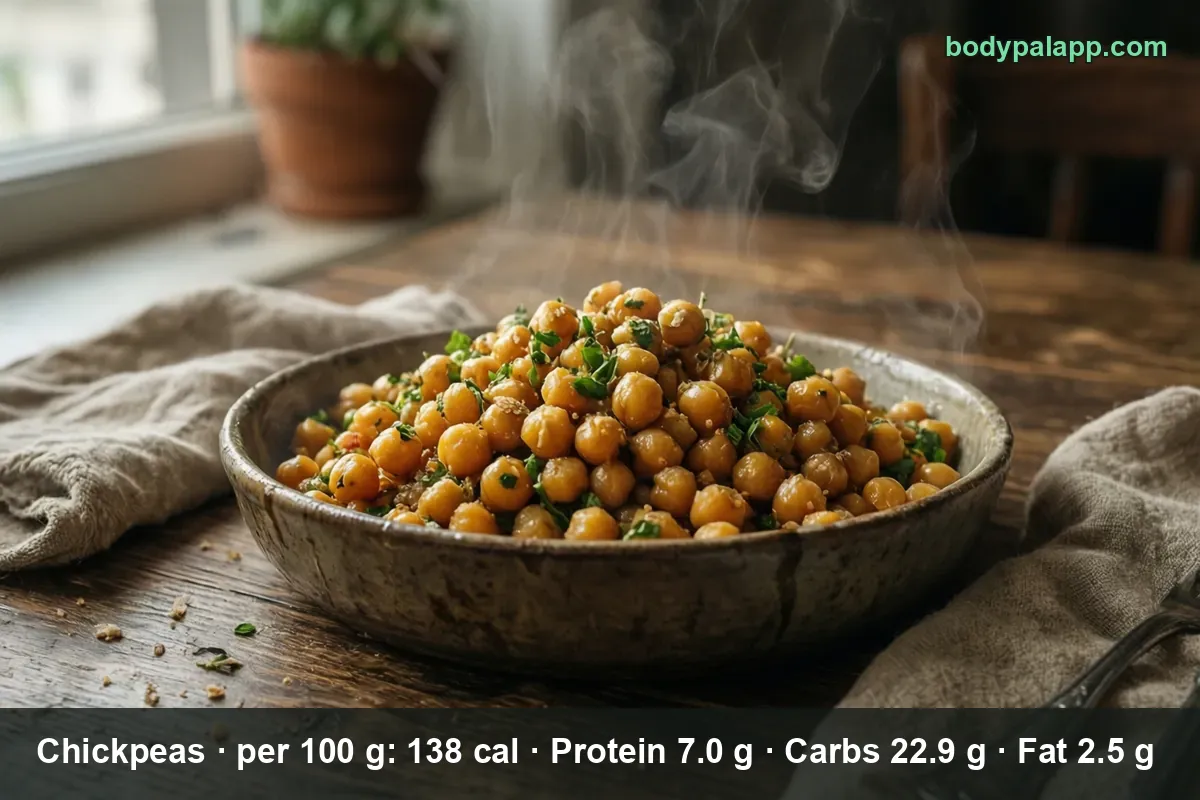
A 1-cup (152 g) serving of canned chickpeas, drained and rinsed, is 210 calories. Per 100 g they run 138 calories, which puts them well under most starches and well over most vegetables. The same cup brings 10.7 g of protein and 9.6 g of fiber, so it eats far bigger than 210 suggests.
On this page
- Chickpea quick facts
- US servings, from one ounce to the whole can
- Canned, cooked from dried, dry and flour
- Draining and rinsing is the sodium lever
- Fiber, not protein, is the headline
- How do chickpeas compare?
- Most popular chickpeas brands
- FAQ
Chickpea quick facts
Americans buy chickpeas in a can and eat them drained and rinsed, so that is the record this page is built on: SR Legacy 173801, "Chickpeas (garbanzo beans, bengal gram), mature seeds, canned, drained, rinsed in tap water". It is the food actually going into the salad bowl or the sheet pan, not an abstraction.
The dry bean (378 per 100 g) and the batch you simmer yourself from dried (164 per 100 g) are different preparations of the same seed, not different sources, and both get their own rows further down. Nothing here is averaged between records.
| Nutrient | Per 100 g | Per 1 cup (152 g) | % Daily Value |
|---|---|---|---|
| Calories | 138 | 210 | — |
| Total fat | 2.47 g | 3.8 g | 5% |
| Saturated fat | 0.21 g | 0.3 g | 2% |
| Carbohydrate | 22.87 g | 34.8 g | 13% |
| Dietary fiber | 6.3 g | 9.6 g | 34% |
| Total sugars | 4 g | 6.1 g | — |
| Protein | 7.04 g | 10.7 g | 21% |
| Sodium | 212 mg | 322 mg | 14% |
% Daily Value is based on a 2,000-calorie diet.
Verified nutrition data
Numbers on this page come from USDA FoodData Central, the U.S. Department of Agriculture’s food composition database, and from manufacturer labels where a branded product is named. Last verified September 2026. How we verify our data →
There is no added sugars row because the SR Legacy edition of this record does not publish one — plain canned chickpeas are packed in salted water, not syrup, so the 6.1 g of total sugars per cup is what the bean brought with it. Cholesterol is 0 mg, as it is in every plant food. Potassium comes to 166 mg a cup, 4% of the Daily Value, which is modest for a legume because a good share of it leaves with the drained brine.
US servings, from one ounce to the whole can
| Serving | Weight | Calories |
|---|---|---|
| 1 oz | 28 g | 39 kcal |
| 1/2 cup, drained and rinsed | 76 g | 105 kcal |
| 1 cup, drained and rinsed | 152 g | 210 kcal |
| 1 can, drained and rinsed | 254 g | 351 kcal |
| Per 100 g | 100 g | 138 kcal |
The 1-cup, 152 g weight is the USDA household measure attached to this record, and the drained can weight sits alongside it. The half cup and the ounce are our own arithmetic from the USDA 100 g figure, not USDA servings — useful because a half cup is how most recipes portion chickpeas and how every canned-bean label counts them.
That last point is worth pausing on. A standard 15.5 oz can yields about 254 g drained, so the whole can is 351 calories — roughly one-sixth of a 2,000-calorie day, and easy to eat in one sitting when the can gets roasted with olive oil. The oil is not in that number; a tablespoon adds about 120 calories of its own.
Canned, cooked from dried, dry and flour
| Version | Per 100 g | Typical serving | Calories |
|---|---|---|---|
| Canned, drained and rinsed | 138 kcal | 1 cup (152 g) | 210 kcal |
| Cooked from dried, no salt | 164 kcal | 1 cup (164 g) | 269 kcal |
| Canned, drained solids (not rinsed) | 139 kcal | 1 can drained (253 g) | 352 kcal |
| Canned, solids and liquids | 88 kcal | 1 cup (240 g) | 211 kcal |
| Canned, solids and liquids, low sodium | 88 kcal | 1 cup (240 g) | 211 kcal |
| Dry, uncooked | 378 kcal | 1 cup (200 g) | 756 kcal |
| Chickpea flour (besan) | 387 kcal | 1 cup (92 g) | 356 kcal |
Two traps live in that table. The first is the word "cup." A cup of canned chickpeas is 210 calories; a cup of dry chickpeas is 756, because dry seeds pack denser and carry no water. That is a 3.6-fold gap on an identical measuring cup, and it is the single most common way a chickpea entry gets logged wrong.
The second is the solids-and-liquids row at 88 calories per 100 g. Nothing was removed from that food — it is simply the bean plus the brine it was weighed with, so the water dilutes every number in the column. It is a fair figure for a soup that uses the whole can and a misleading one for anything you drain.
Cooking from dried lands higher than canned, 164 against 138 per 100 g, for the same reason in reverse: home-simmered beans hold less residual water than the ones sitting in a can. Chickpea flour is a different animal again — 387 per 100 g, but a cup of it weighs only 92 g, so a cup of besan is 356 calories.
Canned brands mostly report against a 1/2 cup (130 g) label serving that includes liquid, which is why Bush's Best Chick Peas print 89 calories per 100 g and 116 per serving rather than anything near 138. Their reduced-sodium and organic versions run 91 to 105 per 100 g on the same basis, and American Farms Garbanzo Beans list 120 per 100 g. Compare a label to a label, and USDA to USDA.
Draining and rinsing is the sodium lever
Sodium is the only row on this page that a home cook can move without changing what is on the plate. Canned chickpeas drained but not rinsed carry 246 mg per 100 g. Drain and rinse them under the tap and it drops to 212 mg — about a 14% cut for ten seconds of work. Leave the liquid in and the figure climbs to 278 mg per 100 g of the whole contents. Simmer your own from dried with no salt and it collapses to 7 mg.
The cup you are most likely to eat, drained and rinsed, is 322 mg of sodium: 14% of the FDA Daily Value of 2,300 mg, or about a seventh of a teaspoon of table salt. That is unremarkable on its own and matters a lot when the chickpeas are joining a can of tomatoes, a stock cube and a handful of olives. If you are watching sodium, rinsed regular cans are fine and low-sodium cans are better; if you are cooking a big batch anyway, dried beans win outright.
Fiber, not protein, is the headline
Chickpeas get filed as a protein food — MyPlate counts them in both the protein and vegetable groups — but the numbers point somewhere else. A cup delivers 10.7 g of protein, 21% of the Daily Value, against 9.6 g of fiber, which is 34% of the 28 g DV. Fiber is the bigger contribution, and it is the one most American diets are short on; the Dietary Guidelines for Americans treat fiber as a nutrient of public health concern.
So the practical framing is a high-fiber carbohydrate that happens to bring useful protein, not a bean standing in for chicken. A cup of chickpeas and a 3 oz piece of chicken are not interchangeable on the protein line; a cup of chickpeas and a cup of rice are very much comparable on the carbohydrate line, and the chickpeas win the fiber column outright.
Fat is a small story here: 3.8 g a cup, of which only 0.3 g is saturated — 2% DV. Whatever fat ends up in a chickpea dish arrives from the pan, not the bean.
How do chickpeas compare?
Legumes are sold dry, so this table compares them dry, bean for bean.
| Legume, dry | Per 100 g | US serving | Calories |
|---|---|---|---|
| Chickpeas | 378 kcal | 1 cup dry (200 g) | 756 kcal |
| Split peas | 364 kcal | 1 cup dry (196 g) | 713 kcal |
| Lentils | 352 kcal | 1 cup dry (192 g) | 676 kcal |
| Mung beans | 347 kcal | 1 cup dry (207 g) | 718 kcal |
Our take: chickpeas are the most calorie-dense of the four per 100 g and the heaviest cup on the list, and the reason is fat — 6.04 g per 100 g against 1.06 g in lentils and 1.15 g in mung beans. They are also the lowest in protein of the four, at 20.47 g per 100 g versus 24.63 g in lentils. If you are cooking for protein per calorie, lentils are the better buy. If you are cooking for texture, roasting or anything that has to hold its shape in a bowl, chickpeas are worth the extra 80 calories a cup — and once cooked or canned, the gap shrinks to something no one needs to manage.
Most popular chickpeas brands in the United States
Ranked by how widely each product appears among foods sold in the United States, from the BodyPal food database of over 3.3 million products. Calories are the figures printed on each Nutrition Facts label, checked against USDA FoodData Central.
| Product | Calories (per 100 g) |
|---|---|
| Bush's Best Chick Peas | 89 cal |
| Bush's Best Reduced Sodium Chick Peas | 91 cal |
| Bush's Best Organic Garbanzo Beans | 95 cal |
| Bush's Best Low Sodium Chick Peas | 99 cal |
| Bush's Best Organic Chick Peas | 105 cal |
| American Farms Garbanzo Beans | 120 cal |
Brand popularity: BodyPal food database. Nutrition: manufacturer labels / USDA FoodData Central.
Chickpea FAQs
How many calories are in 1 cup of chickpeas?
A 1-cup (152 g) serving of canned chickpeas, drained and rinsed, is 210 calories. That cup also carries 10.7 g of protein, 9.6 g of fiber and 34.8 g of carbohydrate. Chickpeas cooked from dried run higher, 269 calories for a 164 g cup, because there is less residual water in them.
How many calories in a can of chickpeas?
A 254 g drained and rinsed can is 351 calories. Drained but not rinsed, a 253 g can comes to 352, so the calorie difference between the two is rounding rather than food. Where the two cans genuinely part ways is sodium: 212 mg per 100 g rinsed against 246 mg unrinsed.
Are canned chickpeas healthy?
A drained, rinsed cup gives 9.6 g of fiber, 34% of the Daily Value, with 0 mg of cholesterol and only 0.3 g of saturated fat. The one row to watch is sodium at 322 mg a cup, 14% DV. Rinsing already trims that, and low-sodium cans cut it further.
How much protein is in chickpeas?
A cup of drained, rinsed chickpeas has 10.7 g of protein, 21% of the Daily Value, or 7.04 g per 100 g. Cooked from dried is a little denser at 8.86 g per 100 g. Chickpeas count as a protein food on MyPlate, but their fiber number, 34% DV a cup, is the bigger one.
Do you drain and rinse chickpeas before eating?
Rinsing takes canned chickpeas from 246 mg of sodium per 100 g down to 212 mg, roughly a 14% cut, and it washes off the starchy brine that clouds a dressing. Calories barely move: 139 per 100 g drained versus 138 drained and rinsed. Keep the liquid only if a recipe asks for aquafaba.
How many carbs are in chickpeas?
A 1-cup (152 g) serving has 34.8 g of total carbohydrate, 13% of the Daily Value. Fiber accounts for 9.6 g of that, leaving roughly 25 g digestible. Total sugars come to 6.1 g per cup, all naturally occurring — USDA does not publish an added sugars figure for this record.
Are chickpeas good for weight loss?
At 138 calories per 100 g, chickpeas sit between a lean protein and a starch, and a cup is 210. The useful part is the 9.6 g of fiber per cup, which makes a small portion feel like a real one. Swap in half a cup, 105 calories, when the rest of the plate is heavy.
Chickpeas vs garbanzo beans - what is the difference?
Nothing at all: 138 calories per 100 g and 210 per cup apply to both names, because they are the same bean. USDA files the record as chickpeas (garbanzo beans, bengal gram), mature seeds, so either label points to that one record. Garbanzo is the Spanish-derived label common on West Coast cans; chickpea is the English one.
Similar foods
- Edamame — 224 cal per cup
- Kidney Beans — 243 cal per cup
- Beans — 244 cal per cup
- Toor Dal — 348 cal per cup
- Garlic — 13 cal for 3 cloves
- Broccoli Slaw — 229 cal per cup
Count it without the math
Point the camera at the bowl and BodyPal counts the chickpeas for you, drained, rinsed or roasted.


How long does it take to burn off chickpeas?
A 1-cup (152 g) serving is 210 kcal. Enter your weight and the amount you ate to see how long it takes you to burn that off:
lb
| Activity | Time to burn 210 kcal |
|---|---|
| Walking, brisk | 42 min |
| Cycling, moderate | 26 min |
| Swimming, moderate | 30 min |
| Jogging | 25 min |
| Weight training, moderate | 47 min |
Times are for a 155 lb adult at a steady pace; change the weight to see yours. The amount is set to the portion in the text (152 g); change it to what you actually ate. BodyPal works this out from your steps automatically.
This table assumes you know your daily total. If you do not, the daily calorie calculator works it out from five numbers.