
How many calories are in kidney beans?
A 1-cup serving of canned kidney beans, drained and warmed without added fat, is 243 calories. Per 100 g the beans run 135 calories, and a half cup is 122. That is a lot of food for the money: the same cup carries 15.7 g of protein and 14.4 g of fiber.
On this page
- Kidney bean quick facts
- US servings, from an ounce to a full cup
- From dried, from a can, with fat added
- Fiber and sodium are the two rows to watch
- How do kidney beans compare?
- Most popular kidney beans brands
- Kidney bean FAQs
Kidney bean quick facts
Most Americans meet kidney beans as a drained can tipped into chili, rice or a salad, so that is the record this page is built on: FNDDS 2707383, "Kidney beans, from canned, no added fat". It is the bean as you eat it, already cooked and without the spoonful of oil that a lot of recipes add on the way to the bowl. The dried-bean and fat-added records are real too, and they sit in their own table further down.
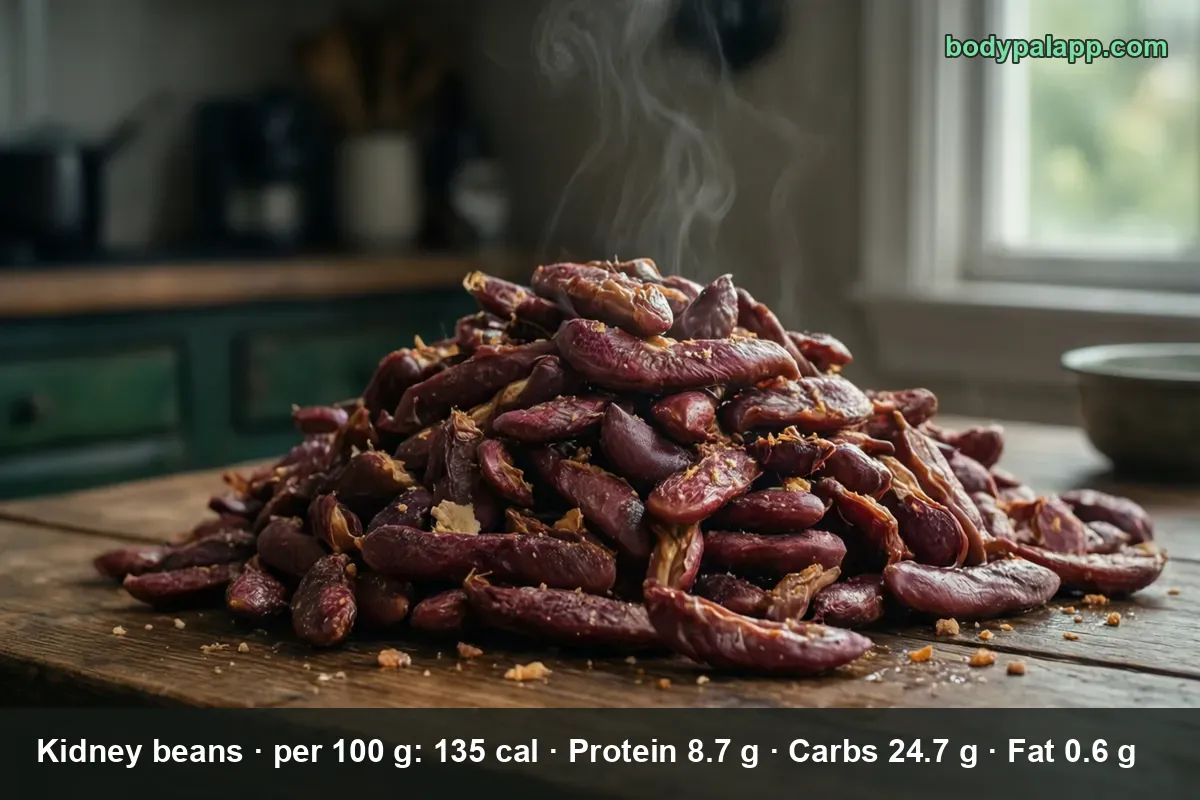
The photo above shows the bean dry, the way it comes in a bag. Dry weight and cooked weight are not the same thing, and the whole page below is on the cooked bean unless a line says otherwise.
| Nutrient | Per 100 g | Per 1 cup (180 g) | % Daily Value |
|---|---|---|---|
| Calories | 135 | 243 | — |
| Total fat | 0.6 g | 1.1 g | 1% |
| Saturated fat | 0.21 g | 0.4 g | 2% |
| Carbohydrate | 24.72 g | 44.5 g | 16% |
| Dietary fiber | 8 g | 14.4 g | 51% |
| Total sugars | 3.08 g | 5.5 g | — |
| Protein | 8.7 g | 15.7 g | 31% |
| Sodium | 311 mg | 560 mg | 24% |
| Cholesterol | 0 mg | 0 mg | 0% |
| Potassium | 433 mg | 779 mg | 17% |
% Daily Value is based on a 2,000-calorie diet.
Verified nutrition data
Numbers on this page come from USDA FoodData Central, the U.S. Department of Agriculture’s food composition database, and from manufacturer labels where a branded product is named. Last verified September 2026. How we verify our data →
There is no added-sugars row and no trans fat row here, because USDA does not publish either value for this record. The Daily Values used in the last column are the FDA reference amounts printed on every Nutrition Facts label.
One number worth pausing on: a cup of these beans covers 17% of the Daily Value for potassium and none of your cholesterol allowance at all, since a plant food has zero.
US servings, from an ounce to a full cup
| Serving | Weight | Calories |
|---|---|---|
| 1 oz | 28 g | 38 kcal |
| 1/4 cup | 45 g | 61 kcal |
| 1/2 cup, the label serving | 90 g | 122 kcal |
| 1 cup | 180 g | 243 kcal |
| Per 100 g | 100 g | 135 kcal |
The cup and the half cup are USDA household measures for this record. The quarter cup and the ounce are our own arithmetic from the USDA 100 g figure, not USDA servings, but they are the two amounts people actually scoop when beans are a garnish rather than the main event.
Watch the ounce, though. An ounce of dry beans out of the bag is not an ounce of dinner: 28 g of dry beans swells to roughly 70 g cooked, which is about 88 calories on the from-dried record — more than double the 38 calories in an ounce straight from the can. Grocery labels tell the same story from the other side. A can of Goya red kidney beans lists 110 calories in a 1/2-cup serving, while the same brand's dry beans list 140 calories in a 1/4 cup, because that quarter cup is going to triple in the pot.
From dried, from a can, with fat added
| Version | Per 100 g | Typical serving | Calories |
|---|---|---|---|
| From canned, no added fat | 135 kcal | 1 cup (180 g) | 243 kcal |
| From dried, no added fat | 126 kcal | 1 cup (180 g) | 227 kcal |
| From canned, fat added | 186 kcal | 1 cup (185 g) | 344 kcal |
| From dried, fat added | 177 kcal | 1 cup (185 g) | 327 kcal |
| Kidney beans, NFS | 177 kcal | 1 cup (185 g) | 327 kcal |
| From canned, reduced sodium | 186 kcal | 1/2 cup (90 g) | 167 kcal |
| Kidney beans with meat | 173 kcal | 1 cup (260 g) | 450 kcal |
Cooking from dried saves you 16 calories a cup. That is nothing. What it does change is the salt, and we get to that below.
The fat is where the real money goes. A cup of beans warmed with a spoonful of oil or bacon fat is 344 calories against 243 plain — 101 calories higher, more than a third again on top of the plain beans. The record labeled NFS, USDA's shorthand for "not further specified," lands at 177 calories per 100 g, which tells you what the average American plate of kidney beans really looks like: cooked with something.
Two more lines are worth knowing. "Kidney beans with meat" is 450 calories a cup at 260 g, and it is the only version here that brings cholesterol to the table. And the fast-food or restaurant record runs 195 calories per 100 g with 350 mg of sodium in that same 100 g — the highest of the eight kidney-bean records compared here, on both counts. There is no household serving attached to that record, so we have not invented one.
The reduced-sodium row surprises people: at 186 calories per 100 g it is heavier than the plain can's 135, because that particular record also carries added fat. Its half-cup figure is our own arithmetic from that 100 g number. Low sodium and low calorie are two different labels.
Fiber and sodium are the two rows to watch
Fiber is the reason to eat this food. One cup is 14.4 g, or 51% of the Daily Value, in a single side dish. Most Americans fall well short of the fiber target set in the Dietary Guidelines, and a cup of beans covers half the day's target for 243 calories. MyPlate counts beans in the protein group and the vegetable group at the same time, which is a fair reflection of what 15.7 g of protein plus 14.4 g of fiber does to a plate.
Sodium is the row going the other way. A cup from the can is 560 mg, 24% of the Daily Value — roughly a quarter teaspoon of table salt you did not add yourself. Beans cooked from dried carry 233 mg per 100 g against 311 mg for the canned bean, and the reduced-sodium can is 188 mg per 100 g. If you are watching salt and not calories, dried beans are the pick, and it is the only argument for soaking them overnight that the numbers actually support.
Draining and rinsing helps, and it takes ten seconds. USDA does not publish a drained-and-rinsed record for kidney beans, so we cannot give you a number for how much salt goes down the sink.
How do kidney beans compare?
| Bean dish | Per 100 g | US serving | Calories |
|---|---|---|---|
| Kidney beans, from canned, no added fat | 135 kcal | 1/2 cup (90 g) | 122 kcal |
| Black beans, from canned, fat added | 178 kcal | 1/2 cup (90 g) | 160 kcal |
| Refried beans, restaurant | 177 kcal | 1/2 cup (90 g) | 159 kcal |
| Beans, canned, type not specified, fat added | 185 kcal | 1/2 cup (90 g) | 167 kcal |
Serving calories for the three neighbors are our own arithmetic from their USDA 100 g figures.
Our take: kidney beans win this table, but not because the bean is special. It wins because the record we chose has no fat in it and the other three do — that is the whole gap of roughly 40 calories in a half cup. Scoop black beans into a bowl without oil and they land in the same neighborhood. The lesson for a Chipotle-style bowl or a pot of chili is that the bean you pick barely matters and the fat you cook it in decides the number. Of the eight USDA kidney-bean records compared here, only one is lighter per gram than the plain canned bean, and it is the same bean cooked from dried.
Most popular kidney beans brands in the United States
Ranked by how widely each product appears among foods sold in the United States, from the BodyPal food database of over 3.3 million products. Calories are the figures printed on each Nutrition Facts label, checked against USDA FoodData Central.
| Product | Calories (per 100 g) |
|---|---|
| Goya Red Kidney Beans | 90 cal |
| Goya Prime Premium Red Kidney Beans | 89 cal |
| Goya Red Kidney Beans 15.5 oz | 74 cal |
| Goya Premium Red Kidney Beans | 73 cal |
| Goya Red Kidney Beans, dry | 333 cal |
| 365 Everyday Value Red Kidney Beans, dry | 333 cal |
Brand popularity: BodyPal food database. Nutrition: manufacturer labels / USDA FoodData Central.
Kidney bean FAQs
How many calories are in 1 cup of kidney beans?
A 1-cup serving of canned kidney beans, drained and warmed without added fat, is 243 calories at 180 g. That works out to 135 calories per 100 g. The same cup cooked from dried beans lands at 227 calories, and a half cup of the canned bean is 122.
How many calories in canned kidney beans?
Canned kidney beans with no added fat run 135 calories per 100 g, so a half cup (90 g) is 122 calories and a full cup (180 g) is 243. Warm them in a spoonful of oil and the USDA record climbs to 186 per 100 g, which is 344 calories a cup.
How much protein is in kidney beans?
A cup of canned kidney beans carries 15.7 g of protein, 31% of the Daily Value, from 8.7 g per 100 g. That is strong for a plant food, and MyPlate counts beans in the protein group and the vegetable group at once. A half cup gives you roughly 7.8 g.
How many carbs are in kidney beans?
A cup holds 44.5 g of total carbohydrate, 16% of the Daily Value, and 14.4 g of that is fiber. Sugars are 5.5 g a cup. Per 100 g the figure is 24.72 g of carbohydrate, while beans cooked from dried come in at 22.66 g with only 0.32 g of sugars.
How much fiber is in a cup of kidney beans?
A cup delivers 14.4 g of dietary fiber, 51% of the Daily Value, from 8 g per 100 g. Very little else on a dinner plate comes close in one serving. Beans cooked from dried are a shade behind at 7.4 g per 100 g, about 13 g a cup by our own arithmetic.
Are canned kidney beans high in sodium?
One cup carries 560 mg of sodium, 24% of the Daily Value and roughly a quarter teaspoon of table salt. The reduced-sodium USDA record is 188 mg per 100 g against 311 mg for the standard can, and beans cooked from dried sit lower still at 233 mg per 100 g.
Are kidney beans good for weight loss?
At 135 calories per 100 g with 8 g of fiber, kidney beans are one of the cheapest ways to fill a plate. A cup is 243 calories and covers 51% of the fiber Daily Value. Serve them plain: the same cup finished with fat is 344 calories, 101 more.
Do you need to drain and rinse canned kidney beans?
The canned bean carries 311 mg of sodium per 100 g, or 560 mg in a cup, so rinsing is worth the ten seconds if you are watching salt. USDA does not publish a drained-and-rinsed record, so there is no figure to quote for how much comes off. A reduced-sodium can is 188 mg per 100 g.
Similar foods
- Chickpeas — 210 cal per cup
- Edamame — 224 cal per cup
- Beans — 244 cal per cup
- Toor Dal — 348 cal per cup
- Broccoli Slaw — 229 cal per cup
- Garlic — 13 cal for 3 cloves
Count it without the math
Point the camera at the bowl and BodyPal counts the beans for you, oil and all.


How long does it take to burn off kidney beans?
A 1-cup (180 g) serving is 243 kcal. Enter your weight and the amount you ate to see how long it takes you to burn that off:
lb
| Activity | Time to burn 243 kcal |
|---|---|
| Walking, brisk | 49 min |
| Cycling, moderate | 30 min |
| Swimming, moderate | 35 min |
| Jogging | 29 min |
| Weight training, moderate | 54 min |
Times are for a 155 lb adult at a steady pace; change the weight to see yours. The amount is set to the portion in the text (180 g); change it to what you actually ate. BodyPal works this out from your steps automatically.
Want the bigger picture? Calculate your daily calorie needs — your maintenance figure, a target for losing or gaining, and the date you get there.