
How many calories are in edamame?
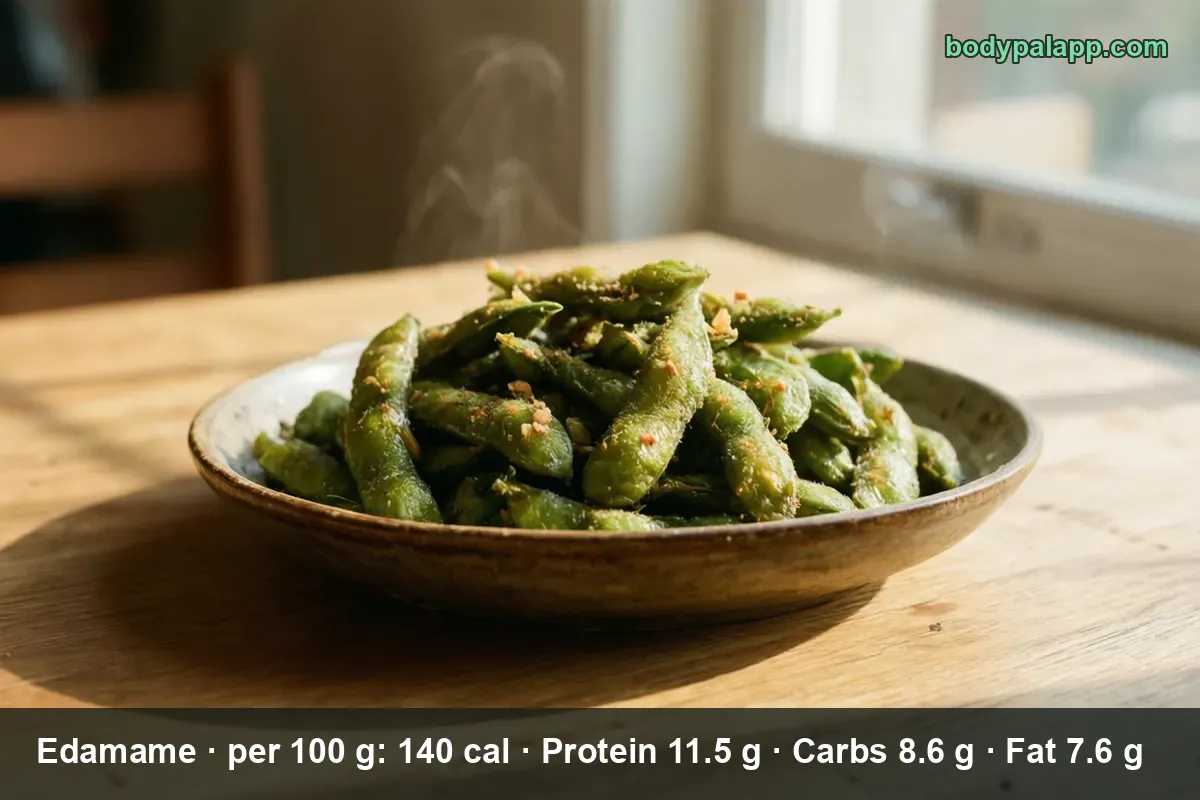
A 1-cup serving of shelled edamame, 160 g the way it lands in a restaurant side dish, is 224 calories, and the cooked, lightly salted bean runs 140 calories per 100 g. A single pod yields about 2 g of beans, so one pod is 3 calories. Most of that plate is protein and fiber.
On this page
- Edamame quick facts
- US servings, from one pod to a full cup
- Frozen, riced and dry roasted edamame
- Protein and fiber are the rows that matter
- How does edamame compare?
- Most popular edamame brands
- FAQ
Edamame quick facts
The record used here is FNDDS 2707436, "Edamame, cooked" from the USDA Survey 2021-2023 release. It describes the bean as it reaches a table: boiled or steamed, salted, served warm in the pod. That is the version people are counting when they order a side at a sushi counter or tear open a microwave bag, so it is the one the numbers below describe.
Two other USDA records cover edamame that has not been cooked or salted yet, and they read lower. Those sit in the variants section further down, with the reason for the gap.
| Nutrient | Per 100 g | Per 1 cup (160 g) | % Daily Value |
|---|---|---|---|
| Calories | 140 | 224 | — |
| Total fat | 7.58 g | 12.1 g | 16% |
| Saturated fat | 1.27 g | 2.0 g | 10% |
| Carbohydrate | 8.63 g | 13.8 g | 5% |
| Dietary fiber | 5 g | 8.0 g | 29% |
| Total sugars | 2.12 g | 3.4 g | — |
| Protein | 11.54 g | 18.5 g | 37% |
| Sodium | 127 mg | 203 mg | 9% |
% Daily Value is based on a 2,000-calorie diet.
Verified nutrition data
Numbers on this page come from USDA FoodData Central, the U.S. Department of Agriculture’s food composition database, and from manufacturer labels where a branded product is named. Last verified September 2026. How we verify our data →
There is no added-sugars row and no trans-fat row above because the FNDDS release does not publish either figure for this record; edamame has no added sugar in it regardless. Cholesterol shows as 2 mg per 100 g, 3 mg in a cup, which is 1% of the Daily Value and comes from whatever fat the kitchen cooked it in rather than from the bean. Potassium is the quiet winner: 422 mg per 100 g, 675 mg in a cup, 14% of the Daily Value.
US servings, from one pod to a full cup
| Serving | Weight | Calories |
|---|---|---|
| 1 pod, beans only | 2 g | 3 kcal |
| 1 oz shelled | 28 g | 39 kcal |
| 1/2 cup shelled | 80 g | 112 kcal |
| 1 cup shelled | 160 g | 224 kcal |
| Per 100 g | 100 g | 140 kcal |
The cup measures and the single pod are USDA household measures for this record. The 1 oz line is our own arithmetic from the USDA 100 g figure, not a USDA serving, because ounces are how packaged edamame gets weighed at the store.
One detail decides whether your log is right: every number on this page is for shelled beans. The pod is fibrous, you chew the salt off it and put it on the side plate, and USDA counts only what gets swallowed. A cup of pods is nowhere near a cup of beans. If you are eyeballing a restaurant bowl, count pods instead, multiplying the USDA per-pod figure ourselves: 12 pods is roughly 36 calories, 40 pods lands close to a half cup at around 120, and a heaped shared bowl of 75 pods is about 225 calories split between however many people reach into it.
Frozen, riced and dry roasted edamame
| Version | Per 100 g | Typical serving | Calories |
|---|---|---|---|
| Cooked, salted (main record) | 140 kcal | 1 cup shelled, 160 g | 224 kcal |
| Frozen, unprepared | 109 kcal | 1 cup, 118 g | 129 kcal |
| Frozen, prepared | 121 kcal | 1 cup, 155 g | 188 kcal |
| Dry roasted snack | 433 kcal | 1/3 cup, 30 g | 130 kcal |
| Riced edamame | 141 kcal | 3/4 cup, 85 g | 120 kcal |
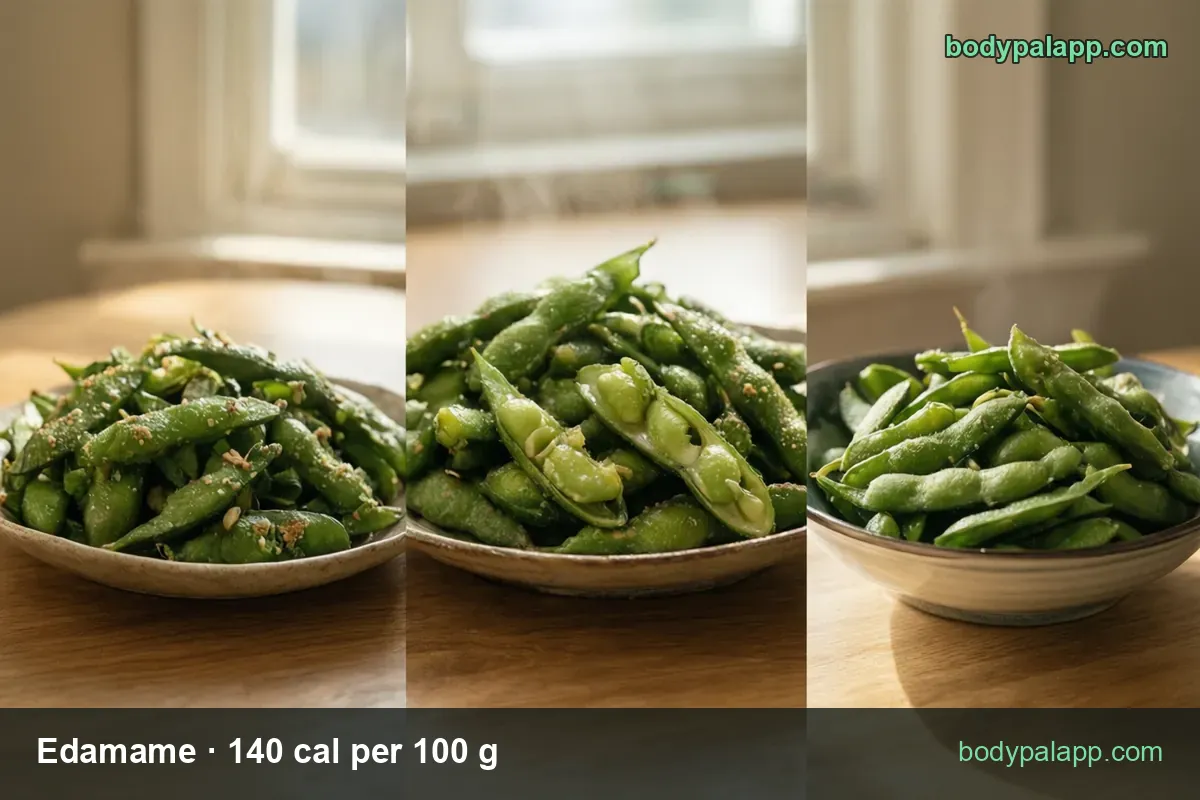
The frozen bag is the interesting one. Straight out of the freezer, unprepared, edamame is 109 calories per 100 g; boiled in plain water with no salt it reads 121; cooked and seasoned the way it is actually served, 140. That 19-calorie step between the plain boiled record and the salted one is fat and seasoning from the pan, not a different bean, and the sodium tells the same story: 6 mg per 100 g unsalted against 127 mg on the finished plate.
The dry roasted snack is a different food wearing the same name. Roasting drives the water off and concentrates everything, so 100 g of it is 433 calories, more than three times the cooked bean. Store labels bear that out across the shelf: sea salt versions sit around 380 to 433 calories per 100 g, and flavored ones such as sriracha and buffalo reach 460 and 477. The standard label serving is 1/3 cup at 30 g, which is 114 to 143 calories depending on the flavor.
Riced edamame is the surprise: 141 calories per 100 g, one calorie clear of the cooked bean, but the 3/4 cup label serving weighs only 85 g and lands at 120 calories. It swaps for rice by volume, not by weight, so the bowl looks the same size for those 120 calories.
Protein and fiber are the rows that matter
A cup of edamame carries 18.5 g of protein, 37% of the Daily Value, and 8.0 g of fiber, 29% of it, for 224 calories. Very few plant sides put both of those numbers on the table at once. MyPlate counts soy foods in the protein group rather than the vegetable group, and the nutrition panel explains why.
Fiber is where most American plates fall short. The Daily Value is 28 g, and the Dietary Guidelines for Americans describe fiber as a nutrient of public health concern because typical intakes sit well below it. A single cup of edamame covers more than a quarter of that in one go.
Sodium is the row worth a glance if you are watching it. The finished, salted version is 203 mg in a cup, 9% of the 2,300 mg Daily Value - under a tenth of a teaspoon of table salt. Most of it is on the pod rather than inside the bean, so if you are the type who chews the shell, you take on more of it than the numbers here suggest. Cook the frozen bag without salt and you are down to 6 mg per 100 g.
How does edamame compare?
| Food | Per 100 g | 1 oz (28 g) | Calories |
|---|---|---|---|
| Edamame, cooked | 140 kcal | 28 g | 39 kcal |
| Pigeon peas, immature seeds, boiled | 111 kcal | 28 g | 31 kcal |
| Succotash, corn and limas, boiled | 111 kcal | 28 g | 31 kcal |
| Mashed potatoes from granules | 108 kcal | 28 g | 30 kcal |
Our take: edamame is the heaviest of these four per 100 g, and it is still the one we would put on the plate. It is the only one of the four in double digits for protein - 11.54 g per 100 g against 5.96 g for pigeon peas, 5.07 g for succotash and 2.05 g for mashed potatoes - and it has the lowest carbohydrate load of the group at 8.63 g. You are paying roughly 30 extra calories per 100 g for double the protein. If the side dish is meant to make dinner feel finished, that is a good trade; if you just want bulk on the plate for the fewest calories, the mashed potatoes win on arithmetic alone at 108 per 100 g.
Most popular edamame brands in the United States
Ranked by how widely each product appears among foods sold in the United States, from the BodyPal food database of over 3.3 million products. Calories are the figures printed on each Nutrition Facts label, checked against USDA FoodData Central.
| Product | Calories (per 100 g) |
|---|---|
| The Only Bean Sriracha Crunchy Roasted Edamame | 460 cal |
| The Only Bean Buffalo Crunchy Roasted Edamame | 477 cal |
| The Only Bean Sea Salt Crunchy Roasted Edamame | 380 cal |
| Seapoint Farms Sea Salt Dry Roasted Edamame | 433 cal |
| Seapoint Farms Sea Salt Dry Roasted Black Edamame | 433 cal |
| Seapoint Farms Riced Edamame | 141 cal |
Brand popularity: BodyPal food database. Nutrition: manufacturer labels / USDA FoodData Central.
Edamame FAQs
How many calories are in edamame?
Cooked, lightly salted edamame is 140 calories per 100 g of shelled beans. The usual restaurant portion, a full cup at 160 g, comes to 224 calories. That plate carries 18.5 g of protein and 8.0 g of fiber, which is why it holds off hunger better than most 224-calorie snacks.
How many calories in 1 cup of edamame?
224 calories for one cup of shelled cooked beans, 160 g on the scale. Half a cup is 112 calories. If your cup is measured in the pod rather than shelled, you are eating far less bean per cup, because the pod itself is chewed and set aside rather than swallowed.
How many calories in edamame in the pod vs shelled?
One pod yields about 2 g of beans, or 3 calories, so a dozen pods is roughly 36 calories of food. Shelled beans are where the numbers live: 140 calories per 100 g. The pod is chewed for the salt and thrown away, and USDA counts only what you swallow.
How much protein is in edamame?
A 1-cup serving delivers 18.5 g of protein, 37% of the Daily Value, from 11.54 g per 100 g. That is more protein than most vegetable sides carry: pigeon peas hold 5.96 g per 100 g and succotash 5.07 g. Edamame is a soybean, which is why it reads like a protein food.
How much fiber does edamame have?
One cup gives 8.0 g of fiber, 29% of the 28 g Daily Value, at 5 g per 100 g. Half a cup still brings 4.0 g. Protein and fiber arriving together inside a 224-calorie portion is the reason edamame sits so well between meals.
Is edamame good for weight loss?
At 140 calories per 100 g, edamame is not the lightest vegetable on the table, but it returns 11.54 g of protein and 5 g of fiber for those calories. A half cup at 112 calories works better as a pre-dinner plate than a 30 g handful of the roasted snack at 130.
How much sodium is in salted edamame?
Cooked salted edamame carries 127 mg of sodium per 100 g, so a full cup is 203 mg, or 9% of the 2,300 mg Daily Value. Boiled from frozen without salt, the USDA record drops to 6 mg per 100 g. The salt sits on the pod, not inside the bean.
How many calories in roasted edamame snacks?
Dry roasted edamame runs 433 calories per 100 g, so the labeled 1/3 cup at 30 g is 130 calories. Flavored versions reach 460 and 477 per 100 g. A 30 g handful therefore costs about the same as a half cup of cooked beans, 112 calories, with far less volume.
Similar foods
- Lasagna — 286 cal per piece
- Toor Dal — 348 cal per cup
- Shrimp Pad Thai — 294 cal per cup
- Chicken Chow Mein — 288 cal per cup
- Half And Half — 20 cal per tbsp
- Snow Cone — 256 cal per snow cone
Count it without the math
Point the camera at the bowl and BodyPal counts the edamame for you, pods and all.


How long does it take to burn off edamame?
A 1-cup (160 g) serving is 224 kcal. Enter your weight and the amount you ate to see how long it takes you to burn that off:
lb
| Activity | Time to burn 224 kcal |
|---|---|
| Walking, brisk | 45 min |
| Cycling, moderate | 28 min |
| Swimming, moderate | 32 min |
| Jogging | 26 min |
| Weight training, moderate | 50 min |
Times are for a 155 lb adult at a steady pace; change the weight to see yours. The amount is set to the portion in the text (160 g); change it to what you actually ate. BodyPal works this out from your steps automatically.
Burning it off is one side of it. The other is knowing your number: work out how many calories you need a day, with macros and a goal date.