
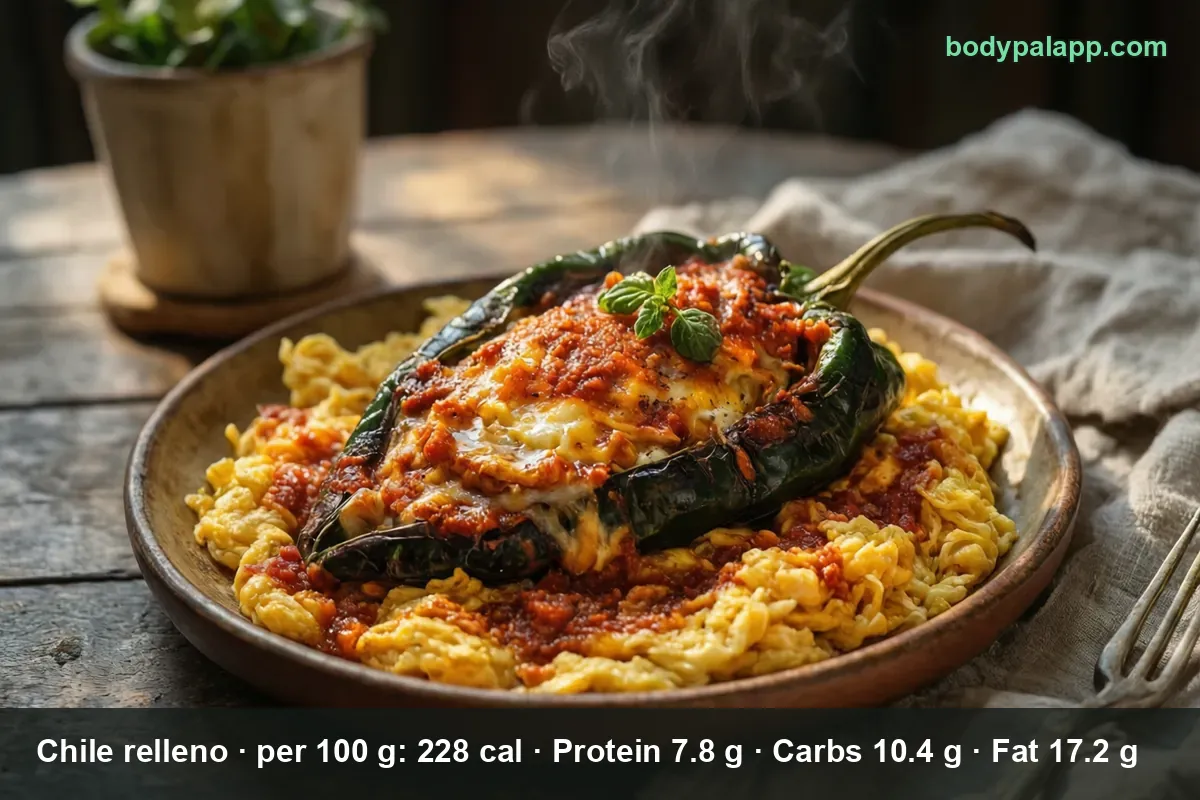
How many calories in a chile relleno?
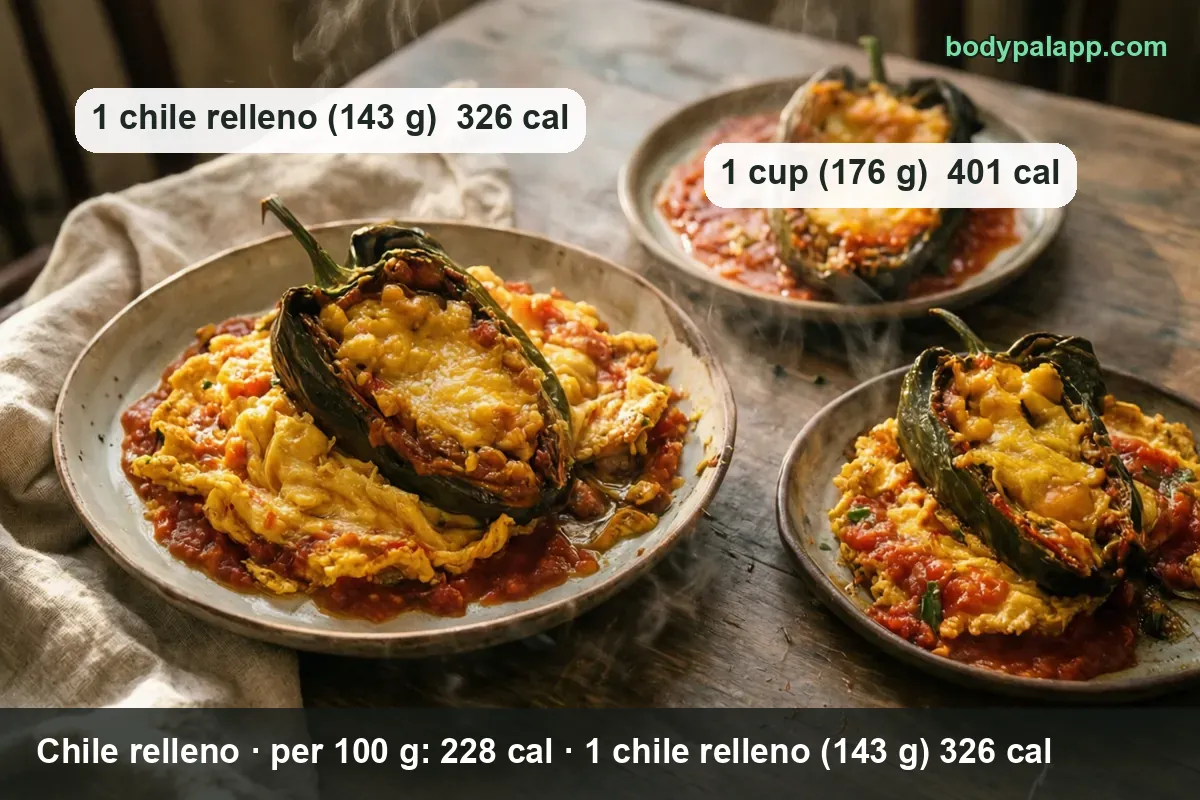
One cheese-filled chile relleno of 143 g is 326 calories, or 228 calories per 100 g. Chop that same pepper into a measuring cup and the figure climbs to 401, because a cup holds 176 g of it. A restaurant plate of two, before the rice and beans arrive, is 652.
On this page
- Chile relleno quick facts
- US servings, from one ounce to a full cup
- Two thirds of the calories are fat
- Cheese only or meat and cheese
- Roasted, battered and frozen versions
- The sodium adds up on a two-pepper plate
- How does a chile relleno compare?
- Most popular chile relleno brands
- FAQ
Chile relleno quick facts
Every figure on this page comes from FNDDS 2710043, "Chiles rellenos, cheese-filled", the USDA survey record for the finished, plated dish rather than for a raw poblano. That distinction matters more here than in most foods: a raw poblano is a vegetable with almost no calories, and a chile relleno is that vegetable after it has been stuffed with cheese, cooked in fat and sauced.
USDA's own household measure for the record is "1 chili" at 143 g, which is the serving column below.
| Nutrient | Per 100 g | Per 1 chile relleno (143 g) | % Daily Value |
|---|---|---|---|
| Calories | 228 | 326 | — |
| Total fat | 17.2 g | 24.6 g | 32% |
| Saturated fat | 6.1 g | 8.7 g | 44% |
| Carbohydrate | 10.4 g | 14.8 g | 5% |
| Dietary fiber | 0.7 g | 1.0 g | 4% |
| Total sugars | 1.5 g | 2.1 g | — |
| Protein | 7.8 g | 11.2 g | 22% |
| Sodium | 445 mg | 636 mg | 28% |
% Daily Value is based on a 2,000-calorie diet.
Verified nutrition data
Numbers on this page come from USDA FoodData Central, the U.S. Department of Agriculture’s food composition database, and from manufacturer labels where a branded product is named. Last verified September 2026. How we verify our data →
Two rows a packaged label would carry are absent, and for a single reason: the 2021–2023 FNDDS release publishes no added sugars and no trans fat value for its mixed dishes. Borrowing those from a frozen product would mean stapling one food's label onto another food's record, so they are left out. Total sugars carry no Daily Value on a US label either, which is why that cell is blank.
Two more numbers sit outside the standard label but come from the same record. Cholesterol is 30 mg per 100 g, so 43 mg in one pepper, roughly a seventh of the 300 mg Daily Value. Potassium is 119 mg per 100 g, or 170 mg in a pepper, about 4% of the day.
One row deserves a second look before anything else. Saturated fat is 44% of the Daily Value in a single pepper — nearly half a day's allowance in one item that most people order two of.
US servings, from one ounce to a full cup
| Serving | Weight | Calories |
|---|---|---|
| 1 oz | 28.35 g | 65 |
| Per 100 g | 100 g | 228 |
| 1 chile relleno, USDA household measure | 143 g | 326 |
| 1 cup, chopped | 176 g | 401 |
USDA lists two real portions for this record and they are only 33 g apart, which is exactly why they cause trouble. The whole pepper is 143 g. The cup measure is 176 g, because cutting a stuffed pepper up and pressing it into a cup fits more of it into the same volume. The 1 oz and per-100 g rows are our own scaling of the same record, not USDA household measures.
Log "1 cup" when what you ate was one pepper and you have added 75 calories that were never on the plate. Do it the other way around, log the pepper when you ate a cupful off a combination platter, and you are 75 short. Neither error is dramatic on its own. Both of them repeat every single time, always in the same direction, which is what makes a food log drift.
Raw against cooked does not apply here the way it does to meat or rice. The USDA record describes the dish as served — pepper, cheese, coating and sauce, already cooked — so there is no second weight to convert from. The ounce row is the useful one for a shared plate: four bites of about an ounce each and you have eaten most of a pepper.
Two thirds of the calories are fat
Split the 228 calories in 100 g by where they come from and the vegetable stops being the story. Fat contributes about 155 of the 228 calories, since 17.2 g of it at 9 calories per gram is 154.8. Carbohydrate and protein together supply the rest.
That is a fat share of roughly 68%, which is the highest thing on this page and the reason the percentage column reads the way it does. One pepper is 5% of the day's carbohydrate but 32% of the day's total fat, measured against the FDA Daily Values of 275 g and 78 g.
Saturated fat is the sharper number. Melted cheese inside a coating that has been cooked in oil puts 8.7 g into one pepper, 44% of the 20 g Daily Value. Federal advice keeps saturated fat under 10% of daily calories, a limit the Dietary Guidelines for Americans restate in every edition. Two peppers clear that limit by themselves.
The flip side is worth saying plainly, because the internet tends to file this dish under "heavy Mexican food" and stop there. Carbohydrate is genuinely low: 14.8 g in a whole pepper, less than half what a gordita or a pupusa brings. If you are counting carbs rather than calories, a chile relleno is one of the lighter things on a Mexican menu. If you are counting calories, it is one of the heavier ones. Both are true, and which one matters depends on what you are tracking.
Cheese only or meat and cheese
USDA keeps a second survey record for the version with picadillo in it, FNDDS 2710044, "Chiles rellenos, filled with meat and cheese", and the comparison is a small surprise.
Per 100 g it is 230 calories against 228. One pepper is 329 calories against 326, and a cup is 405 against 401. Three calories. Adding ground meat to a chile relleno does essentially nothing to the calorie count, because the meat replaces cheese rather than joining it.
What does move is the protein. The meat-filled pepper carries 12.9 g of protein against 11.2 g, a 15% rise, while carbohydrate drops from 14.8 g to 13.9 g and fat is a shade lower at 24.5 g. Sodium is the one number that improves noticeably: 602 mg instead of 636 mg.
So if a menu offers both and you want the better nutritional deal, take the meat one. Same calories, more protein, slightly less sodium. It is rare for a choice this simple to be this one-sided.
Roasted, battered and frozen versions
| Version | Per 100 g | Serving | Calories |
|---|---|---|---|
| Cheese-filled, USDA survey record | 228 | 1 chile (143 g) | 326 |
| Filled with meat and cheese | 230 | 1 chile (143 g) | 329 |
| Frozen roasted, retail tray | 134 | 1 tray (284 g) | 381 |
| Frozen battered, retail | 274 | 1 piece (113 g) | 310 |
| Restaurant plate, two peppers | 228 | 2 chiles (286 g) | 652 |
The frozen aisle splits this dish in two, and the split is bigger than any difference between fillings.
A roasted frozen relleno, the kind that comes on a tray with sauce and no batter, runs 134 calories per 100 g. That is 41% below the USDA survey figure. The whole 284 g tray is 381 calories with 23.0 g of protein, 34.0 g of carbohydrate and 19.0 g of fat, which makes a full frozen dinner cheaper in calories than one and a quarter restaurant peppers. No egg batter and no fryer is the entire explanation.
A battered frozen relleno goes the other way: 274 calories per 100 g, about 20% above the USDA figure, so one 113 g piece is 310 calories with 9.0 g of protein and 29.0 g of fat. Same dish, same freezer, and the coating alone moves the density by more than a hundred calories per 100 g.
This is why "chile relleno calories" has no single honest answer without a second question attached. Roasted or battered? A tray of the first and two pieces of the second differ by nearly 240 calories for a similar-looking dinner. Read the box, not the dish name.
The bottom row is the one restaurants actually serve, and it is our doubling of the USDA record rather than a portion USDA publishes. Two peppers is 286 g and 652 calories, carrying 49.2 g of fat (63% of the Daily Value) and 17.4 g of saturated fat, which is 87% of a day. That is the plate on its own, with no rice, no refried beans and no tortillas counted.
The sodium adds up on a two-pepper plate
Cheese is salt in solid form, and it shows. One pepper holds 636 mg of sodium, 28% of the 2,300 mg Daily Value.
That is a reasonable number for a main dish. The problem is the arithmetic of the standard order: two peppers is 1,272 mg, or 55% of the day, and that is before the rice and beans that arrive on the same plate. More than half a day's sodium in the part of the meal you did not choose for salt.
Anyone watching sodium has one lever here that works. The meat-and-cheese version comes in at 602 mg per pepper instead of 636, which saves 68 mg across a plate of two — real, but small. The frozen roasted tray is the bigger move, and the plate-building advice from MyPlate applies straightforwardly: what surrounds the pepper is where the rest of the day's sodium is decided.
Protein deserves a mention on the other side of the ledger. One pepper delivers 11.2 g, 22% of the Daily Value, and a plate of two gives 22.4 g. Fiber does not follow: 1.0 g in a whole pepper, 4% of the day. A poblano is mostly water, and stuffing it with cheese does not add fiber.
How does a chile relleno compare?
| Item | Per 100 g | Serving | Calories | Protein / Carbs / Fat |
|---|---|---|---|---|
| Chile relleno, cheese-filled | 228 | 1 chile (143 g) | 326 | 11.2 / 14.8 / 24.6 g |
| Fajita, beef or pork | 231 | 1 fajita (95 g) | 219 | 11.5 / 17.1 / 11.6 g |
| Mexican pizza | 249 | 1 pizza (100 g) | 249 | 15.5 / 15.3 / 13.9 g |
| Gordita with beans | 207 | 1 item (175 g) | 362 | 10.2 / 35.3 / 20.7 g |
| Pupusa with beans | 229 | 1 item (130 g) | 298 | 7.3 / 41.0 / 11.7 g |
All five are USDA survey records from the same family of Mexican mixed dishes, so this is a fair fight. Per 100 g they sit inside a narrow band, 207 to 249, a spread of 20%. Per item they range from 219 to 362, a spread of 65%. Density barely separates these foods. Size does almost all of the work.
Our take: the fajita is the pick if you want the smallest number, at 219 calories with 11.5 g of protein and less than half the fat of a relleno. For protein per calorie the Mexican pizza wins outright — 15.5 g in 249 calories beats everything else here. The chile relleno's real claim is the carbohydrate column: 14.8 g against 35.3 for a gordita and 41.0 for a pupusa, which makes it the obvious order on a low-carb night and a poor one on a low-fat night. Its 24.6 g of fat is the highest figure in the table by a clear margin, and that, not the pepper, is what you are paying for.
Most popular chile relleno brands in the United States
Ranked by how widely each product appears among foods sold in the United States, from the BodyPal food database of over 3.3 million products. Calories are the figures printed on each Nutrition Facts label, checked against USDA FoodData Central.
| Product | Calories (per 100 g) |
|---|---|
| Cedarlane Roasted Chile Relleno | 134 cal |
| El Monterey Chile Rellenos | 274 cal |
| Cabo Classic Chile Rellenos | 162 cal |
| Sun Harvest Roasted Chile Relleno | 134 cal |
Brand popularity: BodyPal food database. Nutrition: manufacturer labels / USDA FoodData Central.
Chile relleno FAQs
How many calories are in a chile relleno?
326 calories in one cheese-filled chile relleno of 143 g, which is 228 calories per 100 g. That serving carries 24.6 g of fat, 14.8 g of carbohydrate, 11.2 g of protein and 636 mg of sodium. A plate of two is 652 calories before rice and beans.
How many calories are in a cup of chile relleno?
401 calories for 1 cup chopped, because a cup holds 176 g against 143 g for a whole pepper. That is 75 calories more than the single pepper most people picture. USDA lists both measures for the same record, so logging the wrong one shifts your day by a fixed amount every time.
Is a chile relleno with meat higher in calories than one with cheese?
Barely — 329 calories against 326 for a 143 g pepper, a difference of three. The meat displaces cheese rather than adding to it. Protein rises 15% to 12.9 g, carbohydrate drops to 13.9 g and sodium falls from 636 mg to 602 mg, so the meat version is the better deal at the same cost.
Is a chile relleno high in fat?
Yes — one pepper holds 24.6 g of fat, 32% of the 78 g Daily Value, and 8.7 g of saturated fat at 44% of its 20 g Daily Value. Fat supplies roughly 155 of the 228 calories in 100 g, about two thirds of the total. Melted cheese cooked in oil is what the number measures.
How many carbs and how much protein are in a chile relleno?
14.8 g of carbohydrate and 11.2 g of protein in one 143 g pepper, which is 5% and 22% of the Daily Values. That is the lowest carbohydrate figure on a typical Mexican plate: a gordita with beans brings 35.3 g and a pupusa with beans 41.0 g for a similar-size item.
How many calories are in a frozen chile relleno?
134 calories per 100 g for a frozen roasted relleno, so a 284 g tray is 381 calories, and the coating decides everything. A frozen battered one runs 274 per 100 g, so a single 113 g piece is 310. Roasted is 41% below the USDA restaurant figure and battered is about 20% above it.
How much sodium is in a chile relleno?
636 mg in one 143 g pepper, 28% of the 2,300 mg Daily Value, from 445 mg per 100 g. Two peppers reach 1,272 mg, or 55% of the day, before any rice or beans on the same plate. The meat-and-cheese version is slightly lower at 602 mg.
How many calories are in two chiles rellenos?
652 calories for 286 g, the standard restaurant plate. It carries 49.2 g of fat at 63% of the Daily Value and 17.4 g of saturated fat at 87%, along with 22.4 g of protein. Rice, refried beans and tortillas are all extra on top of that figure.
Similar foods
- French Toast — 149 cal per slice
- Blt — 243 cal per sandwich
- Blt Sandwich — 243 cal per sandwich
- Chicken Thigh — 318 cal per thigh
- Whopper — 678 cal per sandwich
- Carne Asada — 264 cal per 4 oz
Count it without the math
Point the camera at the plate and BodyPal tells you whether that was one pepper or a cupful, and what the second one costs.


How long does it take to burn off chile relleno?
One chile relleno (143 g) is 326 kcal. Enter your weight and the amount you ate to see how long it takes you to burn that off:
lb
| Activity | Time to burn 326 kcal |
|---|---|
| Walking, brisk | 1 hr 5 min |
| Cycling, moderate | 41 min |
| Swimming, moderate | 47 min |
| Jogging | 38 min |
| Weight training, moderate | 1 hr 12 min |
Times are for a 155 lb adult at a steady pace; change the weight to see yours. The amount is set to the portion in the text (143 g); change it to what you actually ate. BodyPal works this out from your steps automatically.
Want the bigger picture? Calculate your daily calorie needs — your maintenance figure, a target for losing or gaining, and the date you get there.