
How Many Calories Are in Chinese Chicken and Broccoli?
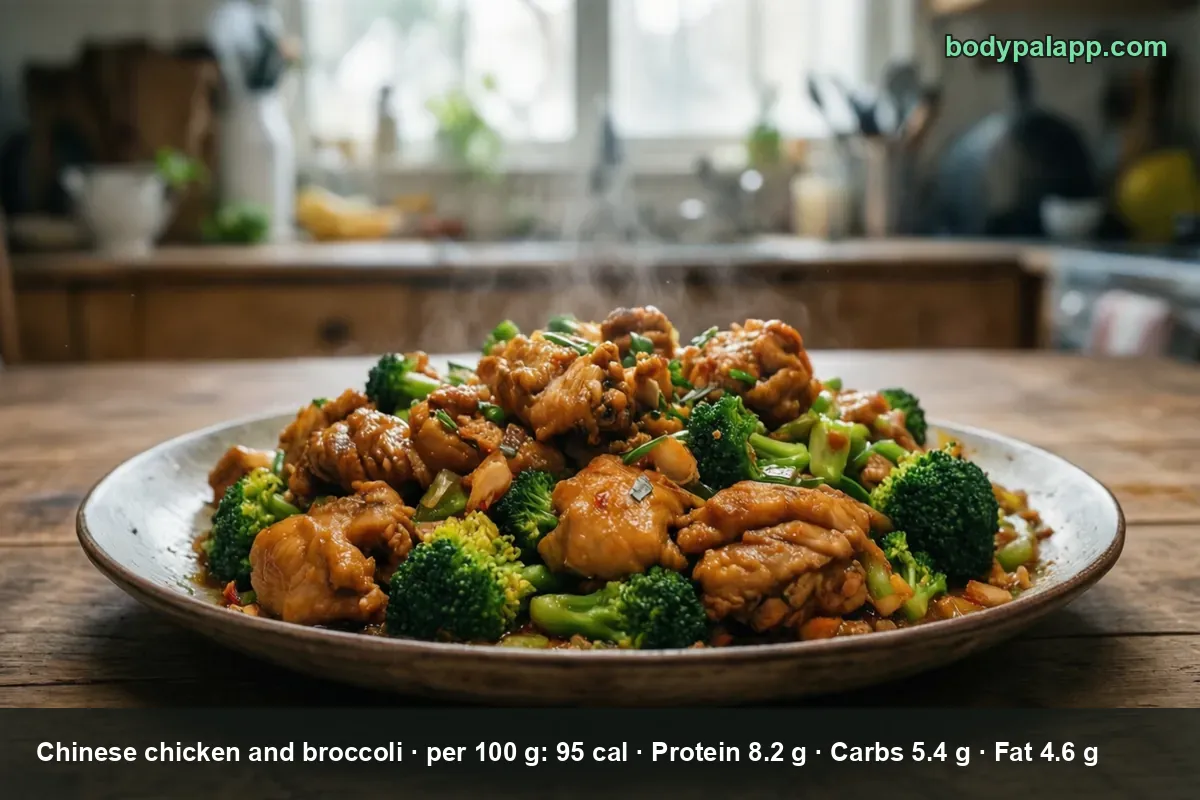
Chinese chicken and broccoli is 206 calories for 1 cup (217 g), or 95 calories per 100 g. That makes it one of the lighter hot entrées on most takeout menus, as long as the rice stays in its own container. A two-cup entrée runs 412. Order the same dish over rice and one cup becomes 284.
On this page
- Chinese chicken and broccoli quick facts
- The USDA record that has no name
- The sauce brings the sodium, not the chicken
- Servings, from one ounce to the takeout box
- What the rice costs
- Steamed, beef, or straight from the freezer
- Protein per calorie is where this dish wins
- How does chinese chicken and broccoli compare?
- Most popular chinese chicken and broccoli brands
- FAQ
Chinese chicken and broccoli quick facts
The reference is the dish as it comes out of the carton: chicken pieces and broccoli in a brown soy-based sauce, no rice underneath, 1 cup on the plate at 217 g.
| Nutrient | Per 100 g | Per 1 cup (217 g) | % Daily Value |
|---|---|---|---|
| Calories | 95 | 206 | — |
| Total fat | 4.56 g | 9.9 g | 13% |
| Saturated fat | 0.77 g | 1.7 g | 8% |
| Carbohydrate | 5.38 g | 11.7 g | 4% |
| Dietary fiber | 0.9 g | 2.0 g | 7% |
| Total sugars | 2.93 g | 6.4 g | — |
| Protein | 8.18 g | 17.8 g | 36% |
| Sodium | 413 mg | 896 mg | 39% |
| Cholesterol | 21 mg | 46 mg | 15% |
| Potassium | 185 mg | 401 mg | 9% |
% Daily Value is based on a 2,000-calorie diet.
Verified nutrition data
Numbers on this page come from USDA FoodData Central, the U.S. Department of Agriculture’s food composition database, and from manufacturer labels where a branded product is named. Last verified September 2026. How we verify our data →
Two rows that appear on a packaged label are missing here on purpose. USDA publishes no added sugars figure and no trans fat figure for this record, and a blank is not a zero, so neither line is filled with a borrowed number. Total sugars carry no Daily Value at all under the FDA label rules, which is why that cell is empty too.
Read the table sideways and the shape of the dish appears. Fat, saturated fat and carbohydrate all sit at 13% of the day or below. Protein is at 36% and sodium at 39% — one cup, two big numbers, and neither of them is the one people search for.
The USDA record that has no name
Here is a small oddity. Search USDA FoodData Central for "beef and broccoli" and a record comes back with exactly that name. Search for chicken and broccoli and nothing does. The dish that outsells it has no entry of its own.
What it has instead is FNDDS record 2706790, described as "Chicken or turkey and vegetables including carrots, broccoli, and/or dark-green leafy; no potatoes, soy-based sauce" and filed under stir-fry and soy-based sauce mixtures. Strip the survey language and that is the carton: poultry, broccoli, brown sauce, no starch.
There is a near-twin one row over, 2706791, identical except that it excludes broccoli. It runs 133 calories per 100 g with 8.22 g of fat against 4.56. Choosing between them is not a matter of taste. A plate dominated by broccoli is wetter, leaner and sweeter than one dominated by other vegetables, and the numbers say which is which.
No blending happened. The 95 is one record's figure, not an average of several, because an average of two dishes describes neither.
The sauce brings the sodium, not the chicken
Take the dish apart and the salt has nowhere to hide.
- Boiled broccoli, unsalted (SR record 169967): 41 mg of sodium per 100 g
- Roasted chicken breast (SR record 171477): 74 mg per 100 g
- The finished takeout dish: 413 mg per 100 g
The two things named in the dish contribute almost none of it. Everything else — soy sauce, oyster sauce, the brine on the chicken, the seasoning in the wok — contributes the rest.
One cup lands at 896 mg, which is 39% of the day. The CDC puts the ceiling at 2,300 mg. A restaurant entrée is rarely one cup, though: two cups is the usual carton, and that is 1,792 mg, or 78% of the day — roughly three quarters of a teaspoon of table salt, before any rice, egg roll or dipping sauce joins it.
The obvious fix does not work as well as it should. Ask for it steamed with the sauce on the side and the USDA row for chicken and vegetables with no sauce still reads 386 mg per 100 g against 413. Skipping the sauce saves about 6% of the sodium and costs you the flavor. It saves nothing at all on calories, as the next table shows.
Servings, from one ounce to the takeout box
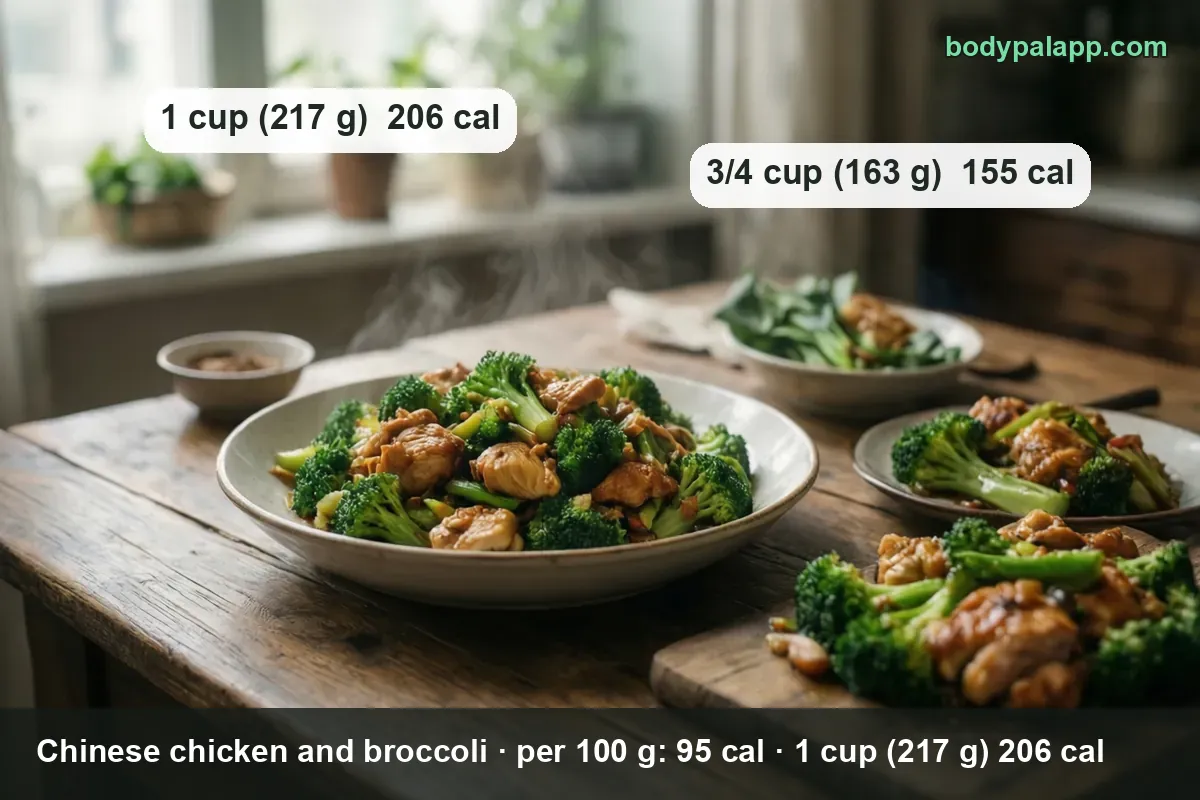
| Serving | Weight | Calories |
|---|---|---|
| 1 cup | 217 g | 206 |
| 3/4 cup | 163 g | 155 |
| 2 cups, takeout entrée | 434 g | 412 |
| 1 oz | 28 g | 27 |
| 100 g | 100 g | 95 |
The cup and the three-quarter cup come straight from USDA's portion table for this record. The two-cup row is our own doubling of the USDA cup, sized to the standard white takeout carton rather than measured from one, and the ounce row is our own scaling of the 100 g figure down to 28 g.
That cup weighs 217 g, which is 7.7 oz. It is worth saying out loud, because "a cup" sounds like a modest amount of food and 7.7 oz of anything is not modest. Anyone logging by the ounce is working in units almost eight times smaller than the one the portion table uses, and the gap between "I had a cup" and "I had an ounce" is 179 calories.
The three-quarter cup is the useful serving. At 155 calories with 13 g of protein it is a real side dish next to something else, and it is what most people actually spoon out when they share a carton.
What the rice costs
The variant query behind this dish is "chicken and broccoli with rice", and USDA lists it as its own record, 2706695: same chicken, same soy-based sauce, rice mixed in.
| Version | Per 100 g | 1 cup | Calories |
|---|---|---|---|
| Chicken and broccoli, no rice | 95 | 217 g | 206 |
| Chicken and broccoli with rice | 131 | 217 g | 284 |
Thirty-six calories per 100 g does not sound like a decision. Across the same cup it is 78 calories, a 38% increase for an identical volume of food, and the cup is not where most people stop — a carton of the rice version is 568 calories against 412.
The trade is not all bad. The rice version carries more protein per cup, 20.3 g against 17.8, simply because there is more food in the same cup once the air between broccoli florets is filled in. Sodium per 100 g actually drops, from 413 to 307, for the same reason: rice dilutes it.
Density is the thing to watch. Rice makes every gram count for more, which is exactly why the calorie total climbs while the per-100 g sodium falls.
Steamed, beef, or straight from the freezer
The original and five versions of the same idea, priced side by side.
| Version | Per 100 g | Serving | Calories |
|---|---|---|---|
| Chicken and broccoli, soy sauce | 95 | 1 cup (217 g) | 206 |
| With rice | 131 | 1 cup (217 g) | 284 |
| Steamed, no sauce | 118 | 1 cup (162 g) | 191 |
| Beef and broccoli | 160 | 1 cup (217 g) | 347 |
| Moo goo gai pan | 69 | 1 cup (216 g) | 149 |
| Frozen, InnovAsian Chicken & Broccoli | 141 | 1 cup (170 g) | 240 |
The steamed row is the surprise of the table. Ordering it with no sauce raises the calories per 100 g from 95 to 118, because the sauce is mostly water and the version without it is denser meat and vegetable. Its cup is smaller, at 162 g, so the plate ends up lighter — but per gram of food, "no sauce" is the heavier choice, not the lighter one.
Moo goo gai pan is the genuinely light order at 69 calories per 100 g. Beef and broccoli is the same dish with the protein swapped and 68% more calories per gram.
The freezer version is denser than the restaurant one: 141 calories per 100 g against 95, so a 170 g cup out of the bag is 240 calories. Frozen entrées are built to survive reheating, which means less water and more sauce solids per gram.
Protein per calorie is where this dish wins
One cup gives 17.8 g of protein for 206 calories — 36% of the Daily Value from a dish that reads like a vegetable side.
Compare it with the beef version at the same cup size. Beef and broccoli brings 22.6 g of protein, more in absolute terms, for 347 calories and 23.1 g of fat. Per calorie eaten, the chicken version delivers noticeably more protein, and it does it with less than half the fat.
That ratio is why MyPlate counts a stir-fry like this in the protein group rather than the vegetable group, even though broccoli shares the fork with the chicken. The dish is chicken with a vegetable, not the other way around.
Fiber is the weak line. 2.0 g per cup is 7% of the day, because a takeout portion holds fewer florets than it appears to once the sauce is accounted for.
How does chinese chicken and broccoli compare?
Every row is a USDA survey record, each at its own cup weight, which is the way it arrives on a table.
| Item | Per 100 g | 1 cup | Calories | Protein per 100 g | Fat per 100 g |
|---|---|---|---|---|---|
| Chinese chicken and broccoli | 95 | 217 g | 206 | 8.2 g | 4.6 g |
| Moo goo gai pan | 69 | 216 g | 149 | 7.1 g | 2.4 g |
| Chicken and broccoli with rice | 131 | 217 g | 284 | 9.4 g | 6.9 g |
| Beef and broccoli | 160 | 217 g | 347 | 10.4 g | 10.6 g |
| General Tso chicken | 295 | 146 g | 431 | 12.9 g | 16.4 g |
Look at the last row twice. General Tso chicken is 431 calories in a cup that weighs 146 g, a third less food than the 217 g cup of chicken and broccoli at 206. Battering and glazing the same bird more than doubles the calories while shrinking the portion. Kung pao chicken sits between them at 129 calories per 100 g.
Our take: if you want the smallest number on a Chinese menu, moo goo gai pan wins at 149 a cup and it is not close. If you want a meal that ends the protein question for the afternoon, chicken and broccoli is the better order — 206 calories, 17.8 g of protein, and the fat is less than half of what the beef version carries. Beef and broccoli earns its place only when 23.1 g of fat per cup is what you came for, and General Tso is a different food wearing the same jacket.
Most popular chinese chicken and broccoli brands in the United States
Ranked by how widely each product appears among foods sold in the United States, from the BodyPal food database of over 3.3 million products. Calories are the figures printed on each Nutrition Facts label, checked against USDA FoodData Central.
| Product | Calories (per 100 g) |
|---|---|
| InnovAsian Chicken & Broccoli | 141 cal |
Brand popularity: BodyPal food database. Nutrition: manufacturer labels / USDA FoodData Central.
Chinese chicken and broccoli FAQs
How many calories are in Chinese chicken and broccoli?
206 calories for 1 cup (217 g), or 95 calories per 100 g, using USDA survey record 2706790 for chicken and vegetables in a soy-based sauce with no potatoes. Three-quarters of a cup is 155. A two-cup takeout entrée is 412.
How many calories in chicken and broccoli from a Chinese restaurant?
About 412 calories, because a restaurant entrée is roughly two cups (434 g) rather than one. That portion also carries 1,792 mg of sodium, which is 78% of the Daily Value. Rice is served separately and adds to both numbers.
How many calories in chicken and broccoli with rice?
284 calories per cup (217 g), at 131 calories per 100 g, from USDA record 2706695. That is 78 more than the same cup without rice, a 38% increase for the same volume of food. A two-cup entrée over rice comes to 568.
How much protein is in chicken and broccoli?
17.8 g in one cup (217 g), which is 36% of the Daily Value, or 8.18 g per 100 g. Beef and broccoli gives more in absolute terms, 22.6 g, but costs 347 calories and 23.1 g of fat for it. Per calorie, the chicken version is the stronger protein source.
Is Chinese chicken and broccoli healthy?
It is 206 calories a cup with 17.8 g of protein, 2.0 g of fiber and only 1.7 g of saturated fat, which is a good return for a takeout dish. The number that needs managing is sodium: 896 mg per cup, 39% of the Daily Value, and 1,792 mg in a two-cup entrée.
How much sodium is in chicken and broccoli?
896 mg in one cup (217 g), or 413 mg per 100 g. Almost none of it comes from the named ingredients: unsalted boiled broccoli is 41 mg per 100 g and roasted chicken breast is 74 mg. The sauce, the brine and the wok seasoning supply the rest.
Chicken and broccoli or beef and broccoli, which has fewer calories?
Chicken, by a wide margin: 95 calories per 100 g against 160, or 206 a cup against 347. The fat gap is the reason, at 4.6 g per 100 g against 10.6. Beef returns 22.6 g of protein per cup to the chicken version's 17.8.
Does ordering chicken and broccoli steamed with no sauce save calories?
Not per gram. The USDA record for chicken and vegetables with no sauce is 118 calories per 100 g against 95 with the soy-based sauce, because sauce is mostly water. Its cup weighs 162 g, so the plate comes to 191 calories, and sodium only falls from 413 mg per 100 g to 386.
Similar foods
- Ham Lunch Meat — 28 cal per slice
- Tripe — 125 cal per cup
- Chicken Souvlaki — 160 cal per cup
- Pork And Beans — 273 cal per cup
- Turkey deli meat — 89 cal for 3 slices
- Turkey Ham — 59 cal for 2 slices
Count it without the math
Point the camera at the carton and BodyPal logs the calories, the protein and the sodium in one shot.


How long does it take to burn off 206 kcal of Chinese chicken & broccoli?
1 cup (217 g) is 206 kcal. Enter your weight and the amount you ate to see how long it takes you to burn that off:
lb
| Activity | Time to burn 206 kcal |
|---|---|
| Walking, brisk | 41 min |
| Cycling, moderate | 26 min |
| Swimming, moderate | 29 min |
| Jogging | 24 min |
| Weight training, moderate | 46 min |
Times are for a 155 lb adult at a steady pace; change the weight to see yours. The amount is set to the portion in the text (217 g); change it to what you actually ate. BodyPal works this out from your steps automatically.
One food is easy to picture; a whole day is harder. See how many calories you need a day and what a deficit actually looks like.