Chocolate calories come to 235 for a 44 g milk chocolate bar and 535 per 100 g. Half of those calories come from fat, but sugar is the number that stands out: a single bar carries 22.7 g of it, and every 100 g holds 51.5 g. The size of the piece decides almost everything else.
235kcal
1 bar · 44 g, milk chocolate
6%protein
3.4 gProtein
26 gCarbs
13.1 gFat
How to burn off 235 kcal
—Walking, brisk
—Jogging
—Cycling, moderate
—Swimming
Skip the math. BodyPal counts these calories from your steps and workouts automatically.
Nutrition facts
Milk chocolate · per 44 g
Calories
235 kcal
Protein
3.4 g
Carbohydrate
26 g
Fat
13.1 g
Saturated fat
8.1 g
Cholesterol
10 mg
Sodium
35 mg
Potassium
164 mg
Iron
1 mg
Source: USDA FoodData Central
🛡️
Verified nutrition data
Numbers on this page come from USDA FoodData Central, the U.S. Department of Agriculture’s food composition database, and from manufacturer labels where a branded product is named. Last verified September 2026. How we verify our data →
Chocolate: calories, protein and sodium by serving
Percent of daily value uses the FDA reference of 2,000 kcal a day.
Serving
kcal
Protein
Carbs
Fat
Sodium
% DV kcal
1 bar (44 g)
235
3.4 g
26.1 g
13.1 g
35 mg
12%
Miniature bar (7 g)
37
0.5 g
4.2 g
2.1 g
6 mg
2%
1 oz portion (28 g)
150
2.1 g
16.6 g
8.3 g
22 mg
7%
100 g
535
7.7 g
59.4 g
29.7 g
79 mg
27%
3 × 1 bar (44 g)
706
10.1 g
104 mg
5 × 1 bar (44 g)
1,177
16.8 g
174 mg
A miniature bar is 37 calories, a full bar 235
The USDA row behind this page is plain milk chocolate, and the piece you pick moves the total more than anything else. A miniature bar of 7 g is 37 calories. A 1 oz portion of 28 g is 150. A standard 44 g bar is 235, which is 12% of the daily value for calories.
Chocolate is easy to stack because the pieces are small and dense. Two bars (88 g) reach 471 calories, three bars (132 g) reach 706, and five bars (220 g) hit 1,177. A 100 g slab is 535 calories, or 27% of the daily calorie value, in a package that fits in a coat pocket.
If you want chocolate without a big bill, the miniature is the cleanest tool. It carries 3.6 g of sugar against 22.7 g in the full bar, and 2.1 g of fat against 13.1 g. Snapping a full bar into squares and putting most of it away works the same way. Calories only count once they are eaten.
Half of every calorie comes from fat
Per 100 g, milk chocolate carries 29.7 g of fat, 59.4 g of carbohydrate and 7.7 g of protein. Fat supplies 50% of the calories, carbs supply 44% and protein just 6%. That split explains the density. Fat packs a lot of energy into very little weight, and chocolate is mostly fat and sugar with little water to dilute it.
Most of the carbohydrate is sugar. Of the 59.4 g of carbs per 100 g, 51.5 g is sugars, while fiber is only 3.4 g. In a 44 g bar that works out to 26.1 g of carbs, 22.7 g of sugars and 1.5 g of fiber, so very little of the carb load comes from anything slow to digest.
Protein barely registers. A full bar has 3.4 g, which is 7% of the daily value, so chocolate will not do much to hold you over between meals. Treat it as a treat rather than a snack that carries you to dinner.
Saturated fat and sugar are the rows to watch
Per 100 g, milk chocolate has 18.5 g of saturated fat. The daily value used on this page is 20 g, so a 100 g bar comes close to a full day's worth on its own. Total fat in that same 100 g is 29.7 g against a daily value of 78 g.
Sugar runs just as high. At 51.5 g per 100 g, sugars make up roughly half the weight of milk chocolate. A 1 oz portion carries 14.4 g, a full 44 g bar carries 22.7 g, and even a miniature bar brings 3.6 g. If you track added sugar, chocolate is one of the fastest ways to use up the day.
Sodium is not the issue here. A bar has 35 mg, just 2% of the 2300 mg daily value, and cholesterol is 23 mg per 100 g. Potassium is a small plus at 372 mg per 100 g, though nobody should pick chocolate for its minerals.
Small pieces fit a day better than whole bars
Chocolate works best as a planned portion rather than something eaten straight from the wrapper. Choosing a miniature bar at 37 calories or a 1 oz portion at 150 lets you enjoy it without crowding out meals that carry more protein and fiber.
Pairing chocolate with foods that bring what it lacks makes the snack more satisfying. Fruit adds fiber and volume, while nuts or plain yogurt add protein. Boxed assortments such as Guylian Assorted Belgian Chocolates or Guylian Temptations Belgian Chocolates are easier to manage when you decide on a number of pieces before the box is open.
If you track intake, log the real weight or the count of pieces, since the gap between a miniature and a 100 g slab is 37 versus 535 calories. BodyPal can log chocolate from a photo, which helps when a bar has already been broken into squares.
How does chocolate compare?
Here is how milk chocolate stacks up against dark chocolate, hot chocolate and Ritz crackers, per 100 g and per usual serving.
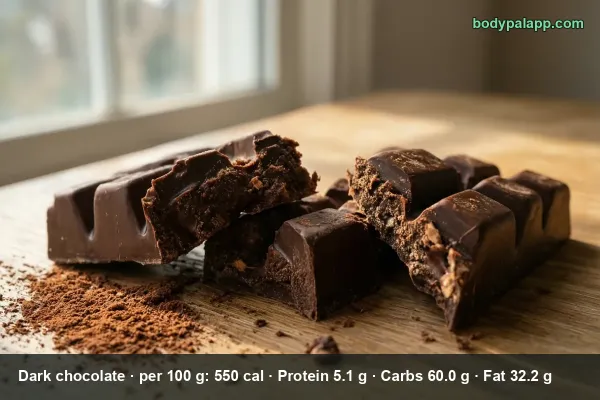
Verdict: Dark chocolate is no lighter at 550 calories per 100 g versus 535 for milk chocolate, so choose it for taste, not to save calories. For the lowest count pick hot chocolate at 91 per 100 g, and if you want a crunchy snack instead, Ritz crackers are 79 calories for 5 crackers but carry 882 mg of sodium per 100 g.
Most popular chocolate brands in the United States
Ranked by popularity in the BodyPal database
# Productkcal / 100 g
1Whole Hazelnut in Milk Chocolate and Nut Croquante100 g603 kcal
2Guylian Artisanal Belgian Chocolates4 pieces · 45 g556 kcal
3Guylian Temptations Belgian Chocolates4 pieces · 38 g579 kcal
4Guylian Assorted Belgian Chocolates4 pieces · 43 g558 kcal
Boxed and filled chocolates carry nuts, cream or praline, so their label numbers read above plain milk chocolate. Source: manufacturer labels / USDA FoodData Central.
Chocolate FAQs
How many calories are in a chocolate bar?
A standard 44 g bar of milk chocolate is 235 calories. A 7 g miniature bar is 37 calories.
Is chocolate good for weight loss?
Milk chocolate is 535 calories per 100 g, among the densest snacks, so one 44 g bar takes 235 calories out of the day and a 7 g miniature only 37.
Which has more calories, milk chocolate or dark chocolate?
Dark chocolate is 550 calories per 100 g and milk chocolate 535, a gap of 15 calories per 100 g.
How much sugar is in chocolate?
Milk chocolate has 51.5 g of sugar per 100 g, which works out to 22.7 g in a 44 g bar.
How many calories are in one small piece of chocolate?
A miniature milk chocolate bar of 7 g has 37 calories. It also carries 3.6 g of sugar and 2.1 g of fat, so several of them add up faster than they seem to.
How many calories are in one serving of chocolate?
A 1 oz portion (28 g) of milk chocolate has 150 calories, or 7% of the daily value. That serving brings 14.4 g of sugars, 8.3 g of fat and 2.1 g of protein.
What are the nutrition facts for chocolate per 100 g?
Per 100 g, milk chocolate has 535 calories, 29.7 g of fat, 59.4 g of carbs, 51.5 g of sugars and 7.7 g of protein. Saturated fat is 18.5 g and sodium is 79 mg.
What are the nutrition facts for a chocolate bar?
A 44 g milk chocolate bar has 235 calories, 13.1 g of fat, 26.1 g of carbs, 22.7 g of sugars, 3.4 g of protein, 1.5 g of fiber and 35 mg of sodium.