
How many calories are in hot chocolate?
A standard 1-cup (248 g) mug of hot chocolate made with whole or 2% milk is 226 calories, or 91 calories per 100 g. Most of that is not fat. It is 41.0 g of carbohydrate and 37.6 g of total sugars, against just 3.8 g of fat and 6.8 g of protein.
On this page
- Hot chocolate quick facts
- US servings from a fluid ounce to a 16 oz mug
- Every USDA version of hot chocolate
- Sugar is the row to watch
- How does hot chocolate compare?
- Most popular hot chocolate brands
- Hot chocolate FAQs
Hot chocolate quick facts
The number here comes from the record for a drink you would actually be holding: FNDDS 2705473, "Hot chocolate / cocoa, made with whole or reduced fat (2%) milk". USDA gives that entry its own household measures — 1 cup at 248 g and 1 fluid ounce at 31 g — so the cup figure is a real serving, not something scaled by hand.
There is also a vaguer "Hot chocolate / cocoa, NFS" entry at 72 calories per 100 g. It sits between the water version and the milk version because it averages preparations, which is exactly what makes it useless when you know what went in your mug. If you stirred a packet into hot milk, the milk record is the honest one.
| Nutrient | Per 100 g | Per 1 cup (248 g) | % Daily Value |
|---|---|---|---|
| Calories | 91 | 226 | — |
| Total fat | 1.54 g | 3.8 g | 5% |
| Saturated fat | 0.9 g | 2.2 g | 11% |
| Carbohydrate | 16.53 g | 41.0 g | 15% |
| Dietary fiber | 0 g | 0 g | 0% |
| Total sugars | 15.18 g | 37.6 g | — |
| Protein | 2.73 g | 6.8 g | 14% |
| Sodium | 60 mg | 149 mg | 6% |
% Daily Value is based on a 2,000-calorie diet.
Verified nutrition data
Numbers on this page come from USDA FoodData Central, the U.S. Department of Agriculture’s food composition database, and from manufacturer labels where a branded product is named. Last verified September 2026. How we verify our data →
Two rows you will not find above: added sugars and trans fat. USDA does not publish either for this FNDDS record, so putting a number there would be invention. Cholesterol and potassium do exist — 17 mg (6% of the Daily Value) and 377 mg (8%) per cup. Percentages follow the FDA Daily Values used on the Nutrition Facts label.
US servings from a fluid ounce to a 16 oz mug
| Serving | Weight | Calories |
|---|---|---|
| 1 fl oz | 31 g | 28 kcal |
| 1 oz | 28.4 g | 26 kcal |
| 1 cup, 8 fl oz | 248 g | 226 kcal |
| 1 mug, 12 fl oz | 372 g | 339 kcal |
| 1 large, 16 fl oz | 496 g | 451 kcal |
| Per 100 g | 100 g | 91 kcal |
Only the 1 cup and 1 fl oz lines are USDA household measures. The 12 fl oz mug, the 16 fl oz large and the 1 oz weight are our own arithmetic from the USDA 100 g figure, not USDA servings.
That distinction is where most people lose track of a few hundred calories. "A cup of hot chocolate" in a nutrition database means 8 fluid ounces. The mug in your cabinet is usually 12, and a coffee-shop large is 16 — the same drink, 451 calories, just about double the cup. Weigh the mug once on a kitchen scale and you will know which line of that table is yours forever.
One more trap: 1 fluid ounce (31 g) and 1 ounce by weight (28.4 g) are not the same thing for a liquid this dense. The gap is small here, 28 calories against 26, but it grows when you start counting in ounces out of habit.
Every USDA version of hot chocolate
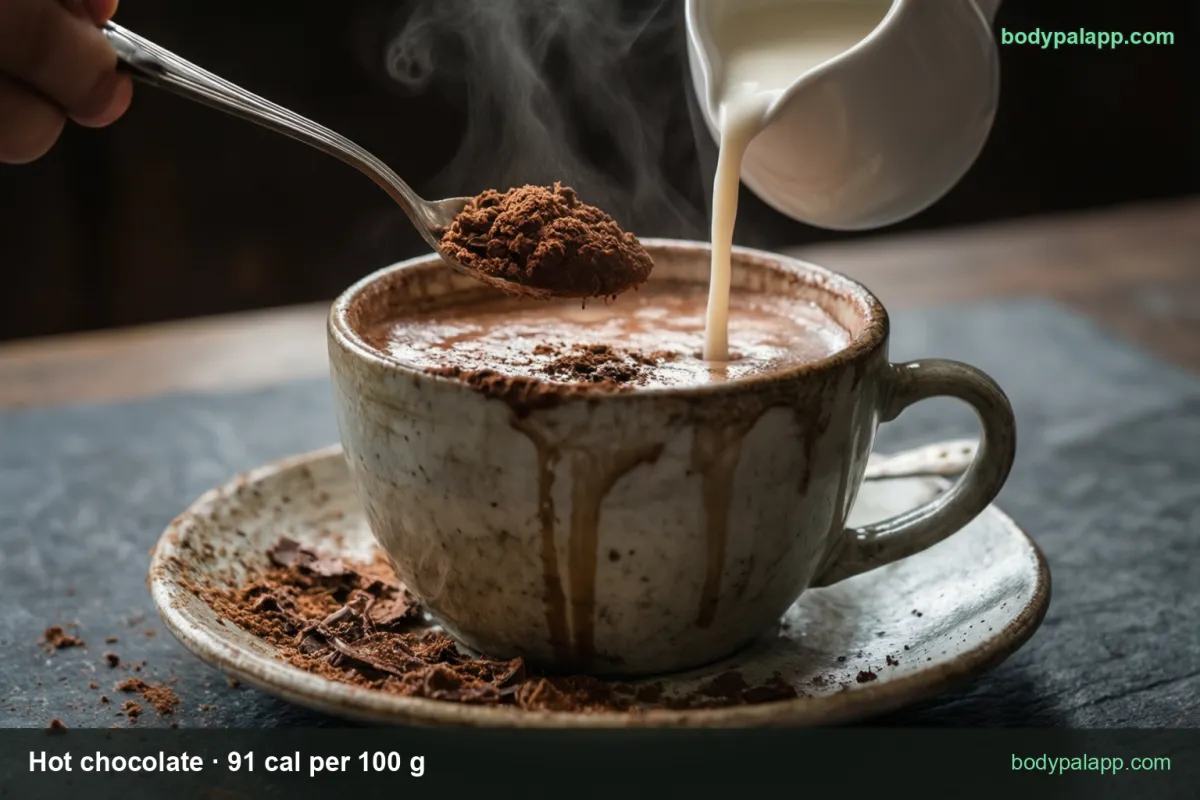
USDA keeps a separate record for each way the drink is built, and they all share the same 1 cup (248 g) measure, so the column below is directly comparable.
| Version | Per 100 g | Calories per cup (248 g) |
|---|---|---|
| Made with water, from a dry mix | 54 kcal | 134 kcal |
| Reduced sugar, with 2% milk | 69 kcal | 171 kcal |
| Average preparation (NFS) | 72 kcal | 179 kcal |
| Made with non-dairy milk | 76 kcal | 188 kcal |
| Made with whole or 2% milk | 91 kcal | 226 kcal |
| From a dry mix with 2% milk | 97 kcal | 241 kcal |
| With whipped cream | 101 kcal | 250 kcal |
Water versus milk is the whole story. A packet mixed with hot water is 134 calories a cup. The same packet in 2% milk is 241. Milk is doing all the work, and it is not free: 92 calories separate the water cup from the plain milk cup, and 107 separate it from the dry-mix-plus-milk version, which also brings more powdered dairy and more salt — 253 mg of sodium per cup, our arithmetic from its 102 mg per 100 g.
Whipped cream costs less than people fear. The topped record is 250 calories a cup, only 24 above the plain milk one. Fat goes from 3.8 g to 6.9 g per cup while sugar barely moves. If you are trimming this drink, the cream on top is not where the calories live.
Non-dairy milk is a protein decision, not a calorie one. At 188 calories a cup it saves 38, but protein falls to 2.3 g against 6.8 g in the dairy version — roughly a third. Skim or 1% milk goes the other way: 78 calories per 100 g, about 193 a cup by our arithmetic, with the protein intact and almost no fat left.
Reduced-sugar mixes are the biggest single lever. 171 calories a cup, and sugar drops to about 23.1 g from the 9.31 g per 100 g in that record, against 37.6 g in the standard cup.
Retail powders are sold by the scoop, not the mug. USDA's branded file puts dry mixes between 314 and 429 calories per 100 g, and a Swiss Miss Hot Chocolate with Marshmallows envelope is 21 g and 90 calories before any liquid touches it. Silly Cow Farms mixes run 314 to 381 per 100 g with 2 tsp servings of 66 to 80 calories. Read those envelope numbers as the powder alone, then add whatever you poured over it.
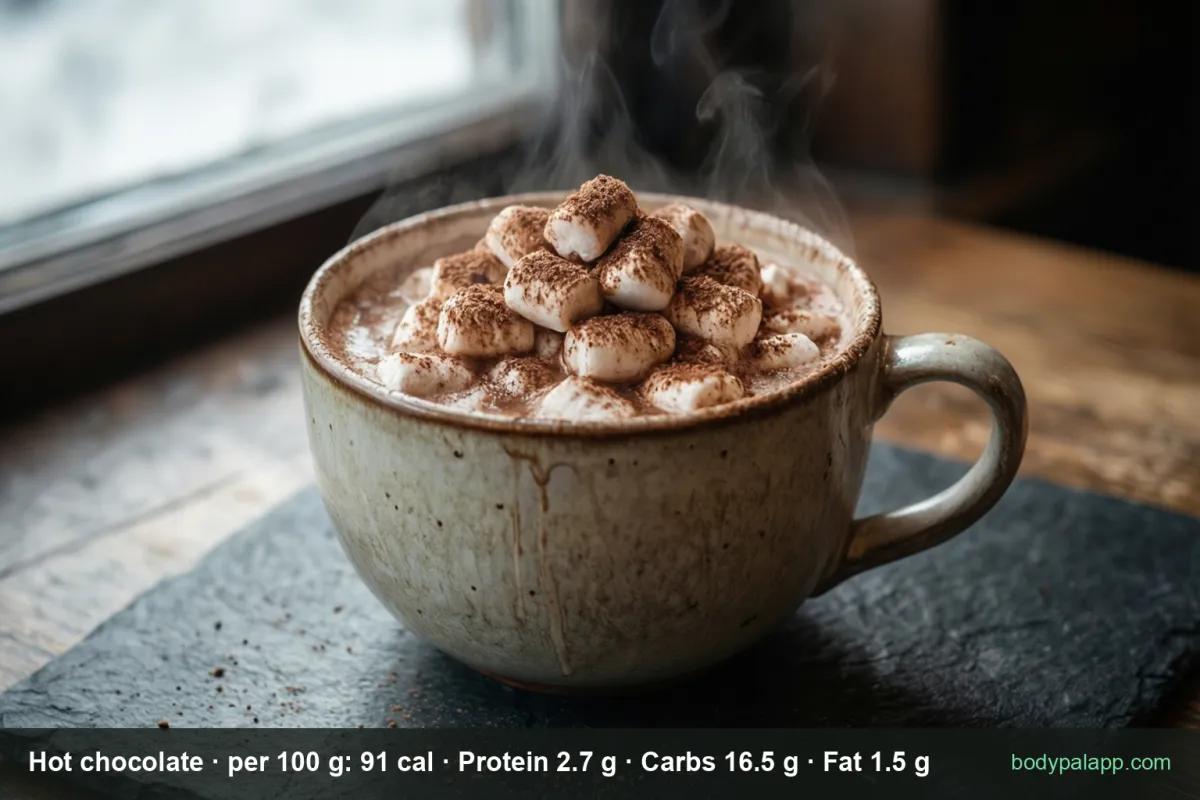
One thing USDA cannot help with: marshmallows on top. There is no FNDDS record for a marshmallow-topped cup, so the honest move is to log the drink and the marshmallows as two items rather than guess at a combined figure.
Sugar is the row to watch
A cup of hot chocolate is not a fatty drink. Saturated fat comes to 2.2 g, 11% of the Daily Value, and sodium to 149 mg, 6%. Cholesterol is 17 mg, also 6%. Those are unremarkable numbers for a hot drink with milk in it.
Sugar is different. One cup carries 37.6 g of total sugars. Part of that is lactose from the milk itself, which is why the figure is labeled total sugars rather than added sugars — USDA does not publish an added sugars value for this record, so there is no % Daily Value to show. The Dietary Guidelines for Americans advise keeping added sugars under 10% of daily calories, and a mix-based hot chocolate is one of the drinks that eats into that allowance fastest.
The upside sits in the protein column: 6.8 g a cup, 14% of the Daily Value, plus 377 mg of potassium. That is real food value, and it is the reason a milk-based cup keeps you going in a way the water version does not. If you are watching calories but want the drink to count for something, the reduced-sugar mix with 2% milk at 171 calories keeps most of the protein and cuts the sugar by about a third.
How does hot chocolate compare?
| Drink | Per 100 g | US serving | Calories |
|---|---|---|---|
| Hot chocolate, 2% milk | 91 kcal | 1 cup, 248 g | 226 kcal |
| Chocolate milk, reduced fat 2% | 76 kcal | 1 cup, 248 g | 188 kcal |
| Malted milk | 66 kcal | 1 cup, 248 g | 164 kcal |
| Chocolate milk, reduced sugar, 2% | 63 kcal | 1 cup, 248 g | 156 kcal |
Our take: hot chocolate is the heaviest of these four, per 100 g and per cup, and the gap to reduced-sugar chocolate milk is 70 calories for what is essentially the same flavor. If you drink one a day, that is the swap worth making. If hot chocolate is an evening thing rather than a habit, the 226-calorie cup is a reasonable dessert-sized drink with 6.8 g of protein attached — treat it as food and stop trying to shave it. What we would not do is drink the 16 fl oz version and call it a beverage; at 451 calories it is a meal component.
Most popular hot chocolate brands in the United States
Ranked by how widely each product appears among foods sold in the United States, from the BodyPal food database of over 3.3 million products. Calories are the figures printed on each Nutrition Facts label, checked against USDA FoodData Central.
| Product | Calories (per 100 g) |
|---|---|
| Silly Cow Farms Hot Chocolate | 381 cal |
| Silly Cow Farms Chocolate Truffle Hot Chocolate | 381 cal |
| Skeleton House Spirited Double Chocolate Cocoa | 400 cal |
| Swiss Miss Hot Chocolate with Marshmallows | 429 cal |
| Franzese Hot Chocolate | 342 cal |
| Silly Cow Farms Jersey Milk Chocolate Hot Chocolate | 314 cal |
Brand popularity: BodyPal food database. Nutrition: manufacturer labels / USDA FoodData Central.
Hot chocolate FAQs
How many calories are in a cup of hot chocolate?
A 1-cup (248 g) serving made with whole or 2% milk is 226 calories, from a USDA rate of 91 calories per 100 g. That cup also carries 6.8 g of protein, 41.0 g of carbohydrate and 149 mg of sodium. A packet mixed with water instead lands at 134.
How many calories in hot chocolate made with water?
Hot chocolate made from a dry packet with water is 54 calories per 100 g, so the same 248 g cup is 134 calories. That is 92 fewer than the milk version. You give up most of the protein too: about 2.2 g in the water cup against 6.8 g in the milk one.
How many calories in a 12 oz hot chocolate?
A 12 fl oz mug holds about 372 g, which works out to 339 calories when it is made with 2% milk. That is our own arithmetic from the USDA 100 g figure, not a USDA serving. A 16 fl oz coffee-shop size, 496 g, reaches 451 calories, just about double the standard cup.
How much sugar is in hot chocolate?
One 248 g cup carries 37.6 g of total sugars, including the lactose the milk brings. USDA does not publish added sugars for this record, so there is no separate row for it. The reduced-sugar version drops to about 23.1 g a cup, our arithmetic from its 9.31 g per 100 g.
How many calories in a Swiss Miss hot chocolate packet?
One Swiss Miss Hot Chocolate with Marshmallows envelope is 21 g and 90 calories, at 429 calories per 100 g of dry mix. That number is the powder alone. Stir it into hot water and the cup stays close to 90; stir it into milk and the milk's own calories are added on top.
How many calories in hot chocolate with whipped cream?
Hot chocolate with whipped cream is 101 calories per 100 g, so a 248 g cup is 250 calories, only 24 above the plain milk version. Fat rises from 3.8 g to about 6.9 g per cup while the sugar barely moves. The cream is a fat topping, not a sugar one.
Is hot chocolate the same as hot cocoa?
The 226-calorie cup covers both names: USDA treats them as one food. Every record is titled "Hot chocolate / cocoa," so the two names carry identical calories. What moves the number is the liquid and the mix, not the word on the package: water 134, 2% milk 226, whipped cream 250.
Is hot chocolate healthy?
One cup is 226 calories with 6.8 g of protein, 377 mg of potassium and 11% of the Daily Value for saturated fat. Sugar is the part to watch, at 37.6 g per cup. If you drink it daily, the reduced-sugar mix with 2% milk at 171 calories is the easier swap.
Similar foods
- Eggnog — 112 cal for 1/2 cup
- Protein Shake — 156 cal per cup
- Bubble Tea — 239 cal per drink
- Apple cider — 114 cal per cup
- Root beer — 152 cal for 12 fl oz glass
- Tonic Water — 124 cal per can or bottle (12 fl oz)
Count it without the math
Point the camera at the mug and BodyPal counts it for you, marshmallows and all.


How long does it take to burn off hot chocolate?
A 1-cup (248 g) serving is 226 kcal. Enter your weight and the amount you ate to see how long it takes you to burn that off:
lb
| Activity | Time to burn 226 kcal |
|---|---|
| Walking, brisk | 45 min |
| Cycling, moderate | 28 min |
| Swimming, moderate | 32 min |
| Jogging | 27 min |
| Weight training, moderate | 50 min |
Times are for a 155 lb adult at a steady pace; change the weight to see yours. The amount is set to the portion in the text (248 g); change it to what you actually ate. BodyPal works this out from your steps automatically.
One food is easy to picture; a whole day is harder. See how many calories you need a day and what a deficit actually looks like.